
Understanding the North Carolina Divorce Process
A practical, step-by-step overview of requirements, paperwork, and court procedures for divorcing in North Carolina.
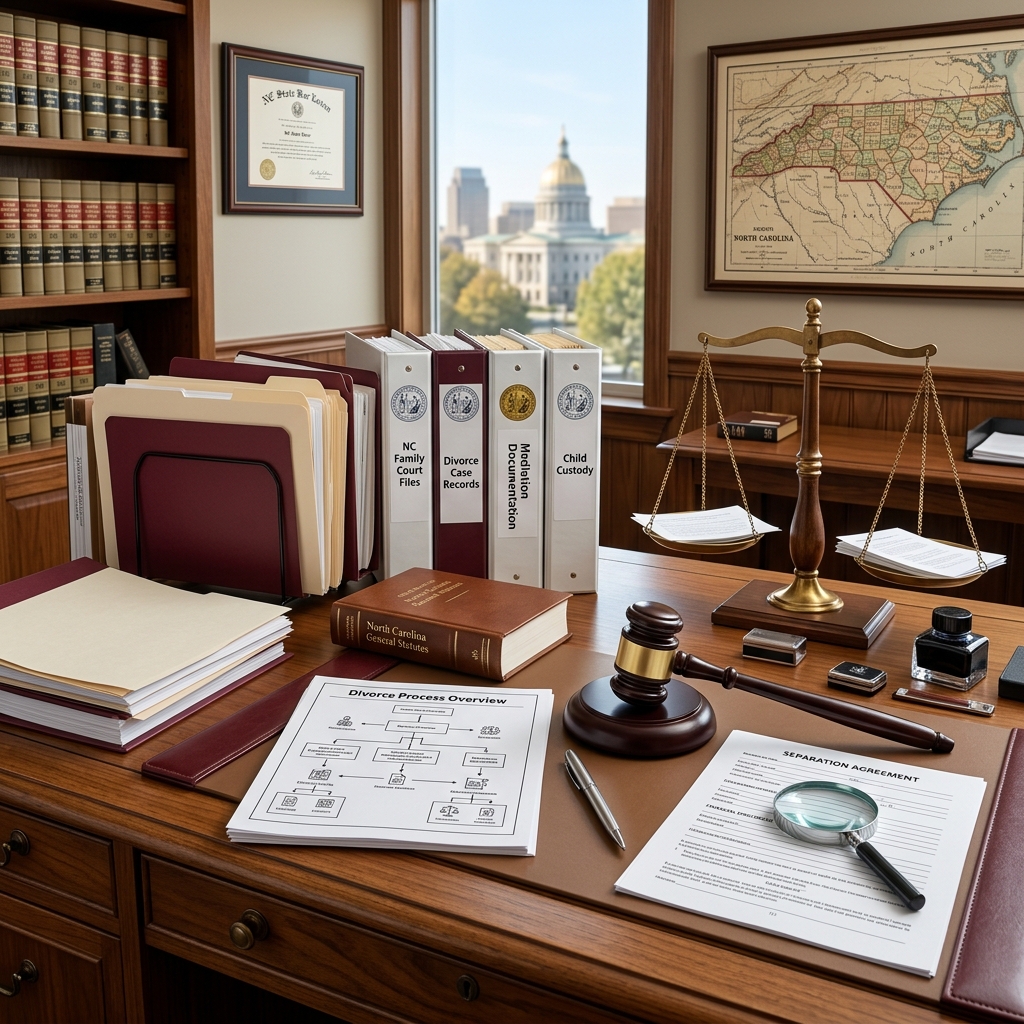
Ending a marriage is both an emotional and legal transition. North Carolina has specific rules about when you can file for divorce, which documents you must use, and how the court process unfolds. This guide explains the major steps in obtaining an absolute divorce in North Carolina, along with practical tips to help you prepare.
North Carolina Divorce Basics
In North Carolina, an absolute divorce legally ends the marriage and allows each spouse to remarry. The state follows a primarily no-fault divorce model, meaning that you generally do not have to prove wrongdoing by your spouse to dissolve the marriage.
Understanding basic terminology will make the process easier:
- Absolute divorce – The standard legal action that ends the marriage fully.
- Separation – Living in different homes with at least one spouse intending the split to be permanent.
- Complaint – The formal written document filed with the court to start the divorce case.
- Summons – A court document notifying your spouse that a lawsuit for divorce has been filed.
Residency and Separation Requirements
Before you can file for divorce in North Carolina, two key conditions must be satisfied: residency and separation.
Residency Rule
Either you or your spouse must have lived in North Carolina for at least six consecutive months immediately before filing for divorce. The case is usually filed in the county where one of you resides.
- Only one spouse needs to meet the six-month requirement.
- Residency is generally proven through testimony and supporting documents if needed.
Mandatory Separation Period
For most absolute divorces, North Carolina requires that spouses live separate and apart for at least one year and one day before filing.
- You must maintain different residences during this separation period.
- At least one spouse must intend that the separation be permanent for the full period.
- A written separation agreement is not required to be legally separated, although some couples choose to create one.
North Carolina also recognizes a limited additional ground for divorce based on a spouse’s incurable insanity combined with a three-year separation, but the one-year separation ground is far more common.
Types of Divorce-Related Actions
When people talk about divorce in North Carolina, they may be referring to several related legal actions. It is important to distinguish among them.
Absolute Divorce
An absolute divorce permanently ends the marriage. Once granted, the spouses are no longer legally married and may remarry.
Divorce from Bed and Board (Fault-Based Separation)
North Carolina also has a traditional form of fault-based action called “divorce from bed and board,” which is more like a court-ordered separation than a complete dissolution of the marriage.
This action requires proving certain misconduct by the other spouse, such as abandonment or cruelty, and is generally used to resolve issues like support and possession of the marital home while the marriage technically remains intact.
Separation Agreements and Other Claims
Couples often address property division, spousal support, and custody through:
- Privately negotiated separation agreements (contracts between spouses).
- Court actions for equitable distribution (property division) or alimony, which must usually be filed before or at the time the divorce complaint is filed.
Failing to assert property and alimony claims before the divorce is finalized can result in losing the right to have those issues decided later.
Key Steps in the North Carolina Divorce Process
While each case is unique, most absolute divorces follow a similar sequence of steps.
Step 1: Prepare Required Court Documents
To begin a typical absolute divorce case, you must prepare several core documents for filing with the Clerk of Court in the proper county.
- Complaint for Absolute Divorce – States the facts (residency, date of marriage, length of separation) and asks the court to grant a divorce.
- Summons – Notifies your spouse of the lawsuit and the need to respond.
- Domestic Civil Action Cover Sheet – A standard court form that categorizes the type of case.
- Servicemembers Civil Relief Act Affidavit (SCRA) – Indicates whether your spouse is in active military service, protecting certain service-related rights.
The complaint must be verified, meaning it is signed under oath before a notary public, to be valid.
Step 2: File the Case and Pay the Fee
Once your documents are prepared, you file them with the Clerk of Superior Court in the county where you or your spouse resides.
Important points at filing include:
- Paying the required filing fee (the exact amount varies by county, and examples from practice show typical fees in the low hundreds of dollars).
- Requesting to proceed as an indigent if you cannot afford the filing fee, using the court’s form for that purpose.
- Receiving stamped copies of your documents for your records and for service on your spouse.
Step 3: Serve the Divorce Papers on Your Spouse
After filing, the documents must be formally delivered to your spouse in a way that complies with North Carolina rules for “service of process.” Proper service ensures that your spouse has legal notice of the case.
Common service methods include:
- Personal service by sheriff – You pay a fee for the Sheriff’s Office to serve the documents directly on your spouse.
- Certified mail – Documents sent by certified mail, return receipt requested, with your spouse signing the receipt.
- Designated delivery service – Services such as UPS or FedEx that provide tracking and delivery confirmation.
If your spouse cannot be located after diligent efforts, service by publication in a newspaper may be possible, but this involves specific legal requirements and is best handled with legal advice.
After service, proof of how and when your spouse was served must be filed with the court.
Step 4: Waiting Period for a Response
Once proper service occurs, your spouse generally has 30 days to file an Answer or other response to the complaint.
- If your spouse files an Answer, the case becomes contested and may involve court hearings or other proceedings on disputed issues.
- If no Answer is filed within the response period, you may request that the court proceed and schedule a hearing; in some cases, this can lead to a “default” divorce when the statutory requirements are otherwise satisfied.
Step 5: Schedule and Attend the Divorce Hearing
To obtain the divorce judgment, a hearing must usually be scheduled before a judge.
Key aspects of the hearing process include:
- Requesting a hearing date from the clerk or scheduling office.
- Serving a Notice of Hearing on your spouse so they know when the hearing will occur.
- Preparing a proposed Judgment of Absolute Divorce for the judge to sign and any required additional forms, such as a certificate for Vital Records.
At the hearing, you (and any necessary witnesses) testify under oath to prove residency, separation, and other basic facts. Your truthful testimony alone can be sufficient evidence, though supporting witnesses or documents may be helpful.
If the judge finds that all legal requirements are met, the court signs the judgment granting your absolute divorce. Copies are then filed and provided to you and, usually, mailed to your spouse.
Property, Support, and Child-Related Issues
Divorce not only ends the marital relationship but can also reshape financial responsibilities and parenting arrangements. In North Carolina, these issues may be handled along with or separate from the absolute divorce claim.
Equitable Distribution of Property
North Carolina uses an equitable distribution approach to divide marital property, meaning assets and debts acquired during the marriage are split fairly, which is not always the same as equally.
Considerations typically include:
- Length of the marriage.
- Each spouse’s income, assets, and debts.
- Contributions to the marital estate, including non-financial contributions.
Property division claims usually must be raised before the divorce judgment is entered, or those claims may be lost.
Spousal Support (Alimony)
Alimony and post-separation support may be available when one spouse is financially dependent on the other. These claims are also typically made in connection with the divorce case and must be asserted in a timely manner.
Child Custody and Support
Child custody and child support can be decided in the same lawsuit or in separate actions. When children are involved, courts focus on the best interests of the child when determining custody arrangements and financial support.
Common Mistakes and Practical Tips
Although North Carolina’s absolute divorce procedure is relatively straightforward, certain missteps can cause long-term problems. Keep these points in mind:
- Do not ignore property and alimony claims – Waiting until after the divorce is granted to address property or spousal support may lead to loss of those claims.
- Confirm proper separation – Living under separate roofs for at least a year and a day is critical; informal or partial separations may not meet the legal standard.
- Maintain documentation – Keep records of where you lived, dates of separation, and any agreements or court orders.
- Monitor service – Follow up to ensure your spouse has been served and that proof of service is filed.
- Consider legal advice – Many legal aid organizations and self-help clinics in North Carolina provide guidance on completing forms and understanding rights.
Illustrative Overview Table
The following table summarizes key requirements and steps in a North Carolina absolute divorce.
| Topic | Key Points |
|---|---|
| Residency | At least one spouse must live in North Carolina for 6 months before filing. |
| Separation | Spouses must live in separate homes for at least one year and one day, with intent for permanent separation. |
| Required Documents | Complaint, Summons, Domestic Civil Action Cover Sheet, SCRA affidavit; complaint must be verified. |
| Service of Process | Sheriff, certified mail, or designated delivery service; proof of service filed with court. |
| Response Time | Spouse typically has 30 days after service to file an Answer. |
| Final Hearing | Judge reviews testimony; if legal requirements are met, issues a Judgment of Absolute Divorce. |
Frequently Asked Questions (FAQs)
1. Do I need a written separation agreement to be considered separated?
No. North Carolina does not require a written separation agreement to be legally separated. You must live in different residences, and at least one spouse must intend for the separation to be permanent. However, written agreements can help clarify property, support, and parenting arrangements.
2. Can the court grant a divorce if my spouse refuses to sign anything?
Yes. Your spouse is not required to sign divorce papers or appear in court for the judge to grant an absolute divorce, provided that the residency and separation requirements are met and your spouse was properly served. After service, the court may proceed even if your spouse does not respond.
3. What happens if my spouse contests the divorce?
In most North Carolina absolute divorce cases, there is little to contest because the key questions are whether residency and separation requirements have been met. Disputes typically arise over property division, alimony, or child-related issues, which may require additional hearings or negotiations to resolve.
4. Can I handle my divorce without a lawyer?
North Carolina provides resources and packets to help individuals pursue a simple divorce on their own, and many people file without an attorney in uncomplicated cases. However, if you have significant property, complex financial issues, or concerns about support and custody, consulting a family law attorney is strongly advisable.
5. How long does it take to get divorced once I file?
The mandatory one-year-and-a-day separation must be completed before filing. After filing, the timeline depends on service, the court’s schedule, and whether any issues are contested. A straightforward case where your spouse is quickly served and does not contest can sometimes be finalized in a matter of weeks to a few months, whereas contested matters may take substantially longer.
6. Will my divorce automatically decide property and alimony?
No. An absolute divorce can be granted without resolving property division or alimony. To preserve your rights to these claims, you must raise them before the divorce judgment is entered. If you are unsure about your rights, seek legal guidance before filing.
References
- Separation and Divorce — North Carolina Judicial Branch. 2024-01-10. https://www.nccourts.gov/help-topics/divorce-and-marriage/separation-and-divorce
- North Carolina Divorce — WomensLaw.org (Legal Information Program of the National Network to End Domestic Violence). 2023-06-15. https://www.womenslaw.org/laws/nc/divorce
- Separation & Divorce — North Carolina Advocates for Justice. 2022-05-20. https://www.ncaj.com/for-the-public/separation-divorce
- North Carolina Divorce Packet — North Carolina Judicial Branch. 2021-09-30. https://www.nccourts.gov/help-topics/divorce-and-marriage/north-carolina-divorce-packet
- Navigating the Divorce Process — Smith Debnam Narron Drake Saintsing & Myers, LLP. 2020-11-12. https://www.smithdebnamlaw.com/article/navigating-the-divorce-process/
- North Carolina Vital Records: Divorce — North Carolina Department of Health and Human Services, Division of Public Health. 2023-08-01. https://vitalrecords.nc.gov/divorce.htm
- NC Simple Divorce Self-Help Clinic — Legal Aid of North Carolina. 2022-03-18. https://legalaidnc.org/video/nc-simple-divorce-self-help-clinic/
Similar Articles








Read full bio of medha deb


