
Nonprofit Tax Filing Requirements Explained
A practical guide to annual returns, deadlines, and compliance steps for nonprofits.
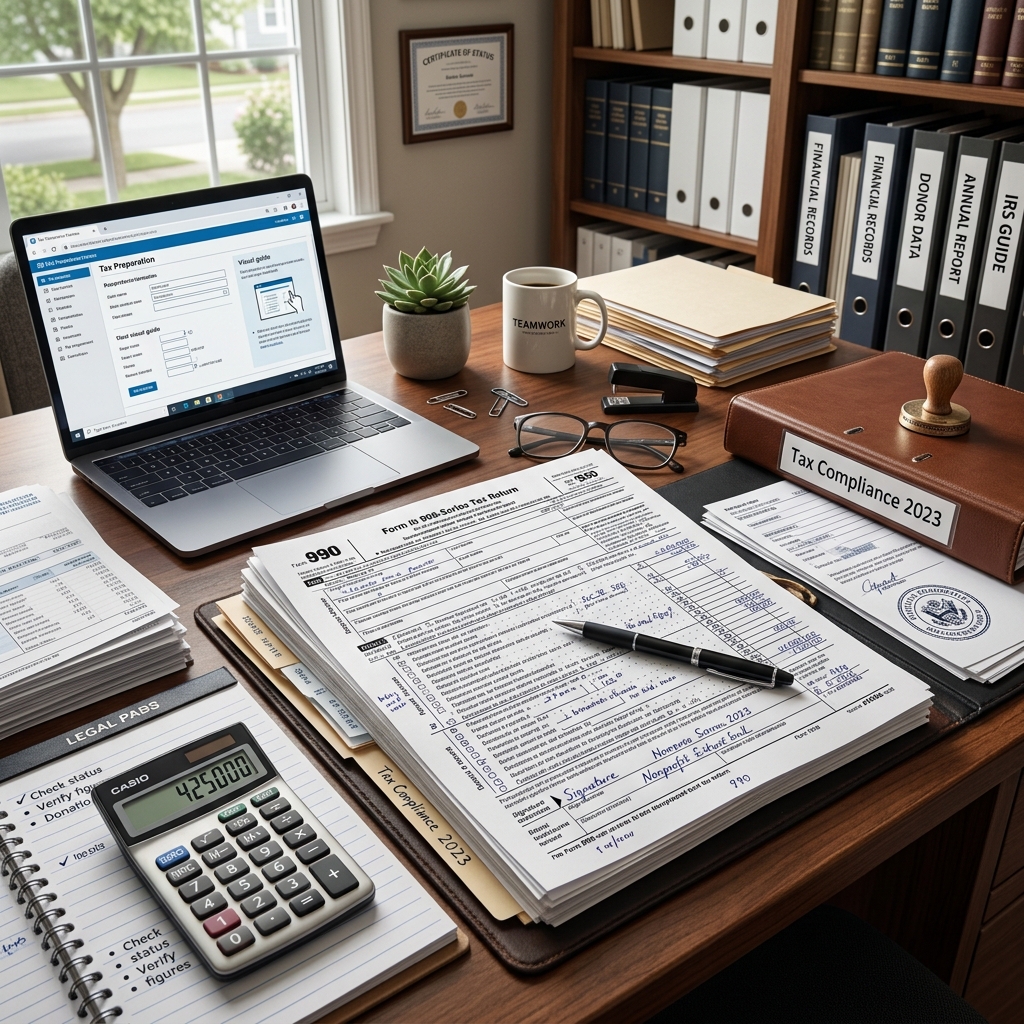
Nonprofit status can reduce or eliminate income tax, but it does not remove filing duties. Most tax-exempt organizations still must submit annual federal returns, follow state reporting rules, and keep records that show they are operating for exempt purposes. The exact forms depend on revenue, assets, organizational type, and whether the nonprofit earns unrelated business income.[10]
Why nonprofits still file taxes
Tax exemption means a nonprofit is not taxed the same way as a for-profit business, but the IRS still uses annual information returns to monitor compliance. These filings help confirm that the organization continues to qualify for exemption and is not operating like a private business. State agencies often use separate filings to track registration, charitable solicitation, and business registration status.[10]
In practical terms, a nonprofit can think of tax filing as part of routine governance. Even if no tax is owed, the organization may still need to report finances, major activities, and compensation data. For many organizations, these annual reports are just as important as fundraising and program delivery.
The main federal return most nonprofits file
The best-known filing for U.S. tax-exempt organizations is the Form 990 series. According to the IRS, organizations that normally have gross receipts of $50,000 or more generally must file an annual information return, and the form used depends on size and structure.
- Form 990 is the full annual return for larger organizations.
- Form 990-EZ is a shorter return for qualifying mid-sized organizations.
- Form 990-N is an electronic notice for small organizations that meet the IRS threshold for the e-Postcard filing.
Private foundations are treated differently. They generally file Form 990-PF regardless of size, and the IRS requires electronic filing for Form 990-PF in many cases.
How to tell which Form 990 applies
The right return usually depends on gross receipts and assets. The IRS states that organizations with annual gross receipts of $50,000 or more are generally required to file an annual return, while very small organizations may be allowed to file Form 990-N instead. Other guidance also notes that organizations with gross receipts under $200,000 and assets under $500,000 may qualify for Form 990-EZ, while those above those levels typically file the full Form 990.
| Organization profile | Common filing | Notes |
|---|---|---|
| Very small nonprofit | Form 990-N | Usually for organizations below the IRS filing threshold. |
| Mid-sized nonprofit | Form 990-EZ | Available to many organizations below certain revenue and asset levels. |
| Larger nonprofit | Form 990 | Used when financial activity is above the smaller-return thresholds. |
| Private foundation | Form 990-PF | Required even when the organization is small. |
Because the filing category can change as an organization grows, many nonprofits review their numbers before each filing season instead of assuming last year’s form still applies.
Deadlines and extensions
For most nonprofits, the annual return is due on the 15th day of the fifth month after the end of the organization’s fiscal year. A calendar-year nonprofit therefore usually files by May 15.
The IRS allows a six-month extension if Form 8868 is filed before the original deadline. An extension gives more time to complete the return, but it does not delay payment of any tax that may be due, especially for organizations with unrelated business income.
Organizations that ignore deadlines risk more than late fees. Failing to file required returns for three consecutive years can result in automatic revocation of tax-exempt status, which is costly and time-consuming to restore.
State filing duties often run alongside federal filings
Federal compliance is only part of the picture. Many states require nonprofits to file separate annual reports, renew charitable registrations, or submit periodic business filings. In California, for example, charities commonly file an annual registration renewal report, and many nonprofits also file a statement of information every two years.
Other states impose their own filing schedules and agency rules. Texas nonprofits, for instance, may need to file IRS annual returns, respond to periodic state reports when requested, and keep registered-agent information current. The exact mix of forms depends on where the organization is formed, where it operates, and whether it solicits donations in other jurisdictions.
Because state requirements vary widely, nonprofit leaders often maintain a compliance calendar that tracks federal and state deadlines together rather than treating them as separate tasks.
Unrelated business income can create a tax bill
Tax exemption does not protect every dollar of revenue. If a nonprofit earns income from a trade or business that is not substantially related to its exempt mission, that income may be subject to unrelated business income tax, often reported on Form 990-T.
California guidance, for example, says a nonprofit should file the state business income tax return when it has more than $1,000 in gross income from an unrelated trade or business. At the federal level, the IRS also uses Form 990-T to report unrelated business income.[10]
This issue matters because a nonprofit can be fully exempt in purpose and still owe tax on a side activity such as advertising revenue, certain rental income, or a business-like service unrelated to its mission. Careful recordkeeping helps separate exempt program income from taxable activity.[10]
Records that support compliant filing
Annual forms are only as accurate as the records behind them. Nonprofits are expected to maintain books and documents showing revenues, expenses, grants, governance decisions, and organizational changes. In California, the FTB specifically lists maintaining records as part of preserving tax-exempt standing.
- Bank statements and accounting reports
- Board meeting minutes and resolutions
- Payroll and contractor records
- Donation and grant documentation
- Copies of filed returns and state reports
Good records make it easier to complete the annual return, answer donor or regulator questions, and defend the organization’s exempt status if it is ever reviewed.[10]
Electronic filing rules
Many nonprofits now file electronically rather than on paper. The IRS requires electronic filing in certain situations, including some organizations with substantial assets and high filing volume, and it also requires private foundations and non-exempt charitable trusts to e-file Form 990-PF.
Electronic filing has become the practical default for many organizations because it can reduce processing errors and simplify submission tracking. Even when e-filing is not mandatory, it often improves internal compliance by creating a cleaner filing record.
Common mistakes nonprofits make
Many filing problems are avoidable. The most common errors usually come from misunderstanding which form applies, missing the deadline, or failing to report separate state obligations.
- Assuming tax exemption means no return is required
- Using the wrong Form 990 version
- Missing the fifth-month filing deadline
- Overlooking unrelated business income
- Forgetting state registrations and periodic reports
- Failing to preserve board-approved records and financial support files
A recurring issue is treating filing as a once-a-year administrative chore rather than a compliance process. Organizations that schedule review points throughout the year tend to catch problems earlier and avoid rushed filings.
Practical compliance checklist
A simple year-round checklist can keep the organization organized and reduce filing risk. The following steps reflect the main themes in IRS and state guidance.[10]
- Confirm the nonprofit’s fiscal year-end
- Review gross receipts and asset levels
- Identify the correct federal return
- Check whether unrelated business income exists
- Mark the federal due date and extension deadline
- Verify state annual report and registration requirements
- Retain final copies of every filed form
For growing organizations, the most efficient approach is usually to assign responsibility before filing season begins. That way, the board, treasurer, bookkeeper, or outside accountant can review the numbers with enough time to correct errors.
Frequently asked questions
Do all nonprofits have to file a return?
Most tax-exempt organizations must file some type of annual federal return, but very small organizations may file Form 990-N instead of a full return. Private foundations generally have their own filing rule and usually file Form 990-PF.
What is the usual Form 990 deadline?
The annual return is usually due on the 15th day of the fifth month after the end of the fiscal year. A calendar-year organization normally files by May 15.
Can a nonprofit get more time to file?
Yes. The IRS allows a six-month extension if the organization submits Form 8868 before the original deadline.
What happens if a nonprofit does not file for three years?
Failure to file the required annual return for three consecutive years can automatically revoke federal tax-exempt status.
Does tax exemption cover unrelated business income?
No. Income from an unrelated trade or business may be taxable and often must be reported separately on Form 990-T.
References
- Annual and filing requirements Charities and nonprofits — California Franchise Tax Board. 2026-07-10. https://www.ftb.ca.gov/file/business/types/charities-nonprofits/annual-and-filing-requirements.html
- Texas Nonprofit Annual Filing Requirements: A Step-by-Step Guide — Labyrinth, Inc. 2026-07-10. https://labyrinthinc.com/nonprofit-annual-filing-requirements-texas/
- Federal Filing Requirements for Nonprofits — National Council of Nonprofits. 2026-07-10. https://www.councilofnonprofits.org/running-nonprofit/administration-and-financial-management/federal-filing-requirements-nonprofits
- Nonprofit Tax Filing — DonorPerfect. 2026-07-10. https://www.donorperfect.com/nonprofit-terms-glossary/nonprofit-tax-filing/
- How to File a 501(c)(3) Tax Exempt Non-Profit Organization — Wolters Kluwer. 2026-07-10. https://www.wolterskluwer.com/en/expert-insights/how-to-file-a-501-c-3-tax-exempt-non-profit-organization
- E-file for charities and nonprofits — Internal Revenue Service. 2026-07-10. https://www.irs.gov/e-file-providers/e-file-for-charities-and-nonprofits
- Nonprofit Compliance Checklist — CalNonprofits. 2026-07-10. https://calnonprofits.org/resources/nonprofit-compliance-checklist/
- Exempt organization annual filing requirements overview — Internal Revenue Service. 2026-07-10. https://www.irs.gov/charities-non-profits/exempt-organization-annual-filing-requirements-overview
- Charities and nonprofits — Internal Revenue Service. 2026-07-10. https://www.irs.gov/charities-and-nonprofits
Similar Articles








Read full bio of Sneha Tete




