
NFT Taxes: 9 Essential Rules For Creators, Collectors, Investors
Understand how NFTs work, when they are taxed, and what creators, collectors, and investors need to know before minting or trading.
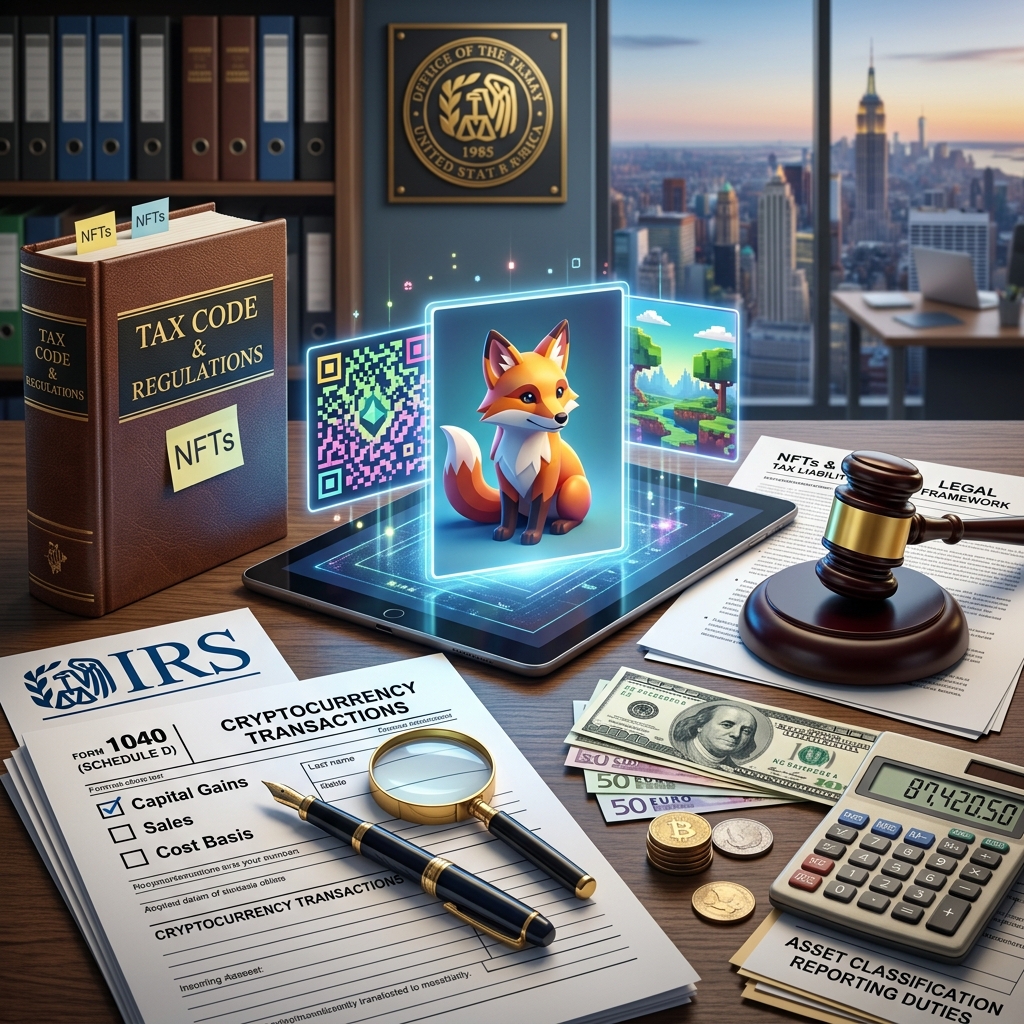
Non-fungible tokens, or NFTs, combine technology, art, gaming, and finance in a way that feels new and often confusing. Alongside the excitement, there is a very traditional element: taxes. In the United States, the IRS now treats NFTs as a type of digital asset, meaning transactions involving NFTs can trigger income tax or capital gains tax, just like many other investments and forms of property.
This guide explains what NFTs are in plain language, how typical NFT transactions are taxed, and what practical steps creators, collectors, and investors can take to stay compliant while minimizing surprises at tax time.
1. What Exactly Is an NFT?
An NFT is a unique cryptographic token recorded on a blockchain. Unlike cryptocurrencies such as Bitcoin or Ether, which are fungible (each unit is interchangeable with any other), every NFT is designed to be non-fungible, meaning it is distinguishable and individually identifiable.
From a legal and tax perspective, it helps to think of an NFT as a digital certificate of ownership or authenticity that is:
- Stored and verified on a blockchain ledger.
- Linked to a specific digital or physical item, such as art, music, in-game items, or membership benefits.
- Transferable between wallets, usually via an online marketplace.
The NFT does not necessarily contain the artwork or media file itself. Instead, it usually points to where that file is stored (on-chain or off-chain) and embeds rules about ownership, royalties, and transfer.
Common Uses of NFTs
- Digital art and illustration – single-edition or limited series artwork.
- Music and video releases – tracks, albums, concert clips, or visual loops.
- Gaming assets – skins, characters, virtual land, or items.
- Collectibles and memorabilia – trading-card style NFTs, sports moments, or brand collectibles.
- Utility and access tokens – passes that grant entry to communities, events, or services.
Despite this variety, U.S. tax authorities generally look through the marketing buzz and focus on what the NFT represents and how it is used when applying tax rules.
2. How the IRS Views NFTs and Digital Assets
The IRS groups NFTs under the broader label of digital assets, which includes cryptocurrencies, stablecoins, and similar blockchain-based tokens. For many purposes, NFTs are treated like property, similar to stocks, real estate, or cryptocurrency.
Digital Assets on Your Tax Return
U.S. individual tax returns now contain a specific question asking whether you have engaged in transactions involving digital assets during the year. This includes NFTs if you:
- Bought, sold, or exchanged an NFT.
- Received an NFT as payment, a reward, or compensation.
- Created and sold NFTs for cryptocurrency.
If you did any of the above, you generally must answer “yes” to the digital asset question and report the relevant income or gains.
Property vs. Collectible Treatment
For federal tax purposes, NFTs can fall into two broad categories:
- General capital assets – treated similarly to stocks or cryptocurrency with standard long-term capital gains rates.
- Collectibles – certain NFTs linked to art or collectibles may be taxed under special collectible rules, which can carry a higher maximum tax rate on long-term gains.
The IRS has signaled that NFTs may be taxed based on whether the underlying asset would itself be considered a collectible (for example, artwork, rare items, or certain forms of memorabilia). That classification can significantly affect the tax rate on profits if you hold an NFT for more than one year.
3. Tax Basics: When Are NFT Transactions Taxable?
Any time you dispose of an NFT or receive one as compensation, you may create a taxable event. For U.S. taxpayers, there are two main types of tax that can apply:
- Capital gains tax – applies when you sell or exchange an NFT held as an investment.
- Ordinary income tax – applies when you receive NFTs or crypto as payment or rewards, or when you earn revenue from creating and selling NFTs.
Typical Taxable NFT Events
- Selling an NFT for cryptocurrency – you may have a capital gain or loss based on the difference between your sale proceeds and your tax basis.
- Trading one NFT for another – usually treated as if you sold the first NFT for its fair market value and immediately used those proceeds to buy the new NFT; this can trigger capital gains.
- Buying an NFT with cryptocurrency – disposing of crypto to acquire the NFT can itself create a gain or loss on the crypto, separate from any future gain or loss on the NFT.
- Receiving an NFT as compensation – if you are paid in NFTs or crypto for services, the fair market value at receipt is taxable as ordinary income.
- Royalties or revenue sharing – ongoing payments to creators or rightsholders from NFT sales are typically ordinary income when received.
4. Capital Gains on NFTs: Holding Period and Rates
When you hold an NFT as an investment, any profit or loss when you dispose of it is classified as a capital gain or capital loss. Two key factors determine how that gain is taxed: how long you held the NFT and whether it is treated as a collectible.
Short-Term vs. Long-Term Gains
- Short-term capital gains – apply if you hold the NFT for one year or less before selling or exchanging it. These gains are taxed at your ordinary income tax rate, which can range roughly from 10% to 37% at the federal level.
- Long-term capital gains – apply if you hold the NFT for more than one year. Standard federal long-term capital gains rates currently range from 0% to 20%, depending on your income level.
High-income taxpayers may also owe an additional 3.8% net investment income tax on certain capital gains, including gains from NFTs.
Collectibles vs. Ordinary Capital Assets
Some NFTs, especially those tied to art or similar assets, may be treated as collectibles for tax purposes. If an NFT is classified as a collectible and held for more than one year, long-term gains can be taxed at up to 28%, which is higher than the maximum standard long-term capital gains rate.
| Scenario | Holding Period | Possible Tax Rate Category |
|---|---|---|
| NFT treated as ordinary capital asset | More than 1 year | Long-term capital gains: generally 0–20%, plus possible 3.8% surtax for high earners |
| NFT treated as collectible | More than 1 year | Collectible long-term gains: up to 28%, plus possible 3.8% surtax |
| Any NFT (collectible or not) | 1 year or less | Short-term gains: taxed at ordinary income rates (approx. 10–37% depending on bracket) |
The exact classification of a particular NFT can be complex. Because the rules are evolving, many taxpayers consult a tax professional when large amounts are at stake.
5. NFT Creators: Income, Self-Employment, and Deductions
If you create and sell NFTs, the tax analysis is different from that of a typical collector. For creators, the IRS generally treats proceeds from initial sales as ordinary income, not capital gains.
Income from Minting and Selling NFTs
When you mint an NFT and sell it on a marketplace, you usually receive payment in cryptocurrency. At that moment:
- The fair market value of the crypto you receive (in U.S. dollars) is taxable as ordinary income.
- If you are regularly creating and selling NFTs as a trade or business, that income may also be subject to self-employment tax.
Later, if you hold the cryptocurrency and it changes in value, you may realize additional capital gains or losses when you eventually dispose of that crypto.
Royalties and Ongoing Payments
Many NFT smart contracts send creators a percentage of each resale. These ongoing royalty payments are generally treated as ordinary income in the year they are received.
Business Expenses and Recordkeeping
Creators who operate as a business can often deduct reasonable expenses associated with producing and selling NFTs, such as:
- Platform and marketplace fees.
- Gas fees for minting or transferring NFTs.
- Design tools, software subscriptions, and hardware.
- Marketing, website hosting, and professional services.
Good records of income and expenses are crucial both for accurate reporting and for defending deductions if ever questioned by tax authorities.
6. Buyers and Investors: Basis, Losses, and Reporting
For collectors and investors, the key questions are usually: how to determine basis, when losses are deductible, and how to report transactions properly.
Determining Your Basis in an NFT
Your tax basis is generally what you paid for the NFT, measured in U.S. dollars at the time of purchase, including certain associated costs.
- If you bought with cryptocurrency, your basis is the fair market value of the crypto in dollars at the time of the transaction.
- Gas fees or transaction fees directly tied to acquiring the NFT can usually be added to basis.
When you sell or otherwise dispose of the NFT, your gain or loss is the difference between your sale proceeds (in dollars) and your basis.
Recognizing and Using Losses
If you sell an NFT for less than your basis, you realize a capital loss. Subject to general capital loss rules, you can typically:
- Use capital losses to offset capital gains from other assets such as stocks or crypto.
- Deduct up to a limited amount of net capital loss against ordinary income each year, with any excess carried forward to future years (current limits apply to overall capital losses, not just NFTs).
Reporting NFT Transactions
In the United States, NFT transactions are typically reported similarly to other capital assets:
- Individual sales, trades, or disposals are reported on Form 8949, listing your basis, proceeds, and gain or loss.
- Totals from Form 8949 flow to Schedule D of Form 1040, where your net capital gain or loss is calculated.
- Income from creating NFTs, receiving them as compensation, or royalties is reported as ordinary income, often on Schedule 1 or Schedule C depending on the nature of the activity.
7. Special Issues and Compliance Risks
NFTs raise several complex questions that do not always arise with more traditional assets. While detailed advice will depend on your individual circumstances, there are recurring issues that taxpayers should be aware of.
Sales Tax and State-Level Rules
In addition to federal income tax, some U.S. states are starting to address whether NFTs are subject to sales tax as digital products. A few states have indicated that NFT transactions may be taxable when linked to certain goods or services. State rules vary significantly and are evolving quickly, so local guidance is important if you operate or sell to buyers in specific jurisdictions.
International Considerations
Outside the United States, NFTs may be subject to different tax regimes, including value-added tax (VAT) or other indirect taxes. Because this guide focuses on U.S. federal law, anyone outside the U.S. or engaging in cross-border NFT activity should seek advice based on the relevant country’s rules.
Audit Risk and Documentation
Digital assets are a growing focus for tax administrations. The IRS explicitly reminds taxpayers that income from digital assets, including NFTs, must be reported, and failure to do so can lead to penalties and interest.
To reduce risk, NFT users should retain:
- Transaction history from marketplaces and wallets.
- Screenshots or records of fair market values in U.S. dollars at transaction times.
- Contracts and descriptions for NFTs, especially where classification as a collectible could be at issue.
8. Practical Tips Before You Mint, Buy, or Sell
Given the complexity of NFT taxation, planning ahead is often easier than trying to reconstruct records later. Consider the following steps before diving deeper into NFT activity:
- Clarify your role – Are you primarily a creator, an investor, a casual collector, or running a business? Your role affects how various transactions are taxed.
- Track everything from day one – Keep detailed logs of dates, values in U.S. dollars, wallet addresses, and transaction IDs for both NFTs and the crypto used to buy them.
- Understand holding periods – The difference between holding an NFT for 11 months versus 13 months can significantly change your tax rate because of short-term vs. long-term treatment.
- Consider the nature of the underlying asset – If the NFT is tied to artwork or other items that might be a collectible, factor in the possibility of higher long-term tax rates.
- Consult professional advice for large transactions – High-value purchases or sales may justify personalized tax and legal guidance, especially in light of evolving IRS positions.
9. Frequently Asked Questions About NFTs and Taxes
Are all NFT transactions taxable?
Not every interaction with an NFT creates immediate tax. Simply holding an NFT in your wallet without selling, trading, or otherwise disposing of it is not a taxable event in itself. However, buying an NFT with appreciated cryptocurrency, selling an NFT, or receiving NFTs as compensation generally will have tax consequences.
Is there an NFT-specific tax loophole?
No. U.S. tax rules do not provide a special loophole that allows NFT traders to avoid tax altogether. Gains and losses from NFT transactions are generally treated like gains and losses from other capital assets or business income, and must be reported on your tax return.
Does gifting an NFT trigger tax?
Giving an NFT as a genuine gift may not generate income tax for the donor, but it can have gift tax implications if the value exceeds annual exclusion limits, and it affects the recipient’s basis. The recipient may later owe capital gains tax when they sell the NFT based on the transferred basis. Because gift and estate rules are complex, large gifts generally warrant professional advice.
How do I know if my NFT is a collectible for tax purposes?
There is no single test, but factors include what the NFT represents and how it is marketed. If the underlying item would typically be considered art, a collectible, or memorabilia, the IRS may treat long-term gains on that NFT as gains from a collectible. The classification can be fact-specific, so documentation about the NFT’s characteristics and use can be important.
What if I never converted my NFT profits back to dollars?
Tax is generally based on realized gains measured in U.S. dollars at the time of each taxable event, not on whether you cashed out to a bank account. Selling an NFT for cryptocurrency or trading one NFT for another can trigger taxable gains even if you stay entirely within the crypto ecosystem.
Do I need to report a loss if an NFT went to zero value?
If an NFT has become worthless or you sold it for a nominal amount, you may be able to claim a capital loss, subject to standard rules on capital losses. Documentation of the NFT’s decline in value and attempts to sell it can support such a claim. Specific treatment will depend on the facts and current IRS guidance.
Can tax software handle NFT transactions?
Some tax and crypto-tracking software now integrate NFT data, but the accuracy of imports depends on marketplace support and wallet connectivity. Complex NFT activity may still require manual review, especially where classification as a collectible, business income, or cross-border transactions are involved.
References
- NFT Taxes: Your Guide for 2026 — TokenTax. 2025-12-01. https://tokentax.co/blog/nft-tax-guide
- What Is an NFT and What Are the Tax Implications? — Rocket Lawyer. 2023-03-15. https://www.rocketlawyer.com/business-and-contracts/intellectual-property/legal-guide/what-is-an-nft-and-what-are-the-tax-implications
- How Are NFTs Taxed? — Experian. 2023-04-19. https://www.experian.com/blogs/ask-experian/how-are-nft-taxed/
- The Ultimate Guide to NFT Taxes in 2026 — CoinLedger. 2026-01-10. https://coinledger.io/blog/how-are-nfts-taxed
- Easy Guide to NFT Taxes for 2025 — Gordon Law Group. 2025-02-05. https://gordonlaw.com/learn/nft-tax-guide/
- The Uncharted Territory of Taxing Non-fungible Tokens (NFTs) — Rice University Baker Institute for Public Policy. 2022-03-10. https://www.bakerinstitute.org/research/taxing-nfts-uncharted-territory
- Digital Assets — Internal Revenue Service. 2024-01-22. https://www.irs.gov/filing/digital-assets
- Cryptocurrencies and Taxes: What You Should Know — Charles Schwab. 2024-02-14. https://www.schwab.com/learn/story/cryptocurrencies-and-taxes-what-you-should-know
Similar Articles








Read full bio of Sneha Tete




