
C Corporation To S Corporation: Key Steps And Tax Issues 2025
A practical look at when switching entity tax status may reduce taxes and when it may backfire.
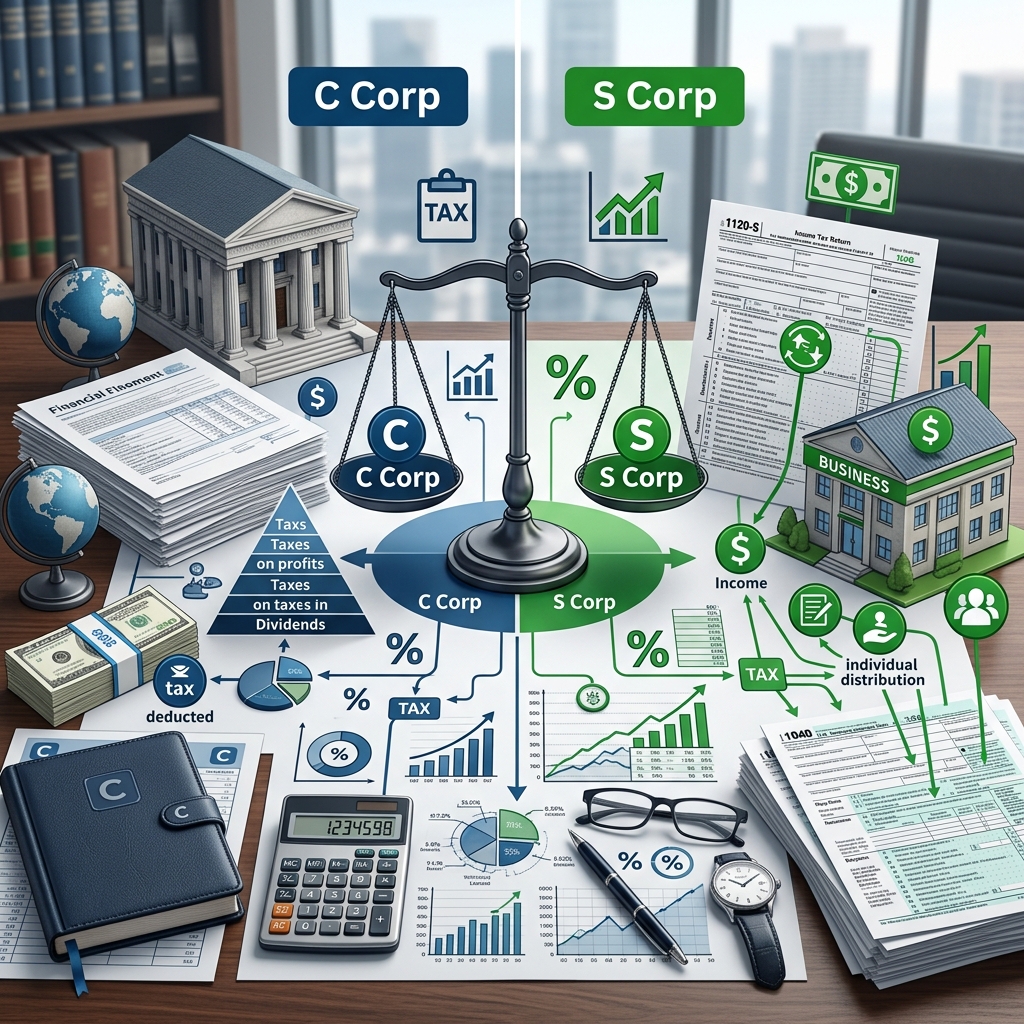
Changing a corporation’s tax treatment from C corporation status to S corporation status can reshape how business income is taxed, how owners pay themselves, and how much flexibility the company has with profits. For some businesses, the move can reduce total tax exposure. For others, the change can create new limits, trigger administrative work, or produce unexpected tax costs.
This guide explains the main reasons a company may consider the switch, the situations where the election is more likely to help, and the issues owners should review before filing. It also outlines the basic IRS process, common tax traps, and planning points that can affect whether the change is worth it.
Why a company might consider the switch
A C corporation is taxed separately from its owners, and profits can be taxed again when distributed to shareholders. By contrast, an S corporation generally passes income through to its owners, which can reduce the possibility of double taxation. That difference is the main tax reason business owners explore the change.
For a profitable company that expects to distribute most earnings to owners, S corporation treatment may be attractive because the corporation itself usually does not pay federal income tax in the same way a C corporation does. Instead, the tax burden is pushed to the shareholder level, where profits are reported on personal returns. This can be helpful when the company’s structure and ownership group fit the S corporation rules.
- Potential reduction in double taxation
- Possible payroll tax savings on part of owner compensation
- Cleaner pass-through treatment for current earnings
- Better alignment with closely held, owner-operated businesses
When the tax savings are most likely
The change is usually most appealing when the business produces steady profits, the owners actively work in the business, and the company does not need to retain large amounts of cash for future expansion. In that setting, pass-through taxation can simplify how current profits are taxed and may lower the overall tax bill on money that would otherwise face corporate-level tax first.
The payroll component also matters. Shareholder-employees of an S corporation generally must receive reasonable compensation for their work. After that salary is paid, additional business income may flow through to the owners without the same employment tax treatment that applies to wages. That can create savings, although the savings depend on salary levels, profit levels, and whether the company can support the structure under IRS rules.
Businesses with a modest number of shareholders and straightforward ownership often find the election easier to manage. Companies that are family-owned or run by a small group of active owners may be especially interested in the combination of pass-through taxation and owner compensation planning.
When staying a C corporation may make more sense
Not every business benefits from S corporation treatment. A C corporation may be better if the company plans to keep significant earnings inside the business, seek outside investors, or preserve a more flexible ownership structure. S corporations have eligibility limits that can make them unsuitable for companies with growth plans that require multiple classes of investors or certain entity owners.
There can also be non-tax reasons to stay with C corporation treatment. Some companies value the ability to reinvest profits at the entity level rather than immediately passing them out to shareholders. Others may want to preserve access to fringe benefits that can be more favorable under C corporation rules. If the business’s long-term strategy depends on those features, the tax savings from an S election may not outweigh the tradeoffs.
- Planned retention of substantial earnings
- Need for broader or more flexible ownership structures
- Desire to preserve corporate-level benefits
- Future financing or exit plans that fit C corporation taxation better
Key tax consequences to review first
Before changing status, owners should examine more than just the headline tax rate. The switch can affect salary planning, distributions, basis tracking, passive income treatment, and the treatment of older corporate earnings. The IRS rules can also make timing important, especially if the company is trying to secure the election for a specific tax year.
One important issue is that a company with accumulated C corporation earnings may carry tax baggage into the S corporation period. In some cases, those historic earnings can trigger special distribution or passive income concerns after the election. The company should also look at whether appreciated assets, prior accounting methods, or loss carryovers could create complications after the transition.
| Issue | Why it matters |
|---|---|
| Owner salary | Shareholder-employees must generally be paid reasonable compensation for services. |
| Retained earnings | Past C corporation profits may still affect future tax planning. |
| Passive income | Excess passive income can create tax problems for corporations with prior C corporation history. |
| Losses and credits | Some tax attributes do not transfer in the same way after the election. |
The election process in plain language
To switch from C corporation taxation to S corporation taxation, the company generally must file the IRS election form for S corporation status and meet the shareholder consent requirements. The election is not automatic, and the timing rules matter. If the filing is late or incomplete, the business may miss the desired effective date.
The IRS also expects the corporation to remain eligible for S corporation treatment. That means the company must monitor shareholder eligibility, stock class rules, and other requirements after the election is made. A successful filing is only the beginning; the business must continue operating in a way that preserves the status.
- Confirm the corporation is eligible for S corporation treatment.
- Obtain the required shareholder consent.
- File the election with the IRS on time.
- Update payroll, accounting, and tax reporting systems.
- Track distributions, basis, and any legacy C corporation tax issues.
Payroll, salaries, and owner compensation
One of the most closely watched parts of S corporation taxation is how owner-employees are paid. The IRS expects shareholder-employees who provide services to the business to receive reasonable wages. That salary is subject to payroll taxes. Only after that compensation is set can remaining profits be distributed in a way that may receive different tax treatment.
This rule is a major reason the switch can reduce taxes, but it is also a major reason the switch can go wrong if owners try to minimize wages too aggressively. The salary must reflect the work performed and the facts of the business. Companies should document how they arrived at compensation levels and make sure payroll systems are prepared before the election takes effect.
- Reasonable salary is required for shareholder-employees
- Wages are subject to employment taxes
- Profit distributions are treated differently from wages
- Documentation helps support the compensation approach
Risks that can reduce or erase the benefit
The tax advantages of S corporation treatment can be offset by special rules that apply after the election. For example, a company with old C corporation earnings may face restrictions on passive income, and some pre-election tax attributes may not be used the way owners expect. The company may also lose access to certain tax-favored fringe benefits that are easier to provide under C corporation rules.
Another risk is a mismatch between the tax structure and the company’s business plan. If the corporation expects to build large reserves, attract investors, or make extensive use of retained earnings, the pass-through model may be less efficient. The election can also add compliance work, since the business must maintain records that support shareholder basis, distributions, and payroll treatment.
In short, the switch can save money, but only if the company’s facts fit the structure and the owners are prepared to follow the rules consistently.
How to evaluate the decision before filing
Business owners should compare several tax and operational factors before making the election. The best choice depends on whether the company earns current profits, whether those profits will be distributed or retained, how many owners are involved, and whether the owners can comply with the salary and reporting requirements.
A good review usually includes a projection of taxable income, expected owner compensation, state tax consequences, and the impact of any old C corporation earnings. It can also help to model multiple years rather than focusing only on the current tax year. A choice that looks favorable in one year may be less attractive once growth, hiring, or financing plans are included.
- Projected profits for the next one to three years
- How much cash the business needs to retain
- Expected owner payroll levels
- State-level tax treatment
- Potential exit or financing plans
Questions owners often ask
Many business owners ask whether the switch is mainly about lower taxes. Tax savings are often the trigger, but the decision also affects ownership structure, accounting, and corporate governance. Others ask whether the filing is reversible. In many cases, the election can be changed later, but reversing it may create its own tax and timing consequences.
Owners also want to know whether they can make the change midyear. Timing rules are important, and the effective date depends on when the election is filed and whether the filing is accepted for the desired tax year. Because of that, the decision should be made before the relevant deadline rather than after year-end planning is complete.
Frequently asked questions
Does converting to S corporation status always save taxes?
No. The switch may reduce taxes for profitable, owner-operated businesses, but the savings depend on salary levels, distributions, retained earnings, and whether the company fits the S corporation rules.
Can a business keep all of its earnings inside the company after the election?
It can retain cash to some extent, but the pass-through structure changes how profits are taxed and tracked. Large retained earnings can reduce the practical value of the election.
Do owners still pay themselves wages after the switch?
Yes. Shareholder-employees generally must receive reasonable compensation for services, and that pay is subject to payroll taxes.
Is the filing process complicated?
The core election is straightforward, but the planning around it is not. Businesses should review eligibility, timing, payroll setup, and legacy C corporation tax items before filing.
Is professional help useful?
Yes. A tax professional can help model the numbers, confirm eligibility, and identify hidden issues such as passive income exposure, basis tracking, and state tax differences.
References
- Filing requirements for filing status change — Internal Revenue Service. 2026-01-01. https://www.irs.gov/businesses/corporations/filing-requirements-for-filing-status-change
- S Corp vs C Corp: Key Differences and Benefits — Wolters Kluwer. 2025-01-01. https://www.wolterskluwer.com/en/expert-insights/s-corp-vs-c-corp-differences-benefits
- From C Corp to S Corp: The What, Why, and When of Making the Conversion — CPA Business Resource. 2025-01-01. https://www.cpabr.com/article-Converting-from-C-Corp-to-S-Corp
- Tax Implications of Converting from a C Corp to an S Corp — Sensiba. 2025-01-01. https://sensiba.com/resources/insights/tax-implications-of-converting-from-a-c-corp-to-an-s-corp/
- Why Convert Your Tax Status from S-Corp to C-Corp — Delaware Inc. 2025-01-01. https://www.delawareinc.com/blog/why-convert-your-tax-status-from-s-corp-to-c-corp/
Similar Articles








Read full bio of medha deb




