
When Online Venting Gets You Fired: NLRB, Social Media and Employee Rights
How the NLRB draws the line between protected workplace discussion and fireable social media posts in the modern employment landscape.
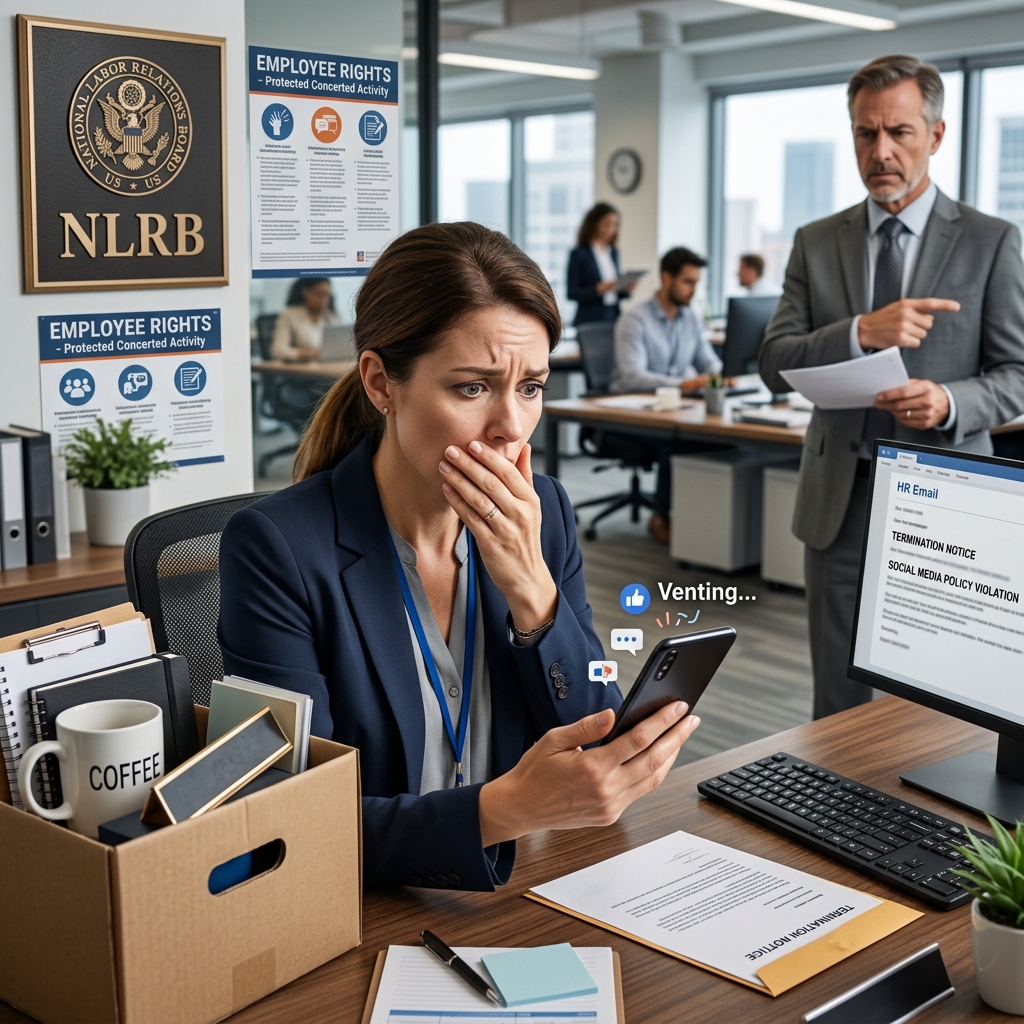
Social media has become a primary place for employees to talk about their jobs, vent frustrations, and share workplace experiences. Yet these online conversations can have serious consequences, including discipline or termination. Under U.S. labor law, some of this activity is legally protected, while other posts fall outside federal protections and may lawfully lead to discharge. Understanding the difference is critical for both employees and employers.
Social Media Meets the National Labor Relations Act
The National Labor Relations Act (NLRA) protects employees who act together to address workplace conditions, whether or not they belong to a union. This protection extends beyond physical spaces like the break room and now applies to online platforms such as Facebook, X (Twitter), Instagram, and other social networks.
In broad terms, employees have the right to:
- Discuss wages, benefits, and working conditions with coworkers online.
- Coordinate or plan group action related to workplace concerns, including via social media.
- Seek support from coworkers and, where applicable, unions to address perceived unfairness at work.
However, this protection is not unlimited. Certain posts can be considered unprotected, even if they involve employment topics, and may lawfully trigger discipline or termination.
Protected Concerted Activity vs. Unprotected Online Venting
A core concept in NLRA jurisprudence is protected concerted activity. The National Labor Relations Board (NLRB), which administers and enforces the NLRA, has clarified how this applies to social media use.
What Counts as Protected Concerted Activity Online?
Online activity is generally protected when it involves employees acting together or seeking to act together regarding workplace issues. Typical examples include:
- Posting about workload, staffing levels, scheduling problems, or safety issues and inviting coworkers to comment.
- Coordinating a group discussion or meeting with management to address pay or work conditions.
- Discussing possible collective responses, such as signing a petition or contacting a government agency about workplace problems.
- Responding to another worker’s post about shared workplace concerns in a way that advances group discussion.
In several NLRB cases, employees who discussed working conditions on Facebook with colleagues were found to be engaged in protected concerted activity, resulting in findings that terminations were unlawful.
When Complaints Become Mere “Gripes”
Not every complaint posted online receives NLRA protection. The NLRB has emphasized that individual gripes that are disconnected from group action or collective concerns are generally unprotected. Examples include:
- Posting an angry rant about a supervisor without linking the complaint to broader workplace issues.
- Insulting coworkers or managers in a purely personal, non-work-related way.
- Expressing frustration about a single incident without attempting to involve others in resolving a workplace-wide problem.
If an employee’s social media post is simply a personal venting session with no meaningful connection to group concerns or action, it is more likely to be treated as unprotected and may lawfully result in discipline.
Types of Social Media Posts and Their Legal Risk
Different kinds of posts present different levels of risk under the NLRA. The table below summarizes common categories and how the NLRB tends to view them.
| Type of Social Media Post | Typical NLRA Treatment | Potential Employer Response |
|---|---|---|
| Discussion of wages, benefits, or workload with coworkers | Often protected concerted activity if linked to group concerns. | Discipline may be unlawful; policy restrictions must be carefully drafted. |
| Personal rant about a manager with no group involvement | Generally considered an unprotected personal gripe. | Discipline or discharge may be lawful, subject to other laws (e.g., anti-discrimination). |
| False statements knowingly made about the employer | Not protected; deliberately false statements fall outside NLRA protection. | Employer may discipline if consistent with other policies and laws. |
| Posts containing egregiously offensive or harassing language | May lose protection if extreme or unlawful (e.g., threats, harassment). | Employer can often rely on general workplace conduct policies. |
| Sharing confidential trade secrets or proprietary data | Not protected; confidentiality rules generally apply online. | Discipline is usually permissible and may be necessary. |
Why Some Employees Are Lawfully Terminated for Online Venting
The legal analysis in social media termination cases often turns on context. Employers have legitimate interests in protecting their reputation, confidential information, and workplace order, but must respect NLRA rights when disciplining employees.
Key Factors the NLRB Considers
When reviewing a termination tied to online posting, the NLRB typically looks at:
- Nature of the content – Does the post discuss terms and conditions of employment, or is it purely personal or abusive?
- Audience and interaction – Were coworkers involved in the conversation or invited to participate?
- Purpose of the post – Was it aimed at initiating or advancing group action, or simply to vent?
- Truthfulness and tone – Did the post include knowingly false statements or egregiously offensive language?
- Existing policy – Did the employer’s social media or conduct policy lawfully restrict the behavior at issue?
Where posts are personal attacks, lack group involvement, or violate clear and lawful workplace policies (such as anti-harassment or confidentiality rules), the NLRB often concludes that termination is lawful.
Designing Lawful Social Media Policies
Many of the NLRB’s early social media cases focused not only on individual posts, but also on employer policies that were so broad or vague that they discouraged protected activity. To comply with the NLRA, policies must balance business needs with employee rights.
Common Policy Mistakes
Policies are more likely to be found unlawful when they:
- Prohibit employees from making any negative comments about the company, managers, or working conditions, without exception.
- Bar employees from discussing wages, benefits, or workplace issues on any online platform.
- Use broad terms like “disparaging” or “inappropriate” without clarifying that lawful, work-related discussions are allowed.
- Fail to include limiting language stating that the policy is not intended to restrict rights under the NLRA.
Elements of a Compliant Social Media Policy
Employment law guidance and NLRB decisions suggest several best practices for drafting social media rules:
- Clarify scope and expectations
Explain how the policy applies to work time, employer equipment, and the use of company branding. - Reinforce existing conduct standards
Apply anti-harassment, anti-violence, and anti-discrimination rules to online behavior as well as in-person conduct. - Protect confidential information
Prohibit sharing trade secrets, sensitive customer data, or proprietary business information online, consistent with general confidentiality rules. - Require honesty and transparency
When employees identify themselves as affiliated with the employer, require them to state that views are their own and not official company statements. - Include NLRA-saving language
Expressly state that nothing in the policy is intended to interfere with employees’ rights to engage in protected concerted activity regarding wages, hours, or working conditions. - Avoid overbroad bans on criticism
Target genuinely harmful behavior (e.g., threats, unlawful harassment, disclosure of confidential information) rather than general criticism of management decisions.
Practical Guidance for Employers
Employers face a difficult balance: protecting the organization and its stakeholders, while respecting legal rights. Effective management of social media issues requires careful, consistent practices.
Before Disciplining for Social Media Activity
Legal practitioners recommend that employers ask several questions before imposing discipline based on an online post:
- Does the content involve wages, working conditions, or other terms of employment?
- Are coworkers involved in the conversation or explicitly addressed?
- Is the employee attempting to initiate or support group action?
- Is the post knowingly false, threatening, discriminatory, or otherwise unlawful?
- Does the post violate a specific, lawfully drafted policy provision?
- Is the employee a non-supervisory worker covered by NLRA protections?
Employers are generally advised to consult experienced labor counsel before discharging an employee based on social media content, especially when posts could plausibly be interpreted as protected concerted activity.
Ongoing Compliance Measures
To reduce risk, employers can:
- Regularly review social media policies in light of evolving NLRB guidance and decisions.
- Train managers and HR staff on the concept of protected concerted activity and how it applies online.
- Ensure discipline decisions are consistent and not targeted at lawful union or collective activity.
- Document the legitimate business reasons for any discipline unrelated to protected activity.
- Maintain channels for employees to raise concerns internally, potentially reducing the need for public airing of grievances.
What Employees Should Know Before Venting Online
Employees also play a critical role in protecting themselves. While the NLRA grants important rights, it does not shield all forms of online expression. Workers should understand how their posts might be viewed legally.
Safer Ways to Discuss Workplace Issues Online
Employees can strengthen the likelihood that their posts are protected by:
- Involving coworkers directly, such as asking “Does anyone else have this issue with scheduling?”
- Focusing on workplace conditions, policies, or systemic problems rather than personal insults.
- Avoiding threats, discriminatory language, or knowingly false statements.
- Connecting posts to possible group solutions, like talking to management or contacting a relevant agency.
- Keeping sensitive client information, trade secrets, and confidential data out of online discussions.
Even when employees act lawfully, employers may still respond negatively. Understanding employer policies, as well as NLRA rights, helps employees make informed decisions about what they share.
Frequently Asked Questions (FAQs)
1. Is every complaint about my job on social media protected by the NLRA?
No. Protection generally applies when posts are part of concerted activity—that is, discussions or actions involving or seeking to involve coworkers regarding workplace conditions. A purely individual gripe without any connection to group concerns is less likely to be protected.
2. Can my employer ban all negative comments about the company online?
Policies that broadly prohibit all negative comments are likely overbroad and may unlawfully restrict protected discussions of wages and working conditions. Employers can limit certain types of harmful behavior (e.g., harassment, disclosure of confidential information) but generally cannot bar lawful criticism related to workplace terms.
3. What if I post false information about my employer?
Knowingly and deliberately posting false statements about your employer or its products can strip away NLRA protection. Such conduct may lawfully result in discipline or termination, aside from other potential legal consequences.
4. Do these protections apply if I’m not in a union?
Yes. The NLRA’s protections for concerted activity apply to most private-sector employees regardless of union membership. Union status is not required for social media discussions about working conditions to be protected.
5. Can I be fired for posting about my wages?
Discussions of wages and compensation among employees are core examples of protected concerted activity under the NLRA. Terminating an employee solely for participating in such lawful wage discussions may be unlawful. However, other factors—such as disclosure of confidential information or unlawful harassment—can still matter.
References
- Social media — National Labor Relations Board. 2024-01-01. https://www.nlrb.gov/about-nlrb/rights-we-protect/the-law/employees/social-media-0
- The NLRB and Social Media — National Labor Relations Board (Fact Sheet, via Seton Hall University). 2012-01-25. https://law.shu.edu/documents/november-3-privacy-conf-nlrb-panel-nlrb-social-media-fact-sheet.pdf
- First NLRB Decisions on Social Media Give Employers Cause to Pause — Pillsbury Winthrop Shaw Pittman LLP. 2012-10-09. https://www.pillsburylaw.com/a/web/4117/Alert20121009LitigationFollowingtheFirstTwoNLRBDecisionsRegardin.pdf
- NLRB Increases Enforcement Activity Against Discipline of Employees for Use of Social Media — Hogan Lovells. 2011-08-01. https://www.hoganlovells.com/en/publications/nlrb-increases-enforcement-activity-against-discipline-of-employees-for-use-of-social-media
- Is Your Social Media Policy Violating Federal Law? — Park & Kruse Co., LPA. 2013-01-09. https://www.pklaborlaw.com/uncategorized/2013/01/09/social-media-policy-violating-federal-law/
- NLRB General Counsel Issues Report On Significant Social Media Case Developments — Bricker & Eckler LLP. 2012-04-01. https://www.bricker.com/employment-law-report/nlrb-general-counsel-issues-report-on-significant-social-media-case-developments
Similar Articles








Read full bio of medha deb




