
Minnesota Newlyweds: Hidden Legal Risks After “I Do”
New Minnesota spouses face automatic property and inheritance rules that can surprise them without thoughtful estate planning.
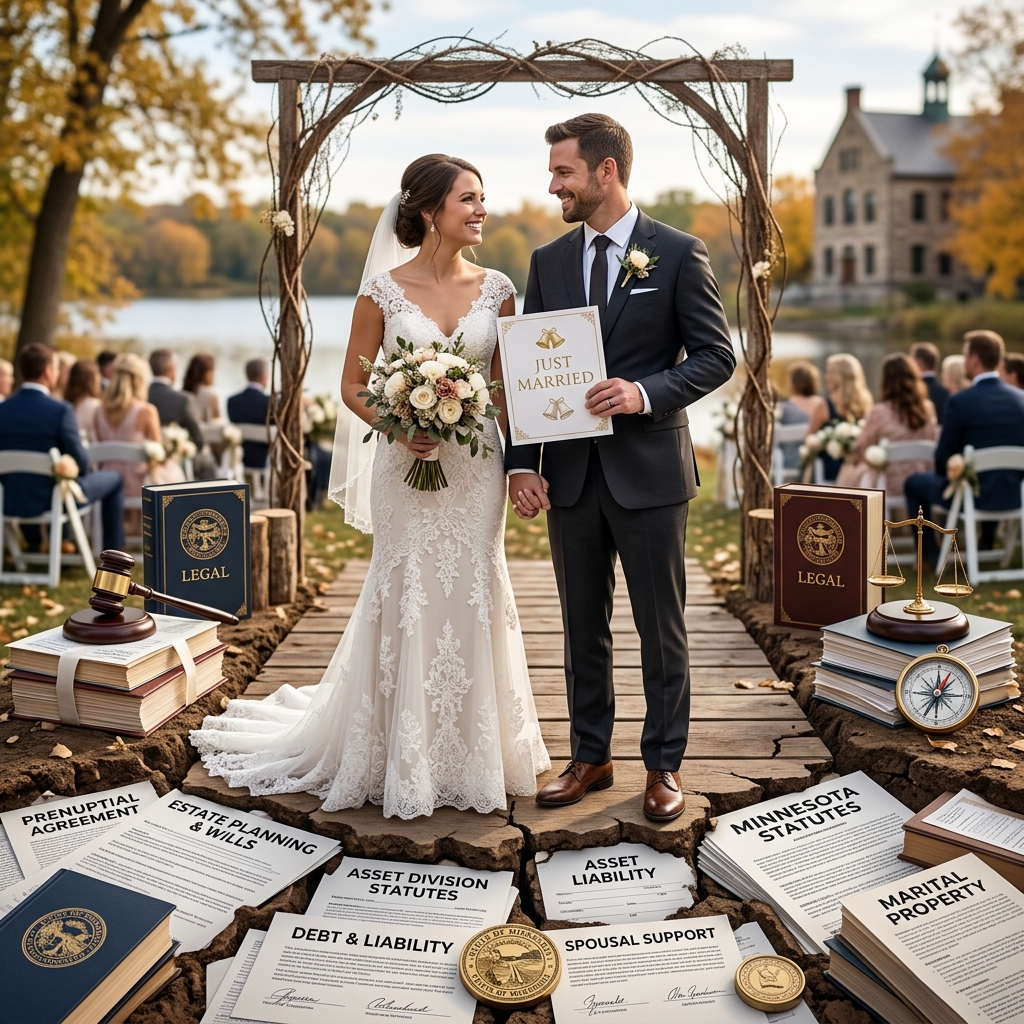
Getting married in Minnesota changes far more than your last name and tax filing status. It creates a new legal relationship with default rights in property, debt, healthcare, and inheritance that apply even if you never sign a single extra document. Many couples are surprised to learn that the law has already written a partial estate and financial plan for them, and it may not match what they actually want.
This article explains how Minnesota marriage laws affect newlyweds, why simple steps like updating beneficiary designations and signing core estate planning documents are critical, and how to avoid common pitfalls that can harm either spouse or children from prior relationships.
How Marriage Changes Your Legal and Financial World
In Minnesota, a marriage is not just a personal commitment; it is also a civil contract that automatically grants each spouse certain rights and protections. These rules influence what happens if either spouse dies, becomes disabled, or the marriage ends.
Key Legal Effects of Saying “I Do”
- Spousal inheritance rights: A surviving spouse gains an automatic right to claim an elective share of the deceased spouse’s estate, even if the will favors someone else.
- Marital property expectations: Assets acquired during marriage are often treated as part of the marital estate, even when titled in one name, especially in divorce proceedings.
- Decision-making authority: Without clear documents, family members may have to seek court orders to manage finances or healthcare if a spouse becomes incapacitated.
- Impact on children from prior relationships: Spousal rights can unintentionally reduce or delay inheritances intended for children from earlier relationships.
These rules protect spouses from being disinherited or left financially stranded. At the same time, they can conflict with prior expectations, informal promises, or older legal documents created before the marriage.
Property Ownership: Individual Title vs. Marital Expectations
Newlyweds often focus on whose name goes on the deed or title, assuming that legal ownership follows that label. In practice, Minnesota law looks at both title and marital context when determining rights in property, especially in divorce and probate proceedings.
Common Asset Types for Newlyweds
- Primary residence: Houses or condos purchased before or after marriage, sometimes with only one spouse on the deed.
- Retirement accounts: 401(k)s, IRAs, pensions and similar plans, often started long before the wedding.
- Investment accounts: Brokerage accounts, savings accounts and certificates of deposit.
- Vehicles: Cars, trucks, and recreational vehicles registered in one or both names.
- Family property: Cabins, farmland, or rental homes inherited from parents or grandparents.
Simply owning an asset in your sole name does not mean your spouse has no rights connected to it. In divorce, courts consider whether property is marital or non-marital based on when and how it was acquired. In probate, a surviving spouse may have statutory claims even if the will leaves the asset elsewhere.
Illustrative Comparison: Title vs. Statutory Protections
| Scenario | Title / Paperwork | Potential Spousal Rights |
|---|---|---|
| Home bought before marriage | Only one spouse listed on deed | May be partly marital if improved or paid for with marital funds in divorce; surviving spouse can still claim inheritance rights through elective share in probate. |
| 401(k) started before marriage | Original beneficiary is a parent | Spouse may have strong expectation and sometimes legal basis to claim part of the account, especially if used for joint retirement planning. |
| Cabin inherited during marriage | Only inheriting spouse on title | Generally treated as non-marital property, but spouse may still have occupancy or inheritance claims depending on estate planning documents. |
Debts and Financial Obligations After Marriage
Assets are only half the story. Newlyweds also need to understand how marriage affects liability for debts, both existing and future. While Minnesota is not a community property state, marriage can change the practical impact of loans and credit decisions.
Types of Debts Commonly Involved
- Student loans and personal loans existing before marriage.
- Joint mortgages or co-signed auto loans taken out after the wedding.
- Credit card balances, especially on joint or authorized-user accounts.
- Medical bills and long-term care costs incurred during the marriage.
Liability usually follows who signed the contract, but both spouses can feel the financial consequences. For example, if a spouse dies with significant debt and no planning, creditors may pursue estate assets that the surviving spouse expected to rely on, including shared savings or the decedent’s share of the home.
Inheritance Rules: Protecting Spouses and Children
One of the biggest surprises for newlyweds comes from inheritance rules. Minnesota law gives surviving spouses minimum inheritance rights unless they have properly waived them through a valid agreement. This is designed to prevent a spouse from being left with nothing, but it can create tension with other family members.
Elective Share and Spousal Protections
Under Minnesota law, a surviving spouse can claim an elective share of the deceased spouse’s estate instead of accepting what the will provides. The size of this share depends on the length of the marriage and the type of property involved, and is intended to ensure a baseline level of support.
This protection matters in several situations:
- When a spouse never updated their will after remarriage.
- When a spouse tried to leave almost everything to children or other relatives.
- When significant assets are held in certain trusts or beneficiary-designated accounts instead of the probate estate.
Without careful planning, elective share claims can lead to disputes among surviving spouses, adult children, and other heirs, and may require court involvement to sort out property rights.
Blended Families and Competing Expectations
Second marriages and blended families raise especially complex issues. A spouse may want to:
- Allow the surviving spouse to live in the home for life.
- Ensure the home ultimately passes to children from a prior relationship.
- Protect certain inheritances (such as a cabin or business interest) for specific heirs.
These goals can often be achieved with properly drafted trusts, transfer-on-death deeds, and tailored beneficiary designations, but they require explicit planning and documentation.
Essential Estate Planning Documents for Minnesota Newlyweds
Because Minnesota marriage laws create default answers that may not fit a couple’s wishes, newlyweds should consider basic estate planning documents soon after the wedding. These instruments can override default rules and clearly state who should receive property and who can make decisions in a crisis.
Core Legal Documents to Prioritize
- Will: Directs where property goes at death, appoints a personal representative to settle the estate, and can nominate guardians for minor children.
- Revocable living trust: Can help avoid probate, organize assets, and manage inheritances over time, especially for blended families or young beneficiaries.
- Financial power of attorney: Authorizes a trusted person (often the spouse) to manage finances if you cannot act, avoiding the need for a court-ordered conservatorship.
- Health care directive: Appoints a health care agent, typically the spouse, to make medical decisions and records treatment preferences, reducing the likelihood of guardianship proceedings.
- Beneficiary designations: Control who receives retirement accounts, life insurance proceeds, and some financial accounts and should be updated to match your current plan.
These documents work together: a will or trust sets the overall plan; beneficiary designations align major accounts with that plan; and powers of attorney and health care directives cover incapacity, not just death.
Step-by-Step Planning Checklist for Newlyweds
To move from theory to action, couples can follow a practical checklist. Each step closes a common gap that causes conflict or financial loss when something goes wrong.
1. Review Existing Documents and Accounts
- Locate any wills, trusts, or powers of attorney created before marriage.
- List all major accounts and policies: retirement plans, life insurance, bank and brokerage accounts.
- Identify current beneficiaries and decision-makers on each document.
2. Update Beneficiary Designations
- Consider naming your spouse as primary beneficiary on retirement accounts and life insurance if that matches your goals.
- Choose contingent beneficiaries in case both spouses die in the same event.
- Avoid naming minor children directly on retirement and insurance accounts; use a trust instead so funds can be managed responsibly.
3. Sign Financial and Healthcare Documents
- Execute a durable financial power of attorney naming your spouse or another trusted individual.
- Create a health care directive appointing a healthcare agent and expressing treatment preferences.
- Review these documents at least every few years or after major life changes.
4. Decide How to Title the Home and Major Assets
- Discuss whether to hold the home jointly or in one name, and how that choice interacts with your broader estate plan.
- Consider transfer-on-death deeds or trusts if you want a clear path for inheritance while protecting a surviving spouse’s housing needs.
- Coordinate titles with your will or trust to avoid contradictions.
5. Address Long-Term Goals and “What If” Scenarios
- Talk about long-term care, potential disability, and where each of you might want to live in later years.
- Consider long-term care insurance, retirement savings strategies, and education plans for children.
- Plan for obligations to elderly parents or disabled family members who may need support.
Common Mistakes Minnesota Newlyweds Should Avoid
Knowing where couples typically go wrong can help you avoid expensive and emotionally draining problems later.
- Leaving pre-marriage wills untouched: Older documents may unintentionally favor former partners or relatives instead of the current spouse.
- Ignoring beneficiary designations: These can override your will and send life insurance or retirement funds to the wrong person.
- Assuming “everything automatically goes to my spouse”: In reality, Minnesota’s rules split interests between spouses, children, and other heirs depending on the circumstances.
- Not planning for blended families: Without specific instructions, conflict among step-children and a surviving spouse is common in second marriages.
- Delaying powers of attorney and health care directives: If incapacity strikes without these documents, family may need to pursue guardianship or conservatorship in court.
Frequently Asked Questions for Minnesota Newlyweds
Do we really need a will if we are young and own very little?
Yes. A will is important even for couples with modest assets because it clarifies who receives your property, who settles your estate, and who cares for minor children. Without one, Minnesota’s intestacy rules apply, which may split assets between your spouse and other relatives in a way you did not expect.
If my spouse is named on my 401(k), do I still need an estate plan?
Beneficiary designations handle specific accounts, but they are not a complete estate plan. You still need a will or trust for other property, and incapacity documents to manage finances and medical decisions if you cannot act for yourself.
What happens if I never update my pre-marriage will after getting married?
Old wills remain legally valid, but your surviving spouse may have the right to claim an elective share that overrides parts of the plan. This can create confusion and litigation risk, particularly when children from prior relationships are involved.
Is a trust necessary for every newlywed couple?
Not always. Trusts are especially helpful when you want to avoid probate, manage complex assets, protect children’s inheritances, or balance interests between a second spouse and children from an earlier relationship. Many couples start with a will and add a trust as their situation becomes more complex.
Can we handle estate planning on our own using online forms?
Some basic steps, such as updating beneficiary designations, can be done directly through financial institutions. However, Minnesota estate and probate rules are nuanced, and generic forms may miss important local requirements. Consulting a qualified Minnesota estate planning attorney helps ensure your documents are valid and work together as intended.
References
- Estate Planning for Married Couples — Boulay Group. 2023-05-01. https://boulaygroup.com/estate-planning-for-a-second-marriage-in-minnesota-a-guide-for-blended-families/
- Minnesota Estate Planning for Married Couples — Minnesota Probate Law Firm. 2022-11-10. https://minnesotaprobatelawfirm.com/married-couples-estate-planning-probate/
- Estate Planning — Messick Law, PLLC. 2023-02-15. https://www.messicklaw.com/estate-planning/
- From “I Do” to “What If”: Estate Planning Must-Do’s for Newlyweds — Spalding Law Office. 2023-08-20. https://spaldinglawoffice.com/from-i-do-to-what-if-estate-planning-must-dos-for-newlyweds-part-1/
- Estate Planning Essentials for Newlyweds — Roulet Law Firm. 2022-09-05. https://www.rouletlaw.com/blog/estate-planning-essentials-for-newlyweds.cfm
- Minnesota Wills & Trusts: Newlyweds and Minnesota Estate Planning — Minnesota Estate Planning Blog. 2021-06-18. https://www.minnesotaestateplanningblog.com/minnesota-wills-trusts-newlyweds-minnesota-estate-planning/
- How an Estate Lawyer in Minnetonka Can Guide Newlyweds — Stone Arch Law Office. 2023-07-30. https://stonearchlaw.com/married-couples-joint-trust-or-separate-trusts/
Similar Articles








Read full bio of Sneha Tete


