
Labor Unions and U.S. Law: An Evolving Relationship
Explore how U.S. labor unions and federal law have shaped each other from colonial-era strikes to modern workplace rights.
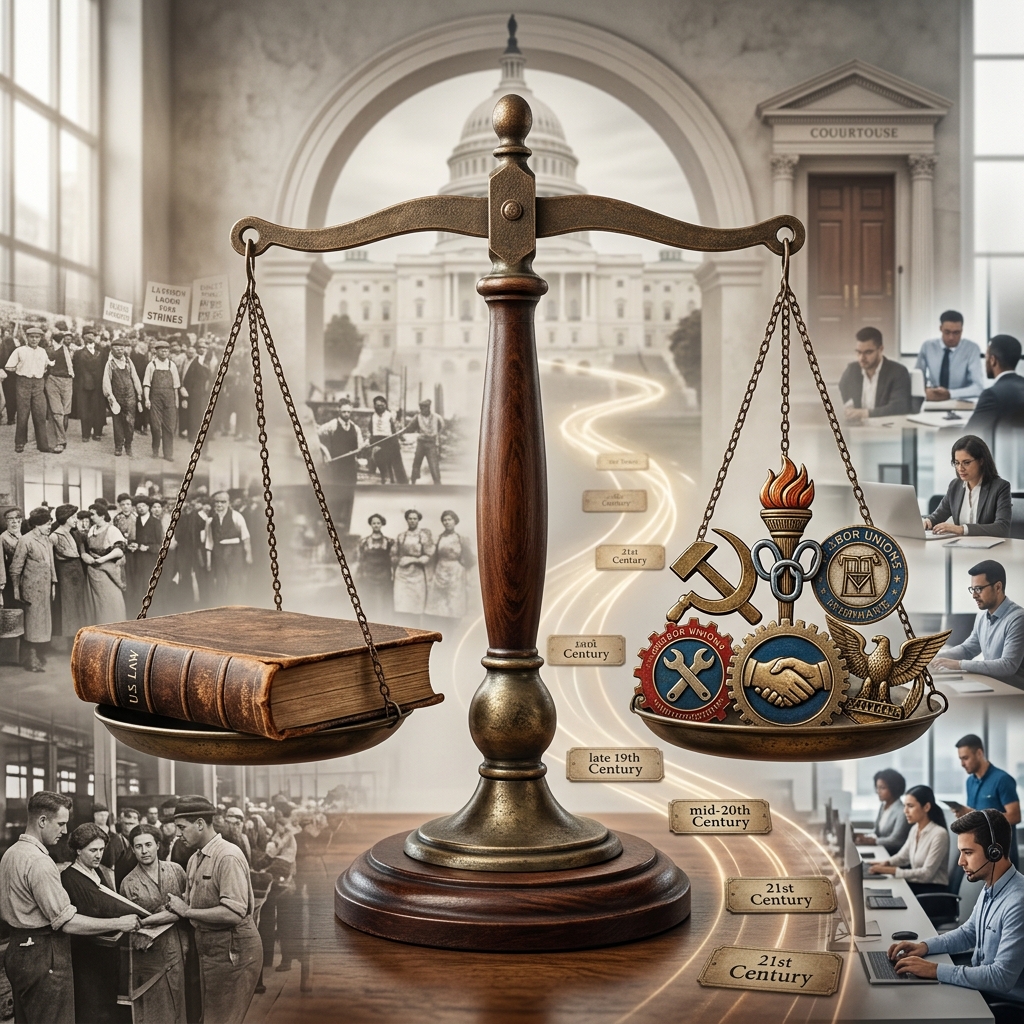
Labor unions have played a central role in defining what fair work looks like in the United States. From early craft guilds and colonial strikes to modern debates over gig work and public sector bargaining, unions have constantly interacted with the law: sometimes confronting it, sometimes shaping it, and often being reshaped by it. This article explores how U.S. labor unions emerged, which landmark statutes and court decisions changed the legal landscape, and how the balance between worker power and employer control has shifted over the last two centuries.
From Colonial Craft Workers to Early Union Experiments
Long before the word “union” became common, workers in the American colonies were organizing informally to resist wage cuts and demand better conditions. In the late 18th century, skilled tradespeople such as tailors and shoemakers began coordinating actions that resembled modern strikes and collective bargaining. These early efforts laid the foundations for later unions and for the eventual development of labor law as a separate legal field.
Several themes characterize this early period:
- Small-scale, local organization among artisans and journeymen, often tied to specific cities or trades.
- Informal agreements to refuse work below certain wage rates or under certain conditions.
- Suspicion from courts, which frequently saw collective wage demands as improper or even conspiratorial under common law.
As industrialization accelerated in the 19th century, these small craft associations evolved into more structured unions, and legal conflict intensified. Judges had to decide whether collective action by workers was a legitimate exercise of freedom or an unlawful combination that interfered with commerce and employer rights.
Courtroom Battles: Unions and Early Common Law
During the 19th century, the legal status of unions was far from settled. Courts often applied English common law rules about conspiracy and restraint of trade. Under these doctrines, workers who banded together to demand higher wages or standard hours could be prosecuted or sued for interfering with employers’ business.
Key developments in this era included:
- Conspiracy charges against organizers, treating union efforts as harmful to the “general welfare” if they restricted competition or interfered with production.
- Gradual recognition of lawful collective action, as some courts began distinguishing between peaceful organizing and violent or coercive conduct.
- Mixed precedents, resulting in uncertainty for both unions and employers about what the law allowed.
This legal ambiguity discouraged some workers from joining unions and limited unions’ ability to act. At the same time, it helped spur political movements seeking clearer statutory protections, eventually leading to landmark federal legislation in the 20th century.
Industrialization, Mass Movements, and Federal Attention
By the late 19th and early 20th centuries, rapid industrial growth, long hours, dangerous factories, and child labor produced a wave of labor unrest. Organized labor moved beyond small craft unions to mass organizations representing miners, railway workers, factory operatives, and other industrial employees.
Several trends pushed labor issues onto the national agenda:
- Large-scale strikes and lockouts, sometimes involving clashes with private security or government troops.
- Growing national unions and federations, such as the American Federation of Labor (AFL), which helped coordinate campaigns for higher wages and safer workplaces.
- Public concern about industrial accidents and sweatshop conditions, leading to pressure for safety laws and limited hours.
These circumstances eventually produced federal intervention, including the creation of the U.S. Department of Labor in 1913 to promote the welfare of workers and improve working conditions. Over time, policy shifted from viewing unions as potential conspiracies to recognizing them as legitimate actors in a regulated labor market.
Major Federal Statutes Reshaping Union–Employer Relations
The modern legal framework for unions rests largely on several key federal laws enacted during the 1930s and after. Together, these laws defined how unions can organize, bargain, strike, and manage internal affairs—and how employers must respond.
National Labor Relations Act (NLRA / Wagner Act)
The National Labor Relations Act of 1935, often called the Wagner Act, transformed labor relations by affirmatively protecting workers’ rights to organize and bargain collectively. The NLRA:
- Guarantees the right of employees to form, join, or assist labor organizations.
- Protects collective bargaining and other “concerted activities” for mutual aid or protection.
- Prohibits certain employer practices, such as interfering with union organizing or retaliating against union supporters.
- Establishes the National Labor Relations Board (NLRB) to conduct union elections and remedy unfair labor practices.
The Wagner Act marked a major shift in federal policy: rather than merely tolerating unions, Congress framed organized labor as essential to industrial peace and economic stability.
Labor Management Relations Act (Taft-Hartley Act)
In 1947, the Labor Management Relations Act, known as the Taft-Hartley Act, revised the NLRA and narrowed some union protections. This law responded to concerns about union power and disruptive strikes, and it introduced significant limits on union conduct.
Important Taft-Hartley provisions include:
- Making closed shops—workplaces that hire only union members—illegal under federal law.
- Authorizing states to pass right-to-work laws, which allow employees to refuse union membership or dues even in unionized workplaces.
- Restricting secondary boycotts and certain forms of picketing, particularly actions targeting businesses other than the primary employer.
- Permitting lawsuits against unions for certain kinds of picketing and boycotting.
Taft-Hartley did not abolish unions but changed the balance of power. Employers gained new tools to resist union pressure, and union organizing strategies had to adapt to stricter legal boundaries.
Labor-Management Reporting and Disclosure Act (Landrum-Griffin)
The Labor-Management Reporting and Disclosure Act, commonly called the Landrum-Griffin Act, focused on internal union governance. It aimed to address corruption and undemocratic practices within some unions by imposing reporting and member rights requirements.
This law introduced:
- A “bill of rights” for union members, including rights to free speech at meetings and to fair elections.
- Mandatory financial reporting and disclosure by unions, designed to reveal misuse of funds.
- Regulation of union officer elections and fiduciary duties.
By setting standards for how unions operate internally, Landrum-Griffin reinforced the idea that unions are not only bargaining agents but also institutions subject to legal oversight.
Fair Labor Standards Act (FLSA)
While not limited to unions, the Fair Labor Standards Act (FLSA) of 1938 established baseline labor protections that unions often advocated. The FLSA:
- Bans most forms of child labor in covered industries.
- Creates a federal minimum wage and requires overtime pay for certain workers.
- Defines the standard 40-hour workweek, above which overtime rules generally apply.
These statutory protections operate whether or not a workplace is unionized, but they reflect decades of union campaigns for shorter hours and better pay.
Changing Union Power: Growth, Peak, and Decline
Union influence has not been constant. It expanded dramatically during the early and mid-20th century, especially in manufacturing and heavy industry, then declined in many private sectors while remaining stronger in public employment.
| Period | Union Trends | Legal and Economic Context |
|---|---|---|
| Early 1900s–1930s | Growing union density; major strikes; safety and wage campaigns. | Industrialization, New Deal reforms, creation of DOL and NLRA. |
| 1940s–1970s | Peak union membership, especially in private manufacturing. | Taft-Hartley constraints, postwar boom, strong collective bargaining structures. |
| 1980s–present | Declining private sector unionization; relatively stronger public sector unions. | Globalization, service economy growth, expansion of right-to-work laws. |
Throughout these shifts, the legal framework has remained anchored in the NLRA, Taft-Hartley, and related statutes, but practical outcomes have changed as industries, politics, and worker expectations evolved.
Right-to-Work Laws and Their Impact
One of the most contested aspects of modern labor law is the spread of state-level right-to-work legislation, made possible by the Taft-Hartley Act. These laws prohibit union-security agreements that require all bargaining-unit employees to join the union or pay equivalent fees.
Supporters argue that right-to-work laws:
- Protect individual freedom of association by allowing workers to opt out of union membership.
- Can make states more attractive to employers by reducing labor costs and perceived union influence.
Critics contend that these laws:
- Lead to “free rider” problems, where non-members benefit from union bargaining without contributing dues.
- Weaken unions’ financial stability, potentially reducing their ability to enforce contracts and advocate for safety.
Legally, right-to-work laws exemplify how federal statutes and state policy interact, creating a patchwork of union rules across the country.
How Unions Advocate for Safety, Wages, and Fair Treatment
In practice, unions affect workplaces through a combination of negotiation, enforcement, and political action. They use legal rights granted by the NLRA and other statutes to secure protections that go beyond minimum federal standards.
Common union roles include:
- Collective bargaining agreements that set wage scales, benefits, scheduling rules, and grievance procedures.
- Health and safety advocacy, often pushing for protective equipment, training, and compliance with regulations enforced by agencies such as OSHA.
- Political lobbying for stronger labor protections, such as updated minimum wage laws, family leave, or improved enforcement resources.
- Legal challenges to unfair labor practices and contract violations through the NLRB and courts.
These activities have contributed to widely recognized improvements in workplace safety and fairness, even as union density has declined in some sectors.
Labor Unions and the Future of Work
Emerging issues such as gig work, remote employment, and algorithmic management raise new questions about how traditional labor laws apply. Many current debates focus on whether existing statutes, designed for factory and office environments, adequately cover platform workers, temp staff, and others whose employment status is contested.
Key challenges include:
- Determining who qualifies as an employee vs. independent contractor for purposes of union rights and wage protections.
- Adapting union strategies to dispersed and digital workplaces where workers rarely meet in person.
- Ensuring that core legal principles—such as the right to organize and be free from retaliation—remain meaningful in new business models.
Although statutes like the NLRA and FLSA were crafted for earlier industrial eras, their underlying goals of promoting fair wages, safe working conditions, and collective voice continue to guide legal and policy discussions.
Frequently Asked Questions (FAQs)
Are labor unions legal in the United States?
Yes. Federal law, especially the National Labor Relations Act, explicitly protects private-sector employees’ rights to organize, form unions, and engage in collective bargaining and other concerted activities, subject to certain limitations.
Can workers be forced to join a union?
Under the Taft-Hartley Act, closed shops that require union membership as a condition of employment are illegal at the federal level. In states with right-to-work laws, workers in unionized workplaces may refuse both membership and dues, though the union still represents them in bargaining.
What kinds of union activities are restricted by law?
While peaceful organizing and bargaining are protected, laws like Taft-Hartley restrict secondary boycotts, certain forms of picketing, and other tactics considered overly disruptive or targeting neutral employers. Some types of strikes, such as sit-down strikes, have also been deemed unlawful by courts.
Do non-union workers benefit from union activity?
Yes. Many statutory protections—such as the federal minimum wage and overtime standards in the FLSA—originated in labor campaigns and now apply broadly. Even in non-union workplaces, employers may adopt better wages or safety practices in response to union standards in their industry.
What is the role of the National Labor Relations Board?
The NLRB oversees union representation elections, investigates and remedies unfair labor practices by unions or employers, and interprets key provisions of the NLRA. Its decisions help define how labor law applies in changing economic conditions.
References
- Labor history of the United States — Various authors, summary of U.S. labor developments. 2024-01-01. https://en.wikipedia.org/wiki/Labor_history_of_the_United_States
- The Legal History of Labor Unions — FindLaw. 2023-05-10. https://www.findlaw.com/employment/wages-and-benefits/the-legal-history-of-labor-unions.html
- A Historical Look at Labor Unions and How Workers Fought for Safety — OSHA Education Center. 2021-09-15. https://www.oshaeducationcenter.com/labor-unions-history/
- 200 Years of Labor History — National Park Service. 2020-08-01. https://www.nps.gov/blrv/learn/historyculture/200-labor-events.htm
- A Brief History: The U.S. Department of Labor — U.S. Department of Labor. 2013-03-01. https://www.dol.gov/general/aboutdol/history/dolhistoxford
- A Brief History of Unions — Union Plus. 2016-01-01. https://www.unionplus.org/page/brief-history-unions
Similar Articles








Read full bio of medha deb




