
How to File Bankruptcy in New York: A Practical Guide
Understand the New York bankruptcy process from first warning signs of debt trouble to discharge, including timelines, costs, forms, and key legal requirements.
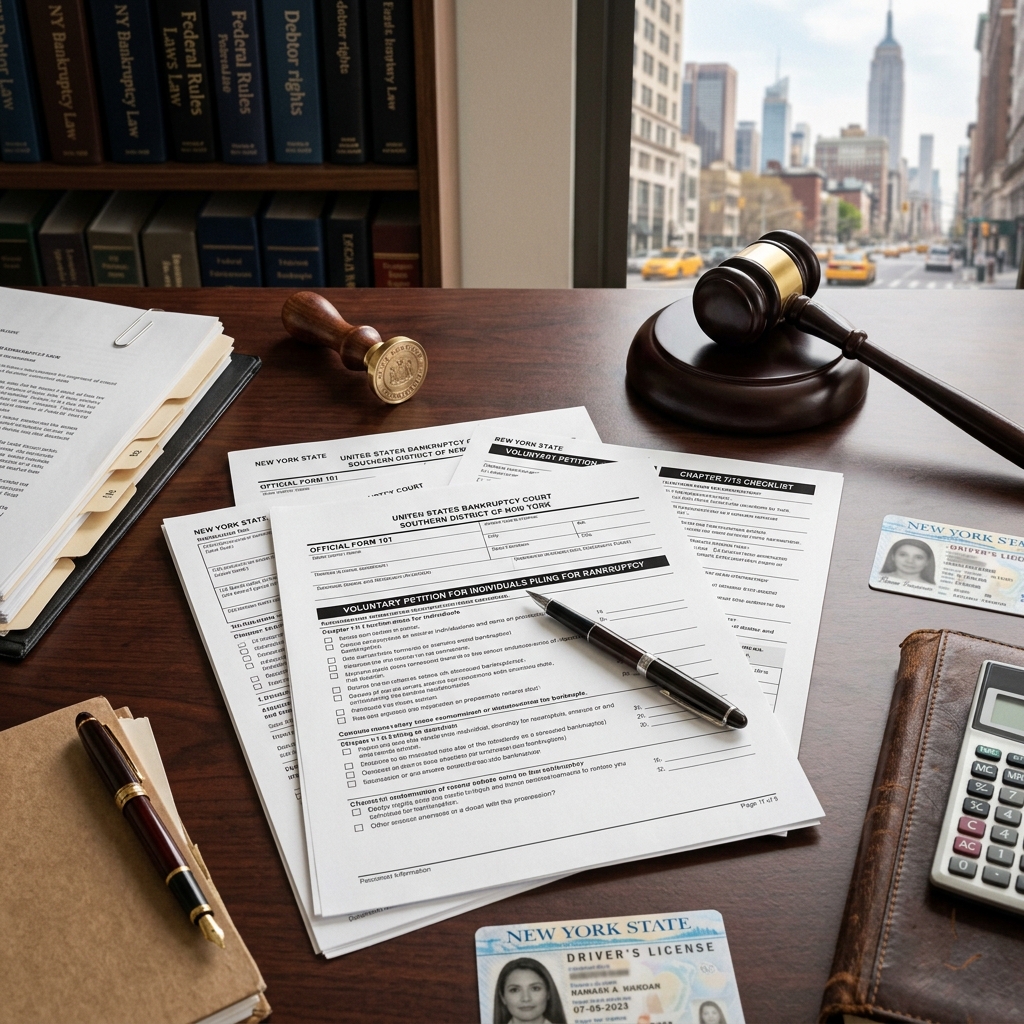
Personal bankruptcy in New York is a powerful legal tool that can stop collections, pause lawsuits, and provide a pathway to manage or erase overwhelming debt. It is also complex, paperwork‑heavy, and governed by both federal law and New York-specific rules. This guide walks you through how bankruptcy works in New York, what to do before you file, how the process unfolds, and what to expect after your case is over.
1. Understanding the Basics: What Bankruptcy Does and Does Not Do
Bankruptcy is a federal court process designed to help individuals who cannot afford to pay their debts get a financial fresh start. All bankruptcy cases are filed in federal bankruptcy courts, not state courts, but New York law plays a major role in determining which property you can keep.
1.1 The Automatic Stay: Immediate Protection
When you file a bankruptcy petition, the court issues an automatic stay that immediately stops most collection actions.
- Stops wage garnishments in most cases
- Stops most lawsuits and collection calls
- Temporarily halts foreclosure and repossession efforts in many situations
The automatic stay usually remains in place until your case is closed or dismissed, or until the court grants a creditor permission to proceed.
1.2 What Bankruptcy Cannot Fix
Bankruptcy is helpful for many unsecured debts, but it has limits. In most cases, bankruptcy does not eliminate:
- Most student loans (unless you prove undue hardship in a separate proceeding)
- Recent income taxes and many other tax debts
- Child support and spousal support obligations
- Fines and penalties owed to government agencies
Understanding these limits helps you decide whether bankruptcy aligns with your financial goals.
2. Choosing Between Chapter 7 and Chapter 13 in New York
Most individuals in New York file under either Chapter 7 (liquidation) or Chapter 13 (repayment plan). The best choice depends on your income, assets, and what you hope to accomplish.
| Feature | Chapter 7 (Straight Bankruptcy) | Chapter 13 (Repayment Plan) |
|---|---|---|
| Goal | Discharge most unsecured debts quickly | Catch up on secured debts and pay what you can over time |
| Typical timeline | About 3–4 months from filing to discharge in many New York cases | 3 to 5 years of monthly plan payments |
| Plan payments | No court‑ordered repayment plan | Regular monthly payments to a Chapter 13 trustee |
| Best for | Lower‑income filers with limited assets | People with regular income who need to save a home, car, or other collateral |
| Risk to property | Non‑exempt property may be sold to pay creditors | Usually keep property while paying into the plan |
Eligibility for Chapter 7 is partly determined by a “means test” that compares your household income to median levels and considers allowable expenses. Chapter 13 requires a steady income to support regular payments.
3. Preparing to File: Documents, Counseling, and Planning
Thorough preparation is one of the best ways to avoid delays or dismissal. Before you file in New York, you will need to complete a credit counseling course, gather financial records, and evaluate your assets under New York exemption law.
3.1 Mandatory Credit Counseling
Federal law requires individuals to complete a credit counseling session from a court‑approved agency during the 180 days before filing bankruptcy.
- The agency must be approved by the U.S. Trustee Program for your district.
- After completion, you receive a certificate that must be filed with your bankruptcy forms.
- The session usually takes about an hour and can often be completed online or by phone.
Skipping this step or using a non‑approved provider is a common mistake that can lead to the rejection of your case.
3.2 Financial Documents to Collect
Accurate information is critical. You should gather at least the following:
- Pay stubs or other income records for the last 6 months
- Federal and state tax returns (commonly the last 2 years)
- Bank and retirement account statements
- Mortgage and car loan statements
- Credit card and medical bills
- Collection notices, lawsuits, and judgments
- Titles, deeds, and any documentation for valuable property
New York courts and trustees typically require you to provide tax returns and bank statements by specific deadlines, especially before the meeting of creditors.
3.3 Listing Assets, Debts, Income, and Expenses
When you file, you must disclose all of your financial information, including:
- Every creditor and collection agency, with mailing addresses
- All real estate, vehicles, and personal property
- Household income from all sources
- Regular monthly living expenses
You must also describe major financial transactions from the last couple of years, such as transfers of property or large payments to insiders. Omissions or inaccurate information can lead to objections or, in serious cases, allegations of fraud.
3.4 Understanding New York Exemptions
Exemption laws determine which property is protected in bankruptcy. New York allows you to keep certain categories of property up to specific values, such as equity in your home, a vehicle, personal belongings, and retirement accounts. Married couples filing jointly may double some exemption amounts.
Choosing between New York’s exemptions and federal exemptions (if available to you) can be a strategic decision that often benefits from legal advice.
4. Filing Your Case in a New York Bankruptcy Court
Once you are prepared, you must complete the official bankruptcy forms and file them with the appropriate court. Individuals may file with or without an attorney (called filing pro se), though the federal judiciary strongly recommends getting legal advice because of the complexity and long‑term consequences of bankruptcy.
4.1 Completing the Official Forms
The core filing includes:
- The voluntary petition (basic identifying and case information)
- Schedules of assets and liabilities
- Schedules of income and expenses
- A statement of financial affairs describing recent financial activity
- The credit counseling certificate
- For Chapter 13, a proposed repayment plan
Many New York courts also offer electronic tools to help self‑represented filers create Chapter 7 and 13 petitions online, which then must be finalized with the court.
4.2 Where and How to File
New York is divided into several federal bankruptcy districts. You generally file in the district where you have lived or maintained your principal assets for most of the last 180 days. Within each district, you may be able to file by:
- Delivering documents in person to the clerk’s office
- Mailing the signed, original petition and required copies
- Using approved electronic tools for certain self‑represented filers (where available)
Your petition is considered filed when it is accepted by the clerk’s office with the required signatures and fees or approved applications for fee relief.
4.3 Court Fees and Fee Relief
Filing fees are set nationwide but periodically adjusted. For example, recent official guidance notes that Chapter 7 and Chapter 13 filings both require several hundred dollars in court fees. If you cannot pay the full fee up front:
- You may request to pay in installments (subject to court approval).
- In some Chapter 7 cases, if your income is very low, you may apply to have the fee waived.
Filing fees are separate from attorney’s fees or fees charged by counseling and education providers.
5. What Happens After You File in New York
Once your case is filed, several important milestones follow: assignment of a trustee, the meeting of creditors, and in Chapter 13, ongoing plan payments. In both chapters, you must also complete a second education course.
5.1 Appointment of a Bankruptcy Trustee
A private trustee is appointed in most consumer cases to administer your estate and oversee the process. The trustee’s role varies by chapter:
- Chapter 7 trustee: Reviews your documents, conducts the creditor meeting, and may sell non‑exempt property to pay creditors.
- Chapter 13 trustee: Reviews your repayment plan, receives monthly payments, and distributes money to creditors as directed by the confirmed plan.
Trustees rely heavily on the documents you provide; failure to cooperate or supply required information can lead to dismissal.
5.2 The 341 Meeting of Creditors
Every bankruptcy filer must attend a meeting of creditors, also called a 341 meeting after the section of the Bankruptcy Code that requires it.
- It is usually scheduled about a month after your case is filed.
- You must bring identification and proof of your Social Security number.
- The trustee will ask questions under oath about your finances, assets, and forms.
- Creditors may appear and ask questions, though in consumer cases this is often rare.
For many Chapter 7 filers in New York, the 341 meeting may be the only time they “appear” in the case.
5.3 Debtor Education: Personal Financial Management Course
In addition to pre‑filing credit counseling, you must also complete a post‑filing debtor education or personal financial management course. Key points:
- The course typically takes around two hours.
- You must use a provider approved by the U.S. Trustee Program.
- In Chapter 7, you should complete it soon after filing so it does not delay discharge.
- In Chapter 13, timing may depend on your attorney’s advice and local practice.
If you do not file the completion certificate, the court may close your case without granting a discharge, forcing you to take additional steps to reopen it later.
5.4 Timeline to Discharge
In a typical New York Chapter 7 case, if there are no major complications or objections, discharge of dischargeable debts often occurs about 100–120 days after filing the petition. Chapter 13 discharges are granted only after successful completion of all plan payments, which can take three to five years.
6. Life After Bankruptcy: Credit, Property, and Future Planning
Bankruptcy is not the end of your financial story; it is a reset point. Understanding what happens after discharge can help you rebuild effectively.
6.1 Impact on Your Credit Report
A bankruptcy filing becomes part of your credit history for years—generally up to 10 years for Chapter 7 and somewhat less time for Chapter 13. However, many individuals begin rebuilding their credit sooner than expected by:
- Paying all ongoing obligations on time (rent, utilities, remaining loans)
- Using secured credit cards responsibly
- Keeping balances low relative to available credit
Many lenders view a fresh discharge differently from unresolved defaulted debts, especially when you demonstrate consistent good financial behavior afterward.
6.2 Protecting Future Assets
Once your case is complete, you are generally free to build savings, acquire property, and make new investments. Future property you acquire is usually not part of the old bankruptcy estate, with some exceptions for inheritances or certain windfalls received shortly after filing.
6.3 Avoiding Repeat Financial Problems
The education courses required in bankruptcy are designed to help you understand budgeting, credit use, and long‑term planning. To make the most of your fresh start, it is useful to:
- Create a realistic budget that prioritizes housing, food, transportation, and healthcare
- Build an emergency fund, even if very small at first
- Review your credit reports regularly for accuracy
- Be cautious about taking on new high‑interest debt
7. When to Consider Legal Help or Other Options
The federal courts emphasize that bankruptcy has serious long‑term financial and legal consequences and recommend that individuals considering bankruptcy seek legal advice. Free or low‑cost help may be available through legal aid organizations or pro bono programs.
7.1 Situations Where Legal Advice Is Especially Important
- You own a home with significant equity or multiple properties.
- You have a small business, are self‑employed, or have complicated tax issues.
- There are pending lawsuits, wage garnishments, or judgments against you.
- You recently transferred property or repaid relatives or friends.
In these situations, legal guidance can help you avoid losing property unnecessarily or facing allegations of improper transfers.
7.2 Alternatives to Bankruptcy
Bankruptcy is not always the best or only solution. Depending on your circumstances, you may want to explore:
- Working directly with creditors for reduced payments or interest
- Nonprofit credit counseling and debt management plans
- Negotiated settlements on specific debts
- Short‑term hardship programs, especially for mortgage or student loans
A credit counselor or attorney can help compare these alternatives to bankruptcy for your specific situation.
8. Frequently Asked Questions About New York Bankruptcy
8.1 Does filing bankruptcy in New York wipe out all my debts?
No. Bankruptcy can eliminate many unsecured debts such as credit card balances and medical bills, but certain obligations—like child support, many recent tax debts, and, in most cases, student loans—are not discharged.
8.2 Will I lose my home if I file Chapter 7?
It depends on the value of your home, your mortgage balance, and the available homestead exemption. If your equity is fully protected by exemption law and you stay current on your mortgage, many New York filers can keep their homes. If you have significant non‑exempt equity, you may want to explore Chapter 13 or consult an attorney.
8.3 Can I file bankruptcy without a lawyer in New York?
Yes. Individuals may file pro se, or without an attorney, in New York federal bankruptcy courts. However, the U.S. courts strongly recommend obtaining legal advice because of the complexity of the forms, strict deadlines, and long‑term consequences. Some districts offer electronic tools to assist self‑represented filers.
8.4 How long does a typical Chapter 7 case take in New York?
Many straightforward Chapter 7 cases in New York take around 100 to 120 days from the filing of the petition to the entry of discharge, provided you complete all required courses and respond promptly to any trustee requests.
8.5 What happens if I do not finish the required courses?
If you skip the pre‑filing credit counseling, your case may be dismissed or not accepted. If you do not complete the post‑filing debtor education course, the court may close your case without granting a discharge, leaving you still legally liable for your debts until the issue is resolved.
References
- Bankruptcy in New York — Legal Assistance of Western New York (LawNY). 2020-12-01. https://www.lawny.org/node/80/bankruptcy-new-york
- Filing Without an Attorney — United States Courts. 2023-05-01. https://www.uscourts.gov/court-programs/bankruptcy/filing-without-attorney
- eSR (Electronic Self-Representation) — U.S. Bankruptcy Court, Eastern District of New York. 2022-08-15. https://www.nyeb.uscourts.gov/esr-electronic-self-representation
- Filing bankruptcy in New York – what is the process — NewYorkBankruptcyLaw.com. 2019-03-10. http://www.newyorkbankruptcylaw.com/process.html
- How Long is the Bankruptcy Process in New York State? — NY Legal Help. 2021-04-06. https://www.nylegalhelp.com/2021/04/how-long-is-the-bankruptcy-process-in-new-york-state/
- Bankruptcy in New York — LawHelpNY. 2022-02-01. https://www.lawhelpny.org/resource/bankruptcy-in-new-york
Similar Articles








Read full bio of medha deb




