
DMV Accident Report: 6-Step Checklist To File Legally On Time
Learn when a crash must be reported, what details to collect, and how to submit the right DMV form on time.
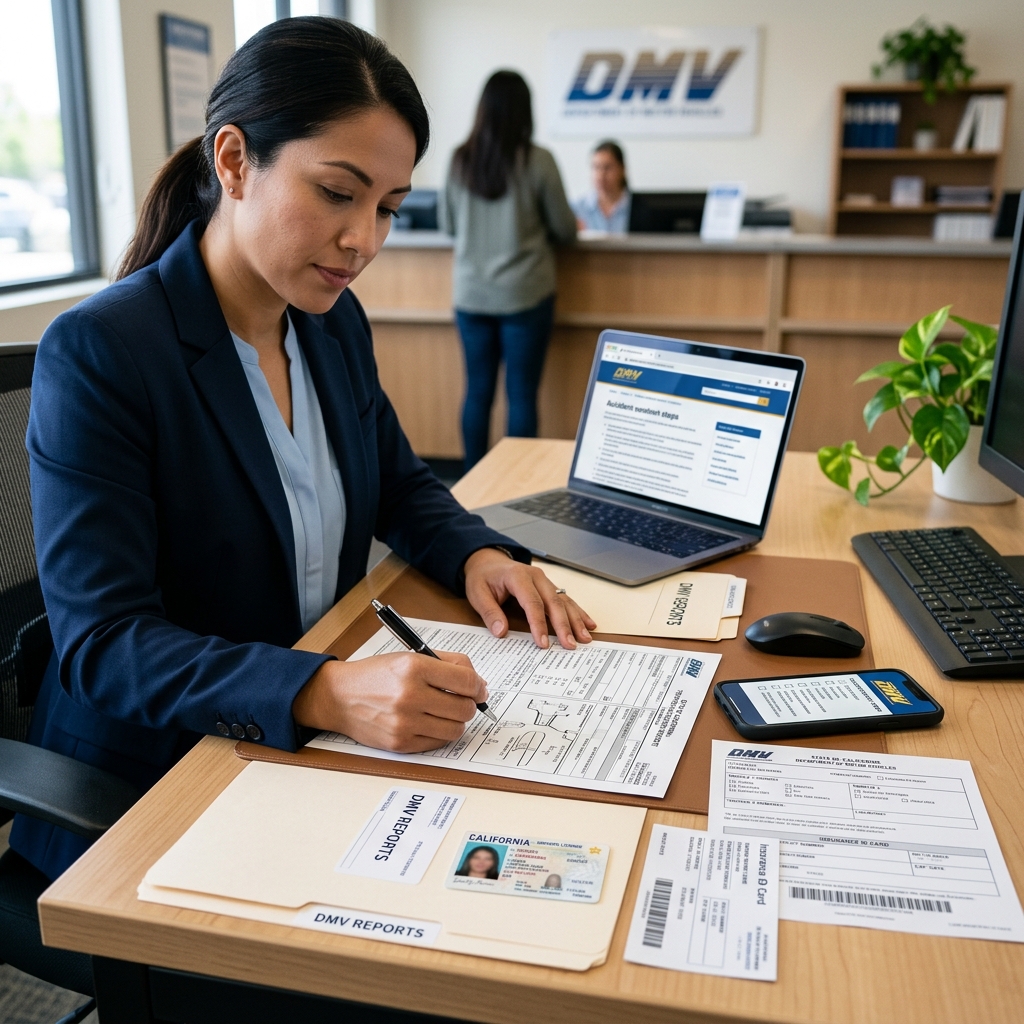
After a collision, drivers often focus first on safety, insurance, and police contact. In many states, however, a crash may also trigger a separate reporting duty with the Department of Motor Vehicles. That filing is not the same as a police report, and missing it can create avoidable legal and administrative problems. The exact rules vary by state, but the process usually follows the same pattern: confirm whether the crash is reportable, collect the required details, complete the correct form, and submit it before the deadline.
Why DMV reporting matters
A DMV accident report creates an official record that a collision occurred and helps the state track serious injury, death, property damage, and insurance compliance. In some states, the report is required even when police already responded to the scene. California, for example, requires an SR-1 report when a crash causes injury, death, or property damage above the state threshold, and the report must be sent to DMV within 10 days. The state also makes clear that the SR-1 is required in addition to any report filed with police, the CHP, or an insurance company.
Other states use similar systems with different deadlines and thresholds. Oregon requires a collision report to be submitted within 72 hours if certain damage or injury conditions are met, while New York requires a motorist crash report when a crash involves injury, death, or other qualifying circumstances under state law.
When a crash must be reported
The first step is to decide whether your state requires a report. The answer usually depends on one or more of the following factors:
- Someone was injured, even if the injury appears minor.
- Someone was killed.
- The damage to a vehicle or other property crossed the state’s reporting threshold.
- A tow was required.
- An uninsured or underinsured driver was involved.
- The state’s law requires a report even if law enforcement already prepared a crash record.
California’s threshold is especially clear: a report is required if someone is injured or killed, or if property damage is over $1,000. Oregon’s threshold is different and depends on injury, death, or property damage above $2,500, including certain tow-related crashes. New York’s reporting rules also depend on statutory conditions, including crashes involving injury or death and some incidents involving e-bikes or e-scooters.
What information you should collect first
Before starting the form, gather the details that agencies typically ask for. Having the information ready makes it easier to complete the report accurately and reduces the chance of having to resubmit it later.
- Your driver’s license or identification card number.
- Your vehicle’s license plate number or VIN.
- The year, make, and model of your vehicle, if requested.
- Your insurance company name and policy number.
- The other driver’s name, vehicle details, and insurance information, if available.
- The date, time, and location of the crash.
- A brief, factual description of what happened.
- The names of injured people, if the form asks for them.
California’s SR-1 guidance specifically tells drivers to gather a driver’s license or ID card, a license plate number or VIN, insurance information, and the other party’s vehicle and insurance details when available. Oregon likewise asks for a driver license number, vehicle and insurance information, and other driver information if available.
Understand the difference between a police report and a DMV report
Many people assume that calling the police is enough. In reality, a police report and a DMV accident report serve different purposes. The police report documents the response at the scene and may support an insurance claim or a later legal case. The DMV report is an administrative filing required by state law in qualifying crashes.
That distinction matters because one report does not automatically replace the other. California explicitly states that its SR-1 is required in addition to reports filed with police, the CHP, or an insurer. If your state has a similar rule, failing to file with the DMV may still count as noncompliance even if an officer documented the collision.
How the filing process usually works
Although each state uses its own form and portal, the filing process often follows a familiar sequence.
- Confirm that your crash meets the reporting threshold in your state.
- Locate the correct form or online portal.
- Gather your documents and contact information before you begin.
- Enter the accident details carefully and honestly.
- Review the report for errors before submission.
- Save a copy, confirmation number, or receipt for your records.
Some states allow electronic filing, while others still rely on a paper form sent by mail, fax, or in person. California allows an SR-1 to be filed online through its virtual office. Oregon also allows submission through its electronic DMV2U system, with paper alternatives for drivers who need them. Colorado offers online request options for crash records and also accepts certain in-person and mail submissions for record access.
Typical deadlines and why they are strict
Deadlines are one of the most important parts of accident reporting. DMV rules are usually short because the state wants the facts recorded while they are still fresh. In California, the deadline is 10 days for a reportable crash. In Oregon, drivers must submit the collision report within 72 hours when the reporting criteria are met.
Because deadlines are state-specific, drivers should not assume the filing window is generous. If a crash happened on a weekend or holiday, the safest approach is to start the process as soon as the required details are available. If you wait until the last minute, missing a deadline may lead to penalties, registration or license problems, or extra follow-up from the DMV.
Where you can submit the report
States generally provide one or more submission methods, but they do not all work the same way. A few common options are listed below.
| Submission method | How it usually works | Common examples |
|---|---|---|
| Online | Complete the form in the state portal and submit electronically | California SR-1 online; Oregon DMV2U submission |
| Print the form, sign it, and send it to the address listed by the DMV | New York MV-104 mailing instructions; South Carolina collision reports | |
| In person | Deliver the form or request help at a DMV office | Colorado crash record options; New York in-person options for some records |
| Fax | Some agencies still accept a faxed report or records request | Virginia allows fax submission for certain crash-related records requests |
Even when a state accepts multiple submission methods, the reporting duty belongs to you. Some states allow a driver, vehicle owner, insurance agent, broker, or legal representative to file the report. If someone else is handling it for you, make sure that person has the correct form and all required details.
What happens after you file
After submission, keep proof that the report was filed. That may include a confirmation page, receipt, tracking number, or copy of the completed form. If the DMV later questions the filing, that record can show you met the deadline.
Filing the accident report may also affect later steps involving insurance or record requests. In some states, drivers can later obtain a copy of the crash record or request certified copies for a fee. North Carolina, for example, allows reports to be requested by phone, in person, or by mail using a specific form, and certified copies are available for a fee. South Carolina likewise provides collision reports for a fee, while Virginia charges for certain records requests and lists several submission methods.
Common mistakes that cause problems
Many accident report errors are preventable. The most common issues include:
- Waiting too long to file.
- Using the wrong form for the state.
- Entering the wrong vehicle or insurance information.
- Leaving required fields blank.
- Guessing about injuries or damage instead of reporting known facts.
- Assuming a police report satisfies the DMV requirement.
The safest approach is to report only what you know and avoid speculation. If you are unsure whether an injury or damage amount crosses the reporting threshold, it is usually better to check the statute or submit the form if the rules require it. Some states are strict about the threshold, and others require reporting based on the involvement of particular vehicles or property damage categories.
How to prepare if the crash was not your fault
Even when another driver caused the collision, you may still need to file a DMV report if your state requires it. Fault does not usually eliminate the reporting duty. The report should remain factual and neutral, identifying the vehicles, location, and known facts without arguing the legal case.
If the other driver failed to provide insurance information, note that in the report. If you needed a tow, mention that as well, since tow-related rules can affect reporting obligations in some states. Oregon, for example, includes certain tow-related collisions in its reporting criteria.
When to ask for legal or insurance help
You may want help from an attorney, insurance professional, or claims representative if the crash involved serious injuries, disputed facts, a commercial vehicle, a hit-and-run, or a reporting deadline you might miss. California allows an insurance agent, broker, or legal representative to complete the SR-1 in some cases, which reflects how often these filings are handled with outside help.
If you are not sure whether your state’s threshold has been met, or if the DMV form asks for information you cannot easily verify, asking for guidance can prevent mistakes. The cost of correcting a bad filing is usually greater than the effort of getting it right the first time.
Frequently asked questions
Do I need to file a DMV report if the police already came to the scene?
Often, yes. In many states, the DMV report is separate from any police report. California explicitly says the SR-1 must be filed in addition to reports made to law enforcement or insurers.
What if the other driver gave me incomplete insurance information?
Submit the information you have and note that some details were unavailable. DMV forms commonly ask for other-party information when available, but they do not usually require you to invent missing data.
Can someone file the report for me?
Yes, in some states. California allows an insurance agent, broker, or legal representative to complete the SR-1, and Virginia allows a driver, owner, or representative to submit certain accident records requests.
How do I know which form to use?
Use the form listed by the DMV for your state’s crash-reporting rule. Examples include California’s SR-1, New York’s MV-104, Oregon’s traffic collision and insurance report, Virginia’s FR200, and North Carolina’s crash-report request form for records access.
Should I keep a copy of the report?
Yes. Keep a copy of everything you submit, along with proof of filing if the state provides it. That record can be useful if the DMV, insurer, or another agency later asks for confirmation.
References
- Report of Traffic Accident Occurring in California (SR-1) — California Department of Motor Vehicles. 2026-07-10. https://www.dmv.ca.gov/portal/dmv-virtual-office/accident-reporting/
- File a Motorist Crash (Accident) Report — New York State Department of Motor Vehicles. 2026-07-10. https://dmv.ny.gov/records/file-a-motorist-crash-accident-report
- Reporting a Crash to DMV — Virginia Department of Motor Vehicles. 2026-07-10. https://www.dmv.virginia.gov/vehicles/general/crash-dmv
- How to Get a Car Accident Report in North Carolina — Whitley Law Firm. 2026-07-10. https://whitleylawfirm.com/faqs/how-to-get-a-car-accident-report-in-north-carolina/
- Collision Reporting and Responsibilities — Oregon Department of Transportation, DMV. 2026-07-10. https://www.oregon.gov/odot/dmv/pages/driverid/accidentreport.aspx
- Report a Crash and Obtain a Crash Record — Colorado Department of Revenue, Division of Motor Vehicles. 2026-07-10. https://dmv.colorado.gov/crash-records
- Collision Reports — South Carolina Department of Motor Vehicles. 2026-07-10. https://dmv.sc.gov/vehicle-owners/collision-reports
Similar Articles








Read full bio of medha deb


