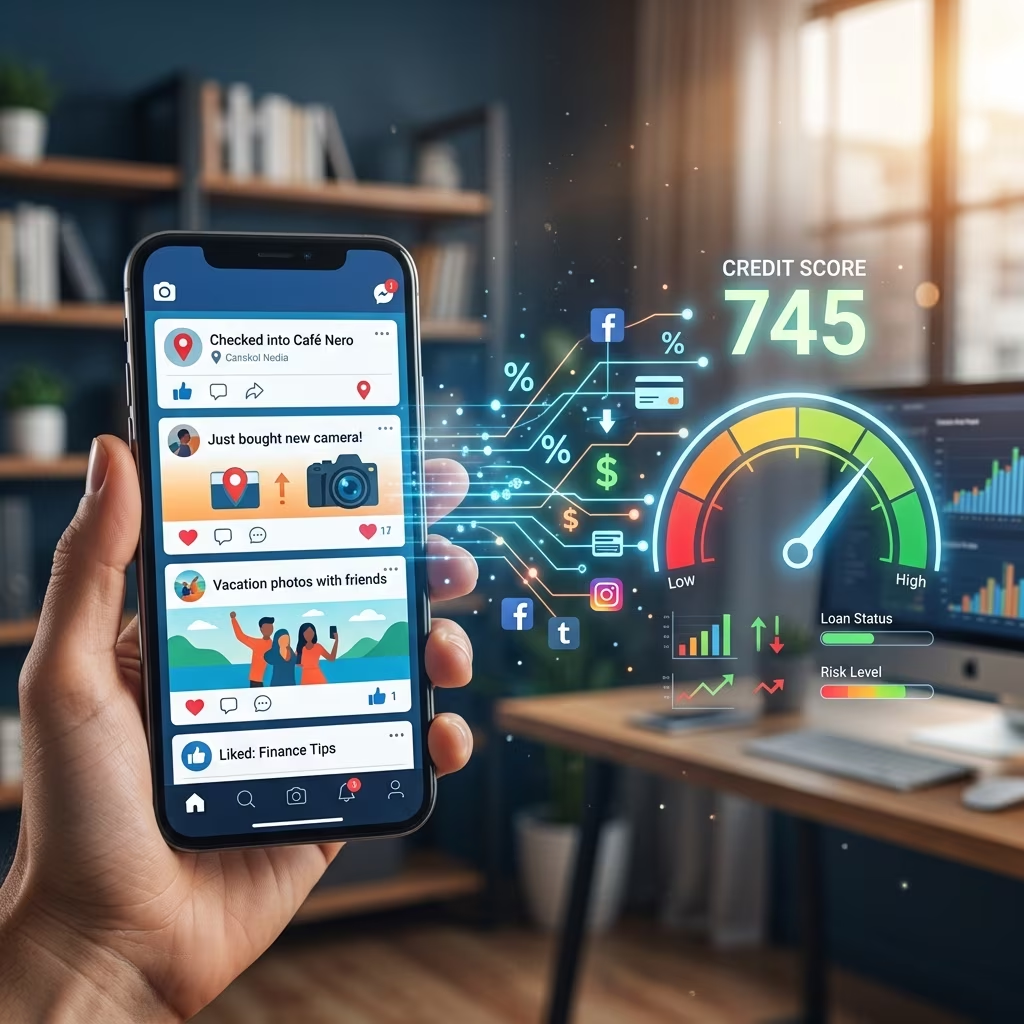
For decades, your credit score depended on a narrow set of financial records: payment history, debt levels, length of credit, and a few other factors. Today, a new frontier is emerging. Technology companies, online lenders, and data brokers are exploring how social media activity and other digital signals could inform decisions about who gets credit and on what terms. While traditional credit bureaus still rely primarily on conventional data, the line between your online life and your financial profile is getting thinner.
This article explains what a credit score is, how it is typically calculated, how social media and other alternative data are being tested in lending, the legal boundaries around these practices, and how you can protect both your credit and your privacy.
From Paper Files to Algorithms: A Quick Credit Score Primer
To understand the debate around social media and credit, it helps to know what a credit score is and how it is normally built. A credit score is a numerical prediction of how likely you are to repay borrowed money on time. The most widely used system in the United States is the FICO score, which ranges from 300 to 850 and is based on data in your credit reports from major credit bureaus like Equifax, Experian, and TransUnion.
Traditional Data Used in Scoring
Standard scoring models draw on a relatively limited set of information from your credit report:
- Payment history – whether you pay bills on time, including credit cards, auto loans, mortgages, and other accounts.
- Amounts owed – your total debt and how much of your available credit you are using.
- Length of credit history – how long accounts have been open and active.
- New credit – recent applications for credit and newly opened accounts.
- Credit mix – the variety of credit types you use (credit cards, installment loans, mortgages, etc.).
None of these factors explicitly reference your social media accounts, smartphone data, or browsing history. Yet, interest is growing in whether these digital footprints might offer additional insight into your reliability as a borrower.
Alternative Data: Expanding the Picture Beyond Credit Cards and Loans
Many people, especially younger adults or those with limited credit experience, have what experts call “thin” or “invisible” credit files. A thin file means there is too little information to generate a conventional score, even if the person is financially responsible. To address this, regulators and policymakers have discussed ways to safely incorporate alternative data—nontraditional information that still reflects financial behavior.
Examples of Alternative Data
Alternative data can include:
- Utility and telecom payments, such as electricity, water, and mobile phone bills.
- Rental payment history from landlords or property managers.
- Bank account cash-flow data (deposits, withdrawals, regular income patterns).
- Educational history and employment records (used cautiously and often in aggregate).
- Some forms of verified digital payments, such as recurring subscription payments.
Regulators like the U.S. Consumer Financial Protection Bureau (CFPB) have encouraged careful exploration of alternative data to expand access to responsible credit, particularly for underserved populations—so long as such data are used in a way that is fair, transparent, and compliant with consumer-protection laws.
Where Social Media Enters the Picture
Compared with utility payments or bank account data, social media information is more speculative and controversial as a credit signal. A handful of fintech startups and research teams have tested whether your online behavior or even your social network can predict the likelihood that you will repay a loan.
Potential Social Media Signals Considered by Lenders
Experiments and early-stage products have looked at diverse, often anonymized patterns from platforms like Facebook, LinkedIn, or other social apps, such as:
- Stability indicators, like how long you have used the same email address or phone number.
- Professional signals from profiles that show job history and education.
- Network-based indicators, where the repayment behavior of people in your online network might be used as a proxy for your own risk level.
- Activity patterns that might correlate with reliability (e.g., consistent contact information and completed profile details).
Some commentators have expressed concern about cruder approaches, such as tracking posts about heavy partying or risky behavior and using them against borrowers. Researchers and privacy advocates warn that such methods are prone to bias, misinterpretation, and discrimination, and that they often lack scientific rigor.
Friend Networks and “Guilt by Association”
One of the most controversial ideas is using your social graph—the network of your online friends and connections—as a risk factor. If many people in your network have poor credit or a history of defaulting on loans, an algorithm might infer that you are more likely to default as well, even if your own record is spotless.
Critics argue that this approach can reinforce existing inequalities and penalize people based on where they live, who they know, or what demographic groups they belong to, rather than on their individual behavior. These concerns raise serious questions under anti-discrimination and fair lending laws.
Legal Protections and Regulatory Limits
Any lender operating in the United States must follow a set of laws designed to ensure that credit decisions are made fairly and transparently. These include the Equal Credit Opportunity Act (ECOA), the Fair Credit Reporting Act (FCRA), and related regulations.
| Law / Regulation | Main Purpose | Relevance to Social Media & Alternative Data |
|---|---|---|
| Equal Credit Opportunity Act (ECOA) | Prohibits discrimination in any aspect of a credit transaction. | Data use cannot directly or indirectly discriminate based on protected characteristics (race, sex, age, etc.). |
| Fair Credit Reporting Act (FCRA) | Regulates consumer reporting agencies and use of consumer reports. | Information used for credit decisions must be accurate, dispute-able, and disclosed when adverse actions occur. |
| CFPB Guidance on Alternative Data | Encourages responsible innovation that expands access to credit. | Stresses need for transparency, fairness, and testing for disparate impact when using new data sources. |
Nontraditional Data and Non-Discrimination
Regulators have made clear that lenders cannot use data that directly reflect protected characteristics, such as race, religion, or gender. They must also avoid using proxies that effectively act as stand-ins for those characteristics—for example, geographic data or network connections that strongly correlate with demographic traits.
When lenders experiment with social media or other novel data sources, they are expected to conduct rigorous testing and documentation. That includes analyzing whether the new data creates systematic disadvantages for certain groups, even if no discriminatory intent exists.
How Lenders May Use Social Media Data in Practice
While mainstream credit bureaus do not currently fold social media posts into FICO or comparable scores, some online lenders and fintech firms have experimented with using digital footprints as additional signals in their own proprietary underwriting models. These models may be most common in small-dollar online lending or in markets where traditional credit data are sparse.
Risk Assessment vs. Verification
There are two broad ways social media and online data might be used in lending:
- Risk assessment – incorporating digital behavior into algorithms that estimate probability of repayment alongside conventional credit data.
- Identity and fraud verification – checking whether identity details match across sources, whether accounts appear authentic, and whether there are signs of fraud.
Fraud prevention and identity verification are less controversial, especially when based on technical signals like IP addresses, device fingerprints, or consistency of contact information. Using social behavior or your friends’ repayment history for risk assessment is much more hotly debated.
International Examples
Outside the United States, some companies have gone further in using mobile and online data to evaluate borrowers. For example:
- Certain lenders in emerging markets have analyzed mobile phone usage patterns—such as call frequency, top-up history, or contact list structure—as proxies for stability and reliability.
- Some platforms initially explored Facebook-based scoring before public critique and tightening platform rules led them to scale back these practices.
These approaches illustrate what is technically possible, even if they raise questions about fairness, privacy, and long-term social consequences.
Privacy Risks and Ethical Concerns
The idea that a lender might scan your social life to evaluate a loan application touches a nerve for many people. Privacy and ethics experts highlight several major concerns:
- Lack of transparency – Consumers often have no clear view of what data are collected, how they are processed, or how much they affect a decision.
- Consent challenges – People may “consent” to data use via long, complex terms of service, without understanding that their information could affect credit or financial opportunities.
- Context collapse – Posts intended as jokes or casual updates may be misinterpreted as evidence of financial irresponsibility.
- Bias and discrimination – Social networks tend to be clustered by community, race, income level, and geography, so network-based scoring can reproduce existing inequalities.
- Data security – More data in more places creates more opportunities for breaches and misuse.
Consumer advocates argue that credit evaluation should focus on objective financial behavior and avoid opaque data sources that consumers cannot easily review or correct.
What You Can Do: Protecting Your Credit and Your Digital Footprint
You cannot control how every technology company designs its algorithms, but you can take steps to manage your traditional credit profile and reduce risks associated with digital data.
Strengthen Your Conventional Credit Profile
Because mainstream lenders still rely heavily on conventional credit data, focusing on the basics remains one of the most effective strategies:
- Pay all bills on time; even a single missed payment can hurt your score.
- Keep credit card balances well below your credit limits.
- Avoid opening many new accounts in a short period.
- Check your credit reports regularly and dispute errors.
- Consider tools that report positive data, such as on-time utilities or phone payments, when appropriate.
Manage Your Social Media Settings
Even if social media are not currently part of standard credit scores, they can still influence perceptions by employers, landlords, and some alternative lenders. To reduce unwanted exposure:
- Review privacy settings on major platforms and limit who can see past and future posts.
- Be cautious about sharing sensitive information, including financial stress, job loss, or personal crises.
- Be aware that “public” posts can be collected and analyzed by third parties, often without your knowledge.
- Regularly audit old content and remove posts you no not wish to represent you today.
Ask Questions When Applying for Credit
If you are considering an online lender or app-based credit product, look for clear explanations of what data they collect and why. Reasonable questions include:
- “What types of data do you use to make lending decisions?”
- “Do you access my social media or contact list? If so, how?”
- “Is your decision-making process compliant with FCRA and ECOA?”
- “Can I obtain an explanation if I am denied, and can I dispute inaccurate information?”
Credible lenders should be able to provide transparent answers and clear disclosures.
Frequently Asked Questions
Does my Facebook activity directly affect my FICO score right now?
As of recent public statements and industry practice, major credit bureaus and the widely used FICO score do not incorporate your individual Facebook posts, likes, or photos in standard scoring models. However, some online lenders may analyze digital data on their own when assessing applications.
Can lenders legally use my social media to decide whether to approve a loan?
In many jurisdictions, lenders are not absolutely forbidden from reviewing public online information, but they must still comply with fair lending and consumer-reporting laws if that information becomes part of a formal credit decision. This means they must avoid discriminatory practices, provide explanations for adverse actions, and ensure data accuracy when they rely on third-party reports.
Could my friends’ poor credit hurt my chances?
Some experimental systems have explored using network data, such as the repayment behavior of a borrower’s online contacts, as a risk factor. Such approaches are controversial and may raise legal issues related to discrimination. They are not part of mainstream credit scoring systems, but awareness of these experiments underscores the importance of monitoring how fintech models evolve.
Is using alternative data always a bad idea?
Not necessarily. Policymakers and regulators have noted that responsible use of alternative data—like rental history or utility payments—can help people with thin credit files access fairly priced credit. The challenge is ensuring that new data do not introduce unfair bias or compromise privacy.
How can I stay informed about changes in credit scoring?
Regulators such as the CFPB, Federal Trade Commission, and central banks regularly publish reports and guidance on credit reporting and financial technology. Following updates from these agencies, as well as from major credit bureaus and scoring companies, can help you track how data practices are changing over time.
Looking Ahead: Balancing Innovation and Fairness
Credit scoring is undergoing a slow but significant transformation. On one hand, new data sources and advanced analytics offer the promise of more inclusive access to credit for people historically left out by traditional systems. On the other hand, incorporating social media and digital footprints into financial decision-making risks entrenching inequality, eroding privacy, and making creditworthiness judgments less transparent.
For now, social media is not a core ingredient in mainstream credit scores, but experiments by fintech firms and alternative lenders show where the industry could go. As technology evolves, so too will the legal frameworks, public expectations, and ethical norms governing the use of personal data. Staying informed, protecting your digital footprint, and maintaining strong financial habits will help you navigate whatever the next generation of credit scoring brings.
References
- Can Your Facebook or Twitter Activity Tank Your Credit Score? — BillsBills.com. 2014-11-11. https://www.billsbills.com/blog/can-your-facebook-or-twitter-activity-tank-your-credit-score
- Credit reports and scores — Consumer Financial Protection Bureau. 2023-05-15. https://www.consumerfinance.gov/consumer-tools/credit-reports-and-scores/
- CFPB Explores Impact of Alternative Data on Credit Access — Consumer Financial Protection Bureau. 2017-02-16. https://www.consumerfinance.gov/about-us/newsroom/cfpb-explores-impact-alternative-data-credit-access/
- Being wasted on Facebook could hurt your credit score? Uh… no, not yet anyway — Bob Sullivan. 2015-08-10. https://bobsullivan.net/cybercrime/privacy/being-wasted-on-facebook-could-hurt-your-credit-score-uh-no-not-yet-anyway/
- Will Your Facebook Friends Make You a Credit Risk? — The Atlantic. 2015-08-04. https://www.theatlantic.com/politics/archive/2015/08/will-your-facebook-friends-make-you-a-credit-risk/432504/
- Using Artificial Intelligence and Algorithms — Federal Trade Commission. 2020-04-08. https://www.ftc.gov/business-guidance/blog/2020/04/using-artificial-intelligence-algorithms