
Guide to Getting a California Marriage License
Learn who can marry, how to apply, and what to expect before and after obtaining your California marriage license.
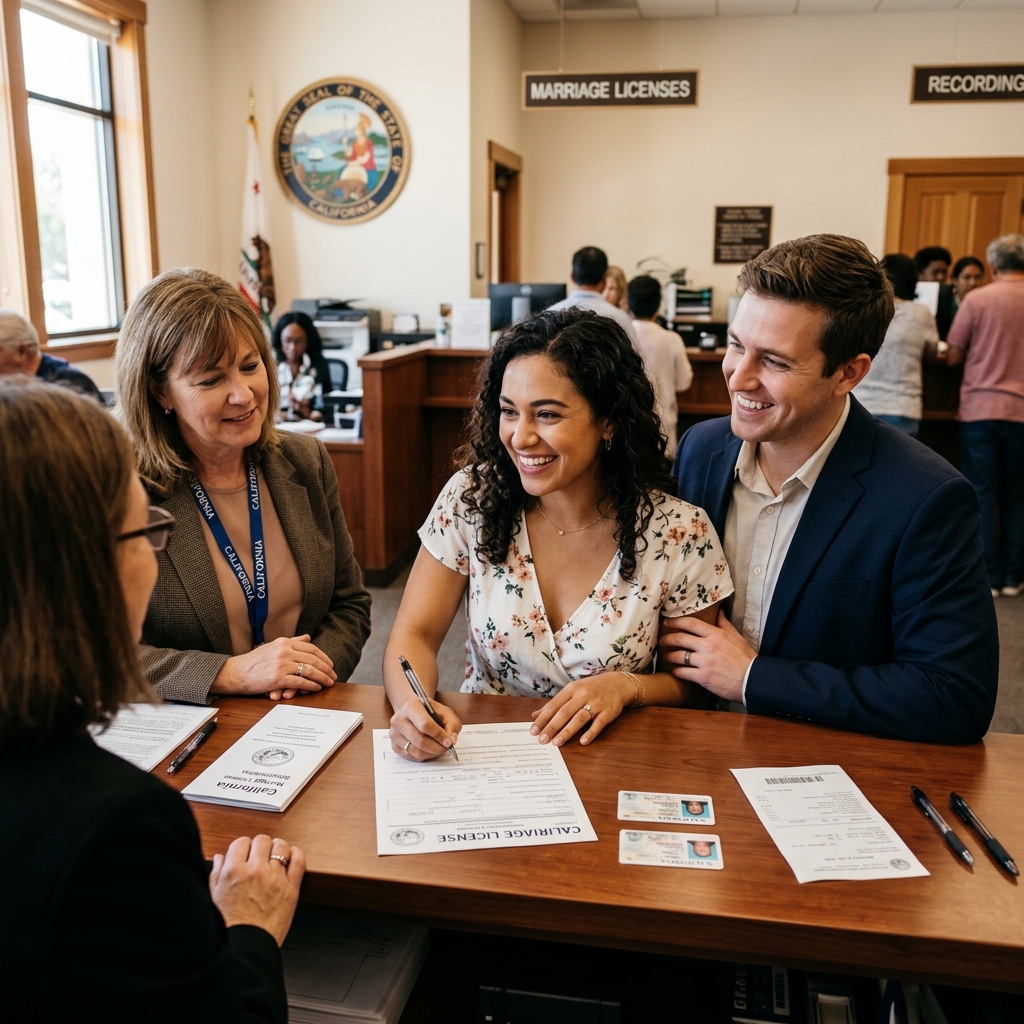
Getting married in California involves more than planning a venue and choosing a date. Before any wedding ceremony can legally take place, couples must obtain a valid California marriage license from a county clerk’s office. This guide explains who is eligible to marry, the difference between license types, how to apply, and what happens after the ceremony, with a focus on clear, practical information that applies statewide.
1. Basic Legal Requirements to Marry in California
California law sets out several foundational rules that apply to all couples, regardless of which county they visit to obtain the license.
- Both parties must be unmarried at the time of the application and ceremony. You cannot be currently married to each other or to another person.
- Marriage by proxy is not allowed. Both individuals, the officiant, and at least one witness (for public licenses) must be physically present at the ceremony.
- Age and capacity: In general, parties should be at least 18 years old and able to understand the nature of the marriage contract. Some counties allow minors to marry only with court approval and specific documentation.
- Residency is not required. You do not need to be a California resident or U.S. citizen to marry in the state.
These requirements are grounded in the California Family Code and apply uniformly throughout the state, even though counties may vary in their procedures and fees.
2. Public vs. Confidential Marriage Licenses
California offers two primary types of marriage licenses: public and confidential. The license type affects privacy, witness requirements, and who can obtain copies later.
| Feature | Public Marriage License | Confidential Marriage License |
|---|---|---|
| Record availability | Becomes a public record; certified copies can be obtained by eligible requesters. | Record is not publicly searchable; generally only the couple can obtain copies. |
| Witness requirement | At least one witness must be physically present and sign the license during the ceremony. | Typically no witness is required at the ceremony for a confidential license. |
| Eligibility condition | No requirement to live together before marriage. | Couple must already be living together when they apply, under California law and county rules. |
| Typical fee range | Often lower than confidential; amounts vary by county (e.g., public license around $80–$120 in several counties). | Usually higher; counties may charge additional fees for confidential licenses. |
Each county sets its own price schedule, but the legal effect of both license types is the same: once properly issued and used in a valid ceremony, the couple is legally married under California law.
3. Preparing to Apply: Identification and Documents
Before booking an appointment, couples should confirm they have the necessary identification and supporting documents. The California Department of Public Health and county clerk offices outline similar requirements:
- Valid government-issued photo ID that includes a photograph, date of birth, issue date, and expiration date. Common examples include:
- State driver’s license or identification card
- Passport
- Military identification card
- If the ID does not show the person’s full legal name, a certified birth certificate or similar document may be required to confirm the complete name.
- For recent divorce or termination of a domestic partnership, some counties request a final judgment or termination order, especially if it became final within the past 90 days.
Counties can impose additional documentation rules depending on the type of ID provided or the applicant’s circumstances, so it is wise to review the local clerk’s website before scheduling an appointment.
4. Step-by-Step Application Process
Although details vary by county, most couples follow a similar sequence to obtain a California marriage license.
4.1 Complete the License Application
Many California counties now require or strongly prefer that couples complete an online marriage license application before visiting the clerk’s office.
- Online forms collect each party’s legal name, address, date of birth, place of birth, marital history, and planned new name if either party chooses to change their name after marriage.
- Some counties allow completion of the application using public kiosks at the clerk’s office, but this may extend the appointment time.
- After submitting the form, couples usually receive a reference or confirmation number needed to schedule the appointment.
4.2 Schedule an Appointment or Visit as a Walk-In
California policy leaves scheduling practices to individual counties. Many require appointments, while others accept walk-ins on a limited basis.
- Appointment-only offices: Some counties issue marriage licenses exclusively by appointment, and couples must appear together at the clerk’s office at the scheduled time.
- Combination systems: Other clerk’s offices allow both walk-in visits and appointments, often giving priority to those with reservations.
- Appointments may be booked online several weeks in advance, and couples should bring their confirmation number, valid ID, and any additional required documents.
4.3 Attend the Clerk’s Office Together
California law requires both parties to appear in person together at the county clerk’s office to obtain the marriage license.
- The clerk will verify identification, review the application, and may ask clarifying questions to ensure information is complete and legible.
- Couples will be asked to swear or affirm that the information provided is true and that they meet the legal requirements to marry.
- Fees for the license are paid at this visit, and the license is issued once all requirements are satisfied.
4.4 Pay Applicable Fees
License fees differ among counties, but they are generally within a predictable range.
- Public license fees often fall around several dozen to a little over one hundred dollars, depending on the county.
- Confidential license fees tend to be slightly higher than public license fees.
- Payment options may include cash, check, or credit card; some counties charge additional processing fees for card payments.
Because counties set their own fee schedules and may adjust them over time, couples should consult the current information published by the clerk-recorder’s office in the county where they will apply.
5. Validity Period and Where You Can Marry
Once issued, a California marriage license does not remain valid indefinitely. Statewide rules govern where and when couples may use the license.
- 90-day validity: The marriage ceremony must take place within 90 days of the license being issued.
- Location of ceremony: A license issued by any California county may be used for a ceremony anywhere within the state. The wedding does not have to occur in the same county where the license was obtained.
- If the couple does not marry within this 90-day period, the license expires and they must obtain a new one before holding a valid ceremony.
6. Who Can Officiate and Ceremony Requirements
The ceremony itself must comply with California law to create a valid marriage. The state sets clear rules for officiants, witnesses, and the handling of the license.
6.1 Authorized Officiants
Under California Family Code, several categories of people may solemnize marriages:
- Religious leaders, such as ministers, priests, rabbis, or other persons authorized by a religious denomination.
- Civil officials, including judges and certain local officials.
- Deputy commissioners of civil marriages, who may be appointed under California Family Code and can perform marriages in any county in the state.
- In some counties, a friend or relative may be authorized as a one-day commissioner for the purpose of officiating a single ceremony, subject to county guidelines.
6.2 Physical Presence and Witnesses
California does not permit remote or proxy ceremonies.
- Both parties must be physically present along with the officiant at the same location during the ceremony.
- For public marriage licenses, at least one witness must attend and sign the license; some couples choose to have two witnesses sign when space is provided.
- For confidential licenses, witness signatures are usually not required, though couples should confirm local practice with the issuing county.
6.3 Completing and Returning the License
Proper handling of the marriage license is critical. Errors can cause delays or require issuance of a duplicate license.
- All information written on the license must be legible, unambiguous, and reproducible. Alterations such as crossing out information or using correction fluid are prohibited.
- The officiant is generally responsible for returning the original signed license to the appropriate county office—either the clerk or recorder—within 10 days of the ceremony.
- If mistakes occur, couples should contact the county clerk for instructions; in some cases, a duplicate license must be issued and fees may apply.
7. After the Wedding: Certified Copies and Records
Once the clerk or recorder processes the returned license, the marriage is formally recorded, and the couple may request certified copies of the marriage certificate for legal purposes.
- Automatic copies are not provided. Couples will not receive a copy of the marriage license or certificate unless they request one and pay the applicable fee.
- Certified copies are often required for name changes, immigration processes, spousal benefits, and various legal or financial transactions.
- Public licenses become part of the public record, meaning certain eligible individuals and entities may request copies. For confidential licenses, access to the record is restricted, typically to the couple themselves.
8. County-Level Differences to Keep in Mind
Although California marriage law is statewide, counties administer marriage licensing and can adopt different procedures and fee structures.
- Fees: The exact amounts for public and confidential licenses differ from county to county and may change over time.
- Appointment rules: Some counties operate strictly by appointment, while others allow walk-ins during designated hours.
- Additional documentation requirements: Certain counties may request extra documentation, such as birth certificates or recent court orders related to divorce or name changes.
- Ceremony services: A number of clerk offices offer civil wedding ceremonies on site, whereas others issue licenses but do not provide officiants.
Because of these local variations, couples are encouraged to review the website of the specific county clerk-recorder where they intend to apply for the license, in addition to understanding general state rules.
9. Practical Tips for a Smooth Licensing Experience
To avoid complications or last-minute stress, couples can take several simple steps when planning for their California marriage license.
- Plan ahead: Schedule your appointment well before the wedding date, especially during busy seasons when appointment slots fill quickly.
- Double-check identification: Ensure both parties have acceptable ID with full legal names, and bring additional documents if your county requires them.
- Review name change options: Decide in advance whether either party will change their name after marriage, and confirm how this should be entered on the application.
- Know your license type: Discuss whether a public or confidential license best suits your privacy and documentation preferences.
- Confirm officiant arrangements: Make sure your chosen officiant is authorized to perform weddings in California and understands their responsibility to return the license promptly.
10. Frequently Asked Questions (FAQs)
Can we marry in California if we live in another state or country?
Yes. California does not impose a residency requirement for marriage licenses. Non-residents may apply for a license and hold their ceremony anywhere in the state, provided they meet all other legal requirements.
Do we need a blood test or medical exam?
No. California does not require blood tests or medical examinations as part of the marriage license application process.
How long is our marriage license valid?
The license is generally valid for 90 days from the date it is issued. The ceremony must take place within this period or the license will expire and a new one will be required.
Can we get married online or have someone stand in for us?
No. Marriage by proxy is not allowed in California. Both parties must be physically present with the officiant at the same location during the ceremony.
Is a witness mandatory at the ceremony?
For a public marriage license, at least one witness must attend and sign the license. For a confidential license, a witness signature is typically not required, but couples should verify local rules with the issuing county.
How do we get a certified copy of our marriage certificate?
After the officiant returns the completed license and the county records the marriage, couples may request certified copies from the county clerk or recorder. A fee is charged for each certified copy, and procedures are published on county websites.
References
- California Marriage License General Information — California Department of Public Health. 2024-01-01. https://www.cdph.ca.gov/Programs/CHSI/Pages/California-Marriage-License-General-Information.aspx
- Get a marriage license — City and County of San Francisco, Office of the County Clerk. 2023-06-01. https://www.sf.gov/get-marriage-license
- Marriage Licenses — Ventura County Clerk-Recorder. 2023-05-15. https://clerkrecorder.venturacounty.gov/county-clerk/marriage-information/marriage-license/
- Marriage License — Sonoma County Clerk-Recorder-Assessor. 2023-04-10. https://sonomacounty.gov/administrative-support-and-fiscal-services/clerk-recorder-assessor/clerk-recorder/clerk-services/marriage-license
- Marriage Services — Orange County Clerk-Recorder Department. 2023-07-20. https://www.ocrecorder.com/services/marriage-services
- Marriage License & Ceremony — San Bernardino County Assessor-Recorder-Clerk. 2023-02-28. https://arc.sbcounty.gov/marriage/
- Apply for a marriage license — Santa Clara County Clerk-Recorder. 2022-11-30. https://clerkrecorder.santaclaracounty.gov/marriage-birth-and-death/apply-marriage-license
Similar Articles








Read full bio of Sneha Tete


