
Florida Phone Passcodes, Court Orders and Your Rights
Understanding when Florida courts can order you to unlock your smartphone and how the Fifth Amendment may protect your passcode.
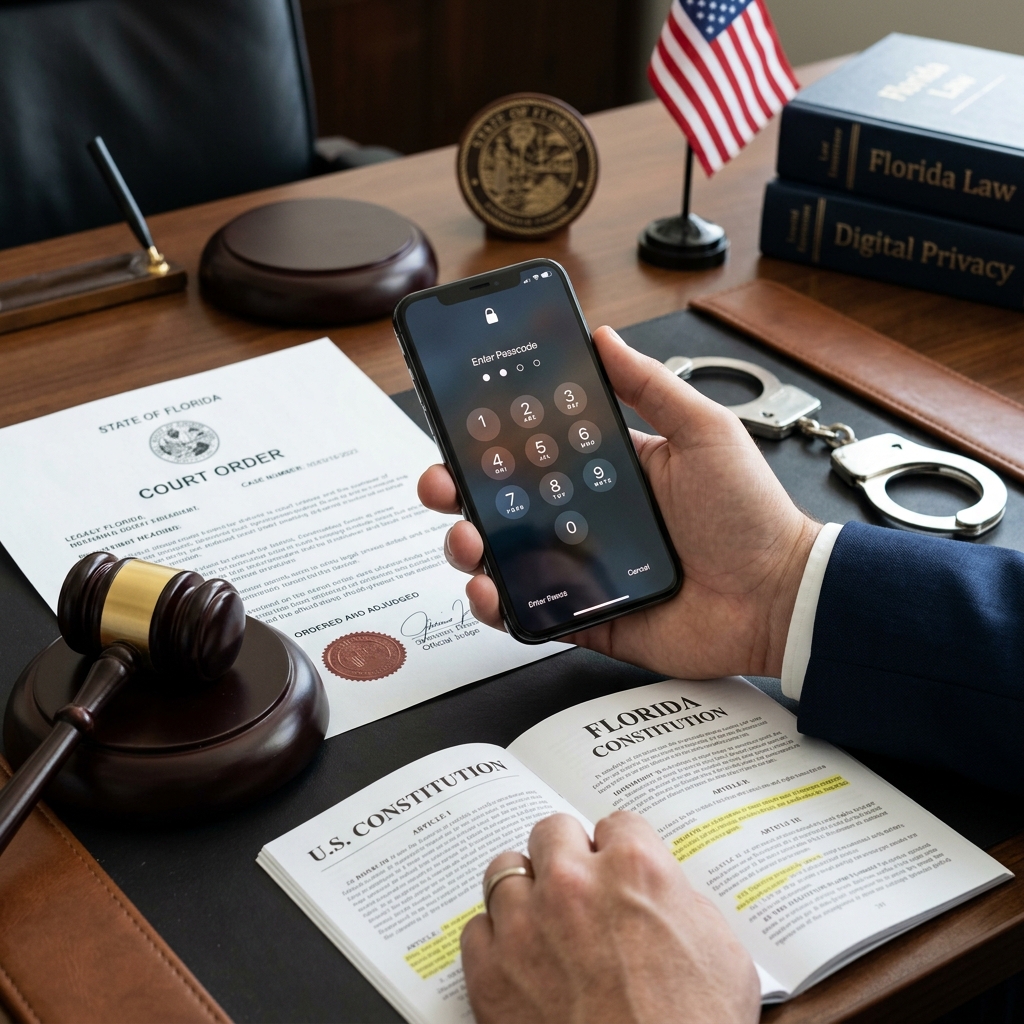
Smartphones hold an enormous amount of personal information, and Florida courts are increasingly asked to decide whether criminal defendants can be forced to unlock them. At the center of the debate is a simple but high‑stakes question: can a judge order you to reveal your phone passcode, and jail you if you refuse? This article explains how those orders work, where the law stands in Florida, and what rights the Fifth Amendment may give you when your phone becomes evidence.
Why Phone Passcodes Have Become a Legal Flashpoint
Modern smartphones often contain:
- Text messages and emails that may tie someone to a crime
- Location history showing where a person has been
- Photos, videos, and social media content
- Financial records, contact lists, and cloud accounts
Because of this, the U.S. Supreme Court has recognized that searching a smartphone is very different from searching a wallet or a car. In Riley v. California, the Court held that police generally must obtain a warrant before searching the contents of a cell phone, even after a lawful arrest. That decision focused on the Fourth Amendment, which governs searches and seizures.
Once police have a warrant, however, another constitutional issue arises: the Fifth Amendment privilege against self‑incrimination. That privilege is at the heart of disputes about whether someone can be forced to provide a passcode or otherwise decrypt their device.
Fourth Amendment vs. Fifth Amendment: Two Very Different Questions
| Issue | Fourth Amendment | Fifth Amendment |
|---|---|---|
| Core question | Can the government lawfully search the phone? | Can the government lawfully compel you to help unlock it? |
| Typical requirement | Valid search warrant based on probable cause | No compelled testimonial self‑incrimination |
| Key case or authority | Riley v. California (U.S. Supreme Court) | Fifth Amendment cases on testimony and “contents of the mind” |
| Practical example | Judge signs a warrant allowing police to search phone data | Judge issues an order commanding you to reveal the passcode |
A valid warrant lets officers attempt to search the phone, but it does not automatically give them the right to force the owner to unlock it. That second step raises Fifth Amendment concerns, because providing a passcode may be treated as a testimonial act revealing what is in a person’s mind.
What Makes Passcodes Legally Different from Fingerprints
Courts often distinguish between two categories of unlocking methods:
- Biometric features such as fingerprints or facial recognition
- Knowledge‑based passcodes such as numeric or alphanumeric passwords
Biometric data is usually considered a physical characteristic, similar to a fingerprint taken during booking. Knowledge‑based passcodes, by contrast, involve communicating a specific piece of information. Multiple courts have noted that forcing someone to reveal a password may probe the “contents of the mind” and therefore implicate the Fifth Amendment.
According to the National Association of Criminal Defense Lawyers, courts have “generally found that compelling individuals to provide their numeric or alphanumeric passcode is potentially testimonial,” because it reveals mental knowledge rather than a purely physical trait. That testimonial nature is crucial to constitutional analysis.
How Florida Courts Have Approached Smartphone Passcodes
Florida appellate courts have reached different conclusions in cases involving compelled disclosure of smartphone passcodes. These conflicts help explain why the law is still unsettled.
Some Florida Decisions Treat Passcodes as Protected Testimony
In one Florida case involving a minor charged in an impaired driving incident, the state sought two passcodes: one for a cell phone and one for an iTunes account alleged to belong to the defendant. A judge on the appellate panel wrote that revealing a password “requires more than just a physical act” and “probes into the contents of an individual’s mind,” so it triggers Fifth Amendment protections.
That decision framed the act of providing a passcode as testimonial because it demonstrated the defendant’s knowledge of how to access the device, and directly enabled the state to obtain potentially incriminating communications. From this perspective, forcing someone to say or write their passcode is unconstitutional self‑incrimination.
Other Florida Rulings Have Allowed Compelled Passcodes
In contrast, another Florida appellate decision concluded that police could compel a suspect to disclose a phone passcode once they had a search warrant, reasoning that “the passcode itself” was not the incriminating evidence at issue. The court relied heavily on the doctrine of foregone conclusion, which permits compelled production of information if the government can show it already knows the relevant facts with “reasonable particularity.”
Under foregone conclusion, if law enforcement can demonstrate that it already knows the device belongs to the suspect and has substantial reason to believe specific files are on it, compelling a password may be treated as merely facilitating access to evidence already effectively identified. The court emphasized that providing the passcode would not “betray” additional knowledge about the circumstances of the offenses, beyond what officers had already established.
Florida Supreme Court Has Not Settled the Issue Statewide
The Florida Supreme Court has had opportunities to address the passcode question but has not yet provided a definitive statewide rule. In one high‑profile case involving a defendant ordered to unlock his phone, the Court later declined to hear the matter after underlying charges were dropped, leaving the legal debate unresolved.
As a result, Florida currently lacks a unified, statewide precedent on whether and when courts may force criminal defendants to reveal smartphone passcodes. The answer can depend on the district court of appeal involved and the specific facts of the case.
The Role of the All Writs Act and Compelled Decryption Orders
In some situations, prosecutors use the federal All Writs Act to seek court orders compelling suspects to decrypt devices or assist in accessing data. The All Writs Act allows courts to issue orders “in aid of” their jurisdiction, but such orders still must comply with the Constitution.
The NACDL notes that an All Writs Act order is not “necessary or appropriate” if the government has other viable means of gaining access, such as vendor assistance, backups, or alternate sources for the information. Courts reviewing these orders must weigh the need for evidence against Fifth Amendment protections and the practical availability of less intrusive alternatives.
Contempt of Court: When Refusal Leads to Jail
If a Florida judge issues a clear order requiring a defendant to provide a passcode, and the defendant refuses or claims an inability the judge does not believe, the court can respond with a finding of contempt of court. Contempt is a powerful tool that allows judges to coerce compliance with lawful orders.
In the passcode context, contempt can lead to:
- Immediate custody for direct contempt, such as refusing an order in the courtroom
- Indefinite jail time designed to compel compliance, as long as the person has the present ability to obey
- Additional fines or sanctions alongside incarceration
In practice, a defendant who stands firm and refuses to reveal a passcode—even at the risk of jail—may argue that the order itself is unconstitutional under the Fifth Amendment. Whether that argument succeeds is highly dependent on jurisdictional precedent and the specific reasoning of the judge issuing the order.
Key Legal Concepts in Passcode Litigation
Testimonial Communications
For the Fifth Amendment to apply, the act must be “testimonial,” meaning it communicates facts or beliefs from the person’s mind. Passcodes, because they are remembered and then conveyed, are often treated as testimonial communications.
Courts evaluate whether the act of decryption or passcode disclosure implicitly reveals information such as:
- The defendant knows how to access the device
- The device belongs to or is controlled by the defendant
- The defendant is aware of the contents behind the passcode wall
Incriminating Nature
The act must also be potentially incriminating. If unlocking the phone would give the government evidence they can use at trial against the defendant, the incriminating requirement is met.
Compulsion
Finally, the act must be compelled, typically through a court order or legal requirement backed by the threat of sanctions. Voluntary unlocking does not raise the same Fifth Amendment concerns.
Foregone Conclusion Doctrine
Courts applying foregone conclusion ask whether the government already knows, with reasonable detail:
- The existence of the files it seeks
- The defendant’s control over the device or account
- The authenticity or evidentiary value of the data
If those elements are satisfied, some courts treat compelled unlocking as permissible because the act does not add new testimonial information. Other courts view this doctrine more narrowly in the digital context, warning that smartphones hold such vast information that compelled decryption exposes far more than the specifically known files.
Practical Implications for Florida Defendants
Because Florida appellate decisions are not uniform and the state Supreme Court has not resolved the issue, defendants face significant uncertainty. Key practical points include:
- A judge may issue an order to disclose a smartphone passcode once police have obtained a warrant.
- Refusal to comply can result in contempt proceedings and possible jail time.
- Defense counsel can argue that compelled passcode disclosure violates the Fifth Amendment, pointing to cases that treat passwords as testimonial communications.
- Prosecutors may invoke the foregone conclusion doctrine or the All Writs Act to justify compelled decryption, especially when they can show detailed prior knowledge of the phone’s contents.
Given the stakes, anyone facing a passcode order in Florida should obtain qualified legal representation and avoid making quick decisions without advice. The legal landscape is evolving, and small differences in facts or jurisdiction can lead to different outcomes.
Frequently Asked Questions About Florida Passcode Orders
1. Can Florida police force me to unlock my phone during a traffic stop?
Without a warrant or a specific court order, officers generally cannot force you to unlock your phone. Under Riley v. California, searching a smartphone typically requires a warrant based on probable cause. However, you should be cautious about consenting voluntarily, as consent can waive many rights.
2. If a judge orders me to provide my passcode, do I have to obey?
A judge’s order is serious. Refusal can lead to contempt of court and possible jail time. At the same time, you may have a Fifth Amendment argument if providing the passcode would be testimonial and incriminating. You should consult a criminal defense attorney immediately before deciding how to respond.
3. Is there one clear statewide rule in Florida about compelled passcodes?
No. The Florida Supreme Court has declined to decide at least one major passcode case, leaving the issue unresolved at the statewide level. Different appellate districts have taken different approaches, so outcomes can vary.
4. Are biometric locks (like fingerprints) treated the same as passcodes?
Many courts treat biometric features more like physical evidence and passcodes more like testimonial communications. As a result, compelling a fingerprint may be more likely to be allowed than compelling a remembered password, though this can depend on jurisdiction and specific case law.
5. What should I do if my phone is seized and officers start asking about my passcode?
The safest step is to clearly request an attorney and avoid answering questions about passwords or contents. Anything you say can potentially be used to argue that unlocking was voluntary. A defense lawyer can evaluate your situation and advise whether asserting the Fifth Amendment privilege is appropriate.
Defensive Strategies in Compelled Decryption Cases
Lawyers confronting compelled passcode orders in Florida and elsewhere often rely on a combination of legal arguments and factual analysis. Common strategies include:
- Emphasizing that passcode disclosure is testimonial and reveals mental knowledge
- Arguing that the government has not satisfied the foregone conclusion doctrine because it lacks specific prior knowledge of the files it seeks
- Highlighting the vast and varied nature of smartphone data, which makes compelled decryption more intrusive than traditional document production
- Challenging the necessity of an All Writs Act order if alternative sources or methods of access exist
Defense counsel may also scrutinize the scope of any warrant and seek to limit how much data can be examined if decryption ultimately occurs. Careful motion practice and constitutional arguments are essential in these cases.
Looking Ahead: Evolving Law on Digital Privacy and Self‑Incrimination
The law governing smartphone passcodes is in flux, not just in Florida but nationwide. Appellate courts continue to grapple with how traditional Fifth Amendment principles should apply to modern encryption and cloud‑connected devices. As more cases reach state supreme courts and possibly the U.S. Supreme Court, clearer standards may emerge.
For now, anyone in Florida facing a demand to unlock a phone should recognize that:
- The issue involves complex constitutional law, not just routine procedure.
- Compelled passcode orders can carry heavy consequences, including contempt sanctions.
- The strength of a Fifth Amendment defense may depend on the specific facts and the appellate district’s prior decisions.
Careful legal advice and an informed understanding of the stakes are essential. Smartphones are now central to both daily life and criminal investigations; how courts treat passcodes will continue to shape privacy and self‑incrimination rights in Florida and beyond.
References
- Compelled Decryption Primer — National Association of Criminal Defense Lawyers. 2018-06-01. https://www.nacdl.org/Content/Compelled-Decryption-Primer
- Florida Supreme Court Won’t Hear Cellphone Passcode Case — WUFT / Fresh Take Florida. 2020-04-03. https://www.wuft.org/fresh-take-florida/2020-04-03/florida-supreme-court-wont-hear-cellphone-passcode-case
- Compelled Password Production — Clayton Rice K.C. 2018-11-07. https://www.claytonrice.com/compelled-password-production/
- Phone Passcodes No Longer Safe In A Florida Court Of Law — The Baez Law Firm. 2018-11-05. https://www.baezlawfirm.com/phone-passcodes-no-longer-safe-in-a-florida-court-of-law/
- Florida Court Rules Phone Passcode Is Protected by 5th Amendment — The Capitolist. 2019-07-05. https://thecapitolist.com/florida-court-rules-phone-passcode-is-protected-by-5th-amendment/
Similar Articles








Read full bio of Sneha Tete


