
Florida Chapter 11 and 12 Bankruptcy: A Practical Guide
Understand how Chapter 11 and Chapter 12 bankruptcy work in Florida, who they help, and what to expect from the reorganization process.
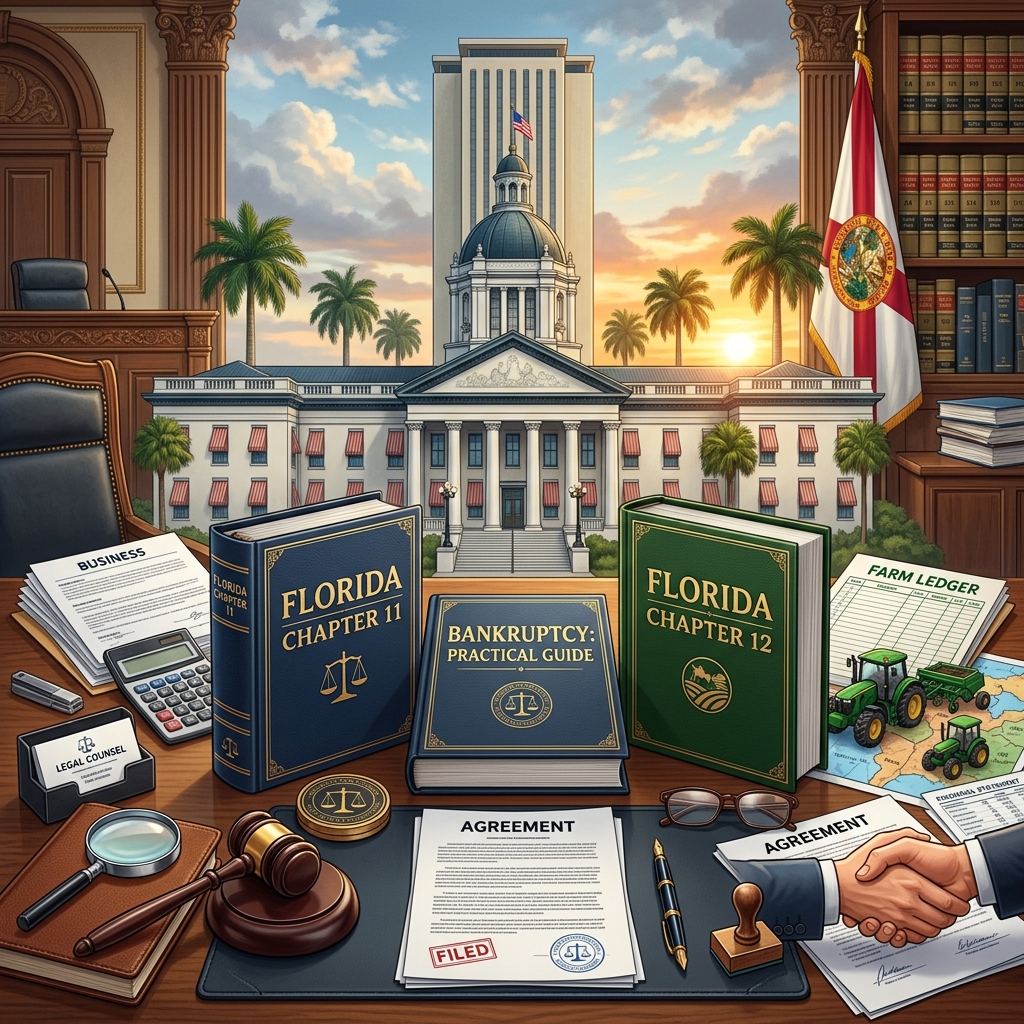
Businesses, family farmers, and family fishermen in Florida who are struggling with overwhelming debt often look to Chapter 11 or Chapter 12 bankruptcy as tools to restructure rather than liquidate. These reorganization chapters allow debtors to keep operating while they develop a court-approved plan to repay or adjust their obligations. Understanding how each chapter works, who qualifies, and what the process looks like in Florida is essential before deciding which option to pursue.
Reorganization vs. Liquidation: The Big Picture
Bankruptcy law offers different chapters depending on the debtor’s goals and circumstances. In Florida, as elsewhere in the United States, the key distinction is between liquidation and reorganization:
- Liquidation (Chapter 7) – Non-exempt assets may be sold to pay creditors, and many debts are discharged. Businesses generally cease operations.
- Reorganization (Chapter 11 and Chapter 12) – The debtor keeps assets and continues operations while following a court-approved plan to manage and repay debt over time.
For ongoing businesses, farms, and fisheries that want to stay in operation, reorganization chapters are usually the primary focus.
Who Typically Uses Chapter 11 in Florida?
Chapter 11 is commonly known as the “business reorganization” chapter, but it is not limited to companies. In Florida, Chapter 11 may be used by:
- Corporations and LLCs wanting to restructure business debt.[10]
- Partnerships and other entities with complex financial obligations.
- Individuals with substantial debt or assets that exceed Chapter 13 limits, including real estate investors and high-net-worth professionals.
The core objective of Chapter 11 is to propose and implement a plan that reorganizes debts, adjusts contracts and leases, and restores financial viability while keeping the enterprise operating.[10]
Who Typically Uses Chapter 12 in Florida?
Chapter 12 is a specialized reorganization chapter designed specifically for:
- Family farmers with regular annual income.
- Family fishermen with regular annual income.
It provides more flexible repayment terms and protections than Chapter 11 or Chapter 13 for agricultural and fishing operations, recognizing the seasonal and unpredictable nature of these industries. Although Chapter 12 filings are less common than Chapter 11 in Florida, they can be critical for family-run farms and fisheries facing equipment loans, land mortgages, and operational debt.
Comparing Chapter 11 and Chapter 12 at a Glance
| Feature | Chapter 11 | Chapter 12 |
|---|---|---|
| Primary users | Businesses and high-debt individuals[10] | Family farmers and family fishermen |
| Main purpose | Business and personal reorganization | Farm/fishery debt adjustment with tailored repayment |
| Plan length | Highly flexible; can extend many years | Typically 3–5 years, similar to Chapter 13 structure |
| Complexity | Procedurally complex and document-heavy | More streamlined, focused on agricultural/fishing income |
| Who proposes plan | Debtor initially has exclusive period (often 120 days) to file plan | Debtor must file a plan, usually early in the case |
Eligibility Basics for Chapter 11 in Florida
Unlike some other chapters, Chapter 11 does not set strict debt ceilings. However, there are important eligibility and procedural requirements:
- Any person or business entity (corporation, LLC, partnership) generally may file Chapter 11, except certain regulated entities like banks and insurance companies which have separate regimes.
- Individual debtors must complete credit counseling from an approved agency within 180 days before filing, unless they qualify for a limited statutory waiver.
- The petition must be filed in the appropriate U.S. Bankruptcy Court for the district where the debtor resides or where the business operates (e.g., Northern, Middle, Southern District of Florida).
Businesses in financial distress often choose Chapter 11 when they have a realistic path to profitability but need time and legal tools to restructure debt, renegotiate leases, or sell assets in an organized manner.
Key Steps in a Florida Chapter 11 Case
Although every case is unique, Chapter 11 reorganization generally follows a recognizable pattern in Florida federal bankruptcy courts.
1. Pre-Filing Preparation
Before filing:
- Individuals must obtain credit counseling from an approved agency within 180 days of filing.
- Debtors gather extensive financial information, including lists of assets, liabilities, contracts, tax returns, and income documentation.
- Businesses often consult both legal and financial advisors to assess whether Chapter 11 is the best strategy compared to alternatives like Chapter 7 or out-of-court restructuring.
2. Filing the Petition and Required Documents
The case begins when the debtor or creditors file a petition with the bankruptcy court. For most Florida Chapter 11 cases, the debtor files voluntarily. Required filings typically include:
- Voluntary bankruptcy petition and basic identifying information.
- Schedules of assets and liabilities, current income and expenses, and executory contracts and leases.
- Statement of financial affairs summarizing recent financial history.
- For businesses, corporate ownership statement and related disclosure documents required by federal and local rules.
- For individuals, evidence of recent income and copies of tax returns as required by statute and local rules.
Courts in Florida emphasize proper form, signatures, and compliance with local rules and federal bankruptcy rules.
3. Automatic Stay and First-Day Proceedings
Once the petition is filed:
- An automatic stay immediately halts most collection actions, lawsuits, and foreclosure efforts against the debtor.
- The court may hold a “first-day” hearing within a short time to address urgent motions, such as permission to use cash collateral, pay critical vendors, or continue payroll.
For many Florida businesses, this stay provides crucial breathing room to stabilize operations while a plan is developed.
4. Meeting of Creditors and Ongoing Reporting
Approximately 30–60 days after filing, the meeting of creditors (often called the “341 meeting”) occurs. The debtor answers questions under oath from the trustee and creditors about assets, liabilities, and business affairs.
Afterward, debtors must comply with ongoing reporting requirements, including:
- Monthly operating reports showing income, expenses, and cash flow.
- Tax filings and other financial disclosures, especially for small business debtors.
5. Developing and Filing the Reorganization Plan
The reorganization plan is the heart of a Chapter 11 case. Federal law typically gives the debtor an exclusive 120-day window after filing to propose a plan, although courts can extend or shorten this period. The plan explains how different classes of creditors will be treated, which debts will be paid, restructured, or discharged, and how the business will operate going forward.
Key elements often include:
- Restructuring secured loans (e.g., adjusting interest rates or extending maturity dates).
- Modifying lease terms or rejecting burdensome contracts subject to court approval.
- Paying unsecured creditors a percentage of their claims over time from future income.
- Addressing tax obligations and priority debts according to statutory requirements.
6. Plan Confirmation and Discharge
Creditors vote on the plan, and the court holds a confirmation hearing to determine whether the plan complies with the Bankruptcy Code and is feasible. Once the plan is confirmed:
- The debtor is bound by the terms of the plan and must make payments as specified.
- Debts treated under the plan are generally discharged upon substantial completion of obligations, although details differ for businesses and individuals.
Confirmation often occurs several months or more than a year after the initial filing, depending on the complexity of the case and negotiations with creditors.
Chapter 12: Tailored Relief for Florida Family Farmers and Fishermen
While many of the procedural steps in Chapter 12 resemble Chapter 11, Chapter 12 is designed specifically around the realities of agricultural and fishing income. For eligible family farmers and fishermen, Chapter 12 offers several advantages:
- Shorter, more predictable plan terms (typically 3–5 years).
- Greater flexibility in restructuring secured debts on equipment, land, and vessels.
- Simplified requirements compared to a full Chapter 11 case, which can reduce legal and administrative costs.
Because Chapter 12 is narrower in scope, it is not available to non-agricultural businesses or individuals who do not meet statutory income and debt thresholds tied to farming or fishing operations.
Documents Commonly Required in Florida Reorganization Cases
Whether filing Chapter 11 or Chapter 12, the debtor must supply detailed financial documentation. For Chapter 11, Florida courts and federal rules typically require:
- Petition and basic forms – Voluntary petition and any required attachments.
- Schedules of assets and liabilities – Including real property, personal property, secured debts, unsecured debts, and co-debtors.
- Schedule of income and expenditures – Showing current and projected financial status.
- Executory contracts and unexpired leases – Listing ongoing obligations like equipment leases and service contracts.
- Statement of financial affairs – Summarizing transfers, lawsuits, recent business activity, and other key events.
- Tax returns and financial statements – Especially for small business debtors, who must file recent balance sheets and cash-flow statements, or explain why they are unavailable.
For individuals, additional documentation may be required, such as evidence of payments received in the 60 days before filing and proof of completion of credit counseling.
Florida-Specific Procedural Considerations
Although bankruptcy law is federal, each Florida district issues local rules and forms that affect how Chapter 11 and Chapter 12 cases proceed. Examples include:
- Local forms for financial management courses and credit counseling waivers.
- District-specific requirements for case management summaries and operating reports.
- Guidance on small business debtor filings, including required financial disclosures.
Debtors and their attorneys must pay close attention to these local variations to avoid delays, deficiencies, or dismissal of the case.
Strategic Considerations: Is Reorganization the Right Choice?
Choosing between Chapter 11, Chapter 12, or another path requires careful evaluation of both legal and business realities. Some important strategic questions include:
- Does the business or farm have a viable long-term business model if debt burdens are adjusted?
- Are key stakeholders (secured lenders, major suppliers, landlords) likely to support a reasonable reorganization plan?
- Can the debtor comply with the required reporting and plan payments for several years?
- Would liquidation or sale outside bankruptcy yield better results for owners and creditors?
In Florida, many debtors begin with a consultation with a bankruptcy attorney to analyze options, review financials, and determine whether Chapter 11 or Chapter 12 aligns with their goals.
Frequently Asked Questions (FAQs)
1. How long does a Chapter 11 case typically last in Florida?
There is no fixed duration, but a general timeline is:
- Credit counseling and preparation in the 180 days before filing (for individuals).
- Petition filing and automatic stay on Day 1.
- Meeting of creditors about 30–60 days after filing.
- Plan development and negotiations over several months, with an initial 120-day exclusive period for the debtor to file a plan.
- Plan confirmation and implementation, which can extend years depending on the structure of payments.
2. Do I lose control of my business in Chapter 11?
In most Chapter 11 cases, the existing management remains in place and operates as a “debtor in possession,” subject to court oversight and fiduciary duties. However, in rare cases involving mismanagement or fraud, the court may appoint a trustee to take over operations.
3. Is Chapter 12 available to corporate farms?
Chapter 12 eligibility depends on meeting statutory criteria related to the nature of the farming or fishing operation, ownership structure, and proportion of income derived from these activities. Some family-owned corporate or partnership farms may qualify, but large agribusinesses that are not “family” operations under the statute typically do not.
4. What happens if I cannot complete my plan payments?
Failure to comply with plan obligations can lead to dismissal of the case, conversion to another chapter (such as Chapter 7), or modification of the plan if circumstances justify a change. Courts in Florida evaluate such situations on a case-by-case basis.
5. Are tax debts dischargeable in Chapter 11 or Chapter 12?
Certain tax debts must be paid in full as priority claims, while others can be treated more flexibly. The treatment of tax obligations is governed by federal statutes and depends on the age, type, and classification of each tax debt. Debtors should obtain specific legal advice to understand how their tax liabilities will be handled.
References
- Filing a Chapter 11 Case — U.S. Bankruptcy Court, Southern District of Florida. 2023-05-01. https://www.flsb.uscourts.gov/filing-chapter-11-case
- Chapter 11 – Reorganization — U.S. Bankruptcy Court, Northern District of Florida. 2023-06-15. https://www.flnb.uscourts.gov/chapter-11-reorganization
- Chapter 11 Bankruptcy Timeline — The Law Offices of Justin McMurray, P.A. 2022-09-10. https://www.yourjacksonvilleattorney.com/chapter-11-bankruptcy-timeline
- How to File for Chapter 11 Bankruptcy — The Law Offices of Justin McMurray, P.A. 2022-03-20. https://www.ocalabankruptcylawyer.com/bankruptcy/how-to-file-for-chapter-11-bankruptcy
- What Documents Are Needed for a Chapter 11 Business Bankruptcy in Florida? — Elrod, Friedman & Weitzman, PLLC. 2021-11-05. https://elrolaw.com/blog/what-documents-are-needed-for-a-chapter-11-business-bankruptcy-in-florida/
- Types of Bankruptcy in Florida – Chapter 7, 11 and 13 — Badgley Law Group. 2023-02-01. https://www.badgleylawgroup.com/types-of-bankruptcy-in-florida/
- The Bankruptcy Process in Florida — Ruff & Cohen. 2021-08-18. https://www.bankruptcylawhelp.com/bankruptcy/bankruptcy-process/
Similar Articles








Read full bio of Sneha Tete




