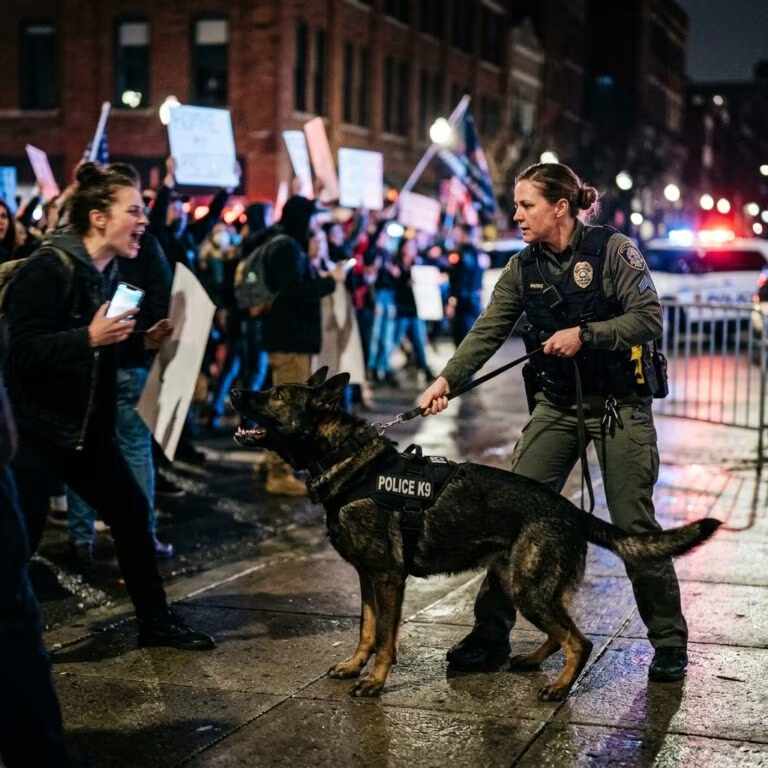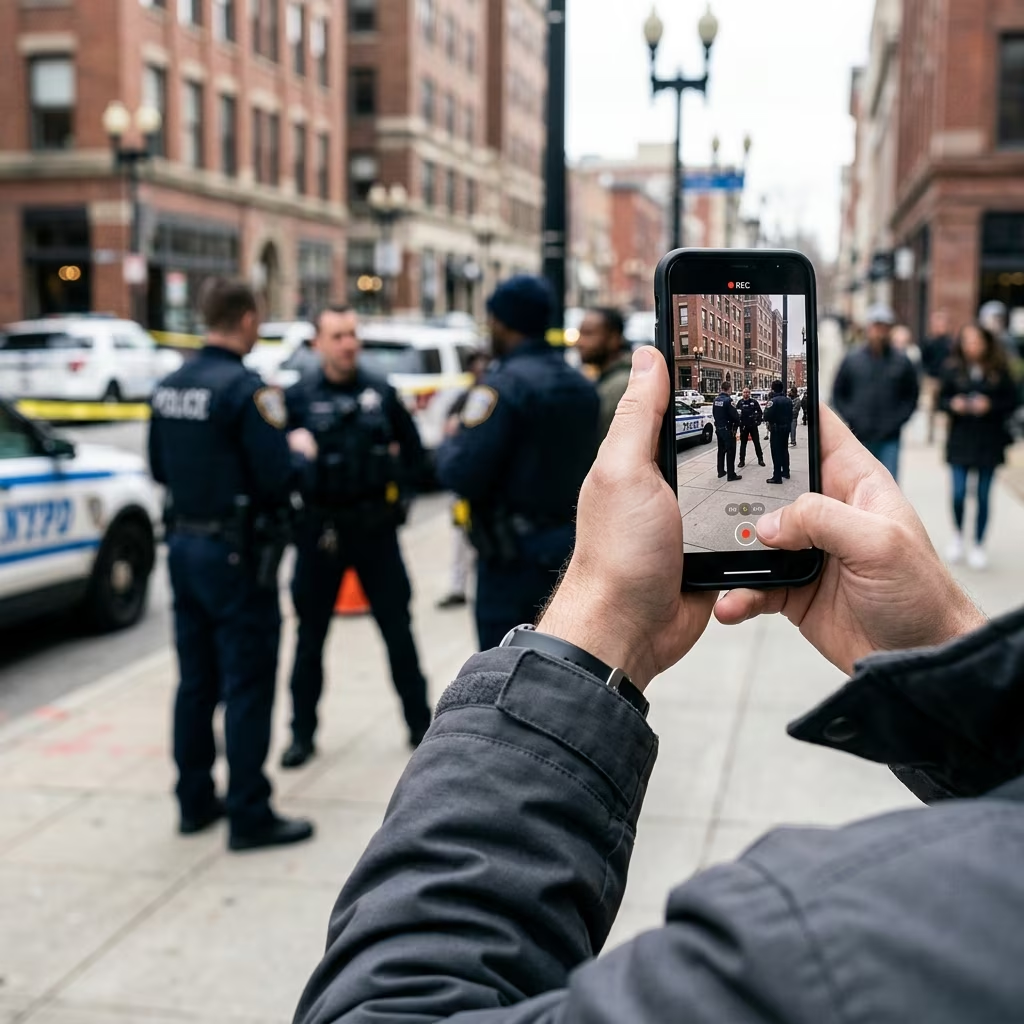
Recording police officers has become a powerful tool for accountability, public debate, and community safety. At the same time, it raises important legal questions: When are you allowed to film? What limits apply? Can officers take your phone or delete your video? This guide explains the core legal principles and offers practical steps to document police activity as safely and effectively as possible, based on widely recognized civil rights protections in the United States.
1. Why Recording Police Matters
Video and photographs of police encounters have shaped national conversations about the use of force, racial justice, and transparency in law enforcement. Courts and civil liberties organizations emphasize that documenting public officials is closely tied to freedom of speech and press, and helps the public:
- Monitor government conduct and expose misconduct.
- Support complaints, lawsuits, or investigations with objective evidence.
- Inform news reporting and community organizing around public safety issues.
Because of this crucial role, federal courts and advocacy groups strongly protect the right to record police performing their duties in public, subject to reasonable limits.
2. The Legal Foundation: First Amendment Protection
In the United States, the central legal protection for recording police comes from the First Amendment, which guarantees freedom of speech, press, and assembly. Courts have interpreted this to include a right to gather information about public officials, including through photography and video.
Every federal appeals court to consider the issue has recognized some form of First Amendment right to record police officers engaged in their official duties in public spaces. These decisions and civil rights guidance make several common points:
- You may record government officials, including police, in public spaces where you are lawfully present.
- The right covers video, still photography, and audio recording when done openly and without interfering with law enforcement operations.
- Law enforcement may impose only reasonable “time, place, and manner” restrictions to address genuine safety or operational needs.
Although exact statutes and case law vary by state, these constitutional principles form the backbone of your right to document police activity in public.
3. Where and When You Can Record Police
Your rights depend heavily on where you are standing and whether you have a legal right to be there. The general rule is that you may record officers in any location where you are lawfully present and can see them.
| Location | Recording Rights |
|---|---|
| Public streets, sidewalks, parks | You may photograph and film anything in plain view, including police, as long as you do not interfere and obey general laws (e.g., not crossing police lines). |
| Public buildings and facilities | Recording is generally allowed in public areas, but specific security rules (e.g., in courthouses or airports) may restrict devices or photography. |
| Private property with permission | You may record police from private property where you have a legal right to be (as an owner, tenant, or invited guest), unless property rules or laws say otherwise. |
| Areas with no legal access | Trespassing, entering restricted zones, or crossing crime scene boundaries to record is not protected and can lead to arrest. |
Police officers performing public duties typically have no reasonable expectation of privacy, so filming them in public from a lawful vantage point is generally allowed.
4. Important Limits: Interference, Safety, and Other Laws
Although you have a constitutional right to record, that right is not unlimited. Law enforcement may step in when your actions go beyond documenting and begin to interfere with their work or create safety risks.
4.1 What counts as interference?
Guidance from civil liberties groups and law enforcement agencies provides examples of conduct that can be treated as interference:
- Standing so close that officers cannot move or safely manage a situation.
- Physically touching officers, suspects, or equipment, or blocking vehicles.
- Ignoring lawful orders to step back or stay behind a barrier.
- Joining a physical struggle or obstructing an arrest while trying to record.
If officers issue a specific, lawful order intended to protect safety or preserve an investigation (such as directing everyone to back up), your recording may be limited so long as reasonable alternatives remain available.
4.2 You cannot break other laws to film
Your right to record does not override neutral laws that apply to everyone. For example, you may not:
- Trespass on private property or restricted government areas.
- Obstruct traffic, ignore lawful crowd-control directions, or enter a closed crime scene.
- Interfere with emergency responders providing medical care.
Civil liberties organizations stress that police cannot stop you just because you are recording, but they may act if your behavior violates independent laws or creates real safety problems.
5. Your Device and Footage: Seizure, Search, and Deletion
One of the most common concerns is whether officers can take your phone or camera, look through it, or delete what you captured. Constitutional and statutory protections give you strong rights over your device and recordings.
5.1 Seizing or searching your phone or camera
- If you are not under arrest, officers generally need a warrant to confiscate your device or view its contents, unless you voluntarily consent.
- If you are under arrest, police may take your device into custody, but they typically still need a warrant to search stored data such as photos, messages, or videos.
- Some policies allow temporary seizure of recordings as evidence only when there is probable cause that a crime is involved and seizure is legally necessary, often followed by a warrant requirement.
Civil liberties groups consistently advise refusing consent to searches by calmly stating that you do not agree to officers viewing your images or videos.
5.2 Deleting or tampering with recordings
Courts and civil rights organizations describe data deletion by police as a serious violation. General guidance emphasizes that:
- The government may never lawfully delete your photographs or videos.
- Officers may not order you to erase footage or alter images under any circumstances.
If you believe an officer has tampered with your recordings, that can be relevant in complaints, civil rights actions, or internal investigations.
6. Practical Tips for Safely Recording Police Encounters
Knowing the law is only part of staying safe and protecting your footage. The following practical steps, drawn from civil liberties “know your rights” materials, can reduce risk during real-world encounters.
6.1 Before you record
- Use a strong password on your phone or camera to protect data if the device is seized.
- Turn on automatic backup if possible, so video uploads to the cloud while you record.
- Keep your battery charged and carry portable power if you expect to document demonstrations or public events.
6.2 While you are filming
- Remain calm and keep your hands visible. Sudden movements can increase tension.
- Maintain a safe distance. Stand far enough away to avoid obstructing officers but close enough to capture clear video.
- Do not hide the fact that you are recording. Visible recording can deter misconduct and shows you are not trying to secretly interfere.
- If an officer approaches, calmly state: “I am recording and I am not interfering.” This underscores your lawful purpose.
6.3 If officers confront you about recording
- Politely ask, “Am I free to leave?” If the answer is yes, you may walk away.
- If you are detained, you generally have the right to remain silent and to decline consent to any search of your device.
- If ordered to stop recording or hand over your phone, calmly say you do not consent and that recording public police activity is protected by the First Amendment, while avoiding physical resistance.
7. Recording Your Own Police Encounter
Your rights are not limited to situations where you are a bystander; you may also record your own interactions with police. Courts and guidance recognize that citizens can document their own questioning, traffic stops, or other encounters, provided recording does not interfere with officers’ duties.
However, there are practical limits:
- Recording routine questioning or a traffic stop is generally permitted if you keep the device visible and do not obstruct the interaction.
- Trying to film while officers restrain or handcuff you may be treated as interference, because it can interfere with their ability to safely complete the arrest.
In many states, audio recording laws (such as “one-party” or “all-party” consent rules) may also apply, especially to non-public conversations. In public police encounters, courts often treat openly recording as protected, but state law variations are important to consider.
8. After the Encounter: Documenting and Reporting
If you believe your rights were violated or you witnessed possible misconduct, what you do after the incident can be just as important as the recording itself. Civil liberties groups recommend carefully documenting the event and considering formal complaints.
8.1 Preserve your evidence
- Save copies of your video and photographs in multiple secure locations.
- Back up files to a trusted cloud service or external drive as soon as possible.
8.2 Write down what happened
- Record the date, time, and location of the encounter.
- Note officers’ names, badge numbers, patrol car numbers, and agency if visible.
- Describe the sequence of events, including any use of force or weapons and any injuries you observed or experienced.
8.3 Gather witnesses and seek help
- Collect contact information from any witnesses willing to speak about the incident.
- Consider filing a written complaint with the relevant police department, internal affairs division, or civilian oversight board.
- For serious concerns, consult an attorney or contact a civil liberties organization that handles police accountability cases.
9. Common Myths About Filming Police
Misinformation can make people hesitant to document police activity. These clarifications reflect widely accepted guidance from civil rights groups and legal authorities.
- Myth: “You must stop recording whenever an officer tells you to.”
Reality: Officers may only restrict recording when they have a genuine, lawful reason (such as safety or crime scene integrity), and any restriction must be reasonable. - Myth: “Police can delete your footage if they think it shows a crime.”
Reality: Deleting your images or videos is not permitted; the government may never delete your photographs or videos. - Myth: “Recording the police is itself suspicious or illegal.”
Reality: Filming public officials in public spaces is a protected activity under the First Amendment and does not, by itself, provide reasonable suspicion of a crime. - Myth: “You have fewer rights if you use a phone instead of a camera.”
Reality: Phones, cameras, and other devices are treated similarly for purposes of recording and data protection.
10. FAQs About Filming and Photographing Police
10.1 Do I have to tell officers that I am recording?
In public spaces, you generally do not have to inform officers that you are recording them, and courts recognize open, non-hidden recording as protected. Still, many civil liberties groups suggest not hiding your device, because visible recording can reduce tension and demonstrate that you are not trying to secretly interfere.
10.2 Can officers detain me just for recording?
Civil liberties guidance explains that police cannot detain you solely because you are filming. To detain you, officers usually must have reasonable suspicion that you are involved in criminal activity beyond simply recording in public.
10.3 What should I say if I am stopped while filming?
Organizations suggest calmly asking, “Am I free to go?” If the answer is yes, you may leave. If you are detained, you can state that you wish to remain silent and that you do not consent to any search of your device.
10.4 Are my rights the same in every state?
The overall First Amendment right to record police in public is recognized across federal appellate courts, but specific details can differ by state, especially regarding audio recording and any state statutes that explicitly protect or regulate filming police. Some states, such as New York, have laws affirming the right to document police activity and to seek remedies for violations.
10.5 What if I fear retaliation for posting the video online?
Sharing recordings of public officials generally falls under First Amendment protection for speech and press. However, posting identifiable footage can have legal and personal consequences, so consulting an attorney or civil rights group may be wise if you anticipate heightened risk.
References
- Know Your Rights: Videotaping Police Officers — ACLU of Michigan. 2017-04-26. https://www.aclumich.org/publications/know-your-rights-videotaping-police-officers/
- Know Your Rights When Filming Police — New York Civil Liberties Union. 2020-06-15. https://www.nyclu.org/resources/know-your-rights/know-your-rights-when-filming-police
- Citizens’ Right to Record the Police — First Amendment Clinic, University of Georgia School of Law. 2020-09-01. https://firstamendment.law.uga.edu/work/citizens-right-to-record-the-police/
- Your Right to Film Police — ACLU of Texas. 2018-07-10. https://www.aclutx.org/know-your-rights/your-right-film-police/
- Recording Police in Public: What You Need to Know — Foundation for Individual Rights and Expression (FIRE). 2023-03-29. https://www.fire.org/research-learn/recording-police-public-what-you-need-know
- Recording and Documenting Police and Federal Agents — American Civil Liberties Union. 2022-08-18. https://www.aclu.org/know-your-rights/recording-and-documenting-police-and-federal-agents
- Public Recording of Law Enforcement Activity — Colorado Department of Revenue. 2021-05-01. https://cdor.colorado.gov/public-recording-of-law-enforcement-activity