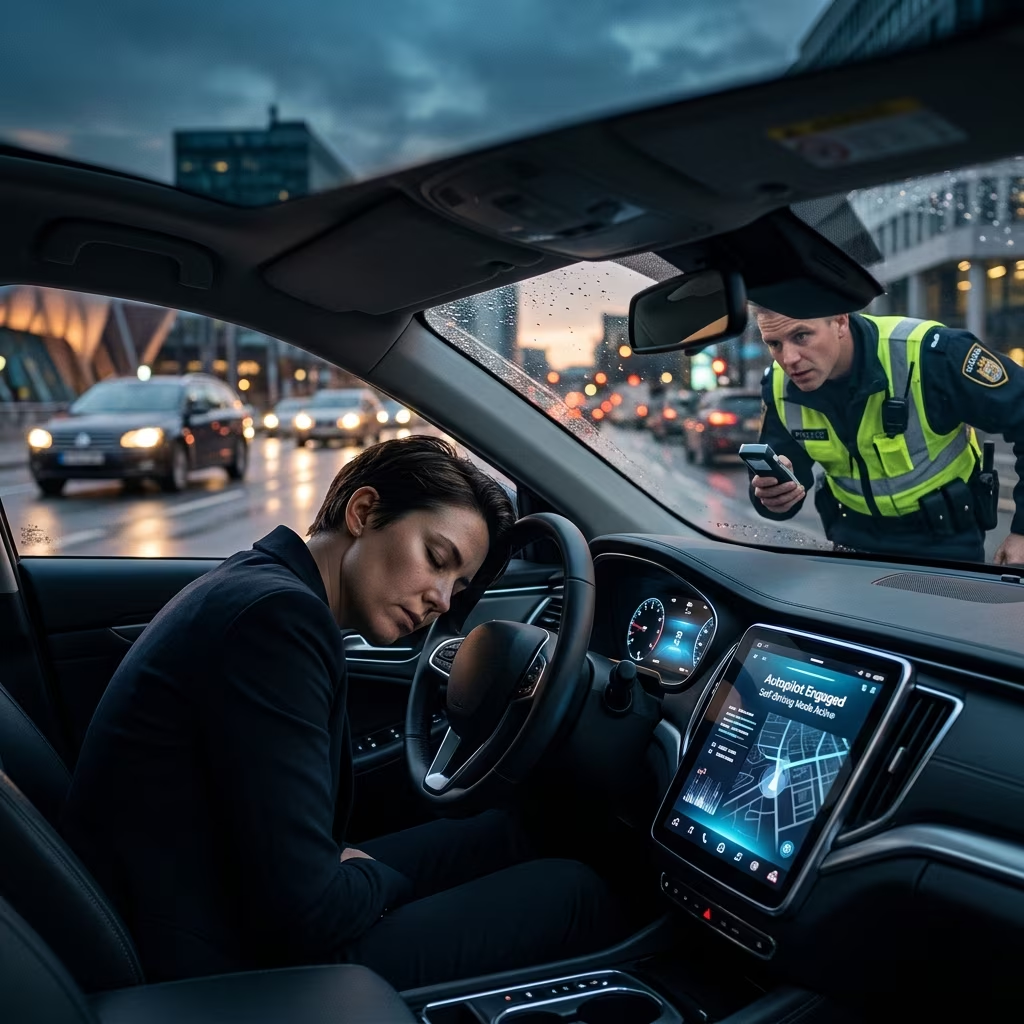
Self-driving vehicles promise a future where machines handle the driving and humans simply ride along. Yet one of the most persistent questions remains: if the car is driving itself, can a drunk occupant still be charged with driving under the influence (DUI)? In most places in the United States today, the answer is still yes, and the core reason is a legal concept known as actual physical control.
Why Self‑Driving Cars Don’t Eliminate DUI Risk
Current DUI statutes were written with human drivers in mind, long before consumer autonomous vehicles were possible. Legislatures and courts have extended these laws broadly to capture situations where an impaired person can operate, or quickly begin operating, a vehicle—even if the car is not moving or is using driver-assist features. This broad approach is intentional: it reduces loopholes and makes it harder for impaired individuals to approach vehicles in ways that endanger public safety.
As a result, being intoxicated in a self-driving or semi-autonomous car often triggers the same legal analysis used for traditional vehicles. What matters is not only who is steering, but who is in a position of control.
The Legal Idea of “Actual Physical Control”
Most states do not limit DUI charges to people actively driving on the road. Instead, many statutes allow charges when someone is in actual physical control of a vehicle, even if it is parked or the autonomous system is engaged. While wording varies by jurisdiction, courts commonly look at whether the person had the immediate ability to operate or direct the vehicle.
Typical Factors Courts Consider
- Location of the person – Sitting in the driver’s seat strongly suggests control; the back seat suggests less control.
- Access to controls – Were the keys available? Could the person start the vehicle or switch modes easily?
- Vehicle status – Is the engine running? Is the vehicle ready to move or already in motion?
- Ability to intervene – Could the person quickly take over steering, braking, or speed control if needed?
- Intent and behavior – Did the person enter the driver’s seat intending to travel, direct a route, or manage the trip?
If these factors point toward control, courts have frequently upheld DUI convictions—even in scenarios where the person was not actively driving or was asleep in the vehicle.
Driver‑Assist vs. True Autonomy: Why the Difference Matters
Many cars marketed as “self-driving” today are better described as driver‑assist systems. These include adaptive cruise control, lane‑keeping assistance, and more advanced supervised automation that still require a human to monitor the environment. Technical standards classify these as Levels 2 or 3 automation, where the human operator must be ready to intervene and remains legally responsible.
| Automation Level | Description | Human Role | DUI Exposure (Typical) |
|---|---|---|---|
| Level 0–1 | Basic assistance (e.g., cruise control) | Human continuously drives | Full DUI liability |
| Level 2–3 | Combined assist & conditional automation | Human monitors and must intervene when needed | Human typically treated as the driver; DUI applies |
| Level 4 | High automation in limited areas | Human may be optional in some contexts | Legal status varies; many laws still assume a human operator |
| Level 5 | Full autonomy, no human driving | No steering wheel or manual controls | Future systems may reduce or eliminate DUI exposure for occupants |
Because most vehicles on public roads today are Level 2 or Level 3, DUI laws almost always treat the person in the driver’s seat as the operator. The technology may automate steering or speed, but it does not shift legal responsibility away from the human.
Common Scenarios: Can You Be Charged with DUI?
To understand how these principles play out, consider several realistic situations involving self-driving or driver‑assist technologies. These scenarios illustrate typical legal reasoning rather than absolute rules, as outcomes can vary by state and by specific facts.
Scenario 1: Intoxicated in the Driver’s Seat, Autonomous Mode On
Imagine a person activates a highway self-driving feature, sits in the driver’s seat, and consumes alcohol during the trip. If pulled over or involved in an incident, that person can usually be charged with DUI because:
- They remain in immediate control and can override the system.
- They are responsible for monitoring the environment and reacting to system limits.
- Police and courts still view their role as operating a motor vehicle.
Even if hands are off the wheel, the combination of impaired condition and control over a vehicle in motion fits squarely within traditional DUI definitions.
Scenario 2: Parked Car, Self‑Driving Feature Available, Driver Asleep
In some states, courts have upheld DUI convictions for individuals sleeping in parked cars if they had the ability to put the car into motion quickly (for example, keys in the ignition and the car ready to drive). With a self-driving feature, the argument is similar: the person could wake up, activate autonomous mode, and direct the car to move.
Factors that increase the risk of a DUI charge include:
- Sitting in the driver’s seat rather than the back.
- Engine running or vehicle in “ready” mode.
- Controls and keys within reach.
Although some defendants argue that sleeping demonstrates an intent not to drive, many courts focus on the potential for control, not on momentary intent.
Scenario 3: Intoxicated Passenger in the Back Seat of a Robo‑Taxi
As more fully autonomous taxis and shuttles emerge, people sometimes ask whether they can ride while drunk in such vehicles. Where the system is truly independent—no steering wheel, no manual controls, and no expectation that passengers intervene—legal exposure to DUI charges is likely lower because passengers do not meet typical definitions of operators.
However, current fleets of autonomous vehicles are still tightly regulated, and many jurisdictions have not yet updated DUI statutes to address fully driverless environments. Until laws evolve, prosecutors may test novel theories of responsibility, particularly if a passenger interferes with the vehicle or directs it in unsafe ways.
Scenario 4: Remote Supervision or Activation of a Self‑Driving Car
Another emerging question is whether someone can be charged for operating a vehicle under the influence when they control or activate it remotely—for example, using a smartphone app to summon or direct a car. Current law in most jurisdictions focuses on physical presence in the vehicle, but statutes often define “operation” broadly.
As remote control technologies mature, some states may consider whether initiating autonomous travel while intoxicated should be treated similarly to physically driving. This area remains largely unsettled and will likely be addressed through future legislation or court decisions.
How Police Handle DUI Stops Involving Self‑Driving Features
Law enforcement procedures have adapted to vehicles equipped with advanced driver‑assist systems. When officers encounter a car apparently driving itself, they still look for a human operator who can be held accountable.
Key Steps Officers Commonly Take
- Assess who is in the front seat – An impaired person in the driver’s seat remains the primary focus.
- Observe behavior and response – Slow reactions, confusion about controls, or signs of intoxication lead to further evaluation.
- Conduct standard DUI investigation – Field sobriety tests and chemical testing proceed much as they would in a conventional vehicle.
- Review vehicle capabilities – Officers may note whether the vehicle allows manual override or expects human supervision.
From a practical standpoint, officers do not treat self-driving features as a legal shield. If a person appears impaired and capable of controlling the vehicle, the standard DUI process typically applies.
Civil and Criminal Liability Beyond DUI
DUI charges are only one piece of the legal picture. Intoxicated operation of self-driving or semi-autonomous vehicles can also carry civil and criminal consequences beyond the core offense.
- Accident liability – If an impaired person tells an autonomous vehicle where to go, fails to intervene when required, or misuses a driver‑assist feature, they may be responsible for resulting crashes and injuries.
- Insurance impact – DUI convictions can raise premiums, lead to policy cancellations, or affect coverage disputes over whether the driver misused the technology.
- Regulatory penalties – Some jurisdictions impose additional sanctions, such as mandatory ignition interlock devices or license suspensions, that apply regardless of automation level.
Even if the technology reduces the risk of collision compared to traditional drunk driving, operating any vehicle while intoxicated remains illegal and can carry serious consequences.
Myths and Misconceptions About DUI and Self‑Driving Cars
The rapid marketing of “self-driving” systems has produced several dangerous misunderstandings. Clarifying these myths is essential for both safety and compliance with the law.
Myth 1: “If I’m Not Touching the Wheel, I’m Not Driving”
In systems that require human supervision, not touching the steering wheel does not remove legal responsibility. Courts look at overall control, not just manual contact with controls. If the person can set the destination, change modes, or intervene, they are still considered the operator.
Myth 2: “Autonomous Mode Is a Legal Loophole”
Several legal analyses emphasize that there is no explicit exception in DUI statutes for autonomous operation. Self-driving features are treated similarly to other vehicle technologies: they can assist the driver, but they do not grant immunity from impairment laws.
Myth 3: “Sleeping in the Car Means I’m Safe from DUI”
Although some people use parked vehicles as a place to sleep while drunk, many courts have held that being asleep in a vehicle can still constitute actual physical control if there is easy access to controls and the vehicle is ready to move. Self-driving capability does not change this reasoning; the question remains whether the person could quickly activate movement.
Looking Ahead: How Laws May Evolve
As technology advances toward fully autonomous Level 5 vehicles, legislators and regulators will need to refine how DUI statutes apply to occupants. There are several models under discussion:
- Passenger-only frameworks – For vehicles without manual controls, law may focus on passenger conduct (such as vandalism or interference) rather than traditional driving offenses.
- Shared responsibility models – In vehicles with mixed control, law could distinguish phases of travel where the human or system is primarily responsible.
- Operator licensing for autonomous systems – Some proposals suggest licensing or certifying autonomous systems, with manufacturers or fleet operators bearing a greater share of responsibility.
Until such frameworks are widely adopted, however, individuals should not assume that automation protects them from DUI charges. Human behavior and the ability to control the vehicle remain central to legal analysis.
Practical Guidance for Drivers Using Self‑Driving Features
Given the current state of law and technology, drivers and riders should treat self-driving systems as sophisticated assistance—not as a green light to drink and ride without consequences.
- Do not activate self‑driving features while impaired – If you would not drive manually in your condition, you should not command or supervise an autonomous or semi‑autonomous vehicle either.
- Use a true ride service when drinking – Traditional taxis, ride‑hailing services, or designated drivers remain the safest and least legally risky options.
- Understand your vehicle’s capabilities – Review your owner’s manual and manufacturer guidance to learn whether the system is driver‑assist or closer to full autonomy.
- Stay out of the driver’s seat if intoxicated – Sitting in the back seat rather than the front can significantly reduce the appearance of control, though it is not a guaranteed shield.
FAQs: DUI and Self‑Driving Cars
Can I still get a DUI if my car is driving itself?
Yes, in most jurisdictions you can. If you are in the driver’s seat and have the ability to control or override the system, current laws typically treat you as operating the vehicle, even when driver‑assist or autonomous features are active.
Is it safer and legal to ride drunk in a self‑driving car instead of driving manually?
While advanced assistance may reduce some accident risks, it does not make impaired operation legal. Being intoxicated and in control of any motor vehicle, including one with self-driving capabilities, can result in criminal charges and civil liability.
What happens if police stop a self‑driving car with an impaired person inside?
Officers will typically identify the human occupant in the driver’s seat and evaluate them just as they would in a traditional vehicle: observing behavior, conducting sobriety tests, and determining whether the person is in actual physical control of the car.
Are passengers in the back seat of a fully autonomous taxi at risk of DUI charges?
In systems without manual controls where passengers cannot operate the vehicle, traditional DUI theories are less likely to apply. However, legal frameworks for fully autonomous taxis are still emerging, and responsibility may be addressed through future regulations.
Will future laws make it legal to ride drunk in fully driverless cars?
Some policymakers have discussed treating truly driverless cars more like public transportation, where passengers are not considered operators. Any change would require explicit legal reforms; until those reforms are enacted, occupants should assume that traditional DUI rules remain in force.
References
- Can You Get a DUI in a Self-Driving Car in Florida? — Michael White, Esq. 2026-01-10. https://www.michaelwhiteesq.com/dui-self-driving-car-florida/
- Can You Be Charged with a DUI in a Self-Driving Car? A Legal Perspective — Hoglund Law. 2024-06-05. https://hoglundlaw.com/driving/can-you-be-charged-with-a-dui-in-a-self-driving-car-a-legal-perspective/
- Do DUI Laws Apply to Self-Driving Cars? — LifeSafer Ignition Interlock. 2023-09-14. https://www.lifesafer.com/blog/do-dui-laws-apply-to-self-driving-cars/
- DUI in a Self-Driving Car? What Police Do in 2025 — Mochel Law. 2025-03-21. https://www.mochellaw.com/dui/2025/pulled-over-in-a-self-driving-car-how-police-handle-dui-stops-in-2025/
- Drinking and Self-Driving Cars: A Safety Concern — GGRM Law Firm. 2022-11-03. https://ggrmlawfirm.com/blog/personal-injury/auto-accidents/drinking-and-self-driving-cars/