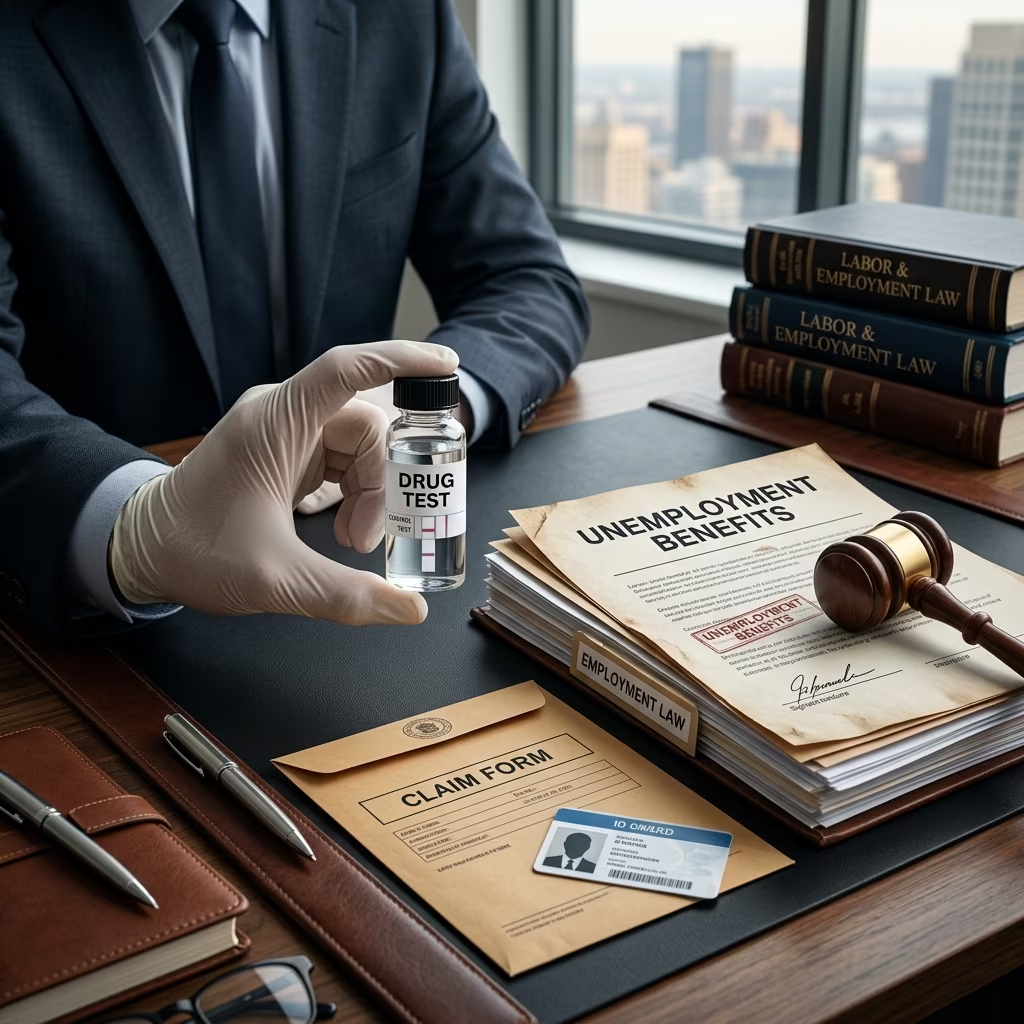
Drug testing and unemployment benefits increasingly intersect in ways that can be confusing for both workers and employers. Some states have explored or adopted rules that tie eligibility for unemployment insurance (UI) to passing a drug test, while others limit this practice based on federal requirements and constitutional concerns. This guide explains when drug testing is legally relevant to UI, what federal law permits, how state policies differ, and what practical steps you can take to protect your interests.
Unemployment Insurance Basics: Why Eligibility Matters
Unemployment insurance is a joint federal–state program that provides temporary wage replacement to workers who lose their jobs through no fault of their own. While each state administers its own UI program, they must comply with federal standards to receive funding and tax advantages.
Common baseline requirements for UI eligibility include:
- Prior covered employment for a sufficient period and earnings level.
- Involuntary job loss that is not due to disqualifying misconduct.
- Ability and availability to work, plus active job search.
Drug use and drug testing usually become relevant when a worker is discharged for alleged misconduct, or when state law allows screening certain applicants whose occupations regularly require drug tests.
Federal Rules on Drug Testing for Unemployment Benefits
Congress addressed drug testing in the UI context in the Middle Class Tax Relief and Job Creation Act of 2012. This law amended federal unemployment provisions to allow, but strictly limit, when states may condition initial eligibility for benefits on drug testing.
Under the 2012 law and subsequent U.S. Department of Labor regulations:
- States may require drug tests as a condition of initial eligibility only in two situations:
- Discharge for unlawful drug use — if the worker was fired because of illegal drug use, a state may test and deny benefits based on a positive result.
- Occupations that regularly drug test — if the only suitable work available is in an occupation where drug testing is standard practice, states may condition eligibility on passing a test.
Outside these narrow circumstances, federal law prohibits states from using unrelated conditions, such as blanket drug testing of all applicants, to restrict UI eligibility. States cannot simply require every claimant to submit to random tests, because that would be unrelated to the “fact or cause” of the unemployment.
Why Federal Limits Exist
Federal restrictions serve two main purposes:
- Uniform minimum standards so that workers across states receive basic protection against arbitrary disqualification.
- Protection of privacy and constitutional rights by avoiding sweeping, suspicionless testing requirements that courts have found problematic in other benefit programs.
Courts have struck down similar laws that imposed warrantless, suspicionless drug tests on welfare recipients without reasonable grounds to suspect drug use, citing Fourth Amendment concerns. These decisions influence how states approach drug testing in the UI system.
State-Level Approaches: Variation Within Federal Boundaries
Within the federal framework, states differ significantly in whether and how they link drug testing to unemployment benefits. Some have adopted or proposed stricter rules; others have focused only on misconduct tied to positive tests. A few examples illustrate this diversity.
Example: South Carolina’s Positive Test and “For Cause” Discharge
South Carolina revised its law to make employees discharged for failing a drug test ineligible for unemployment benefits, provided the employer had communicated a clear policy prohibiting illegal drug use. Under this approach, a positive test, obtained under legally compliant procedures, can support a finding that the worker was discharged “for cause” and therefore disqualified from UI.
To rely on a failed test, South Carolina sets detailed requirements for the collection, analysis, and documentation of samples, including:
- Use of trained collectors or licensed health professionals.
- Testing by certified laboratories (for example, those recognized by national accreditation bodies).
- Strict chain-of-custody records from collection through analysis.
- Confirmatory testing for initial positive results using accepted analytical methods such as gas chromatography/mass spectrometry.
These procedural safeguards are designed to ensure that a positive result accurately reflects drug use and to provide reliable evidence in UI hearings.
Example: Proposed Blanket Testing in North Carolina
Some proposals, such as a North Carolina bill, have sought to make drug testing a routine condition of UI eligibility by requiring initial claimants to submit to and pass a drug test and subjecting benefit recipients to random testing. Under federal law, however, such broad, automatic testing of all claimants would generally be impermissible unless it falls within the two allowed categories related to discharge for unlawful drug use or occupations that regularly test.
Federal guidance emphasizes that states may not adopt UI eligibility rules wholly unrelated to the reason for unemployment or the nature of suitable work. As a result, many expansive proposals have been narrowed, modified, or not implemented.
Drug Testing as Misconduct: Legal Standards and Evidence
Most UI disputes involving drug tests arise when an employee is fired after:
- Testing positive for drugs or alcohol; or
- Refusing to submit to a test.
Whether the worker receives benefits usually turns on the definition of “misconduct” in the relevant state statute and how the evidence is evaluated.
How States Define Misconduct
State UI laws typically define misconduct as a willful or reckless disregard of the employer’s interests, such as deliberate violations of known rules or gross negligence. Use of illegal drugs or violation of a clear drug policy can fall within this category, but the connection must be proven.
Some key principles highlighted in legal analysis include:
- Context matters — mere failure or refusal to take a test, without additional evidence, may not always amount to misconduct.
- Reasonable suspicion — one view is that employers should show concrete evidence of impairment or on-the-job drug use before testing, particularly if they rely on results to deny benefits.
- Reliability of tests — where test accuracy is in question, an employer may need to demonstrate proper procedures and confirmatory testing to support a misconduct finding.
When a Positive Test Disqualifies a Worker
In some states, statutes explicitly state that a worker discharged for refusing or failing a legally compliant drug test is considered to have engaged in misconduct and is disqualified from UI. For example, Oklahoma law provides that employees discharged on the basis of a confirmed positive test or refusal to undergo testing conducted under the state’s Workplace Drug and Alcohol Testing Act are disqualified from benefits.
To rely on this rule, employers must show full compliance with the testing standards, including:
- Documentation of a positive test result from the testing facility.
- Chain-of-custody records for the sample.
- Certification from a medical review officer regarding proper testing procedures.
- A copy of the company’s written drug testing policy.
- Evidence of an employee assistance program, where required.
Without adequate documentation, a hearing officer may decide that the employer has not proven misconduct, and the claimant may still receive benefits.
Random Drug Testing of UI Claimants: Legal and Practical Constraints
The idea of random drug testing for all unemployment recipients attracts attention in policy debates, but its legal footing is narrow. Federal law only allows routine testing when it is tied to specific circumstances—discharge for unlawful drug use or occupations that regularly test—and constitutional privacy protections further limit suspicionless testing.
Important limitations include:
- No general testing of all claimants without a connection to the reason for unemployment or the nature of available work.
- Need for statutory authority at the state level that complies with federal requirements.
- Potential court challenges based on privacy rights and unreasonable search concerns, as seen in welfare drug-testing cases.
As a result, many states focus on workplace misconduct and drug policies rather than sweeping random tests of everyone receiving UI.
Practical Guidance for Workers
If you are applying for or receiving unemployment benefits and drug testing is involved, the following practical steps may help you navigate the process:
Know Your Rights and Obligations
- Ask whether there is a specific legal basis for the test related to your discharge or occupation.
- Request copies of your former employer’s written drug policy and any documentation used in your case.
- Keep records of all communications, test orders, and results.
If You Were Fired After a Drug Test
- Review the circumstances of the test: Was it random, based on suspicion, post-incident, or tied to a routine screening program?
- Consider whether you were given proper notice of the drug policy and consented to testing.
- If you dispute the result, inquire about confirmatory testing and whether samples were handled according to recognized standards.
Appealing a Benefit Denial
- Most states allow you to appeal an initial UI determination. Deadlines are short, so act quickly.
- Gather evidence, including lab reports, chain-of-custody documents, and any witness statements related to the test.
- Consider consulting an attorney or legal aid organization experienced in unemployment law, especially if complex testing issues are involved.
Guidance for Employers
Employers who wish to use drug testing as a basis for denying UI claims must balance compliance with workplace safety goals and legal requirements. Key considerations include:
Design a Legally Sound Drug Policy
- Ensure the policy is clear, written, and communicated to all employees.
- Specify when testing may occur (pre-employment, random, post-incident, reasonable suspicion) and which substances are prohibited.
- Align procedures with state workplace drug testing statutes and federal law regarding UI eligibility.
Use Reliable Testing Methods and Documentation
- Work with accredited laboratories and qualified collectors to ensure sample integrity.
- Maintain detailed chain-of-custody records for each test.
- Obtain a medical review officer’s certification when required, and keep copies of all test results and related correspondence.
Prepare for UI Hearings
- Be ready to provide live testimony and authentic documents showing compliance with testing standards.
- Understand the state’s definition of misconduct and how it applies to drug policy violations.
- Consider whether the test was justified under reasonable suspicion or standard program rules, as this may affect credibility.
Comparison: Worker and Employer Perspectives
| Perspective | Main Concerns | Key Actions |
|---|---|---|
| Worker | Fair access to UI, privacy, accuracy of tests, avoiding unjust misconduct findings. | Request documentation, appeal denials, seek legal advice, challenge unreliable tests. |
| Employer | Workplace safety, controlling UI costs, complying with testing laws, defending decisions. | Maintain clear policies, use accredited labs, document procedures, prepare for hearings. |
| State Agency | Federal compliance, consistent adjudication, protection of claimant rights. | Apply federal limits on testing, evaluate evidence, issue guidance to stakeholders. |
Frequently Asked Questions (FAQs)
Can my state require a drug test every time I apply for unemployment?
Not in general. Federal law only allows states to condition initial UI eligibility on drug testing in two situations: when you were discharged for unlawful drug use, or when the only suitable work available is in an occupation that regularly uses drug testing. Any broader requirement would likely conflict with federal rules.
What happens if I refuse to take a workplace drug test and then apply for UI?
In some states, refusal to submit to a lawful workplace drug test may be treated as misconduct if the employer’s policy is clear and the test complies with legal standards. If you are discharged on that basis, the unemployment agency will examine whether your refusal meets the statutory definition of misconduct. You may still contest the circumstances of the test and any procedural flaws.
Can I challenge the accuracy of a positive drug test in an unemployment hearing?
Yes. You can question whether proper collection, chain-of-custody, and confirmatory testing were used, and whether the lab is accredited. Employers who rely on test results must typically demonstrate that recognized methods and procedures were followed. Any weaknesses in documentation or handling may affect the weight of the evidence.
Are random drug tests of all UI recipients constitutional?
Courts have expressed skepticism about blanket, suspicionless drug testing of benefit recipients. Federal appellate courts have struck down similar welfare testing laws when they lacked reasonable suspicion tied to individual conduct. While each program and statute is evaluated on its own terms, these decisions influence how states design UI-related testing policies.
Does a failed drug test always mean I lose unemployment benefits?
No. Eligibility depends on state law, the definition of misconduct, and the facts of your case. A failed test may lead to a misconduct finding in some jurisdictions, especially when the employer followed all required procedures and had a clear policy. In other situations, particularly where testing was legally questionable or poorly documented, benefits may still be granted.
References
- Limiting Drug Testing for Unemployment Insurance — National Employment Law Project. 2015-10-01. https://www.nelp.org/app/uploads/2015/10/2C-Limiting-Drug-Testing-for-UI.pdf
- U.S. Department of Labor Issues Final Rule for Unemployment Compensation Drug Testing — U.S. Department of Labor. 2019-10-03. https://www.dol.gov/newsroom/releases/eta/eta20191003-0
- Drug Testing and the Unemployment Compensation System — University of Chicago Legal Forum. 1990. https://chicagounbound.uchicago.edu/cgi/viewcontent.cgi?article=1044&context=uclf
- South Carolina Drug Testing Requirements Impact Unemployment Benefits — Ogletree Deakins. 2005-06-01. https://ogletree.com/insights-resources/blog-posts/south-carolina-drug-testing-requirements-impact-unemployment-benefits/
- Unemployment Benefits? But He Failed A Drug Test! — McAfee & Taft. 2012-03-01. https://www.mcafeetaft.com/unemployment-benefits-but-he-failed-a-drug-test/