
Domestic Violence Convictions and Federal Gun Bans
How federal law treats firearms access for people with domestic violence convictions or protective orders and what that means in daily life.
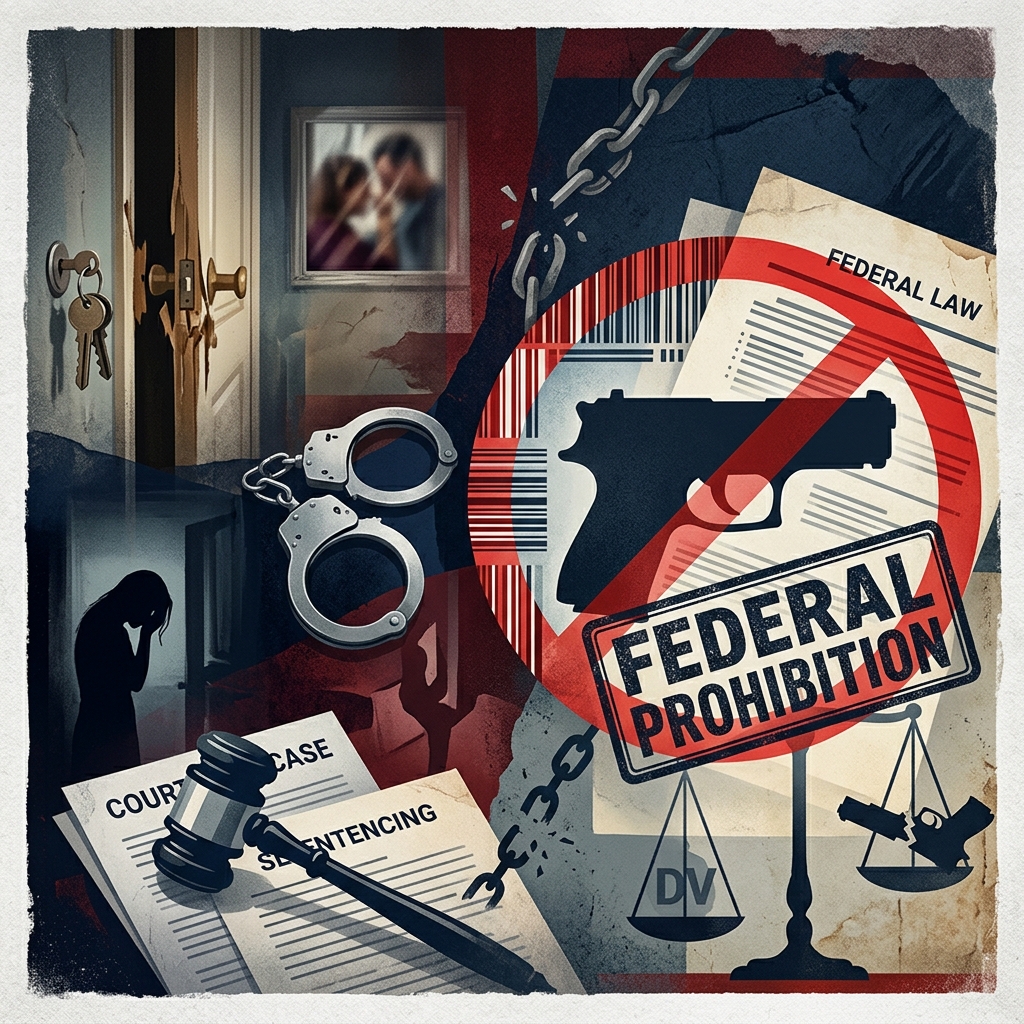
Federal firearms law takes domestic violence extremely seriously. A qualifying conviction or certain types of protective orders can trigger a ban on owning, possessing, buying, or receiving guns and ammunition under national law. These consequences are often long‑lasting, can apply even to police and military personnel, and may reach back to convictions that happened decades ago.
This article explains how domestic violence offenses and court orders interact with federal gun regulations, what types of relationships are covered, how recent legislation affects “dating partners,” and when rights can potentially be restored.
Understanding the Federal Framework
Modern federal firearms restrictions for domestic violence arise from the Gun Control Act of 1968 and later amendments, particularly the Domestic Violence Offender Gun Ban, often called the Lautenberg Amendment. These laws are codified primarily in 18 U.S.C. § 922(g), which lists categories of people barred from having firearms or ammunition.
Within that statute, domestic violence is addressed in two major ways:
- Misdemeanor crime of domestic violence — usually triggers a ban on firearms possession or receipt.
- Domestic violence protective orders — certain restraining orders can also prohibit firearm possession while the order is in effect.
These provisions operate alongside broader rules that bar people convicted of felonies from possessing firearms.
Who Is a “Prohibited Person” Under Federal Law?
Federal law identifies several categories of individuals who are not allowed to possess or receive firearms and ammunition. For domestic violence, the most relevant categories are:
- Felony offenders — anyone convicted of a crime punishable by more than one year in prison (with limited exceptions).
- Domestic violence misdemeanants — anyone convicted of a qualifying misdemeanor crime of domestic violence.
- Persons subject to certain protective orders — individuals restrained by specific domestic violence-related court orders.
Once someone falls into a prohibited category, it becomes a federal offense for them to possess, receive, ship, or transport any firearm or ammunition in or affecting interstate commerce.
What Counts as a “Misdemeanor Crime of Domestic Violence”?
The term misdemeanor crime of domestic violence has a precise legal meaning. Federal law defines it as a misdemeanor offense that:
- has, as an element, the use or attempted use of physical force, or the threatened use of a deadly weapon, and
- is committed by a person who has a specified domestic relationship with the victim.
Qualifying relationships typically include:
- current or former spouse of the victim
- parent or guardian of the victim
- a person with whom the victim shares a child in common
- a cohabitant or former cohabitant in an intimate relationship
State criminal codes do not always use the phrase “domestic violence” in the offense title, so a seemingly ordinary assault or battery charge may qualify as a misdemeanor crime of domestic violence depending on the relationship and the elements of the offense.
Key Features of the Lautenberg Amendment
The Domestic Violence Offender Gun Ban, enacted in 1996, dramatically expanded who could be barred from possessing firearms by adding misdemeanor domestic violence convictions to the list of prohibited categories. Prior to this law, only felony convictions typically resulted in federal firearms disqualification.
Important characteristics of the amendment include:
- Lifetime ban for most qualifying convictions — in general, a qualifying misdemeanor domestic violence conviction results in a permanent federal prohibition, unless rights are later restored by legal mechanisms.
- No governmental exception — unlike some other firearms restrictions, domestic violence misdemeanants cannot possess guns even in the course of official duties, such as serving as law enforcement officers or members of the armed forces.
- Retroactive application — convictions that occurred prior to the law’s effective date still trigger the ban; as of September 30, 1996, anyone with a qualifying prior conviction became subject to the federal prohibition.
Protective Orders and Firearm Restrictions
Federal law also restricts firearms access for certain individuals under domestic violence protective orders (sometimes called restraining orders).[10] The relevant provisions apply only when specific conditions are met.
Conditions for a Protective Order to Trigger the Ban
To disqualify someone from possessing firearms under federal law, a protective order must generally:
- be issued after the person has received actual notice of the proceedings and has had an opportunity to participate in a hearing,
- restrain the individual from harassing, stalking, or threatening an intimate partner or a child, or engaging in conduct that would place them in reasonable fear of bodily injury,
- include a finding that the person represents a credible threat or explicitly prohibit the use of physical force against the protected party.
Temporary, ex parte orders issued without notice and a hearing do not typically trigger the federal firearms ban, although some states impose their own, separate restrictions.
Who Counts as an “Intimate Partner”?
The statute defines “intimate partner” narrowly, focusing on relationships such as:
- current or former spouse
- individual who shares a child with the respondent
- individual who currently or previously cohabited with the respondent in an intimate relationship
Historically, this definition excluded many dating partners who did not live with the respondent or share a child, contributing to what advocates described as the “boyfriend loophole.”
The “Boyfriend Loophole” and Dating Partners
For years, federal domestic violence gun laws were criticized for failing to fully protect victims from abusive dating partners who were not spouses, cohabitants, or co‑parents. This gap meant that some individuals convicted of violence against dating partners could retain firearms access.
In 2022, the Bipartisan Safer Communities Act was enacted, partially addressing this issue. The law created a new category for misdemeanor crimes of domestic violence involving a dating relationship and set a specific prohibition period for those offenders.
Five-Year Ban for Some Dating-Relationship Convictions
Under the updated framework:
- people convicted in any court of a misdemeanor crime of domestic violence against a victim with whom they had a current or recent dating relationship are prohibited from purchasing or possessing firearms for five years,
- after five years, if the person has no additional disqualifying convictions and meets other conditions, federal law may treat their rights as restored with respect to dating‑relationship misdemeanors.
The Bureau of Alcohol, Tobacco, Firearms and Explosives (ATF) has clarified how this restoration operates: if an individual has only one qualifying dating‑relationship misdemeanor, more than five years have elapsed since conviction or completion of sentence, and no other disqualifying offenses occurred, then that specific conviction no longer disqualifies them under federal law.
Penalties for Violating Domestic Violence Firearm Bans
Violating federal domestic violence-related firearm prohibitions is a serious offense. Penalties can include substantial prison sentences and fines.
| Type of Violation | Possible Federal Penalty |
|---|---|
| Possessing firearms after a qualifying misdemeanor domestic violence conviction | Up to 10–15 years imprisonment and/or large fines (exact maximum depends on statute and circumstances). |
| Possessing firearms while subject to a qualifying protective order | Up to 10 years imprisonment and/or fines. |
| Knowingly selling or transferring firearms to a prohibited person | Federal criminal liability, including potential imprisonment and fines. |
Exact sentencing outcomes depend on many factors, including prior criminal history, details of the offense, and applicable sentencing guidelines.
Interaction with State Law
Federal rules set a national baseline, but state laws can provide additional protections and restrictions. Many states:
- create their own categories of people barred from possessing firearms based on domestic violence or related offenses,
- impose temporary gun removal procedures during emergency protective orders, even when federal law does not yet apply,
- define domestic violence and qualifying relationships differently, which can affect whether a conviction qualifies as a misdemeanor crime of domestic violence under federal law.
Some states also adopt specific time‑limited firearm bans for certain domestic violence offenses, such as three‑year prohibitions for particular misdemeanor assault convictions involving spouses or co‑parents.
Restoration of Firearm Rights
Federal law recognizes several paths by which a person with a domestic violence conviction might eventually regain firearms rights, though the process is complex and often depends heavily on state law.
Common Restoration Mechanisms
A person may no longer be considered “convicted” for federal firearms purposes if:
- the conviction has been expunged or set aside by a court,
- the person has received a pardon for the offense,
- the jurisdiction has fully restored the person’s civil rights, including rights to vote, serve on a jury, and hold office, and the restoration does not expressly forbid firearms possession.
Even where such relief is available, it often requires formal legal proceedings and careful analysis of both state and federal law. Partial restoration of civil rights that leaves firearm restrictions in place will not remove the federal firearms disability.
Practical Implications for Affected Individuals
Being subject to a domestic violence firearms ban can impact many aspects of life, including employment, family safety considerations, and legal exposure. The consequences are particularly significant for people whose jobs involve carrying weapons.
- Law enforcement and military careers — a qualifying misdemeanor domestic violence conviction can prevent individuals from serving in positions that require firearms, even when on duty.
- Hunting and sport shooting — recreational gun ownership and participation in shooting sports are generally prohibited for individuals with ongoing federal firearms disabilities.
- Cross‑state moves — because federal law applies nationwide, moving to another state does not eliminate the prohibition, although state‑level rules may add further restrictions or processes.
Given the severity of potential penalties for unlawful possession, anyone with a domestic violence history or a protective order should understand their legal status before handling firearms or ammunition.
Role of the Courts and Recent Supreme Court Decisions
Federal courts, including the Supreme Court, continue to shape how domestic violence firearm bans interact with constitutional rights. Recent decisions have upheld the basic framework that allows Congress to prohibit individuals subject to domestic violence protective orders from possessing firearms.[10]
These rulings emphasize that protecting victims from gun violence is a legitimate and important governmental objective, particularly where courts have already found that an individual poses a credible threat to an intimate partner or child. At the same time, courts apply detailed constitutional analysis, examining the history and tradition of firearm regulation when evaluating modern domestic violence restrictions.[10]
Frequently Asked Questions (FAQs)
1. Does every domestic violence conviction automatically result in a federal gun ban?
Not every conviction labeled “domestic violence” under state law qualifies. The offense must meet the federal definition of a misdemeanor crime of domestic violence, which requires both a specified domestic relationship and an element involving physical force or a deadly weapon.
2. Can someone under a temporary restraining order still legally possess firearms?
Temporary, ex parte orders typically do not trigger the federal firearm prohibition because they are issued without a full hearing and notice. However, many states impose their own restrictions, so a person may still be barred under state law.
3. How long does the domestic violence gun ban last?
For most qualifying misdemeanor crimes of domestic violence, the ban is for life, unless rights are restored through expungement, pardon, or civil rights restoration that explicitly includes firearm rights. For some dating‑relationship misdemeanors, recent law provides a limited five‑year prohibition period if conditions for restoration are met.
4. Are police officers and military personnel treated differently under the law?
No. The Lautenberg Amendment was designed to apply equally to all individuals, including law enforcement and military members. There is no government or employment exception for qualifying misdemeanor domestic violence convictions.
5. What should someone do if they are unsure whether a past conviction affects their gun rights?
Because the analysis depends on the exact language of the criminal statute, the relationship to the victim, and the disposition of the case, individuals should seek advice from qualified legal counsel. A lawyer familiar with both state and federal firearms law can help determine whether a conviction is disqualifying and whether any restoration options may exist.
Key Takeaways
- Federal law bars many people with domestic violence convictions and certain protective orders from possessing firearms and ammunition, often for life.
- The Lautenberg Amendment expanded firearms prohibitions to include misdemeanor crimes of domestic violence, with no exception for government employees.
- Protective orders trigger federal restrictions only when they meet specific statutory criteria and involve intimate partners or children.
- Recent legislation addresses some gaps in coverage for dating partners by imposing a five‑year ban on gun access for certain dating‑relationship misdemeanor convictions.
- Violations of these prohibitions carry severe criminal penalties, making it critical for affected individuals to understand their legal status and seek legal guidance when needed.
- Federal Firearms Ban for Domestic Violence Convictions — Nolo / CriminalDefenseLawyer.com. 2024-01-01. https://www.criminaldefenselawyer.com/resources/what-kind-domestic-violence-conviction-prevents-having-gun.html
- Domestic Violence Offender Gun Ban (Lautenberg Amendment) — 18 U.S.C. § 922(g)(9), Omnibus Consolidated Appropriations Act of 1997. 1996-09-30. https://en.wikipedia.org/wiki/Domestic_Violence_Offender_Gun_Ban
- Restrictions on the Possession of Firearms by Individuals Convicted of a Misdemeanor Crime of Domestic Violence — U.S. Department of Justice (Justice Manual §1117). 1997-10-01. https://www.justice.gov/archives/jm/criminal-resource-manual-1117-restrictions-possession-firearms-individuals-convicted
- Domestic Violence & Firearms — Giffords Law Center. 2023-06-01. https://giffords.org/lawcenter/gun-laws/policy-areas/who-can-have-a-gun/domestic-violence-firearms/
- Misdemeanor Crimes of Domestic Violence Prohibitions — Bureau of Alcohol, Tobacco, Firearms and Explosives (ATF). 2023-01-01. https://www.atf.gov/media/25266/download
- Federal and State Firearms Law: Domestic Violence Gun Ban — Supreme Court of Virginia (pamphlet). 2019-01-01. https://www.vacourts.gov/courtadmin/aoc/djs/programs/dvps/resources/firearmspamphlet.pdf
- APPENDIX C: Federal Domestic Violence Laws — Washington Courts Domestic Violence Manual. 2020-01-01. https://www.courts.wa.gov/content/manuals/domViol/appendixC.pdf
- Prohibition for Convicted Domestic Abusers — Everytown Research & Policy. 2023-07-01. https://everytownresearch.org/rankings/law/prohibition-for-convicted-domestic-abusers/
- Supreme Court Upholds Domestic Violence Gun Ban — Johns Hopkins Center for Gun Violence Solutions. 2024-06-21. https://publichealth.jhu.edu/center-for-gun-violence-solutions/2024/supreme-court-upholds-domestic-violence-gun-ban-implications-for-the-second-amendment-and-survivors-of-domestic-violence
References
Similar Articles








Read full bio of medha deb


