
Cloud vs On-Premise: Smart Choice for Small Firms
Discover if cloud migration saves costs and boosts growth for small businesses, weighing pros, cons, and key trends.
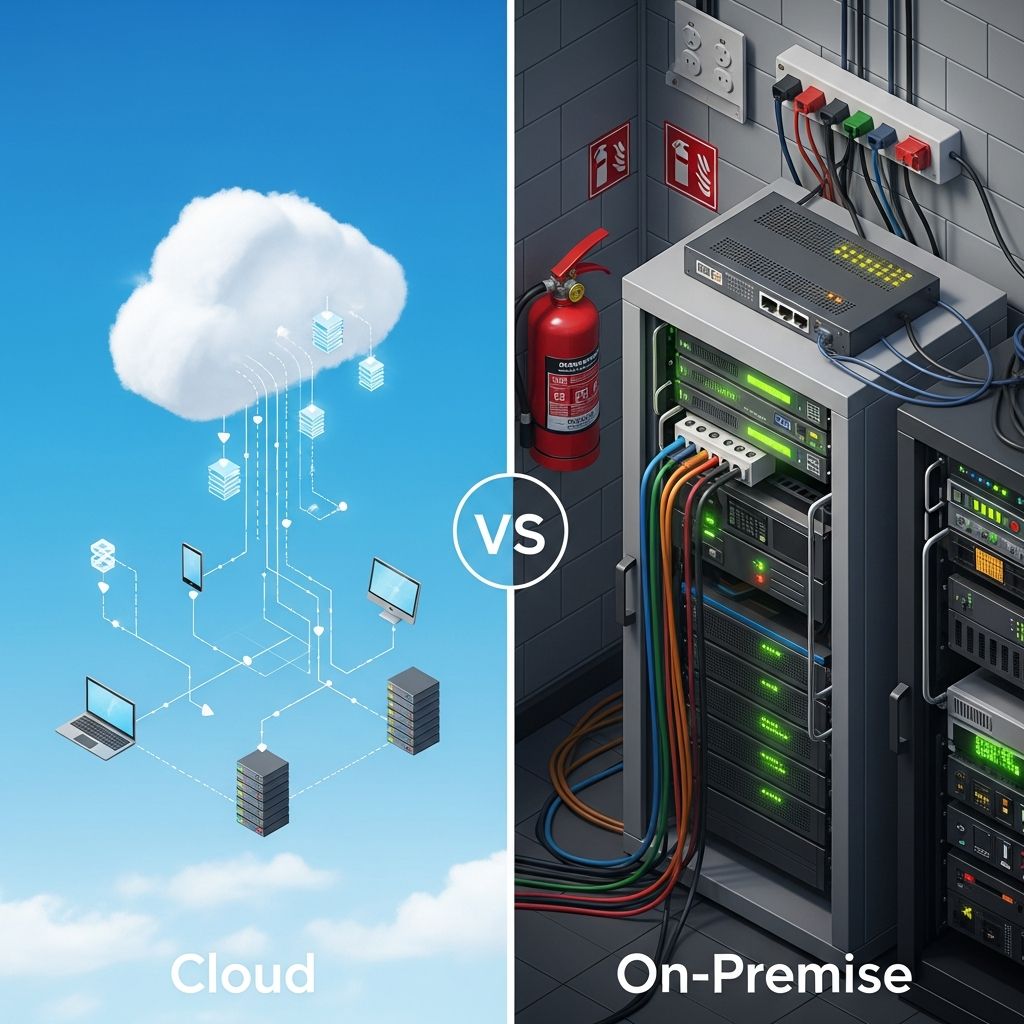
Small businesses stand at a crossroads in managing their IT infrastructure: adopt cloud computing for its flexibility or maintain on-premise systems to sidestep recurring fees. This decision impacts costs, operations, and growth potential profoundly. Cloud solutions eliminate hefty upfront hardware investments, offering scalability and advanced features, while on-premise setups provide control but demand ongoing maintenance.
Understanding Core IT Infrastructure Options
IT infrastructure forms the backbone of any small business, handling data storage, application hosting, and daily operations. On-premise systems rely on physical servers and software installed locally, granting full ownership but requiring in-house expertise for upkeep. In contrast, cloud computing delivers these services via internet-connected remote data centers managed by providers like AWS or Google Cloud.
This shift matters because traditional setups often strain limited budgets. Small firms report up to 40% IT cost reductions post-migration due to pay-as-you-go models. Yet, the monthly fees spark debate: are they an expense or an investment in efficiency?
Financial Implications: Breaking Down Costs
Cost structures differ sharply between models. On-premise demands capital expenditures (CapEx) for servers, software licenses, and cooling systems—often $10,000-$50,000 initially for modest setups. Annual maintenance adds 15-20% of that value, plus electricity and staff time.
Cloud shifts to operational expenses (OpEx), charging only for used resources. Businesses save 20-30% on infrastructure annually, with predictable billing avoiding surprise repairs. A table illustrates this:
| Aspect | On-Premise | Cloud |
|---|---|---|
| Upfront Cost | High ($20K+) | Low (None) |
| Ongoing Fees | Maintenance (15-20% yearly) | Subscription ($100-$1K/mo) |
| Total 3-Year Savings | Variable | 30-40% lower |
| Scalability Cost | Hardware upgrades | Instant, usage-based |
Small and medium businesses (SMBs) using cloud report 21% higher profits and 26% faster growth, turning IT from a drag into a growth engine.
Scalability: Adapting to Business Flux
Growth isn’t linear for small businesses—seasonal peaks, new clients, or expansions demand flexible resources. On-premise systems falter here, requiring weeks for procurement and installation, often leading to over-provisioning (paying for idle capacity).
Cloud excels with elastic scaling: ramp up servers during a product launch or dial down in slow months. 89% of adopters note improved scalability, enabling 26% quicker growth. Remote teams access tools seamlessly, boosting collaboration by 25%.
- Instant resource adjustment without hardware buys.
- Supports hybrid work, vital post-pandemic.
- Handles data surges, like e-commerce spikes.
Security and Compliance: Myths vs Reality
Many hesitate on cloud due to security fears, yet providers invest billions in defenses surpassing most SMB capabilities. Features include AI threat detection, encryption, and compliance with GDPR, HIPAA, SOC 2—reducing breach risks amid $6 trillion annual cyber losses.
On-premise exposes firms to unpatched vulnerabilities; cloud automates updates. Disaster recovery? Cloud backups enable hours-long restores versus days. Still, shared responsibility applies: businesses secure their data, providers handle infrastructure.
Operational Efficiency and Collaboration Boost
Cloud centralizes apps like CRM, ERP, and file sharing, slashing email chains and version conflicts. Teams collaborate real-time from any device, lifting productivity 35%. Integration with AI automation streamlines workflows, freeing staff for high-value tasks.
For 2026, trends emphasize outcome-focused clouds: native tools for reporting and omnichannel customer engagement. Small firms gain enterprise-grade analytics without specialists.
Potential Downsides and Migration Hurdles
No choice is flawless. Cloud dependencies risk outages (though 99.99% uptime is standard) and data lock-in with vendors. Monthly fees accumulate—$500/month equals $6,000 yearly—but pale against on-premise totals.
Migration challenges include data transfer, staff training, and app compatibility. Poor planning leads to disruptions; phased approaches mitigate this.
- Internet reliance: Downtime halts access.
- Customization limits versus on-premise.
- Long-term vendor pricing uncertainty.
Strategic Migration Roadmap
Assess needs: Inventory apps, data volume, growth projections. Start hybrid—move non-critical tools first. Choose providers matching scale: Microsoft 365 for offices, AWS for heavy compute.
- Audit current IT: Identify migration candidates.
- Select provider: Prioritize security, integrations.
- Pilot test: Migrate one department.
- Train staff: Minimize resistance.
- Monitor and optimize: Track ROI quarterly.
SMBs see ROI in 6-12 months, with 11.2% annual profit gains.
Industry Case Studies and Stats
A small architecture firm ditched servers for cloud project management, cutting costs 40% and enabling remote bids. Retailers scale e-commerce during holidays without crashes. Stats: Cloud market hits $947.3B by 2026, driven by SMB adoption.
Future-Proofing with 2026 Trends
By 2026, edge computing, AI integration, and zero-trust security dominate. SMBs ignoring cloud risk obsolescence as competitors leverage agility. Hybrid models blend best worlds: sensitive data on-premise, scalable apps in cloud.
Frequently Asked Questions
What are the biggest cost savings from cloud for small businesses?
Eliminating hardware CapEx, reducing maintenance by 30-40%, and paying only for usage lead to substantial savings.
Is cloud secure enough for my business data?
Yes, providers offer enterprise-grade encryption and compliance, often superior to in-house setups.
How long does cloud migration take?
Phased migrations complete in 3-6 months for most SMBs, with pilots in weeks.
Can I switch back from cloud to on-premise?
Possible but costly; plan for vendor lock-in by choosing open standards.
What if my internet goes down?
Offline modes and backups mitigate risks; select providers with strong SLAs.
This analysis equips small businesses to decide confidently, balancing immediate fees against long-term gains. Cloud isn’t for everyone, but data shows it’s fueling resilient growth.
References
- Benefits of Cloud Computing for Small and Medium Businesses — ePATHUSA. 2024. https://epathusa.net/benefits-of-cloud-computing-for-small-and-medium-businesses/
- Why Cloud Computing Has Big Benefits for Small Business — Deltek. 2024. https://www.deltek.com/en/saas/cloud-benefits-small-business
- Unlock the benefits of cloud computing for small business — CloudVara. 2024. https://cloudvara.com/benefits-of-cloud-computing-for-small-business/
- Why Small and Mid-Sized Businesses Are Moving to the Cloud — Compass MSP. 2024. https://compassmsp.com/resources/why-small-and-mid-sized-businesses-are-moving-to-the-cloud-and-why-you-should-too
- 2026 Small Business Cloud Trends — BlueTeam Networks. 2026-01-01. https://blueteamnetworks.com/blog/2026-smb-cloud-computing-trends/
Similar Articles








Read full bio of Sneha Tete


