
Children and the Fourth Amendment at School
How constitutional search-and-seizure rules change when students are minors in a school setting.
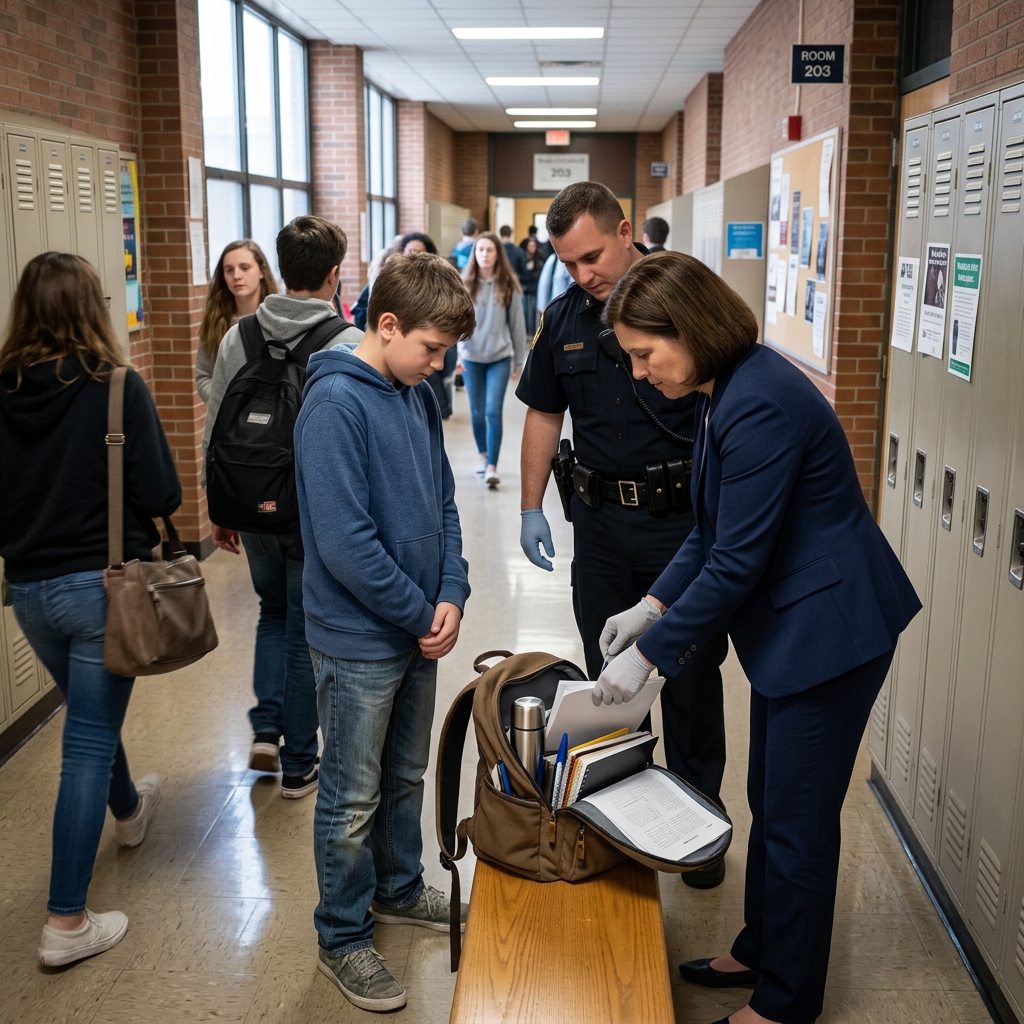
The Fourth Amendment protects people from unreasonable searches and seizures, but that protection looks different when the person being searched is a student at school. Courts have long recognized that children do have constitutional rights, yet those rights are often shaped by the school environment, the student’s age, and the government’s interest in safety and order.
This article explains how search-and-seizure rules work for minors in schools, why the law gives school officials more flexibility than police officers usually have, and where the limits still remain.
Why student privacy is treated differently
The basic rule of the Fourth Amendment is that government searches should be reasonable, and warrants are generally required in the criminal context. In schools, however, the Supreme Court has recognized that a stricter warrant-and-probable-cause standard would be difficult to apply to ordinary school discipline and safety concerns.
School officials are government actors, so their conduct is not outside the Constitution. At the same time, schools are not treated like streets, homes, or police stations. Administrators must respond quickly to misconduct, contraband, safety threats, and rule violations, often without the time needed to seek a warrant.
- Students keep Fourth Amendment rights inside school.
- Those rights are narrower than the rights adults usually have in ordinary criminal investigations.
- Courts look for reasonableness instead of a warrant in many school searches.
The core legal standard: reasonableness
The leading constitutional rule for student searches is that a search by school officials must be reasonable under all the circumstances. That standard is more flexible than probable cause. It asks whether the school had a proper reason to search and whether the search was carried out in a way that fit the problem being investigated.
In practice, this means the legality of a school search usually turns on two questions:
| Question | What courts look for |
|---|---|
| Was the search justified? | Did school officials have a reasonable basis to think the search would uncover a rule violation, dangerous item, or other relevant evidence? |
| Was the search limited? | Was the search no more intrusive than needed in light of the student’s age, sex, and the suspected issue? |
This framework gives schools room to maintain order, but it also prevents searches that are arbitrary, humiliating, or far broader than the situation requires.
What schools can search
School searches can involve a student’s person, clothing, locker, backpack, purse, desk, or other items under school control. Courts have generally allowed searches of student property when the search is tied to a legitimate school concern and remains appropriately narrow.
Examples of situations that may support a search include suspicion of stolen property, drugs, weapons, electronic contraband, or evidence of misconduct that affects school safety or discipline. The key point is not that a school must wait until danger becomes certain, but that it must have a reason grounded in facts rather than a hunch.
- Backpacks and purses may be searched if there is a reasonable basis to do so.
- Lockers are often treated as school-controlled spaces, which can reduce a student’s expectation of privacy.
- A search becomes harder to justify when it expands beyond the suspected item or offense.
Why age matters in the analysis
Children are not simply smaller adults. Constitutional law involving minors often takes account of the fact that young people may have less maturity, less understanding of their rights, and a different relationship to authority. Scholarship on juvenile rights has emphasized that courts often consider context, parental authority, and a child’s capacity when evaluating constitutional claims.
That same logic affects school searches. A search that might be minimally intrusive for an older student may be excessive for a younger child. The Supreme Court’s school-search doctrine reflects this by asking whether the scope of the search is reasonable in light of the student’s age and sex.
As a result, schools cannot rely on a one-size-fits-all approach. A search of a kindergartner, middle school student, and high school senior may all be evaluated differently if the same facts are presented.
How school searches differ from police searches
Police investigations are usually governed by the familiar probable-cause and warrant framework, especially in homes and other private spaces. School officials, by contrast, may search on a lower standard because their role is educational as well as disciplinary.
This difference matters. A school principal is not free to ignore the Constitution, but the principal is also not required to use the same procedures as a criminal detective before responding to everyday school problems. The legal system recognizes that discipline and student safety often require immediate action.
- Police searches are typically more heavily regulated.
- School searches may rely on reasonable suspicion or a reasonableness test rather than probable cause.
- Evidence found in a school search may still be used in later proceedings if the search was lawful.
Student rights still have real limits on campus
Although students keep constitutional protection, courts have repeatedly allowed schools to exercise authority that would be more difficult to justify in another setting. The Supreme Court has recognized that maintaining an orderly learning environment is a legitimate public function, and the government has a strong interest in preventing danger, disruption, and misconduct in schools.
That does not mean a student loses all privacy on campus. It means the law balances privacy with the school’s duty to supervise children. A search that is purely retaliatory, based on personal animus, or unnecessarily invasive can still violate the Fourth Amendment.
Courts often examine whether the school official acted on specific facts, whether the search was tied to a real concern, and whether the manner of the search respected the student’s dignity as much as possible under the circumstances.
Situations where school searches become legally risky
Some searches are more likely than others to raise constitutional problems. The issue is usually not the existence of school authority itself, but the way that authority is used.
- Searching a student without any factual basis or credible report.
- Using a search to embarrass, intimidate, or punish rather than investigate.
- Making the search more intrusive than the suspected offense justifies.
- Continuing to search after the suspected item could not reasonably be located.
For example, if a teacher suspects a student has a missing assignment, that would not justify the same level of intrusion as a search for a weapon. The seriousness of the suspected problem matters because the reasonableness of the search depends on the nature of the risk.
How juvenile rights fit into the bigger constitutional picture
The Fourth Amendment is only one part of the constitutional protections minors receive. The federal government has recognized that juveniles are entitled to various safeguards in delinquency proceedings, including notice, counsel, and the privilege against self-incrimination. Courts have also acknowledged that the exclusionary rule can apply when evidence is obtained through unconstitutional juvenile searches.
In broader constitutional law, children often receive protection that is sensitive to developmental differences, even if the protection is not identical to what adults receive. The same theme appears in school search cases: minors are entitled to privacy, but the law measures that privacy in light of the school setting and the child’s status as a student.
Practical questions parents and students often ask
Can a school search a backpack without permission? Yes, if the search is reasonable under the circumstances and tied to a legitimate school concern.
Does a student need to be suspected of a crime? No. A search may be tied to school discipline or safety concerns, not just criminal conduct.
Can school officials search a phone? The general Fourth Amendment principles still apply, but the legality depends on the facts, the scope of the search, and the school’s justification. A broad search with no clear connection to the suspected issue is more vulnerable to challenge.
Is consent important? Consent can matter in many Fourth Amendment settings, but in schools the legal analysis often focuses on the reasonableness of the search rather than a formal warrant process.
FAQs
Do students have Fourth Amendment rights at school?
Yes. Students do have Fourth Amendment rights, but those rights are applied in a school-specific way that gives administrators more flexibility than police typically have.
Why don’t schools need warrants for every search?
Because the school environment requires quick decisions about discipline and safety, the law uses a reasonableness standard instead of a warrant requirement for many school searches.
Can a school search a student’s personal items?
Yes, if the search is justified and not excessively intrusive. Backpacks, purses, and similar items may be searched when the facts support it.
Can evidence from a bad search be excluded?
Yes. Unlawfully obtained evidence can be challenged, and the exclusionary rule has been applied in juvenile contexts.
Do younger students have the same privacy rights as older students?
They have constitutional rights, but the level of intrusion allowed can depend on age, maturity, and the educational setting.
Bottom line for families and schools
Students are protected by the Fourth Amendment, but school searches are judged by a more flexible standard than ordinary police investigations. Courts ask whether the search was justified, whether it was limited, and whether it respected the student’s age and the school context.
For families, the practical lesson is that a search is not automatically lawful just because it happens at school. For schools, the practical lesson is that authority is broad but not unlimited. A careful, fact-based, and proportionate search is far more likely to withstand constitutional scrutiny than one based on speculation or overreaction.
References
- What Does the Fourth Amendment Mean? — United States Courts. n.d. https://www.uscourts.gov/about-federal-courts/educational-resources/about-educational-outreach/activity-resources/what-does-fourth-amendment-mean
- Constitutional Protections Afforded Juveniles — U.S. Department of Justice, Justice Manual. n.d. https://www.justice.gov/archives/jm/criminal-resource-manual-121-constitutional-protections-afforded-juveniles
- The Fourth Amendment Rights of Children at Home: When Parental Authority Meets the Constitution — William & Mary Law Review / author source page. n.d. https://scholarship.law.wm.edu/wmlr/vol53/iss1/3/
- Minors and the Fourth Amendment: How Juvenile Status Should Invoke Different Standards for Searches and Seizures on the Street — New York University Law Review. n.d. https://nyulawreview.org/issues/volume-71-number-3/minors-and-the-fourth-amendment-how-juvenile-status-should-invoke-different-standards-for-searches-and-seizures-on-the-street/
- Fourth Amendment Protection for the Juvenile Offender — Fordham Law Review archive. n.d. https://ir.lawnet.fordham.edu/cgi/viewcontent.cgi?article=2496&context=flr
- The Fourth Amendment Rights of Public School Students — California legal education resource. n.d. https://www.fdap.org/wp-content/uploads/2020/11/2018_Fourth_Amendment_Rights_of_Public_School_Students.pdf
Similar Articles








Read full bio of Sneha Tete




