
Drug-Sniffing Dogs At Homes: What Homeowners Need To Know Now
A clear look at when a canine sniff at a home crosses the Fourth Amendment line.
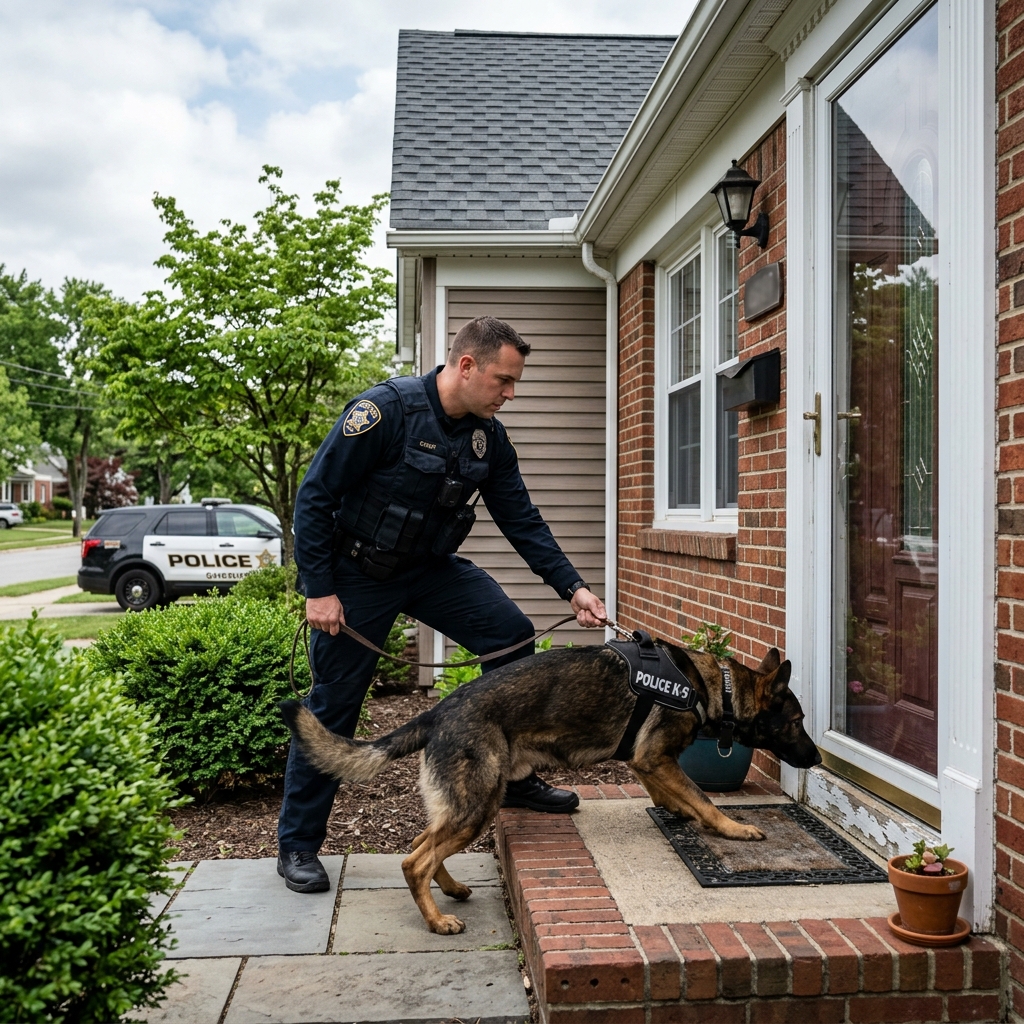
Drug-sniffing dogs are a familiar tool in criminal investigations, but their use becomes far more sensitive when the target is a home. The Supreme Court has made clear that the area immediately around a house receives special constitutional protection, and officers generally need a warrant when they want to use a trained dog to investigate that space for evidence.
This issue matters because the Fourth Amendment is designed to draw a line between ordinary police observation and a true search. A dog sniff at a front porch, doorway, or similar area is not treated the same way as a casual approach by a visitor. When officers use a trained canine to gather evidence from the curtilage of a home, courts focus on whether the police exceeded the limited license that members of the public normally have to approach a residence.
Why the Home Gets Special Protection
The Supreme Court has long treated the home as the core of Fourth Amendment privacy. That protection does not stop at the walls of the house. It also extends to the curtilage, meaning the immediate area around the home that is closely tied to private life.
Curtilage can include spaces such as a front porch, entry steps, a small enclosed yard, or other areas that are intimately connected to the home. The Court’s reasoning is that these areas are not open to the kind of general investigation that police may conduct in public places.
In practical terms, a homeowner may expect a mail carrier, a neighbor, or a child collecting candy to walk up to the front door. But that ordinary social permission does not automatically allow officers to bring a trained dog to sniff for hidden contraband. The Court distinguished normal, implied social access from a targeted law-enforcement search.
What the Supreme Court Said About Dog Sniffs
In the key case discussed in the source material, the Supreme Court held that using a trained drug dog to investigate the home and its immediate surroundings is a search under the Fourth Amendment. Because the officers did not have a warrant, the search was unconstitutional.
The Court’s logic rested on physical intrusion. The officers entered constitutionally protected space with the purpose of collecting information that would not have been available from a lawful ordinary visit. That kind of investigative conduct is different from merely seeing something in plain view from a public sidewalk.
The Court also emphasized that a dog sniff at the home is not a passive observation. The dog is not just detecting odors drifting into a public area; it is being used as an instrument of law enforcement to explore the protected space around the home in hopes of finding evidence of a crime.
How This Differs from Dog Sniffs in Cars
Dog-sniff cases involving vehicles have often been analyzed differently from home cases. In traffic-stop settings, the Supreme Court has said that police may not prolong a lawful stop simply to conduct a canine sniff unless there is adequate legal justification for extending the detention.
That rule shows that even outside the home, police cannot use a dog in a way that creates an unreasonable detention. But homes receive even stronger protection than cars. A vehicle is mobile and heavily regulated; a residence is the place where privacy interests are at their highest.
This difference explains why a canine sniff that may be permitted in some vehicle-related settings can still be unconstitutional when the target is a front porch or other area tied to the home.
The Role of the Warrant Requirement
A warrant is central because it forces police to show probable cause and submit to prior judicial approval before searching protected property. In the home-sniff context, the absence of a warrant was a major reason the Court found the search invalid.
The warrant requirement does not mean police can never use a drug dog near a residence. It means they must generally obtain judicial authorization first unless a recognized exception to the warrant rule applies. Without that protection, the risk is that police could use trained dogs to probe private homes based on little more than suspicion.
This framework keeps the investigative power of the government in check. It also preserves the distinction between public-facing areas and the private sphere where occupants are entitled to the highest constitutional security.
What Counts as an Unlawful Intrusion?
The key question is not only whether the police were physically close to the house, but why they were there and what they did. If officers approach a home as ordinary visitors would, they may walk to the front door for a knock and talk. But if they bring a drug dog to explore the area surrounding the house for evidence, the action can become a search.
That distinction matters because law enforcement cannot rely on an implied invitation to visit a home as a license to conduct forensic investigation. The Court described the ordinary invitation to approach a door as limited and informal; it does not authorize police to turn the front entrance into a sniff zone.
In other words, the Constitution allows access for communication, not covert detection. Once officers shift from conversation to evidence-gathering, the legal analysis changes sharply.
How Lower Courts and Related Cases Fit In
Lower courts have continued to wrestle with canine sniffs in residential and semi-residential settings, including apartment doors and shared hallways. Some decisions have focused on whether the sniff took place in a truly private space or in a common area accessible to multiple residents and visitors.
That issue can matter because apartment buildings and shared entrances do not always function like a single-family home. Still, the general constitutional principle remains the same: the more closely the area is tied to private domestic life, the stronger the Fourth Amendment protection.
Related Supreme Court cases also reinforce a broader theme. In the traffic-stop setting, the Court has rejected unnecessary extensions of detentions for dog sniffs when police lack the required justification. Together, these cases show that canine investigation is not a free-standing exception to the Fourth Amendment. Its legality depends on context, location, and the presence of proper legal authority.
Practical Effects for Homeowners and Tenants
For people who live in homes, apartments, or duplexes, the ruling means police cannot simply walk onto protected residential space with a drug dog and treat the resulting alert as automatic probable cause. If officers want to investigate the private area of a residence using a canine, they usually need a warrant or another valid legal basis.
- Homeowners may challenge evidence gathered from a dog sniff that took place on protected residential property without judicial authorization.
- Tenants may also have privacy interests in the immediate area around their dwelling, depending on the layout and control of the space.
- Police may still use ordinary observation, but they cannot convert a normal approach to a door into a search for hidden contraband.
This does not eliminate police investigative authority. It places a constitutional checkpoint in front of highly intrusive tactics used against homes.
Key Fourth Amendment Principles in Plain Language
| Principle | What it means |
|---|---|
| Home privacy | The home is the most protected place under the Fourth Amendment. |
| Curtilage | The area immediately around a home may receive the same protection as the house itself. |
| Search | Using a drug dog to gather evidence from protected residential space can count as a search. |
| Warrant rule | Police generally need a warrant before conducting that search. |
| Limited license | Ordinary visitors may approach a door, but that does not authorize evidence gathering. |
This table captures the basic constitutional structure behind the Court’s treatment of dog sniffs near a house. The details can vary, but the legal center of gravity is clear: home-based investigative sniffs are strongly disfavored without prior judicial approval.
Common Questions About Dog Sniffs and Homes
Can police bring a drug dog to the front door without a warrant?
Not when the goal is to investigate the home and its protected surroundings for evidence. The Supreme Court has treated that conduct as a search requiring a warrant.
What if police just walk up like regular visitors?
Police may approach a home for legitimate, ordinary contact, such as a knock and talk. But the implied permission to approach does not include bringing a trained dog to search for incriminating odors.
Does the rule apply to apartments too?
Apartment cases can be more complicated because hallways and entryways may be shared. Courts look closely at whether the sniff occurred in a protected private area or in a common space with less privacy.
Are dog sniffs always illegal?
No. Canine sniffs can be lawful in some settings, especially when supported by proper legal authority and not used to invade protected residential space. The legality depends on where the sniff occurs and whether police had a valid justification.
Why the Decision Still Matters
The Court’s ruling remains important because it limits a technique that could otherwise become a shortcut around the warrant process. A drug dog can produce powerful evidence, but constitutional protections do not disappear simply because the evidence is obtained through an animal rather than a person.
The ruling also sends a broader message about technology and law enforcement methods: when police use specialized tools to reveal what would not normally be observable from a lawful public vantage point, the Fourth Amendment may require a warrant.
For that reason, the home remains a hard boundary in search-and-seizure law. Police may investigate crime aggressively, but the Constitution demands extra care before they use investigative methods that penetrate private domestic space.
Final Takeaway
When officers use a drug-sniffing dog to investigate the outside of a home, the Supreme Court has said that the conduct can qualify as a search and therefore usually requires a warrant. The decision reflects a long-standing constitutional principle: the closer the government comes to the home, the stronger the privacy protection becomes.
References
- Supreme Court Finds the Use of a Drug-Sniffing Dog to Investigate a Home Unconstitutional — Brookings. 2013-03-27. https://www.brookings.edu/articles/supreme-court-finds-the-use-of-a-drug-sniffing-dog-to-investigate-a-home-unconstitutional/
- United States v. Johnson — Harvard Law Review. 2025-??-??. https://harvardlawreview.org/print/vol-139/united-states-v-johnson/
- Drug Charges from Drug-Sniffing Dogs at Routine Traffic Stops Now Illegal Per Supreme Court — Strom Law Firm. 2015-04-21. https://stromlaw.com/supreme-court-rules-drug-sniffing-dogs-at-traffic-stops-are-illegal/
- Rodriguez v. United States | Supreme Court Bulletin — Cornell Law School. 2014-10-02. https://www.law.cornell.edu/supct/cert/13-9972
- Supreme Court Hears Cases on Drug-Sniffing Dogs and Privacy — PBS NewsHour. 2013-03-27. https://www.youtube.com/watch?v=JWeTh1g0mf4
- Canine Sniffs: The Search That Isn’t — NYU Law. 2018-06-09. https://www.law.nyu.edu/sites/default/files/ECM_PRO_060918.pdf
- Supreme Court Finds the Use of a Drug-Sniffing Dog to Investigate a Home Unconstitutional — Brookings. 2013-03-27. https://www.brookings.edu/articles/supreme-court-finds-the-use-of-a-drug-sniffing-dog-to-investigate-a-home-unconstitutional/
Similar Articles








Read full bio of medha deb




