
Undefined: Can College Athletes Unionize? Expert Guide For 2025
A clear look at when college athletes may organize, bargain, and what law still leaves unresolved.
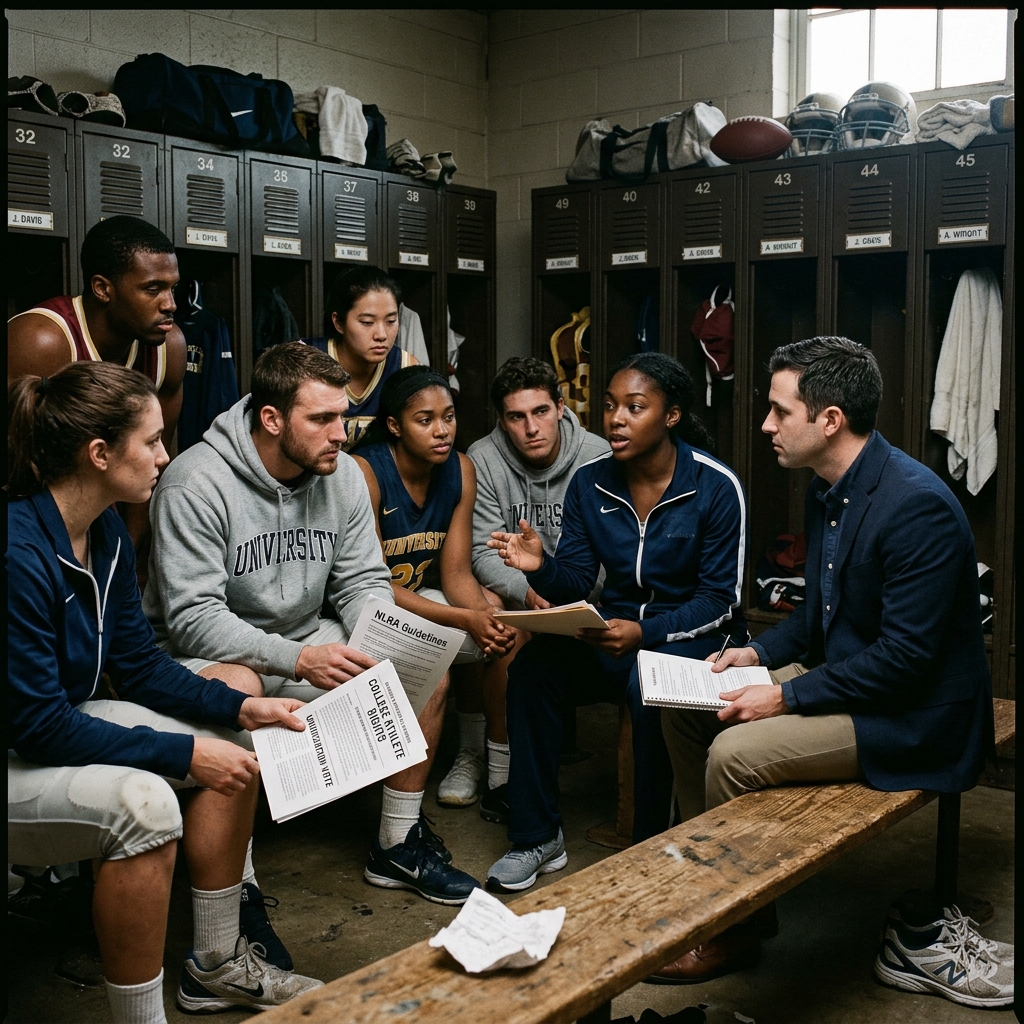
Can College Athletes Unionize?
Whether college athletes can form a union depends on how labor law treats them, which kind of school they attend, and whether federal agencies or Congress change the rules. The issue has moved from a theoretical debate to a real legal fight because recent developments have pushed some athletes closer to employee status, while other barriers remain in place.
At the center of the controversy is a simple question with complicated consequences: are college athletes students who participate in sports, or workers who provide labor in exchange for compensation and control? That distinction matters because union rights generally attach to employees, not independent contractors or volunteers.
The basic legal issue
Unionization in the United States is tied to labor law, especially the National Labor Relations Act. If athletes are considered employees under that law, they may be able to organize, choose a representative, and bargain over wages, working conditions, health and safety, and other terms of employment.
If they are not employees, they generally cannot invoke the federal right to unionize under that statute. That is why every college-athlete union effort begins with the same threshold question: whether the athletes fit the legal definition of workers rather than simply students participating in extracurricular activity.
Private universities are especially important in this discussion because federal labor law generally applies to private-sector workplaces. Public universities are usually governed by state labor law, and those state systems can differ widely. That means a path to unionization may exist in one state and not another, even when the sport and the athletes are similar.
Why the conversation changed
The modern push for athlete organizing accelerated as college sports became more commercialized. Schools, conferences, and the NCAA now operate within an environment where television contracts, sponsorships, and postseason revenue are enormous, while players still face strict rules on compensation and control over their athletic schedules.
That mismatch has encouraged advocates to argue that athletes are performing valuable services under intensive supervision. They point to training demands, travel, mandatory workouts, media obligations, and eligibility rules as evidence that college athletics looks more like a regulated workplace than a casual student activity.
A major turning point came when the National Labor Relations Board’s general counsel took the position that some athletes at private universities should be treated as employees and therefore may organize. That guidance did not automatically create unions, but it signaled that the legal landscape had shifted in favor of recognizing labor rights for at least some college athletes.
Private schools, public schools, and different legal paths
Not every college athlete faces the same legal route. Private schools are often analyzed under federal labor law, while public schools may fall under state statutes or constitutional constraints. As a result, two athletes on rival teams may have very different rights depending solely on whether their university is private or public.
Congress has also been considering legislation that would extend or clarify athlete bargaining rights. One proposed federal approach would amend labor law to define some college athletes as employees and to make clear that public institutions could also be covered for athletics-related labor disputes. If adopted, such a law would narrow the current patchwork and create a more uniform national rule.
Until that happens, the answer to whether athletes can unionize remains conditional rather than universal. In some settings, the question is being resolved by agency interpretation or litigation; in others, lawmakers would need to act before collective bargaining becomes realistic.
The arguments for union rights
Supporters of unionization make several recurring points. First, college athletes often follow detailed schedules imposed by coaches and athletic departments, leaving limited freedom over how their time is used.
Second, they may receive compensation or benefits tied to athletic participation, including grants-in-aid or other forms of support. That arrangement can resemble an employment relationship more than a purely educational one, especially when participation is required as a condition of receiving the benefit.
Third, unionization could give athletes a formal voice on issues that directly affect them. Common topics include medical coverage, injury protocols, mental health resources, travel burdens, housing, discipline, and transfer policies. Advocates argue that collective bargaining is a practical mechanism for addressing these concerns in a structured way.[10]
Finally, many supporters say labor rights should not depend on the romantic idea of amateurism. They contend that once colleges profit from athletic labor on a large scale, the law should not ignore the realities of the relationship between schools and players.
The arguments against unionization
Opponents respond that college sports are fundamentally educational and that athletes are enrolled as students first. They warn that treating athletes as employees could alter the structure of college athletics, create conflicts with academic missions, and increase compliance burdens for schools.
Another common concern is fragmentation. Large athletic programs involve multiple sports, scholarship structures, conference rules, and competitive calendars. Critics argue that union bargaining could become difficult to manage across different teams and institutions, especially if no single standard applies nationwide.
There is also disagreement about whether athlete benefits should be treated as wages, whether scholarship aid should trigger employee status, and whether collective bargaining would upset existing recruiting and eligibility systems. These questions matter because legal classification can affect not only labor rights but also tax, financial aid, and administrative rules.
What recent legal actions show
Recent cases demonstrate that the issue is not just academic. Athletes at private schools have pursued representation petitions and unfair labor practice claims to test whether they are employees under federal law.
One high-profile example involved men’s basketball players at Dartmouth, who advanced far enough to vote in favor of forming a union before their effort stalled in the appeals process. Another involved athletes at USC and in the Pac-12, where labor complaints helped spark broader debate about whether players are entitled to bargaining rights.
These cases show that athlete unionization is proceeding through ordinary labor-law channels rather than through a special sports statute. That makes the outcome highly dependent on agency interpretation, litigation strategy, and changes in political leadership at the federal level.
Possible structures for athlete bargaining
If unionization continues to expand, the form it takes may vary. One possibility is school-by-school bargaining, where athletes at a single campus negotiate with their institution. Another is conference-wide bargaining, which could reduce duplication and create more consistent standards across a league.[10]
A third possibility is a broader model in which a representative body negotiates a master agreement covering several schools or sports categories. Advocates of this approach argue that health and safety rules, academic protections, and basic compensation issues could be handled more efficiently at a higher level.
Each model has advantages and drawbacks. Local bargaining may reflect the realities of a particular campus, while broader bargaining may create uniformity and leverage. The legal system has not yet settled on one preferred design.[10]
How athletes could benefit from unionization
Unionization could give players a formal seat at the table. That could matter most in areas where individual athletes have little bargaining power on their own, such as medical treatment after injury, limits on practice hours, protection against retaliation, or minimum standards for facilities and support services.[10]
A union may also help athletes negotiate for clearer standards around safety and welfare. Because college sports involve intense physical demands, advocates believe organized bargaining could improve transparency and accountability in how institutions manage risk.
Another likely benefit is consistency. Rather than relying on informal promises or changing administrative policies, athletes could push for written agreements that stay in place until renegotiated.[10]
Why the issue is still unresolved
Even with new legal momentum, college-athlete unionization remains unsettled because the law is still evolving. Some athletes may eventually qualify as employees under federal labor law, while others may not. Public schools, in particular, may continue to follow different state rules.
Political change also matters. Agency guidance can shift with new administrations, and congressional proposals can either expand or restrict the rights of athletes depending on how lawmakers define employment.
As a practical matter, this means a future in which some teams bargain collectively is more plausible than a single nationwide answer that settles everything at once. The legal system is moving, but it has not finished drawing the boundaries.
Comparison of the main legal paths
| Path | Who it affects | What it could allow | Main limitation |
|---|---|---|---|
| Federal labor law | Private-school athletes most directly | Union elections and collective bargaining if employees | Depends on employee status under the NLRA |
| State labor law | Public-school athletes in some states | Possible organizing and bargaining rights | Varies widely by state |
| Congressional reform | Nationally, if enacted | Uniform rules for athlete bargaining | Requires legislation and political agreement |
What colleges should watch
- How the NLRB defines employee status for athletes at private institutions.
- Whether federal legislation creates a national framework for collective bargaining.
- How courts treat pending athlete cases involving labor and compensation disputes.
- Whether public universities face separate obligations under state labor systems.
Frequently asked questions
Can college athletes unionize right now? Some athletes may be able to pursue union rights, especially at private schools, but the answer is not uniform nationwide because the law is still developing.
Do all college athletes count as employees? No. The legal status question depends on the institution, the compensation structure, and the governing law.
Would unionization apply only to football and basketball? Not necessarily. Different sports could be covered depending on how a bargaining unit is defined and how labor authorities handle the case.
Does a scholarship automatically make someone an employee? Not automatically, but compensation tied to athletic participation is one of the facts lawyers and regulators examine when assessing employee status.
What is the biggest barrier to unionization? The biggest barrier is unresolved legal classification, because union rights usually depend on being recognized as an employee under applicable law.
Where the debate is headed
The most likely near-term outcome is continued piecemeal development through agency decisions, litigation, and targeted legislation rather than one sweeping national rule. That means college athletes, universities, and conferences should expect more legal uncertainty before the landscape becomes stable.
For now, the best answer is that college athletes may be able to unionize in some circumstances, but not simply because they play for a university. Their rights will depend on whether labor law treats them as workers, whether the school is public or private, and whether lawmakers or courts create a clearer national standard.
References
- College Athletes Can Finally Unionize — Jacobin. 2021-10. https://jacobin.com/2021/10/college-athletes-pay-unionizing-nlrb
- Rep. Lee, Sen. Murphy Reintroduce College Athlete Right to Organize Act — Office of Rep. Summer Lee. 2025-07-24. http://summerlee.house.gov/newsroom/press-releases/rep-lee-sen-murphy-reintroduce-college-athlete-right-to-organize-act
- College Athlete Unionization — Texas A&M Law Review / ScholarWorks. 2022. https://scholarship.law.tamu.edu/lawreview/vol11/iss4/4/
- Effort to unionize college athletes hits stumbling block — ESPN. 2025-01-08. https://www.espn.com/college-sports/story/_/id/43361128/effort-unionize-college-athletes-hits-stumbling-block
- Collective Bargaining in College Athletics — Virginia Law Review. 2024. https://virginialawreview.org/articles/standing-shoulder-pad-to-shoulder-pad-collective-bargaining-in-college-athletics/
- Do College Athletes Have Labor Rights? — Jason Stahl’s Newsletter. 2025. https://jasonstahl.substack.com/p/do-college-athletes-have-labor-rights
- New Report Illustrates Complications With College Athlete Unionization — Jones Walker. 2024. https://www.joneswalker.com/en/insights/blogs/perspectives/new-report-illustrates-complications-with-college-athlete-unionization.html
- Should College Athletes Unionize? A Former NLRB… — YouTube. 2024. https://www.youtube.com/watch?v=laY34CHsv54
- How Can Collective Bargaining Work In College Sports? — Athletic Director U. 2024. https://athleticdirectoru.com/video/how-can-collective-bargaining-work-in-college-sports/
- The Case for College Athlete Unions — Front Office Sports. 2024. https://frontofficesports.com/videos/the-case-for-college-athlete-unions/
Similar Articles








Read full bio of Sneha Tete




