
Biden’s Executive Order and the Future of Non‑Compete Agreements
How President Biden’s competition-focused executive order reshaped the debate over non-compete agreements and worker mobility nationwide.
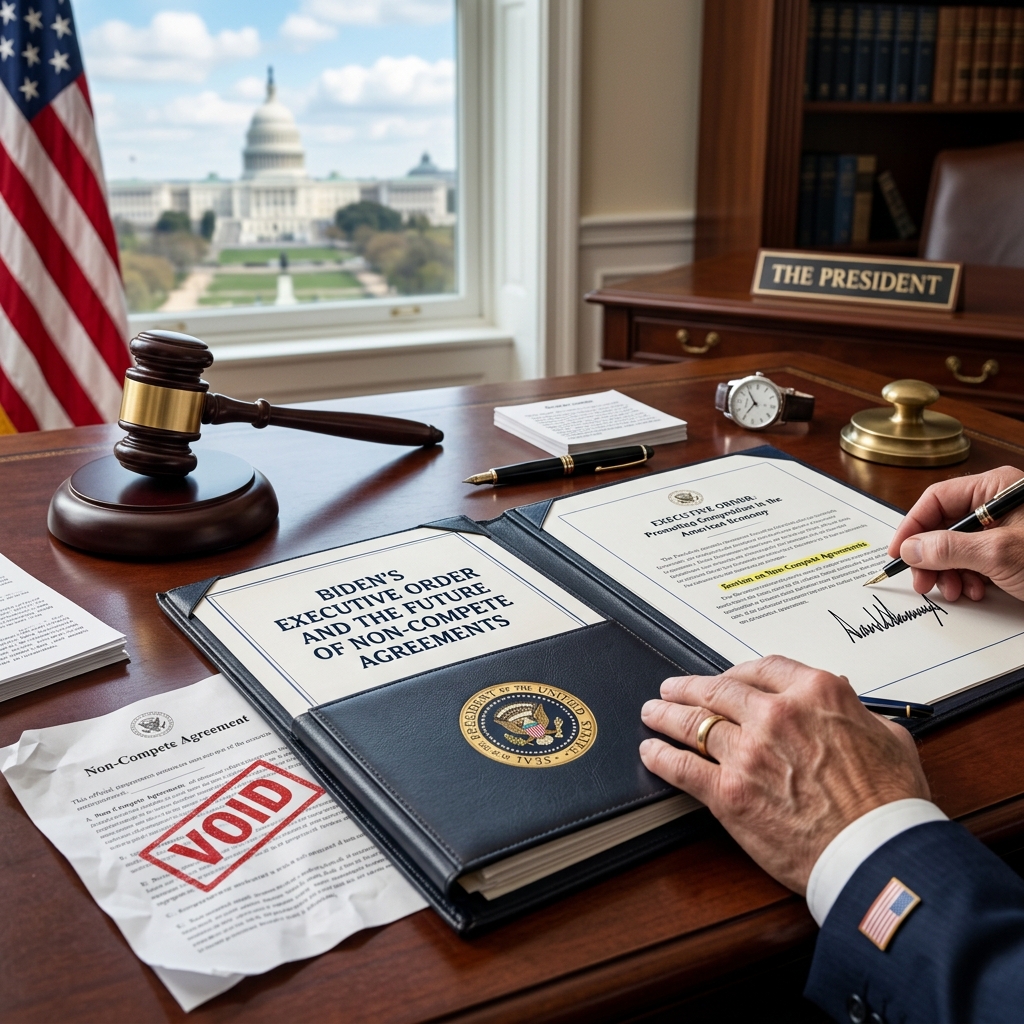
Non‑compete agreements have long been a common feature of U.S. employment contracts, used by companies to protect trade secrets, client relationships, and other competitive interests. In recent years, however, these clauses have come under intense scrutiny from policymakers who argue they suppress wages, restrict worker mobility, and harm competition in the broader economy.
President Joe Biden’s Executive Order on Promoting Competition in the American Economy marked a major turning point in this debate by explicitly calling on the Federal Trade Commission (FTC) to address what it described as the unfair use of non‑compete agreements. Although the order itself did not change the law overnight, it signaled a strong federal policy shift toward limiting or banning many non‑competes and set the stage for significant regulatory and legal developments.
Background: What Are Non‑Compete Agreements?
A non‑compete agreement is a contract clause that restricts an employee from working for a competitor, starting a competing business, or engaging in similar activities for a specified period and within a defined geographic area after their employment ends. Historically, states have governed these clauses under their own contract and employment laws, leading to a patchwork of rules across the country.
Typical elements of a non‑compete
- Restricted activities: working for a direct competitor, starting a competing company, or servicing certain clients.
- Duration: commonly six months to two years, although this varies by state and industry.
- Geographic scope: a specific city, region, or broader territory where competition is prohibited.
- Protected interests: trade secrets, confidential information, customer goodwill, and specialized training.
Courts traditionally evaluate these clauses using a reasonableness test: is the restriction no broader than necessary to protect legitimate business interests and not unduly burdensome on the worker or the public?
Why Non‑Competes Became a Federal Competition Issue
Although non‑compete law developed primarily at the state level, mounting evidence that these agreements were affecting large segments of the labor market led federal policymakers to view them as a competition and antitrust concern.
Key concerns raised by policymakers
- Reduced worker mobility: Non‑competes can make it difficult for employees to change jobs, switch industries, or relocate for better opportunities.
- Depressed wages: Economists and regulators argue that restricting job switching weakens workers’ bargaining power and can lower wage growth.
- Barrier to entrepreneurship: Employees who might otherwise start new businesses may be deterred by the risk of breaching a non‑compete.
- Overuse in low‑wage sectors: Reports showed non‑competes being used for workers with little access to trade secrets, such as retail or service employees, raising questions about necessity.
These concerns fit within a broader policy agenda focused on promoting competition across the U.S. economy, including in labor markets, healthcare, agriculture, technology, and consumer goods.
Biden’s Executive Order: Core Direction on Non‑Competes
President Biden’s wide‑ranging competition order was not limited to non‑competes, but one of its most closely watched provisions urged the FTC to use its rulemaking authority to curb restrictive employment agreements.
Key competition objectives in the order
- Encourage federal agencies to address practices that reduce competition and harm consumers and workers.
- Direct the FTC to consider rulemaking to limit the unfair use of non‑compete clauses and similar restrictive arrangements that constrain worker mobility.
- Promote labor market competition as a specific policy priority, alongside traditional product market competition.
The language of the order is important: it did not simply address “non‑compete agreements” in the narrow sense, but also referred to “other clauses or agreements that may unfairly limit worker mobility.” This phrasing opened the door to potential scrutiny of non‑solicitation provisions, no‑hire agreements, and related restrictions that, in practice, can have non‑compete‑like effects.
What the order did immediately — and what it did not
| Aspect | Immediate Effect of the Executive Order |
|---|---|
| Existing non‑compete laws | No direct change; state law and existing federal law continued to govern enforceability. |
| FTC authority | Formally encouraged the FTC to use its rulemaking powers under the FTC Act to address non‑competes. |
| Employer obligations | No new compliance duties were created solely by the order; obligations would arise later through FTC rules or legislation. |
| State enforcement | States remained free to enforce or restrict non‑competes under their own laws; some continued expanding employee protections. |
The FTC’s Response: Toward a Nationwide Rule
Following the executive order, the FTC signaled that it viewed non‑competes as falling within its consumer protection and antitrust mandate. In April 2024, the Commission took the unprecedented step of adopting a final rule that would have banned most non‑compete clauses nationwide.
Main features of the FTC’s 2024 final rule
- General ban on new non‑competes: Employers would have been prohibited from entering into new non‑compete agreements with nearly all workers, including senior executives.
- Invalidation of existing non‑competes: Existing non‑compete clauses for the vast majority of employees would have become unenforceable on the rule’s effective date.
- Limited exception for senior executives: A narrow group of high‑level executives (less than 0.75% of workers) could have remained subject to existing non‑competes, though employers still could not enter into new ones with them.
- Notice requirement: Employers would have been required to notify affected workers that their non‑competes would no longer be enforced.
The rule was framed as a competition measure designed to protect workers’ ability to change jobs, support innovation, and foster new business formation.
Legal challenges and subsequent developments
The FTC’s final rule faced immediate legal challenges, with litigants arguing that the agency had exceeded its statutory authority under the FTC Act, among other claims. Federal courts subsequently issued nationwide orders preventing the FTC from enforcing the rule, and the Commission later dismissed its appeals, conceding that the rule was not legally viable in its adopted form.
Despite these setbacks, the FTC has indicated that it will continue to use its existing enforcement powers, particularly under Section 5 of the FTC Act, to police what it views as unfair or anticompetitive non‑compete practices, especially in sensitive sectors like healthcare.
State Law Still Matters: A Patchwork of Approaches
Even as federal agencies and the White House have pursued a more aggressive stance on non‑competes, state law remains central. Several states have either prohibited most non‑compete clauses or significantly restricted their use, especially for lower‑wage workers.
Examples of state‑level restrictions
- Broad bans: States such as California have long prohibited most non‑compete clauses in employment contracts, with narrow exceptions related to the sale of a business.
- Income thresholds: Some states allow non‑competes only for employees who earn above a specified salary or wage level.
- Notice and transparency rules: Certain jurisdictions require employers to provide non‑competes for review before a job offer is accepted or to offer additional consideration when imposing a new non‑compete on an existing employee.
- Choice‑of‑law limitations: New laws in some states attempt to prevent employers from evading stricter non‑compete rules by using another state’s law in the contract.
Because of these variations, employers with multi‑state operations must track both federal initiatives and the specific non‑compete standards applicable in each state where they hire or operate.
Practical Implications for Employers
While Biden’s executive order itself did not invalidate existing non‑competes, it has altered the risk environment and regulatory expectations for employers.
Risk areas for businesses
- Overbroad clauses: Non‑competes that cover wide geographic areas, long time periods, or broad categories of work face heightened scrutiny and may be more vulnerable to challenge.
- Low‑wage workers: Using non‑competes for workers with limited access to confidential information may be viewed as unfair, even in states that technically allow them.
- Standardized templates: One‑size‑fits‑all agreements used across all roles increase the likelihood that some applications will be deemed unreasonable.
- Inconsistent state compliance: Contracts that ignore or conflict with state non‑compete restrictions can generate litigation risk and regulatory attention.
Alternative tools to protect business interests
In response to the shifting landscape, many employers are reassessing whether they truly need non‑compete clauses or can rely on less restrictive alternatives, such as:
- Non‑disclosure agreements (NDAs) to safeguard trade secrets and confidential information.
- Non‑solicitation provisions limiting attempts to poach clients or employees, drafted carefully to avoid functioning as de facto non‑competes.
- Invention assignment agreements to clarify ownership of intellectual property created by employees.
- Stronger internal security practices for data, customer lists, and proprietary tools.
Although some of these alternatives may also face scrutiny if used in ways that effectively block workers from changing jobs, they generally impose narrower restraints and may be more defensible under both state and federal law when properly tailored.
Implications for Workers
For workers, Biden’s executive order and the related FTC activity have brought renewed attention to the impact of non‑competes on career mobility and bargaining power. Even where formal legal changes have been slow, the issue has become more visible in negotiations and disputes.
What workers should consider when facing a non‑compete
- Scope of restrictions: Understand exactly what activities are prohibited, for how long, and in which geographic areas.
- State law protections: Some states provide strong protections, including outright bans or income‑based limitations; workers should know which law applies to their contract.
- Timing of disclosure: Whether the non‑compete was disclosed before accepting an offer can influence enforceability in some jurisdictions.
- Negotiation options: Particularly for employees with in‑demand skills, it may be possible to narrow or remove non‑compete clauses during contract negotiations.
In light of the evolving policy debate, some workers and their counsel are more willing to challenge non‑competes they view as unreasonable, especially when the restriction appears disconnected from any legitimate business interest.
Policy Debate: Balancing Competition and Protection
The conversation sparked by Biden’s executive order highlights a fundamental tension: how to balance employers’ need to protect investments and confidential information with workers’ rights to pursue better opportunities and the economy’s need for robust competition.
Arguments for tighter limits or bans
- Labor market dynamism: Advocates argue that limiting non‑competes will increase job switching, boost wages, and spur innovation.
- Fairness for low‑wage workers: When employees have minimal access to sensitive information, non‑competes can seem more like a tool to keep wages down than to protect legitimate interests.
- Start‑up ecosystem: Reducing restrictive covenants may encourage more entrepreneurship and new firm formation.
Arguments for retaining non‑compete flexibility
- Protection of trade secrets: Businesses contend that non‑competes are sometimes the most effective way to prevent immediate competition using proprietary know‑how.
- Investment in training: Employers argue they are more willing to invest in specialized training when they can be confident employees will not immediately leave for a competitor.
- Need for case‑by‑case analysis: Critics of broad bans maintain that courts are well‑positioned to assess reasonableness based on specific facts rather than rigid national rules.
Biden’s executive order did not resolve these debates but elevated them to the national policy level, ensuring that non‑compete use will remain a prominent employment law and competition issue for years to come.
Frequently Asked Questions
Does Biden’s executive order itself ban non‑compete agreements?
No. The executive order does not directly ban or invalidate non‑competes. It encourages the FTC to use its rulemaking powers to address what it describes as unfair non‑compete practices, but any actual prohibition must come from subsequent rules, legislation, or court decisions.
What happened to the FTC’s nationwide non‑compete ban?
The FTC adopted a rule in 2024 that would have banned most non‑competes and required employers to notify workers that existing agreements were no longer enforceable. Federal courts later barred enforcement of the rule, and the FTC dismissed its appeals, effectively leaving the ban unenforceable.
Are non‑compete agreements still enforceable today?
In many states, non‑compete agreements remain enforceable, subject to each state’s standards for reasonableness and statutory limitations. However, some states broadly restrict or ban non‑competes, particularly for certain categories of workers. Employers and employees must analyze the applicable state law to determine enforceability.
Does the executive order affect other types of restrictive covenants?
Yes, in the sense that the order’s language extends to other clauses that may unfairly limit worker mobility, not just traditional non‑compete provisions. This could include certain non‑solicitation, no‑hire, or non‑servicing clauses if they operate like non‑competes, though the exact legal impact depends on future regulatory and enforcement actions.
What should employers do now in light of Biden’s executive order?
Employers should review their restrictive covenant strategies, paying particular attention to whether non‑competes are narrowly tailored, genuinely necessary, and compliant with state law. Many organizations are shifting toward greater reliance on confidentiality and non‑solicitation agreements, combined with robust data security practices, rather than broad non‑compete clauses.
References
- Non-Compete Agreements — Frasier, Amaro & Brune, P.C. (FAB Attorneys). 2021-07-19. https://www.fabattorneys.com/non-competeagreements
- Takeaways from President Biden’s Executive Order on Non-Competes — Jackson Lewis P.C. 2021-07-13. https://www.jacksonlewis.com/insights/takeaways-president-bidens-executive-order-non-competes
- Biden Issues Executive Order Urging FTC to Limit or Ban Non-Compete Agreements — Miller Johnson. 2021-07-14. https://www.michlaborlaw.com/biden-order-ban-non-compete
- FTC Announces Rule Banning Noncompetes — Federal Trade Commission. 2024-04-23. https://www.ftc.gov/news-events/news/press-releases/2024/04/ftc-announces-rule-banning-noncompetes
- White & Case Global Non-Compete Resource Center (NCRC) — White & Case LLP. 2025-09-12 (updated overview including 2024–2025 developments). https://www.whitecase.com/insight-tool/white-case-global-non-compete-resource-center-ncrc
Similar Articles








Read full bio of medha deb




