
At-Will Employment Disclaimer: 3 Legal Risks To Avoid In 2025
Understand how handbook language can weaken at-will employment and raise labor-law exposure.
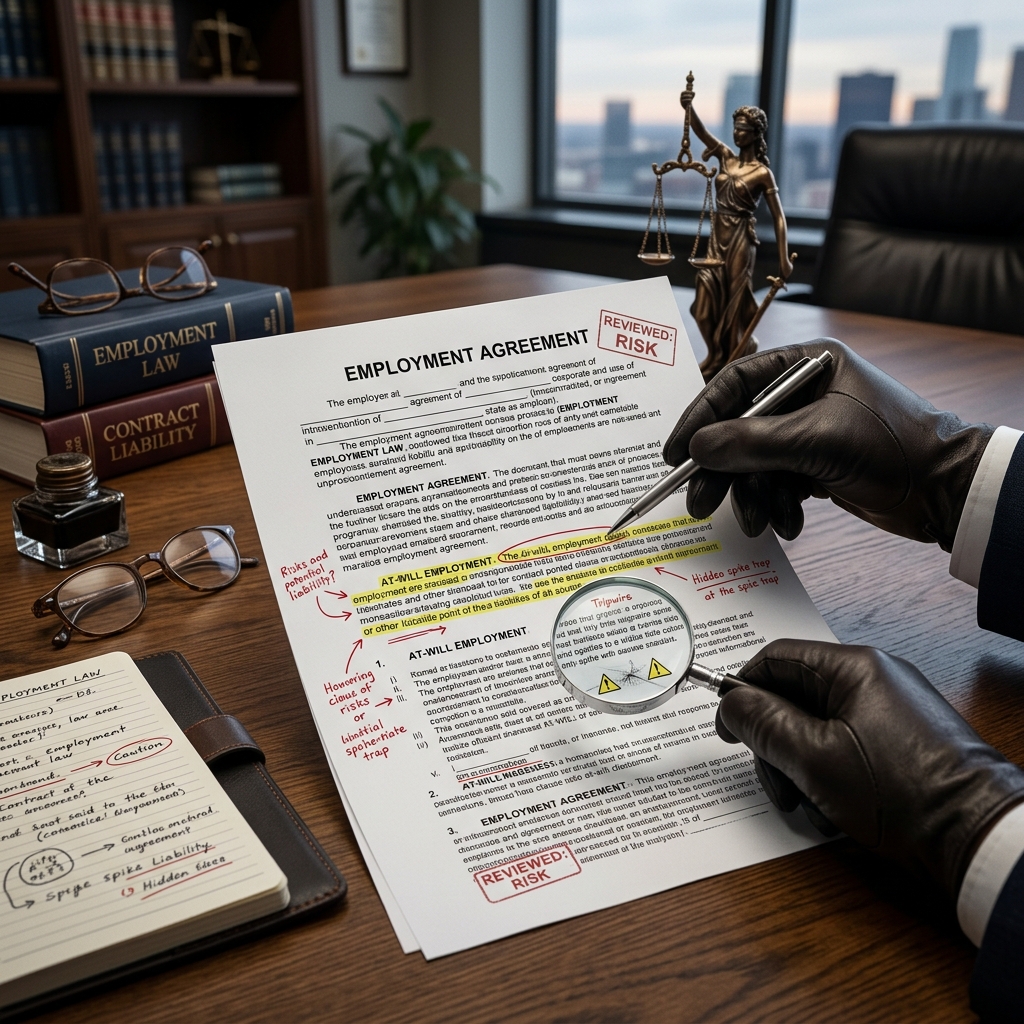
At-will employment is often described as simple: either side may end the relationship, usually without notice and without needing to show cause. But the language employers use in handbooks, offer letters, and policy manuals can complicate that picture. A disclaimer meant to preserve flexibility can instead create confusion, invite contract claims, or draw scrutiny under labor law if it is too rigid or too broad.
The safest approach is not to treat at-will language as a boilerplate afterthought. Employers should draft it carefully, review it regularly, and make sure it fits with the rest of their written policies. A clear disclaimer can help preserve the at-will relationship; a careless one can undermine it.
Why at-will language matters more than many employers expect
In the United States, at-will employment is generally the default rule unless a contract, statute, collective bargaining agreement, or another legal doctrine changes the relationship. That default, however, does not give employers unlimited discretion. Federal and state anti-discrimination laws, retaliation rules, wage-and-hour protections, whistleblower laws, and public policy exceptions still apply.
At-will language matters because employees and courts do not look only at a single disclaimer in isolation. They also examine the handbook as a whole, the employer’s written promises, the termination process actually used, and whether the policy language suggests that discipline or discharge will happen only after certain steps. If the writing reads like a commitment, a court may treat it that way.
How a disclaimer can accidentally become a problem
Many employers assume that any statement saying “employment is at will” is enough. In practice, the problem often lies in the surrounding wording. When a handbook says policies are mandatory, discipline must always follow a strict sequence, or termination can occur only in defined circumstances, the employer may create the impression that the handbook itself is a binding contract.
Another risk appears when a disclaimer is too absolute. Language that insists the employer can never change at-will status except through a narrow formal process may be read as a promise about how future changes will be made. That kind of wording can be problematic if management later acts inconsistently with the policy or if other documents suggest a different relationship.
Employers also run into trouble when the disclaimer is buried in fine print, contradicted by other statements, or presented in a way that employees are unlikely to notice. A disclaimer is most effective when it is prominent, understandable, and consistent with the rest of the employment materials.
Three legal pressure points employers should watch
At-will disclaimers can create risk in more than one direction. A policy intended to preserve flexibility may end up affecting contract interpretation, labor rights, or both.
| Risk area | What can go wrong | Why it matters |
|---|---|---|
| Implied contract | Handbook promises may look mandatory | An employee may argue the policy created enforceable rights |
| Labor law | Overly broad wording may discourage protected workplace activity | Policies can attract scrutiny under federal labor law |
| Termination disputes | Mismatch between policy and practice | Inconsistent enforcement weakens the employer’s position |
These concerns do not mean employers should avoid disclaimers. They mean the disclaimer has to be drafted with care and supported by consistent workplace practices.
The contract issue: when handbook language becomes too specific
A major purpose of an at-will disclaimer is to prevent employees from arguing that handbook language created an implied contract. This risk increases when the handbook includes detailed discipline steps, long lists of reasons for termination, or statements that imply discharge will happen only after specific warnings.
Courts often look at whether the employer made a clear promise and whether the employee reasonably relied on that promise. If a handbook suggests that termination will always follow a progressive path, an employee may claim the employer gave up some of its discretion. A well-drafted disclaimer helps prevent that result by stating that the handbook is informational, not contractual.
Still, a disclaimer alone is not enough if the rest of the handbook says the opposite. For example, a policy that says managers “must” follow a certain sequence before discharge can undermine a disclaimer that says the handbook creates no rights. Consistency matters as much as placement.
The labor-law issue: broad disclaimers can chill protected activity
Another risk comes from federal labor law, especially when a disclaimer is written in a way that appears to restrict employee communication, collective action, or concerted workplace complaints. A policy that tells employees at-will status can never be altered, or that only management may discuss changes to employment conditions, can be read as discouraging protected activity.
Employees covered by labor law generally have rights to discuss wages, working conditions, scheduling, and workplace concerns with one another and, in some situations, with outside representatives. If a disclaimer can reasonably be read as limiting those rights, it may be challenged even if the employer’s real goal was simply to preserve at-will employment.
This is why precision matters. Employers should avoid language that sounds like a blanket ban on employee action or an absolute statement that no policy can ever be discussed, revised, or challenged. A safer disclaimer focuses on preserving at-will status while acknowledging that nothing in the handbook is intended to interfere with legally protected rights.
Safer drafting principles for employers
Effective disclaimers are clear, visible, and narrowly tailored. They should explain what the handbook is and what it is not, without making promises that conflict with at-will employment or with applicable law.
- State plainly that employment is at will and may be ended by either side, subject to applicable law.
- Say that the handbook is not a contract and does not guarantee continued employment.
- Reserve the employer’s right to change policies, procedures, and benefits when permitted by law.
- Avoid language that suggests disciplinary steps are mandatory in every case.
- Do not imply that only one person or one document can alter at-will status unless that is truly the employer’s intent.
- Include a statement that the handbook does not limit employee rights protected by law.
Placement also matters. The disclaimer should not be hidden deep in the manual. Many employers place it near the front of the handbook and repeat the concept in an acknowledgment form so employees cannot reasonably miss it.
Policy consistency is just as important as policy wording
A clean disclaimer can lose value if the employer’s everyday practices tell a different story. Supervisors who casually promise job security, managers who describe discipline as automatic, or HR staff who treat progressive discipline as mandatory in all cases can create expectations that the written disclaimer was supposed to avoid.
That means training is part of risk management. Supervisors should know not to make off-the-cuff promises about lifetime employment, guaranteed promotion, or fixed termination procedures. They should also understand that written policies need flexibility and that exceptions may be necessary depending on the facts, the law, and the workplace situation.
Better handbook design starts with the full document, not just one clause
An at-will disclaimer should fit naturally within the handbook’s overall structure. If the manual contains detailed rules about performance reviews, discipline, attendance, or misconduct, the disclaimer should clarify that those rules are general guidelines, not binding steps that must be followed in every case.
The best handbooks avoid contradictory language. If one section says the employer may change policies at any time and another section says no policy can change without written approval from the CEO, employees will notice the conflict. Likewise, if the handbook contains a progressive discipline chart but the disclaimer says discipline may occur at any time with or without warning, the employer should explain that the chart is illustrative, not mandatory, unless the organization truly intends otherwise.
A practical checklist for employers
Before distributing or revising an employee handbook, employers should review the whole document for internal consistency and legal risk.
- Check whether the disclaimer is prominent and easy to understand.
- Make sure the handbook does not promise specific procedures as absolute rules.
- Confirm that managers and supervisors are trained on the language.
- Review offer letters, onboarding forms, and policy acknowledgments for conflicting statements.
- Update the handbook when laws change or when workplace practices evolve.
- Consider having counsel review language that affects termination, discipline, or employee rights.
This checklist is especially important for growing businesses. Smaller employers often begin with templates or borrowed policies, then add new sections over time. That patchwork approach can produce contradictions that are hard to spot until a dispute arises.
Common mistakes employers should avoid
Several recurring drafting mistakes make at-will disclaimers weaker than they should be.
- Using legal jargon that employees will not understand.
- Placing the disclaimer in a location that is easy to overlook.
- Writing a disclaimer that conflicts with the handbook’s discipline policy.
- Failing to reserve the right to revise policies.
- Ignoring labor-law language that protects employee rights.
- Having managers communicate promises that the handbook does not support.
None of these mistakes guarantees liability, but each one increases the chance that a policy will be challenged or interpreted against the employer.
Frequently asked questions
Does an at-will disclaimer make termination risk-free?
No. An at-will disclaimer may preserve flexibility, but it does not override anti-discrimination laws, retaliation protections, wage laws, public policy limits, or any contract that actually exists.
Should every handbook have an at-will disclaimer?
Most employers benefit from one if they rely on at-will employment. The key is to make sure the disclaimer is accurate, visible, and consistent with the rest of the handbook and onboarding materials.
Can a disclaimer stop all contract claims?
It can help, but not always. If other documents or repeated promises suggest a guaranteed process or fixed term of employment, an employee may still argue that a contract was created.
Can a disclaimer create labor-law problems?
Yes, if it is drafted too broadly. Language that appears to restrict protected workplace discussion or activity can attract scrutiny even when the employer’s purpose was only to preserve at-will status.
Is one disclaimer in a handbook enough?
Often it is not. Employers should align handbook language, offer letters, acknowledgments, and supervisor communication so the same message is repeated consistently.
Final drafting mindset
The most effective at-will disclaimer does not try to sound absolute. It sounds accurate. It tells employees that the relationship is at will, that the handbook is not a contract, and that nothing in the document takes away rights protected by law. It also avoids turning ordinary policy language into a rigid promise.
For employers, the goal is balance: preserve operational flexibility without writing a handbook that creates new legal exposure. That balance is easiest to achieve when the disclaimer is simple, consistent, and paired with careful management practices.
References
- Can An “At-Will” Employment Disclaimer Violate the NLRA? — HR Defense Blog. 2012-07. https://www.hrdefenseblog.com/2012/07/can-an-at-will-employment-disclaimer-violate-the-nlra/
- Brief At-Will Employment – Overview — National Conference of State Legislatures. 2026-01-01. https://www.ncsl.org/labor-and-employment/at-will-employment-overview
- The employment-at-will doctrine: three major exceptions — U.S. Bureau of Labor Statistics. 2001-01. https://www.bls.gov/opub/mlr/2001/01/art1full.pdf
- At-Will Employment Termination Risks — Clark Schaefer Strategic HR. 2026-01-01. https://strategichrinc.com/at-will-termination-risks/
- At-Will Employment Policy Guidelines for 2026 — SixFifty. 2026-01-01. https://www.sixfifty.com/blog/at-will-employment-policy/
Similar Articles








Read full bio of Sneha Tete




