The rapid rise of ride-hailing platforms such as Uber and Lyft has transformed how people work, travel, and do business. At the heart of this transformation lies a fundamental question: are the drivers powering these platforms employees, or independent contractors? That classification determines everything from minimum wage and overtime to unemployment insurance, workers’ compensation, and the right to unionize.
Courts, regulators, and legislators across multiple jurisdictions have struggled with this question. In some places, Uber and Lyft drivers remain classified as independent contractors; in others, lawsuits and legislative reforms have pushed toward employee status or hybrid arrangements that blend both models. Juries and judges are increasingly being asked to resolve this debate, case by case, statute by statute.
Why Employment Status Matters So Much
Whether a driver is labeled an employee or an independent contractor is far more than a technical detail. It determines the legal protections and economic benefits the driver may receive, and the responsibilities the platform must shoulder.
- Employees generally receive statutory protections such as minimum wage, overtime pay, contributions to unemployment insurance, and sometimes health and retirement benefits.
- Independent contractors are treated as self-employed business owners: they have more formal autonomy but must cover their own taxes, insurance, and many work-related costs.
In the gig economy, platforms typically favor contractor status because it lowers labor costs and allows them to scale quickly. Many drivers value flexibility but also raise concerns about insufficient protections, unstable income, and limited recourse when problems arise.
Key Legal Tests Used to Classify Drivers
Courts and agencies do not rely on a single universal rule when deciding if a worker is an employee or a contractor. Instead, they apply different legal tests depending on the statute and jurisdiction. Uber and Lyft drivers have been evaluated under several prominent tests.
The Economic Reality Test Under Federal Wage Law
Under the United States Fair Labor Standards Act (FLSA), the economic reality test examines whether a worker is economically dependent on the hiring entity or truly in business for themselves. In 2024, the U.S. Department of Labor issued a final rule reaffirming this approach for distinguishing employees from independent contractors under federal wage and hour law.
Factors commonly considered include:
- How much control the company exerts over the worker’s performance and working conditions.
- The worker’s opportunity for profit or loss based on managerial skill.
- The amount of investment the worker makes in their own business.
- The permanence or duration of the relationship.
- The importance of the work to the company’s core business.
Legal analyses applying this test to ride-hailing suggest that drivers often depend heavily on the platforms for income and lack meaningful business independence, which supports classifying them as employees for FLSA purposes.
The ABC Test in Some States
Several U.S. states have adopted the ABC test to determine employment status for labor and tax laws. This test presumes a worker is an employee unless all three prongs are satisfied:
- (A) The worker is free from the company’s control and direction in performing the work.
- (B) The work is outside the usual course of the company’s business.
- (C) The worker is customarily engaged in an independently established trade or business.
For ride-hailing, the second prong is often especially contentious. Because transporting passengers is central to Uber and Lyft’s business, many courts and scholars argue that drivers do not satisfy prong B and thus are employees under statutes using the ABC test.
The IRS Common Law Test
For federal tax purposes, the Internal Revenue Service applies a common law test that focuses on the degree of control over behavioral, financial, and relational aspects of the work. Key considerations include:
- Behavioral control – Whether the company directs how, when, and where work is performed.
- Financial control – How the worker is paid, whether expenses are reimbursed, and whether tools or equipment are provided.
- Type of relationship – The presence of written contracts, benefits, the expectation of an ongoing relationship, and whether services are a key part of the business.
Using this framework, U.S. tax authorities have generally treated Uber and Lyft drivers as independent contractors, highlighting the absence of traditional employee benefits and the drivers’ ability to choose when to log on or off.
How Courts and Juries Are Shaping the Debate
While agencies and legislatures write rules, courts and juries are increasingly tasked with applying those rules to real-world disputes involving gig workers. Several recent developments illustrate how complex and fragmented the legal landscape has become.
State-Level Litigation and Injunctions
In some states, attorneys general have sued Uber and Lyft, arguing that their drivers should be treated as employees under state law. For example, a widely discussed case involved a state seeking an injunction that would force the platforms to reclassify drivers as employees under a revised worker-protection statute.
In that litigation, courts initially sided with the state, issuing orders that required proper classification of drivers as employees under the new standard. These decisions intensified pressure on the companies and prompted political and ballot-box responses designed to carve out special rules for app-based drivers.
Ballot Initiatives and Supreme Court Review
In one of the most significant gig-economy rulings to date, a state supreme court upheld a voter-approved initiative that preserved independent contractor status for app-based drivers while offering a tailored set of benefits and protections. The court ruled that the state constitution did not prevent voters from enacting legislation that affected workers’ compensation and related policies, thereby validating the proposition.
As a consequence, Uber and Lyft drivers in that state remain classified as independent contractors, but they receive certain guaranteed minimum earnings and access to limited benefits provided under the initiative’s framework. Legal scholars have described this outcome as leaving drivers’ employment status “unsettlingly settled,” since core classification questions remain contested even as a political compromise operates in practice.
Settlements That Create Hybrid Protections
Another trend is the negotiation of large settlements between ride-hailing companies and state authorities. In one notable case, Uber and Lyft reached a settlement worth approximately $175 million with a state attorney general. The agreement allowed drivers to remain independent contractors but required the platforms to provide substantial benefits and wage standards.
Key features of that settlement included:
- A guaranteed minimum earnings floor (over $30 per hour) for time spent traveling to pick up passengers and driving them to destinations, indexed to inflation.
- Paid sick leave accrual aligned with the state’s existing statute.
- Access to paid family and medical leave through stipends.
- Health insurance stipends for drivers working more than a specified number of hours.
- Occupational accident insurance providing up to $1 million in coverage for work-related injuries.
- Non-discrimination protections, language-access tools in the app, and transparency enhancements for trip and earnings information.
Although these drivers remain contractors, the settlement illustrates a middle path between pure independent contracting and full employee status. It also sets a precedent that other jurisdictions may look to as they craft their own gig-economy frameworks.
Comparing Employee and Contractor Models for Ride-Hailing
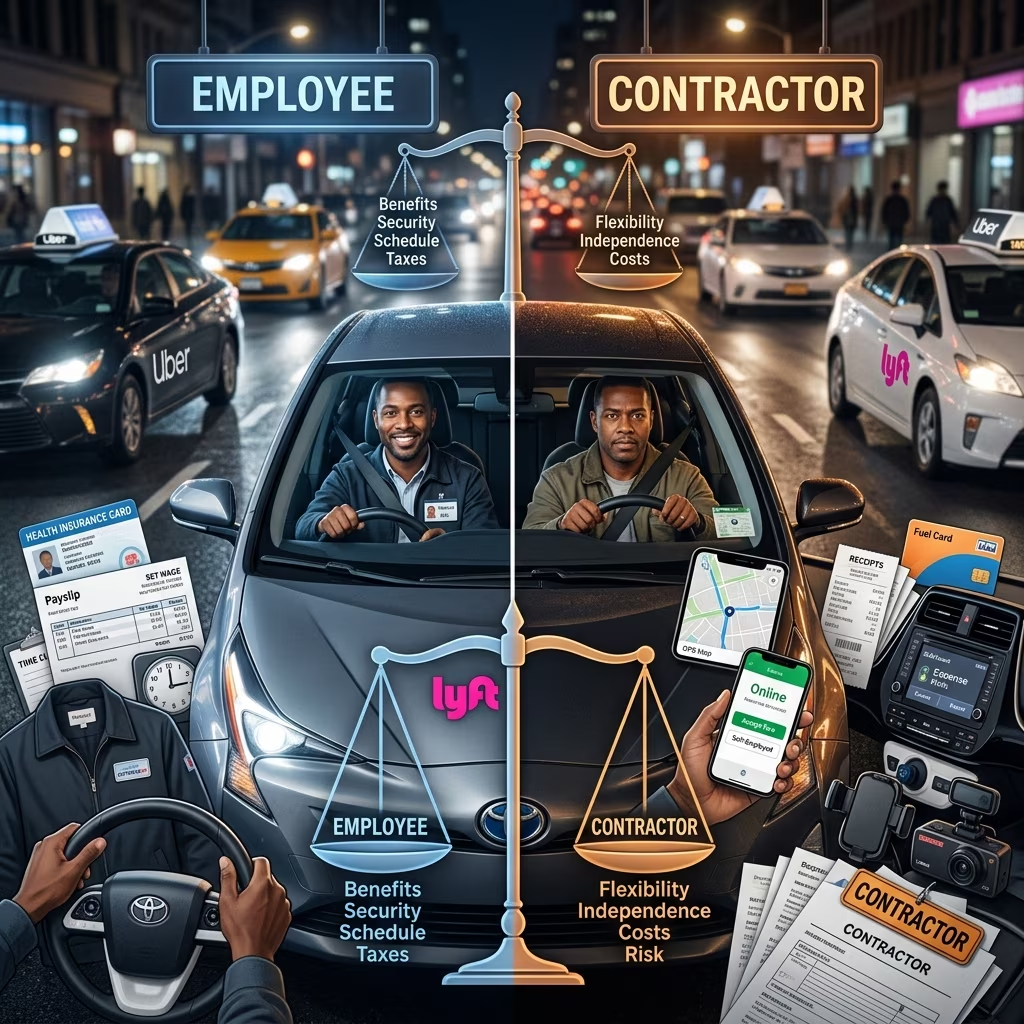
To understand the stakes of jury and court decisions, it is useful to compare what an employee model and a contractor model generally mean for ride-hailing drivers.
| Feature | Employee Status | Independent Contractor Status |
|---|---|---|
| Legal protections | Covered by minimum wage, overtime, anti-retaliation statutes, unemployment insurance, and workers’ compensation. | Limited statutory protections; must rely on contract terms and general civil law. |
| Flexibility | Employer may set schedules, performance standards, and routes. | Drivers usually choose when to log on, where to drive, and whether to accept rides. |
| Benefits | Possible eligibility for employer-sponsored health insurance, paid leave, retirement plans. | Benefits typically not provided; drivers must arrange and fund their own coverage. |
| Taxes and social contributions | Employer withholds income and payroll taxes and pays part of social insurance contributions. | Drivers pay self-employment taxes and are responsible for estimated tax payments. |
| Business risk | Primarily borne by the employer. | Borne by the driver, including costs for vehicles, fuel, maintenance, and insurance. |
The Role of Juries in Driver Misclassification Cases
While many key rulings have come from judges and appellate courts, juries can play a decisive role in disputes over driver classification, especially when facts about control, dependence, and working conditions are contested.
In class actions and individual lawsuits alleging misclassification, juries may be asked to answer specific factual questions such as:
- How much real freedom do drivers have to set their own prices, choose routes, or decline rides?
- Do platform rules and ratings effectively control how drivers perform the work?
- Are drivers investing in and marketing their own transportation business, or primarily relying on the platform’s brand and customer base?
The answers to these questions inform how legal tests like the economic reality or common law control tests are applied. A jury’s finding that drivers have limited autonomy and are economically dependent on the platform can push a court toward employee classification, with significant financial and operational consequences for the company.
Global Perspectives: Divergent Outcomes Beyond the U.S.
Although this article focuses on U.S. law, it is worth noting that courts in other countries have sometimes reached different conclusions. For example, courts in certain jurisdictions have held that ride-hailing drivers are workers or employees entitled to key protections, even if not fully equivalent to traditional full-time employees.
These international decisions often underscore common themes: drivers rely heavily on the platform for work; the platform retains considerable control over pricing and access to customers; and drivers bear substantial costs without guaranteed minimum earnings. As a result, judges abroad have sometimes favored a more protective classification that sits somewhere between contractor and traditional employee.
Policy Options: Pathways to Fairness and Flexibility
Policymakers face a delicate balancing act: how to protect gig workers from exploitation without undermining the flexibility that many drivers value. Several broad policy options have emerged from the ongoing debate:
- Full employee reclassification under existing labor laws, giving drivers the same rights and benefits as other employees.
- Preserving contractor status but layering statutory minimum earnings, benefits, and safety standards on top, as seen in some ballot initiatives and settlements.
- Creating a new intermediate category of worker that formally recognizes dependence on platforms while preserving some flexibility, with tailored rights and obligations.
- Sector-specific codes that establish standards for ride-hailing and delivery work, negotiated between companies, worker groups, and governments.
Each approach has trade-offs. Full reclassification may raise costs and lead platforms to reduce the availability of work, whereas hybrid solutions can create legal uncertainty and uneven protections across jurisdictions.
What Drivers, Riders, and Platforms Should Watch
The status of Uber and Lyft drivers remains contested, and future cases, jury verdicts, and legislative actions will continue to shape the landscape. Stakeholders should pay attention to several emerging trends:
- New federal and state guidance on worker classification, including any updates to economic reality or ABC tests.
- Major settlements and ballot initiatives that create unique rights and standards for app-based drivers in specific jurisdictions.
- Class actions and appeals filed by drivers seeking back pay, benefits, or reclassification, which may result in influential precedents.
- Technological changes in how platforms dispatch rides, monitor performance, and structure pay, which can affect legal assessments of control and dependence.
For now, the gig economy offers drivers both opportunity and uncertainty. Whether juries and judges ultimately define them as employees, independent contractors, or something in between will have profound implications for the future of work.
Frequently Asked Questions (FAQs)
Are Uber and Lyft drivers employees in the United States?
In most U.S. jurisdictions, Uber and Lyft drivers are currently classified as independent contractors, although some states have adopted special rules or negotiated settlements that grant them additional protections and benefits.
What benefits do drivers receive if they are employees?
Employees may be entitled to minimum wage, overtime, unemployment insurance, workers’ compensation, and potentially employer-sponsored health insurance and paid leave, depending on the jurisdiction and the size of the employer.
Can a jury decide whether drivers are employees or contractors?
Yes. In misclassification lawsuits, juries can be asked to decide key factual issues about control, dependence, and working conditions. Those findings guide courts in applying legal tests to determine classification.
What is the difference between the economic reality test and the ABC test?
The economic reality test focuses on whether a worker is economically dependent on the company, while the ABC test presumes a worker is an employee unless the company can prove the worker is free from control, works outside the company’s usual business, and runs an independent business.
Will the status of Uber and Lyft drivers change in the future?
The status of ride-hailing drivers is actively evolving. New legislation, regulatory rules, settlements, and court decisions—including those decided by juries—may alter how these drivers are classified and what rights they have.
References
- California Supreme Court Unanimously Rules That Uber, Lyft Drivers May Remain Classified as Independent Contractors — Benesch Law. 2024-07-31. https://www.beneschlaw.com/insight/california-supreme-court-unanimously-rules-that-uber-lyft-drivers-may-remain-classified-as-independent-contractors/
- Uber and Lyft Settlement Provides New Precedent for the Gig Economy and Major Benefits for Massachusetts Drivers — Fisher Phillips. 2024-07-03. https://www.fisherphillips.com/en/insights/uber-and-lyft-settlement-provides-new-precedent-for-the-gig-economy-and-major-benefits-for-massachusetts-drivers-key-employer-takeaways
- Employee or Independent Contractor? A Legal Analysis of Uber’s Worker Misclassification — Columbia Undergraduate Law Review. 2024-10-10. https://www.culawreview.org/current-events-2/employee-or-independent-contractor-a-legal-analysis-of-ubers-worker-misclassification
- Fight Over Employment Status of Uber and Lyft Drivers Moves Through State Courts — Brennan Center for Justice, State Court Report. 2023-09-07. https://statecourtreport.org/our-work/analysis-opinion/fight-over-employment-status-uber-and-lyft-drivers-moves-through-state
- Employment Status of Uber and Lyft Drivers: Unsettlingly Settled — Hastings Women’s Law Journal. 2018-01-01. https://repository.uclawsf.edu/hwlj/vol29/iss1/4/
- Employee or Self-Employed? — UK Supreme Court judgments and UK employment law guidance (background on non-U.S. cases, as discussed via secondary commentary). 2021-02-19. https://statecourtreport.org/our-work/analysis-opinion/fight-over-employment-status-uber-and-lyft-drivers-moves-through-state
- IRS Topic No. 762: Independent Contractor vs. Employee — Internal Revenue Service. 2023-05-01. https://www.irs.gov/businesses/small-businesses-self-employed/independent-contractor-defined