
Annulment vs. Divorce: Legal Differences and Grounds
Understand how annulments and divorces differ, when each is available, and the legal grounds and consequences that follow.
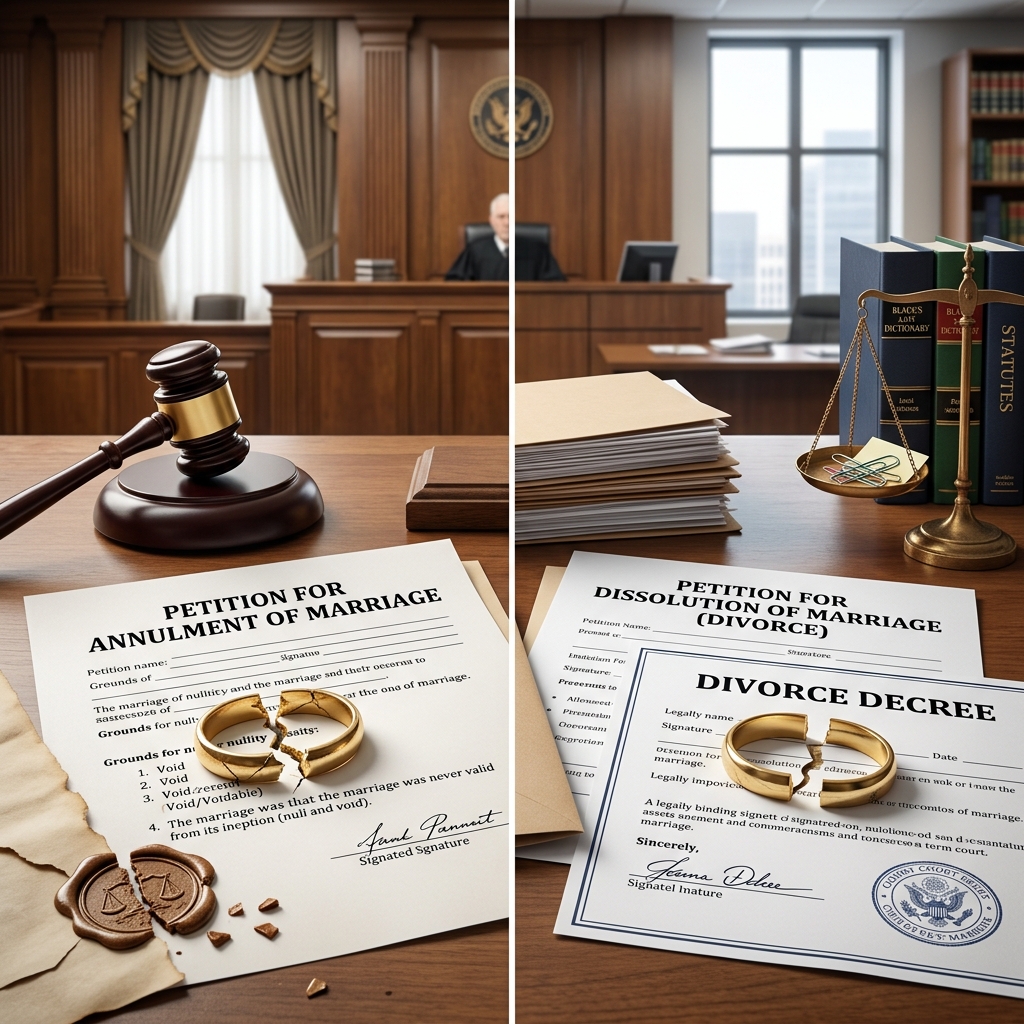
When a marriage breaks down, most people think about divorce. However, in some situations, a marriage annulment may be available instead. Both procedures end a relationship in the eyes of the law, but they do so in fundamentally different ways, with different requirements and consequences.
This guide explains what each process does, the legal grounds for an annulment, how both options handle property and children, and practical considerations to discuss with a family law attorney.
Core Legal Difference: Ending vs. Erasing a Marriage
The most important distinction is how the law treats the marriage once the court enters a final judgment.
- Divorce – Legally ends a valid marriage and recognizes that the marriage existed.
- Annulment – Declares that the marriage was never legally valid, treating it as void or voidable from the start.
After a divorce, the parties are considered former spouses whose marriage has been dissolved. After an annulment, the law generally treats the parties as though they were never married, although a record of the ceremony and the court order still exists.
Key Legal Concepts: Void and Voidable Marriages
To understand annulment, it helps to distinguish between two categories of problematic marriages often recognized in statutes and case law.
- Void marriage – A marriage that is legally invalid from the moment it is entered, often because it violates basic legal prohibitions (for example, close blood relatives marrying, or a spouse already being married to someone else).
- Voidable marriage – A marriage that is presumed valid unless and until a court declares it invalid due to specific problems such as fraud, coercion, or lack of capacity.
Annulment is the mechanism used to obtain a court ruling that a void or voidable marriage is legally treated as if it never existed. The precise definitions and categories vary by jurisdiction, and local statutes will control how your state or country uses these terms.
Comparison Table: Annulment vs. Divorce
| Aspect | Annulment | Divorce |
|---|---|---|
| Legal effect | Marriage declared never legally valid; treated as if it did not exist. | Legally ends a valid marriage; acknowledges the marriage existed. |
| Grounds | Strict, specific grounds such as underage marriage, incest, bigamy, fraud, duress, or lack of capacity. | Often available on no-fault grounds (irreconcilable differences) without proof of wrongdoing. |
| Time limits | Frequently subject to deadlines tied to the specific ground (e.g., certain years after discovery of fraud). | Generally no strict deadline; spouses can file after short or long marriages. |
| Property division | Community or marital property schemes may be limited; assets are often treated as separate unless statutes provide otherwise. | Marital property divided under community property or equitable distribution rules. |
| Spousal support | Often unavailable or more limited because the marriage is considered invalid. | Available based on statute, length of marriage, and financial circumstances. |
| Children | Children remain legally legitimate; custody and support handled similarly to divorce. | Custody, visitation, and child support determined under standard family law principles. |
Common Legal Grounds for Annulment
Annulment is not simply an alternative to divorce for spouses who regret getting married. Courts typically require proof that legal requirements for a valid marriage were not met. Grounds vary by jurisdiction, but commonly include:
Underage Marriage
Many jurisdictions require both spouses to be a minimum age, often 18, or to have appropriate parental or judicial consent. A marriage may be annulled if one spouse was under the legal age without meeting these conditions.
- Statutes often specify the age thresholds and whether parental consent cures the defect.
- Some laws impose a deadline, such as requiring the underage spouse to file before a certain age.
Incest (Prohibited Degrees of Kinship)
Marriages between close blood relatives are widely prohibited. If such a marriage occurs, it is usually classified as void and can be annulled at any time.
- Exact definitions of “close relatives” differ, but typically include parent-child and siblings.
- Courts treat these unions as never valid, regardless of the parties’ knowledge or intentions.
Bigamy (Already Married to Another Person)
If one spouse was already legally married to someone else at the time of the new marriage, the later marriage is often considered void.
- Annulment is used to confirm that the second marriage is legally ineffective.
- Some jurisdictions distinguish situations where the prior spouse was presumed dead or missing, and may provide different rules.
Fraud or Misrepresentation
Fraud-based annulments involve serious deception about facts that go to the heart of the marital relationship. Minor disappointments or ordinary marital conflicts are not enough.
- Examples may include concealing:
- Existing children or major family obligations
- Significant criminal history
- Serious physical or mental illness
- Inability or refusal to have children when this was central to the decision to marry
- Statutes often require filing within a specific period after discovering the fraud.
Duress, Force, or Lack of Genuine Consent
A valid marriage requires voluntary consent. If a person is pressured, threatened, or otherwise coerced into marrying, a court may annul the marriage.
- Duress can involve physical threats, severe psychological pressure, or other coercive circumstances.
- Courts look at whether the party had a meaningful choice at the time of the ceremony.
Lack of Capacity: Mental Impairment or Intoxication
A spouse must be mentally capable of understanding the nature of marriage and consenting to it. Annulment may be available when capacity was impaired.
- Mental illness, cognitive disability, or extreme intoxication can interfere with the ability to consent.
- Some jurisdictions provide different time limits or evidentiary requirements for capacity-based annulments.
Physical Incapacity to Consummate the Marriage
Some legal systems recognize the inability to consummate the marriage as a ground for annulment when the condition is permanent and was unknown to the other spouse.
- This ground is often narrowly defined and may require medical evidence.
- Parties typically must act within a specified period after discovering the incapacity.
Grounds for Divorce
By contrast, modern divorce law in many jurisdictions allows couples to end a marriage without proving fault such as adultery or cruelty.
- No-fault divorce – The most common model requires only a statement that the marriage has broken down due to irreconcilable differences or incompatibility.
- Fault-based divorce – Some jurisdictions still permit or require proof of misconduct (e.g., adultery, abandonment, abuse), which may influence property division or support.
Crucially, ordinary marital problems – communication breakdown, financial stress, or simply growing apart – are typically sufficient for divorce but not for annulment.
Timing and Procedural Differences
Annulments and divorces follow different timelines and procedural expectations.
- Time limits for annulment – Many statutes impose deadlines based on the specific ground. For example, a spouse might have a limited number of years to seek annulment for fraud after learning of the deception.
- Divorce timing – Divorce can generally be filed at any point during the marriage, whether the relationship lasted months or decades.
- Residency and waiting periods – Some jurisdictions impose residency requirements and waiting periods for divorce. In contrast, certain annulment statutes may not require the same waiting period because the marriage is considered invalid.
- Court hearings – Annulments frequently require a court hearing and evidence to establish the ground for invalidity. Uncontested divorces may proceed largely through paperwork.
Financial Consequences: Property and Support
Because a divorce ends a valid marriage while an annulment declares one invalid, the financial consequences can differ significantly.
Property Division
- Divorce
- Courts divide marital or community property under statutory schemes such as community property or equitable distribution.
- Assets and debts acquired during the marriage are typically considered marital and subject to division.
- Annulment
- When a marriage is annulled, some jurisdictions do not apply community property rules in the same way because the marriage is treated as invalid.
- Property may be treated as each party’s separate property, and jointly titled assets can be divided using general contract or property law rather than marital statutes.
Spousal Support (Alimony)
- Divorce – Courts regularly consider spousal support based on factors such as the length of the marriage, earnings, health, and contributions to the household or career.
- Annulment – Because the marriage is deemed invalid, statutes may provide limited or no spousal support, or treat it differently than in divorce.
Some jurisdictions include special provisions to prevent unfair hardship, even in annulment cases, so local legal advice is essential.
Children of an Annulled Marriage
A critical concern is how annulment affects children. Modern family law is clear on this point: children of an annulled marriage are not penalized for their parents’ legal status.
- Children are considered legally legitimate even if the marriage is later annulled.
- Both parents remain responsible for child support and are eligible for custody and visitation, just as in divorce.
- Courts apply the same “best interests of the child” standards when making parenting decisions.
In practice, custody and support proceedings associated with annulments closely resemble those in divorce cases.
When Might Someone Seek Annulment Instead of Divorce?
Annulment is not necessarily better or worse than divorce; it is simply designed for a different category of cases. People may consider annulment for several reasons:
- Legal invalidity – The marriage clearly violated legal requirements (for example, bigamy or incest), so annulment aligns the legal record with reality.
- Religious or moral considerations – Some faith traditions view annulment differently from divorce, and a civil annulment may make it easier to pursue religious steps.
- Short duration and serious defect – When a marriage is brief and involves major deception or coercion, annulment may feel more appropriate than divorce.
- Financial and legal implications – In certain jurisdictions, the way property and spousal support are treated may make annulment more or less attractive.
Because the consequences can be complex, it is important to understand not only personal or moral reasons but also how an annulment will affect property rights, support, and future obligations.
Practical Steps: Talking to a Family Law Attorney
Whether annulment is available and advisable in your situation depends on detailed facts and the law of your jurisdiction. Consulting a family law attorney can help you understand:
- Which legal grounds might apply to your case
- Any deadlines or residency requirements
- Expected treatment of property, debts, and support payments
- How custody and parenting time will be handled if you have children
- Evidence you may need to prove fraud, duress, or lack of capacity
Legal advice is especially important where the marriage involved complex assets, immigration issues, or overlapping religious proceedings.
SEO-Friendly FAQs About Annulment and Divorce
Is an annulment easier to get than a divorce?
In most situations, a divorce is easier to obtain than an annulment. Divorce usually requires only a breakdown of the relationship, while annulment demands proof that the marriage was legally invalid from the start.
Can any short marriage be annulled?
No. Length alone is not enough. A short marriage can end in divorce if it was valid when entered. Annulment requires specific legal grounds such as fraud, bigamy, or lack of consent.
Do annulments and divorces affect children differently?
Generally, no. Children remain legally legitimate either way, and courts handle custody and child support using the same standards whether the parents divorce or annul their marriage.
Will an annulment erase our marriage records?
Civil records of the ceremony and the court order typically remain, but legally the marriage is treated as if it was never valid. This distinction matters for property, support, and marital status going forward.
Can I remarry after an annulment?
Yes. Both annulment and divorce restore the parties to single status in civil law, allowing them to remarry, subject to any jurisdiction-specific waiting periods or licensing requirements.
References
- Annulment vs. Divorce: What Are the Differences? — Verywell Mind. 2023-08-15. https://www.verywellmind.com/difference-between-divorce-and-annulment-2302038
- Annulment vs Divorce: Legal Options in CA — Law Office of Steven M. Bishop. 2022-11-10. https://www.stevenmbishop.com/annulment-vs-divorce-in-california/
- Annulment vs. Divorce: Similarities and Differences — MetLife Legal Resources. 2022-06-01. https://www.metlife.com/stories/legal/annulment-vs-divorce/
- Understanding the Difference Between Annulment and Divorce — Lepley Law. 2021-09-20. https://www.lepleylaw.com/understanding-the-difference-between-annulment-and-divorce
- Annulments vs. Divorce: Understanding the Differences in California — Flicker, Kerin, Kruger & Bissada LLP. 2023-03-15. https://flickerkerin.com/blog/2023/03/annulments-vs-divorce-understanding-the-differences-in-california/
- Annulment vs. Divorce: What’s the Difference? — Fisher Law LLC. 2022-05-05. https://fisherlawkc.com/annulment-vs-divorce-whats-the-difference/
- Annulment Vs Divorce In California — It's Over Law. 2026-02-10. https://www.itsover.com/2026/02/annulment-vs-divorce-in-california/
Similar Articles








Read full bio of medha deb


