
Annulment or Divorce: Understanding Your Options
Learn how annulment and divorce differ in law, process, and consequences so you can choose the path that fits your situation.
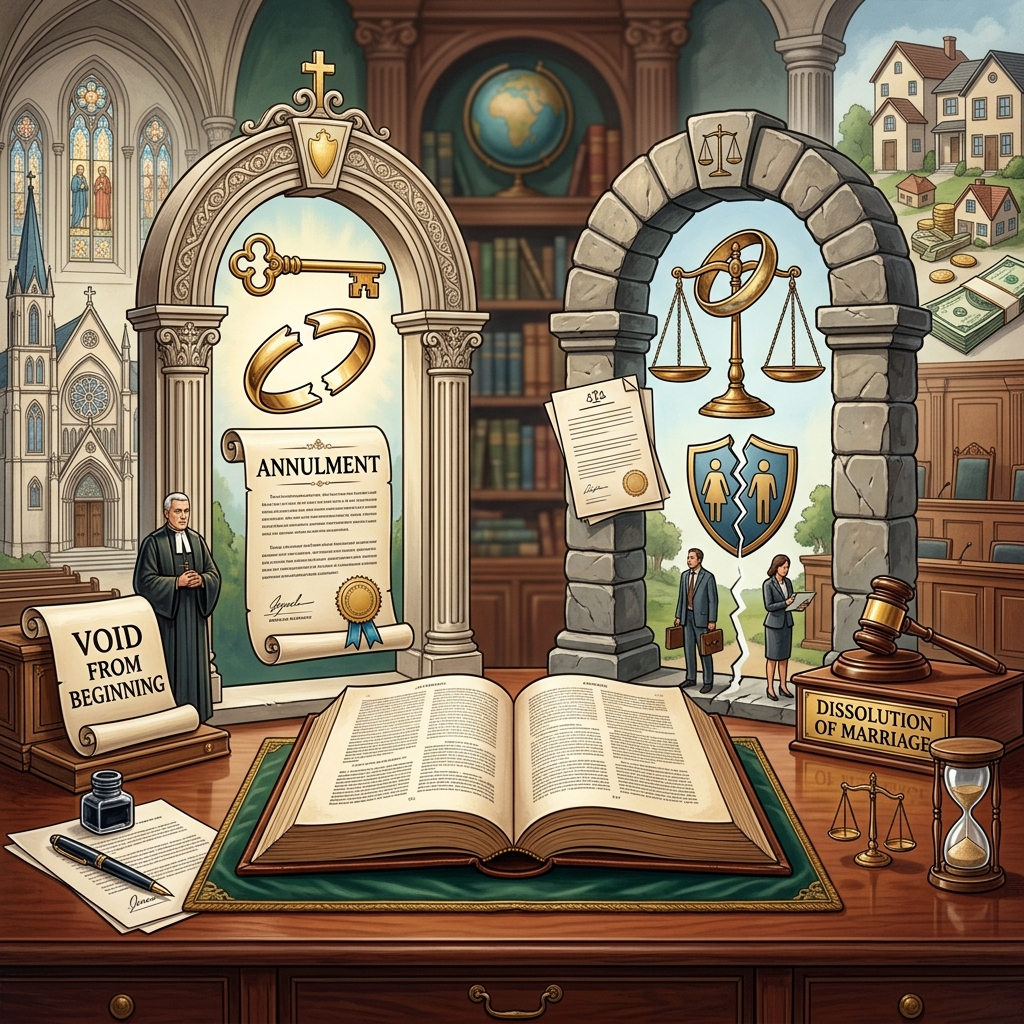
When a marriage breaks down or turns out to be fundamentally flawed, the law offers more than one way to end it. The two most common routes are divorce and annulment, and while both can free you to move on with your life, they do so in very different legal ways. Understanding these differences is critical before you file papers or sign any agreement.
This guide explains how annulment and divorce work, what each means in the eyes of the law, which circumstances may qualify for an annulment, and practical considerations such as property, support, and children. It is general information, not individual legal advice; laws vary by jurisdiction, so it is always wise to speak with a qualified family law attorney where you live.
Big Picture: How Annulment and Divorce Differ
The most important distinction is how the law views the marriage itself:
- Divorce ends a valid marriage and recognizes that the relationship legally existed before it was dissolved.
- Annulment declares that the marriage was never legally valid in the first place, treating it as if it should not have occurred under the law.
After a divorce, you are typically regarded as a divorced person. After an annulment, you are generally considered to have been single throughout, at least in the civil legal sense. This difference can affect financial rights, record-keeping, and sometimes religious or cultural considerations.
Key Legal Consequences Compared
| Aspect | Divorce | Annulment |
|---|---|---|
| Legal status of marriage | Marriage is valid but now legally ended. | Marriage is declared invalid or void, as if it never legally existed. |
| Typical grounds | No-fault (irreconcilable differences) and, in some places, fault-based grounds (adultery, cruelty, etc.). | Specific legal flaws at the start of the marriage, such as fraud, duress, bigamy, underage, incapacity, or prohibited relationship. |
| Property division | Marital assets and debts are generally divided under state rules (equitable distribution or community property). | Parties often revert closer to their pre-marriage financial status; there may be fewer rights to the other spouse’s property or income. |
| Spousal support | Spousal support (alimony) may be awarded, depending on circumstances. | Ongoing spousal support is less common because the parties are not treated as valid spouses, though courts can still address fairness in some cases. |
| Children | Child custody, parenting time, and child support are decided like in any other divorce involving children. | Children are generally still legally recognized, and courts usually handle custody and support similarly to divorce proceedings. |
| Ease of obtaining | More widely available; no-fault divorce is recognized in every U.S. state. | More limited; requires proof of specific grounds and may be harder to obtain. |
What Is a Divorce?
A divorce is the formal legal process that terminates a valid marriage. It dissolves the marital bond and, in most systems, divides property, addresses responsibility for debts, and may establish spousal support. Once the divorce decree is issued, the spouses are free to remarry.
Common Legal Grounds for Divorce
Specific rules depend on your jurisdiction, but broadly speaking, divorce may rest on:
- No-fault grounds: Many places allow divorce simply because the relationship has broken down beyond repair, sometimes called “irreconcilable differences” or an “irretrievable breakdown”.
- Fault-based grounds (where recognized): These might include adultery, cruelty, abandonment, or substance abuse, among others.
Because no-fault divorce is widely recognized in the United States and other jurisdictions, most couples can dissolve a valid marriage even when no specific wrongdoing can be proven.
Typical Steps in a Divorce Case
While procedures differ, a divorce usually involves:
- Filing a petition or complaint for divorce with the appropriate court.
- Serving the other spouse with legal notice.
- Exchanging financial information and, if necessary, other evidence.
- Negotiating or litigating property division, debt allocation, spousal support, and parenting arrangements.
- Obtaining a final judgment or decree that formally ends the marriage.
Divorce can be relatively straightforward when spouses agree on major issues or more complex and time-consuming when they do not.
What Is an Annulment?
An annulment is a court ruling that a marriage was never legally valid, usually because of a problem that existed at the time of the wedding. Instead of ending a legitimate marriage, annulment wipes it off the legal map. This is sometimes called declaring the marriage “void” or “voidable,” depending on the jurisdiction.
Typical Grounds for Annulment
The law typically restricts annulments to specific situations. Although the details vary, common grounds include:
- Fraud or misrepresentation: One spouse lied or hid crucial facts (such as an existing marriage, an inability or refusal to have children, or serious criminal history) that would have affected the other’s decision to marry.
- Duress or coercion: The marriage occurred because one spouse felt forced, threatened, or pressured to marry against their free will.
- Bigamy: One person was already legally married to someone else when the new marriage ceremony took place.
- Underage marriage: One or both spouses were below the legal age to marry and did not have the necessary consent or court approval.
- Lack of mental capacity: A spouse was unable to understand the nature of the marriage or give valid consent, sometimes due to mental illness, cognitive disability, or extreme intoxication.
- Prohibited relationship: The spouses are too closely related by blood or adoption (incest), making the marriage legally forbidden.
- Non-consummation or inability to consummate: In some jurisdictions, failure or inability to consummate the marriage may qualify.
Because annulments focus on conditions at the beginning of the relationship, they are often pursued relatively soon after the wedding, though deadlines (called statutes of limitations) vary by region.
Process Features Unique to Annulment
Annulment cases may feel similar to divorce procedurally — they still require court filings and hearings — but they are often more evidence-driven. The person requesting annulment usually must prove that qualifying grounds were present when the marriage took place. This can involve:
- Testimony from the spouses and possibly other witnesses.
- Documents showing prior marriages or legal relationships.
- Medical or psychological records relating to capacity to consent.
- Communications revealing fraud, concealment, or coercion.
Because grounds are limited and must be proven, annulment is generally considered harder to obtain than divorce in modern legal systems.
Financial and Property Implications
One of the most practical differences between divorce and annulment concerns money and property. Divorce starts with the assumption that a valid marital economic partnership existed. Annulment, on the other hand, often treats the spouses more like individuals who were never legally bound together.
Property Division in Divorce
In a divorce, courts usually divide marital assets and debts according to the rules of the jurisdiction. Many U.S. states follow either:
- Equitable distribution: Property is divided fairly, which does not always mean equally. Courts may consider factors like length of the marriage, earning capacity, and contributions to the household.
- Community property: In a minority of states, most property and income acquired during the marriage is treated as jointly owned and divided roughly equally.
Retirement accounts, real estate, business interests, and other assets can all be subject to division. Divorce decrees may also apportion responsibility for joint debts like credit cards, mortgages, or loans.
Property Outcomes in Annulment
In an annulment, courts often attempt to restore the parties to something closer to their pre-marriage financial status. Because the marriage is treated as invalid, there may be fewer automatic rights to the other spouse’s property or income. However, courts can still address fairness and rely on contract or equity principles to avoid unjust outcomes.
Key features may include:
- Property each person owned before the marriage usually remains that person’s.
- Jointly titled assets may be divided based on contributions or agreements.
- Prenuptial agreements may be affected, because they are built on the assumption of a valid marriage. Some jurisdictions treat them as unenforceable after an annulment.
Because rules differ, it is important to obtain jurisdiction-specific advice before assuming an annulment will have a particular financial outcome.
Spousal Support and Ongoing Obligations
Divorce courts regularly consider spousal support (alimony), especially in longer marriages or where there is a significant income gap. Annulment, by contrast, may lead to fewer ongoing obligations between the parties. If the marriage was never valid, many systems are less likely to order long-term spousal support, though short-term orders or other remedies can still be used to prevent serious unfairness.
Children, Custody, and Support
The legal status of the parents’ relationship does not remove the court’s obligation to protect children’s best interests. Whether a case involves divorce or annulment, courts generally still address:
- Legal custody: Who has authority to make important decisions about the child’s education, health, and welfare.
- Physical custody / parenting time: Where the child lives and how time is shared.
- Child support: How the child’s financial needs are met, based on income, caregiving responsibilities, and legal guidelines.
Even when a marriage is annulled, children born or adopted during the relationship are typically recognized as legitimate, and both parents remain responsible for their welfare. Annulment does not erase parenthood.
Choosing Between Annulment and Divorce
You usually cannot select annulment simply because it feels emotionally preferable. Courts require legitimate legal grounds. For many couples, divorce will be the only realistic option to dissolve a valid marriage. Annulment may be appropriate in narrower circumstances, especially when some fundamental legal defect existed from the start.
Questions to Consider
When deciding which path to pursue, consider:
- Did a qualifying defect exist at the time of marriage? Fraud, coercion, bigamy, incapacity, or prohibited relationship strongly point toward an annulment analysis.
- How long ago was the wedding? Some jurisdictions limit how long you have to seek annulment after discovering the problem.
- What are your financial expectations? Divorce may provide clearer frameworks for property division and spousal support, while annulment may reduce ongoing obligations but offer fewer automatic rights.
- Are there religious or cultural reasons? Some individuals seek annulment to align civil status with religious rules while also managing legal consequences.
- Where do you live? Family law is highly jurisdiction-specific. Always verify local requirements.
In practice, people often explore annulment when something about the marriage seems legally wrong from the start. When a once-valid relationship simply deteriorates over time, divorce is typically the appropriate route.
Common Myths and Misunderstandings
- Myth: Short marriages are automatically eligible for annulment.
Reality: Duration alone rarely qualifies. Annulment usually requires specific legal defects such as fraud or bigamy, not simply a brief relationship. - Myth: Annulment erases all legal records.
Reality: Even when a marriage is annulled, many jurisdictions retain records of the proceeding; the marriage is treated as invalid for legal purposes but not always erased from history. - Myth: Annulment is easier than divorce.
Reality: Annulment often requires more proof and has stricter eligibility criteria. Divorce is generally more accessible, especially under no-fault rules. - Myth: Children become illegitimate after an annulment.
Reality: Modern law in most places protects children’s status regardless of whether the parents’ marriage is later annulled.
Frequently Asked Questions (FAQs)
1. Is annulment always better than divorce?
Not necessarily. Annulment can be useful when the marriage should never have been legally valid, but it may offer fewer financial protections than divorce. The “better” option depends on your facts, jurisdiction, and priorities.
2. Can I ask for an annulment just because I regret getting married?
Regret alone is not enough. Courts typically require concrete legal grounds such as fraud, duress, or incapacity. Without such grounds, you will usually need to pursue divorce if you want to end the marriage.
3. Does the timing of my request matter?
Yes. Some annulment grounds must be raised within a certain time after discovery of the problem or after the wedding, depending on local law. Divorce laws also have residency or waiting requirements, but they are usually more flexible.
4. Are religious annulments the same as legal annulments?
No. Religious institutions may grant their own form of annulment under spiritual or doctrinal rules. A civil court annulment is separate and affects your legal status, property rights, and obligations under state law. You may need both if you want alignment between religious and civil status.
5. Do I need a lawyer for an annulment or divorce?
While you can sometimes represent yourself, both processes involve important rights and obligations. Because annulments require proving specific legal grounds and divorces can have long-term financial and parental consequences, legal advice is strongly recommended.
Practical Next Steps
If you are considering ending a marriage or questioning its validity, these steps can help you proceed thoughtfully:
- Gather documents: marriage certificate, prior divorce decrees, financial statements, and any evidence related to fraud, coercion, or capacity.
- Write down a timeline of your relationship, including when you learned key facts that might support annulment grounds.
- Consult a knowledgeable family law attorney in your jurisdiction to evaluate whether annulment is legally available or if divorce is the more realistic option.
- Consider emotional and practical implications, including financial stability and impact on children.
Deciding between annulment and divorce is not just a technical legal choice; it can shape your financial future, your parenting arrangements, and how your past relationship is viewed by the law. Clear information and competent advice make it easier to choose the path that matches both the facts of your case and your long-term goals.
References
- Annulment vs. Divorce: What Are the Differences? — Verywell Mind. 2024-03-15. https://www.verywellmind.com/difference-between-divorce-and-annulment-2302038
- Annulment vs. Divorce: Similarities and Differences — MetLife Legal Resources. 2023-06-01. https://www.metlife.com/stories/legal/annulment-vs-divorce/
- Understanding the Difference Between Annulment and Divorce — Lepley, Engelman & Yaw, LLC. 2022-05-10. https://www.lepleylaw.com/understanding-the-difference-between-annulment-and-divorce
- Annulment vs. Divorce: What’s the Difference? — Fisher Law LLC. 2021-11-18. https://fisherlawkc.com/annulment-vs-divorce-whats-the-difference/
- Is It Better To Get a Divorce or an Annulment? — Super Lawyers. 2020-09-30. https://www.superlawyers.com/resources/divorce/divorce-alternatives/is-it-better-to-get-a-divorce-or-an-annulment/
- Annulment vs. Divorce vs. Legal Separation — Evan Taylor Law Office. 2023-02-14. https://www.evantaylorlaw.com/blog/annulment-vs-divorce-vs-legal-separation/
- What’s the difference between a divorce, a dissolution of marriage, and an annulment? — CTLawHelp.org. 2019-08-01. https://ctlawhelp.org/divorce-separation-annulment
Similar Articles








Read full bio of Sneha Tete


