
Amazon Security Screenings and Wage Laws
How courts across the United States are reshaping the rules on pay for mandatory workplace security checks.
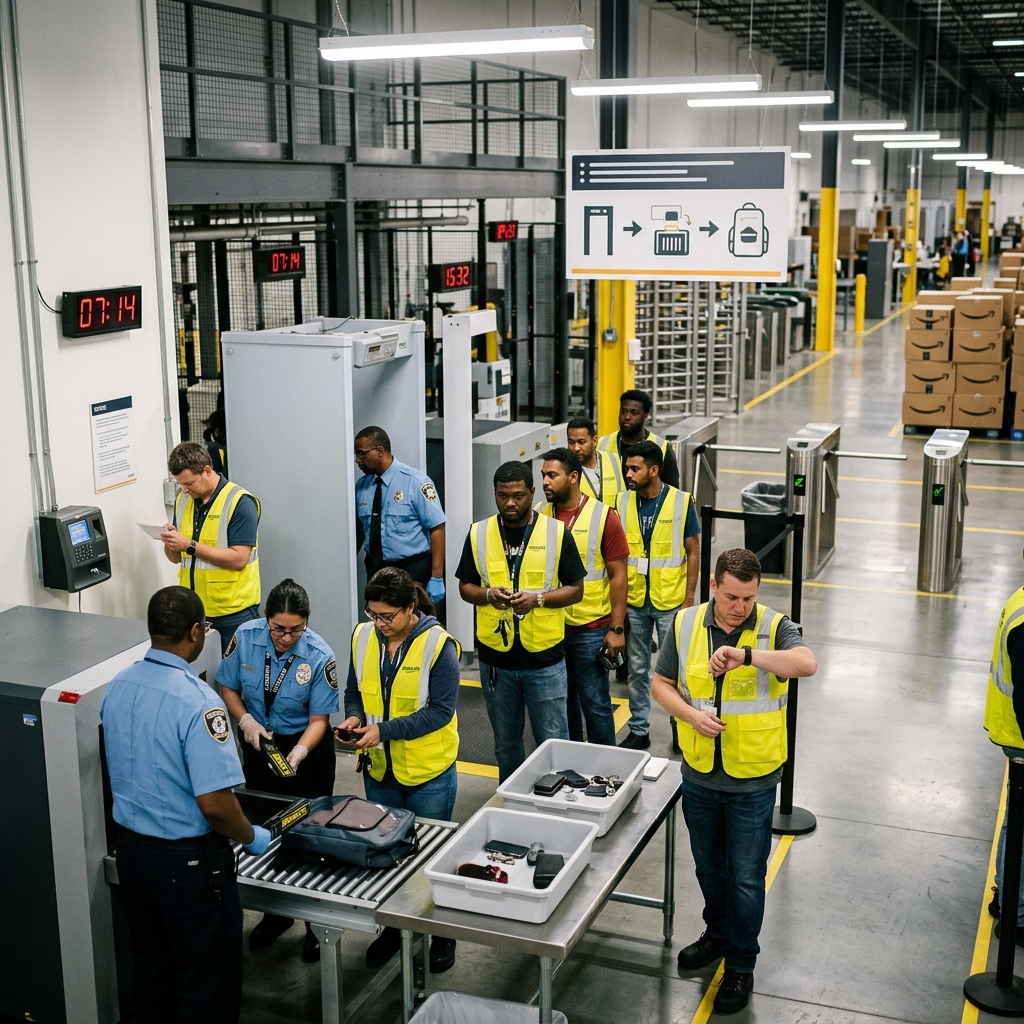
Across the United States, employers increasingly use security screenings to prevent theft and protect high-value inventory. For thousands of warehouse workers, especially those employed in or for Amazon, these checks can add minutes—or even longer—to the end of every shift. The core legal question is simple but far-reaching: must workers be paid for the time it takes to wait for and go through those security checks?
This issue has produced sharply different answers in federal and state courts. At the federal level, the U.S. Supreme Court held that such time is generally not compensable under the Fair Labor Standards Act (FLSA), while several states have interpreted their own wage laws to require payment for security-screening time. These conflicting approaches have major implications for employers, employees, and ongoing wage-and-hour litigation.
Why Security Screenings Became a Legal Flashpoint
Security checks are not unique to Amazon, but the company’s large warehouse network and tight controls over inventory have made it a central figure in the legal debate. Warehouse workers often allege that, after clocking out, they must stand in line and pass through metal detectors or bag inspections as part of anti-theft protocols. This process can take several minutes, and historically, many employers have treated that time as unpaid.
The controversy arises because wage laws generally require payment for hours worked. The question is whether waiting in line for security and walking through screening devices counts as part of those hours. To answer that question, courts examine both:
- The text of relevant wage statutes and regulations.
- Judicial interpretations of what activities are sufficiently related to an employee’s core job duties.
Federal Law: The Busk Decision and the Portal-to-Portal Framework
Under federal law, the key case is Integrity Staffing Solutions, Inc. v. Busk, a 2014 U.S. Supreme Court decision involving workers at Amazon fulfillment centers. The workers contended that security screenings at the end of their shifts—allegedly lasting up to 30 minutes—should be treated as paid time. The Supreme Court unanimously disagreed.
The Court’s reasoning hinges on the Portal-to-Portal Act, which amended the FLSA to clarify that employers are generally not required to pay for certain pre- and post-shift activities that are not integral to an employee’s principal job tasks. The Court drew a distinction between:
- Principal activities: the main duties an employee is hired to perform (e.g., picking items from shelves, packaging goods).
- Preliminary or postliminary activities: tasks before or after the main work that are only compensable if they are an intrinsic element of the principal activity and cannot be dispensed with.
In Busk, the Court held that going through security screening is not an intrinsic element of warehouse work. The screenings were primarily for the employer’s benefit, but they were not so closely tied to the employees’ core tasks that the work itself could not be performed without them. As a result, the time spent waiting for and undergoing security checks was deemed non-compensable under the FLSA.
| Legal concept | Application to security checks |
|---|---|
| Principal activity | Warehouse tasks like picking, packing, and sorting orders. |
| Preliminary/postliminary activity | Security screenings after clocking out. |
| Integral and indispensable | Security checks not considered integral to warehouse duties, so time is generally not compensable under FLSA. |
State Wage Laws: A Different Path for Workers
While the federal rule is clear, state wage laws may adopt broader definitions of compensable time. Several courts have been asked to decide whether state statutes track the FLSA approach or instead require payment whenever workers must remain on the employer’s premises for job-related reasons. One example involves litigation under the Pennsylvania Minimum Wage Act (PMWA).
In a case concerning Amazon warehouse employees, the U.S. Court of Appeals for the Sixth Circuit certified questions to the Pennsylvania Supreme Court about whether time spent waiting for and undergoing mandatory security screening, on the employer’s premises, counts as “hours worked” under the PMWA, and whether small amounts of such time can be treated as legally insignificant under the de minimis doctrine.
Pennsylvania regulations implementing the PMWA define compensable “hours worked” broadly, including:
- Time when an employee is required to be on the employer’s premises.
- Time when an employee is required to be on duty or at a prescribed workplace.
- Certain travel time during normal working hours.
- Time when an employee is employed or permitted to work.
The regulations also specify limited exclusions, such as bona fide meal periods and time spent on the premises solely for the employee’s convenience. State courts have reasoned that mandatory security screenings do not fit these exclusions, because workers are required to participate before leaving.
Pennsylvania’s Approach: Required Presence Equals Pay
In interpreting the PMWA, Pennsylvania’s high court concluded that when employees must remain on the employer’s premises for required activities like security checks, that time falls within the statutory definition of hours worked. This means that, unlike under the FLSA, Amazon and similar employers must treat security-screening time as paid labor in Pennsylvania.
Equally important, the court rejected the argument that very short screening times could be considered de minimis and therefore non-compensable. It emphasized that neither the PMWA nor its regulations include a de minimis exception; instead, they require payment for all hours worked, however small. That interpretation reflects the legislature’s intent that even seemingly minor increments of time cannot be written off simply because they are difficult to measure.
| Issue | Federal FLSA (Busk) | Pennsylvania PMWA |
|---|---|---|
| Security screening time | Not compensable; not integral to principal activity. | Compensable; workers required to be on premises for employer’s purposes. |
| De minimis doctrine | Recognized for small amounts of time that are hard to track. | Not incorporated into PMWA; all hours worked must be paid. |
Other State Developments: Connecticut and Beyond
Pennsylvania is not the only jurisdiction to diverge from the federal standard. State wage laws in other parts of the country, including Connecticut, have also come under scrutiny in connection with Amazon security screenings. In those cases, courts examining state statutes ask similar questions: Are workers being required to remain at work for employer-directed tasks, and does the statutory language tie pay obligations to the employer’s control over workers’ time?
For example, Connecticut’s wage laws have been interpreted to require employers to compensate employees for time spent undergoing mandatory security screenings on the employer’s premises. Such rulings emphasize that when attendance at security checks is compulsory, and when workers cannot freely leave without undergoing the process, the time is part of the employment relationship and must be treated as paid.
Real-World Impact on Amazon Workers
For Amazon workers, these legal distinctions translate directly into paychecks. State-based litigation has described security screening processes that can add anywhere from a few minutes up to a quarter of an hour or more to the end of each shift. Over weeks and months, that time can accumulate into a significant number of unpaid—or, in some states, now paid—hours.
Workers and advocates argue that uncompensated screening time effectively reduces hourly wages, particularly for those earning near the minimum wage. They contend that employers benefit from anti-theft measures and should bear the cost of controlling their premises. When courts agree, employers may be required to modify payroll practices, track post-shift activities more carefully, and sometimes pay back wages to affected employees.
From the employer perspective, companies emphasize administrative burdens and costs. They argue that measuring small increments of time between clock-out and security clearance is difficult and that such tasks were historically treated as outside the scope of paid work. Federal law, as interpreted in Busk, tends to support that view, whereas some state laws do not.
Key Considerations for Employers
Employers with operations similar to Amazon’s must navigate a complex landscape where federal and state rules do not always align. To reduce legal risk, organizations should carefully examine wage laws in each jurisdiction where they operate and assess whether their security-screening policies comply.
Practical steps include:
- Reviewing state wage statutes and regulations to understand how “hours worked” are defined.
- Evaluating mandatory post-shift procedures—such as security checks or equipment returns—to determine whether they may be compensable under local law.
- Implementing accurate time-tracking systems that capture the beginning and end of required activities.
- Training managers and HR personnel to recognize when employees must be paid for time beyond the scheduled shift.
In states where security-screening time is considered payable, employers may need to:
- Allow workers to remain on the clock until all required screening is complete.
- Adjust staffing and scheduling to account for screening time.
- Audit past practices for potential wage exposure.
What Workers Should Know About Their Rights
For employees, understanding whether screening time must be paid depends on both federal and state law. While the FLSA provides a baseline, state statutes can offer greater protection. Workers should consider the following:
- Check your state’s wage laws: Some states interpret “hours worked” more broadly than federal law.
- Document your experience: Keep records of how long security screenings typically take and whether you are required to participate after clocking out.
- Review employer policies: Employee handbooks and posted notices may describe how the company defines paid time.
- Seek legal advice when needed: Wage-and-hour rules are complex, and individual circumstances can vary.
Collective actions—such as class or group lawsuits—have played a significant role in clarifying the law. When appellate courts or state supreme courts resolve disputes about security-screening pay, their decisions often have ripple effects for many workers beyond the original plaintiffs.
Frequently Asked Questions (FAQs)
Do federal law and state law always agree on security-screening pay?
No. Under the FLSA, as interpreted in Busk, time spent in post-shift security screenings is generally not compensable because it is not considered integral and indispensable to the employee’s principal activities. Some states, however, interpret their own wage laws more broadly and treat required on-premises security checks as paid time.
If my employer requires a bag check after I clock out, does that time count as work?
It may, depending on where you work. In states whose wage laws define “hours worked” to include time when employees are required to be on the employer’s premises for job-related reasons, mandatory security procedures can be treated as compensable. In other states, federal principles may dominate, and such time might not be paid.
What is the de minimis doctrine in wage-and-hour law?
The de minimis doctrine refers to the idea that very small amounts of time, which are difficult to record accurately, may not need to be compensated under certain circumstances. Federal courts have applied this doctrine to the FLSA in some settings, but not all state wage statutes incorporate it. For example, Pennsylvania has interpreted its minimum wage law to require payment for all hours worked without a de minimis exception.
Can employers change security procedures to avoid paying for screening time?
Employers can modify policies, such as allowing workers to pass through security while still on the clock or streamlining procedures to reduce wait times. However, where state law mandates payment for required on-premises activities, employers cannot lawfully avoid compensation by simply reclassifying the time; they must ensure compliance with statutory definitions of hours worked.
Does the outcome of Amazon-related cases affect other companies?
Yes. Although the facts of each case may be specific to Amazon’s warehouses, court rulings interpreting wage statutes apply generally to employers within that jurisdiction. Companies that require similar security checks must consider these decisions when designing policies and payroll practices.
Looking Ahead: Evolving Standards in Wage-and-Hour Law
The debate over security-screening pay illustrates a broader tension in wage-and-hour law: how to balance employers’ desire for efficient, theft-resistant operations with workers’ right to be paid for time spent under employer control. As more states analyze their wage statutes in light of federal precedent, the patchwork of rules may grow more complex.
Future developments may include:
- Additional state supreme court decisions clarifying whether security checks are compensable.
- Legislative amendments that either align state law with federal standards or deliberately provide greater protections.
- Changes in business practices, such as redesigned exits or automated security technology, to minimize wait time.
For now, employers and employees must pay close attention to the specific language of the laws governing their jurisdictions. The example of Amazon’s warehouses shows that the answer to whether security screening time must be paid can change dramatically from one state to the next—even when the underlying workplace practices look very similar.
References
- No Pay For Security Checks: Supreme Court — Fisher & Phillips LLP. 2014-11-13. https://www.fisherphillips.com/en/insights/insights/no-pay-for-security-checks-supreme-court
- U.S. Supreme Court Decision in Amazon Worker Security Screening Case is Clear Victory for Employers — McBrayer PLLC. 2014-12-02. https://www.mcbrayerfirm.com/blogs-Employment-Law-Blog,u-s-supreme-court-decision-in-amazon-worker-security-screening-case-is-clear-victory-for-employers
- Amazon Must Pay Associates for Security Checks — Barley Snyder. 2021-08-03. https://www.barley.com/amazon-must-pay-associates-for-security-checks/
- Heimbach v. Amazon.com, Inc., No. 18-5942 — U.S. Court of Appeals for the Sixth Circuit (via Justia). 2019-11-04. https://law.justia.com/cases/federal/appellate-courts/ca6/18-5942/18-5942-2019-11-04.html
- Amazon’s off-the-clock security screenings cheat workers out of wages — Public Justice. 2021-03-29. https://www.publicjustice.org/en/news/martinez-v-amazon-amicus-brief/
- Employment Law Supreme Court Opinion (Connecticut wage laws) — Connecticut Judicial Branch. 2024-04-01. https://www.jud.ct.gov/LegalResources/NewsLog/Post?id=6642
Similar Articles








Read full bio of Sneha Tete




