
Pre-Employment Tests: Legal Risks And Best Practices For SMBs
A practical guide to the legal rules that shape lawful pre-employment screening.
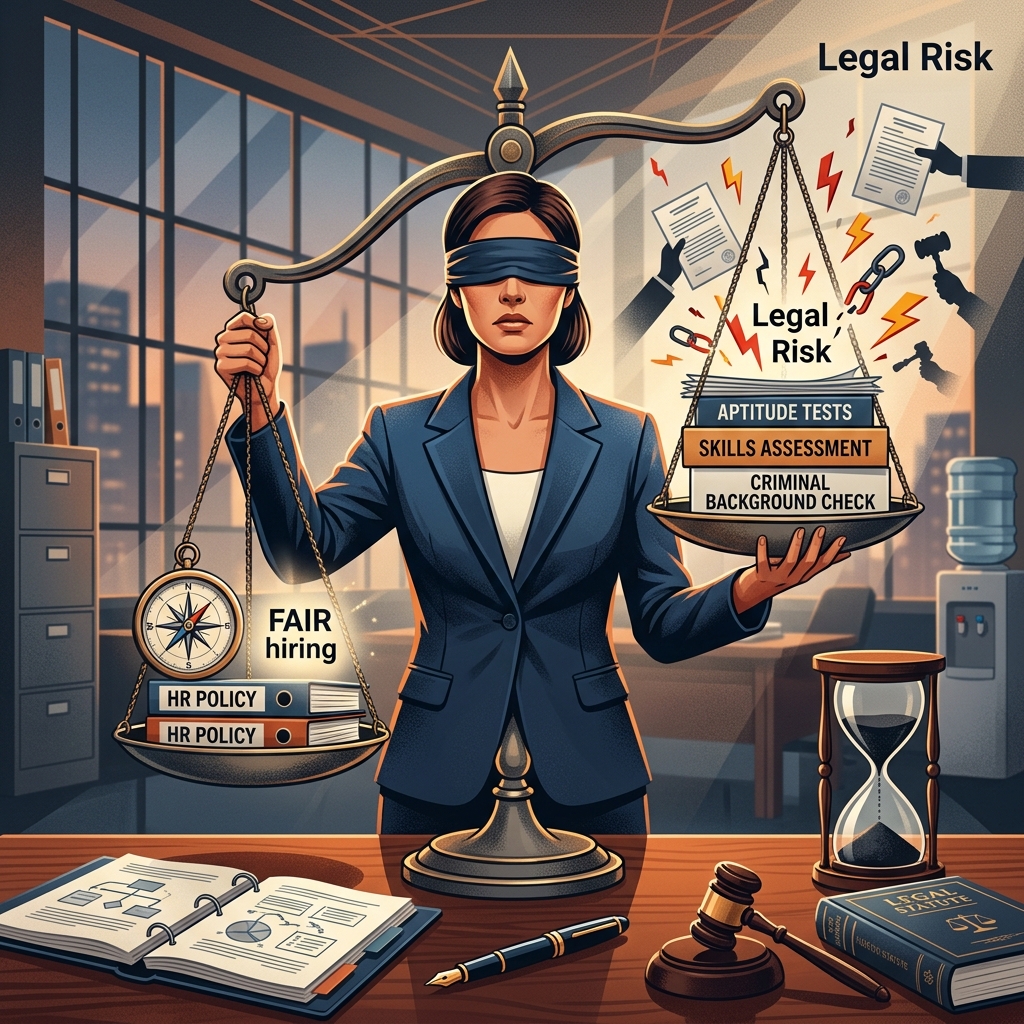
Why hiring tests can become a legal problem
Pre-employment tests can help employers compare candidates in a more structured way, but they can also create legal exposure if they are used carelessly. Federal anti-discrimination rules allow testing in hiring, yet they also prohibit employers from using selection tools in a way that intentionally or effectively screens out protected groups without a lawful justification.
The legal risk usually does not come from testing itself. The problem arises when a test is poorly designed, unrelated to the actual job, administered inconsistently, or used in a way that produces unfair results for applicants based on race, sex, disability, age, religion, or national origin.
For small businesses, this matters because a simple hiring shortcut can turn into a discrimination claim, an EEOC charge, or a costly dispute over whether the company used a valid selection method.
What the law generally allows
Employment tests are not automatically illegal. Under federal guidance, employers may use tests and other selection procedures as long as they are not designed or used to discriminate and are tied to legitimate job requirements.
The central idea is job-relatedness. A test should measure the knowledge, skill, or ability that the position actually requires. If a warehouse job requires the ability to safely lift certain weights, a physical test may make sense. If an office role mainly involves customer communication and data entry, a strength test would be harder to justify.
In other words, the law does not ban all screening tools. It asks whether the tool is a fair and relevant way to predict success in the specific role.
The main federal laws that shape hiring tests
Several federal statutes affect how employers can use tests in hiring. Title VII of the Civil Rights Act bars discrimination based on race, color, religion, sex, and national origin, and it also limits employment tests that are designed, intended, or used to discriminate on those bases.
The Americans with Disabilities Act limits tests that screen out applicants with disabilities unless the employer can show the test is job-related and consistent with business necessity. The Age Discrimination in Employment Act provides similar protection for applicants age 40 and older when a neutral screening method has a discriminatory impact without a legally acceptable reason.
These laws operate together with the EEOC’s guidance on employment tests and selection procedures, which explains that even a neutral test can be unlawful if it disproportionately excludes a protected group and the employer cannot justify it under the law.
How discrimination claims usually arise
There are two broad ways a hiring test can create liability. First, an employer may use the test with discriminatory intent, such as choosing a screening method because it eliminates certain applicants. Second, a test may appear neutral on its face but still have a disparate impact, meaning it screens out people in a protected group at a higher rate than others.
Disparate impact cases matter because employers cannot rely on a test simply by saying it was administered equally to everyone. If the test disproportionately excludes a protected group, the employer generally must show that the test is job-related and consistent with business necessity.
That is why employers should think beyond whether a test is convenient. The legal question is whether it actually predicts performance in the role and whether it does so in a fair way.
Signs a test may be too risky to use
- The test measures traits that are not essential to the job.
- The employer cannot explain why the test predicts job performance.
- Different applicants are given different instructions, timing, or support.
- The test is taken from an unverified online source without validation.
- The results show group disparities that have not been reviewed for fairness.
- The test is used as the only hiring factor instead of one part of a broader process.
Why validation matters so much
Validation is one of the most important safeguards in lawful testing. Guidance on selection procedures emphasizes that pre-employment tests should measure traits related to performance for the particular position. In practice, that means employers should be able to explain what the test measures, why that matters for the job, and how the employer knows the test is a reliable predictor.
A valid test is not just a test that feels reasonable. It is a test that has evidence behind it. Employers are advised to use professionally developed assessments, document the basis for their use, and review them when job duties change.
Validation is also important because a test may look neutral but still have unfair effects. Periodic review helps employers detect whether an assessment is causing unintended exclusion of protected groups.
Fair administration is part of legal compliance
Even a job-related test can become problematic if it is not administered consistently. Employers should give similarly situated candidates the same test at the same stage of the process and under similar conditions.
If one applicant receives extra guidance, more time, or feedback that others do not get, the process may lose fairness and credibility. Consistency also matters when employers decide whether some candidates can skip a test while others cannot.
Reasonable accommodations are another key issue. If a candidate has a disability and needs an adjustment to participate in a test, employers may need to provide one unless doing so would create an undue hardship.
Using different kinds of tests with caution
Employers use many kinds of assessments, including cognitive tests, skills tests, and personality or behavioral questionnaires. Each type has benefits, but each also carries legal and practical risks if used without care.
| Test type | Common business purpose | Main legal concern |
|---|---|---|
| Cognitive ability tests | Measure reasoning, problem-solving, and learning capacity | May disproportionately exclude protected groups if not validated and job-related |
| Skills assessments | Check technical or role-specific competence | Must reflect real job tasks rather than irrelevant challenges |
| Behavioral or personality tests | Assess communication style, work habits, or teamwork tendencies | Can be overinterpreted or used beyond what the test can reliably measure |
Because these tools measure different things, employers should avoid treating any one assessment as a complete picture of a candidate.
Best practices for reducing hiring risk
Employers can lower the chance of a claim by building a careful process before they ever use a test. One important step is to connect every assessment to an actual job requirement and keep records showing why the test was chosen.
Another useful step is to combine tests with other hiring tools, such as interviews, reference checks, and background screening where appropriate. Guidance from employer compliance materials notes that assessments should not be the sole basis for a hiring decision.
Employers should also review outcomes over time. If a test appears to exclude a protected group at a higher rate, the company should examine whether there is a less discriminatory method that would work just as well.
- Use tests only for positions where they are truly relevant.
- Apply the same procedure to comparable applicants.
- Keep documentation explaining the business reason for the test.
- Check whether the test has evidence of validity and reliability.
- Reevaluate assessments when job duties, tools, or staffing needs change.
- Use legal counsel when a test may implicate disability, age, or other protected-class concerns.
When a vendor test is not enough
Many businesses assume that buying a test from a third-party vendor automatically makes it safe to use. That assumption can be costly. Compliance guidance warns employers not to rely on something just because it is sold commercially or promoted as a hiring solution.
Employers remain responsible for how the tool is used in their own process. Even a professionally designed assessment should be reviewed for relevance, consistency, and potential adverse impact before it becomes part of hiring.
That is especially important when the employer adopts a test that was designed for a broad audience rather than for a specific job in a specific workplace. A tool can be well made in the abstract and still be a poor fit for a particular position.
Practical examples of safer decision-making
Consider a sales role that requires frequent written communication, customer follow-up, and basic data entry. A short writing sample or job simulation may be easier to defend than a broad personality screen because the assessment closely mirrors real work tasks.
Now consider a safety-sensitive role. A physical ability test may be justifiable if it measures a task that everyone in the job must perform. The employer should still apply the same standard to all candidates and confirm that the test reflects an actual business need.
By contrast, a test that asks applicants to solve abstract problems unrelated to the position may be much harder to defend if it filters out candidates who could otherwise perform the job well.
Questions employers should ask before using a test
- What job duty does this test measure?
- Can we explain why that duty matters for performance?
- Has the test been validated for this role?
- Will every comparable candidate take the same test under similar conditions?
- Could the test disproportionately exclude a protected group?
- Do we have a backup process if an accommodation is needed?
- Are we using the test as one input rather than the final answer?
Frequently asked questions
Are pre-employment tests illegal?
No. Federal law allows employment testing, but the test must not be discriminatory and should be job-related and consistent with business necessity when required.
Can a neutral test still create liability?
Yes. A test can be neutral on its face and still violate the law if it disproportionately excludes a protected group and the employer cannot justify its use.
Do employers need to validate every assessment?
Validation is a strong best practice and often central to legal defensibility. Employers should be able to show that the test measures qualities that matter for the job.
Should a hiring test be the only factor in a decision?
No. Compliance guidance recommends using assessments alongside other selection tools rather than making them the sole basis for hiring.
What is the safest approach for a small business?
The safest approach is to use only tests that are clearly tied to the job, applied consistently, documented carefully, and reviewed for fairness over time.
References
- Employment Tests and Selection Procedures — U.S. Equal Employment Opportunity Commission. 2024-01-01. https://www.eeoc.gov/laws/guidance/employment-tests-and-selection-procedures
- Pre-Employment Screening Tests: When Are They Legal? — Insureon. 2024-01-01. https://www.insureon.com/blog/pre-employment-tests
- Legal Issues Relating to Pre-Employment Testing — Criteria Corp. 2024-01-01. http://www.criteriacorp.com/resources/definitive-guide-validity-of-preemployment-tests/what-are-the-legal-issues-relating-pre
- Could Your Pre-Employment Testing Cost You Millions in a Lawsuit? — SkillPath. 2024-01-01. https://skillpath.com/blog/could-your-pre-employment-testing-cost-you-millions-in-a-lawsuit
- Legal Risks of Applicant Selection and Assessment — ADP. 2024-01-01. https://www.adp.com/tools-and-resources/case-studies-white-papers/~/media/White%20Papers/NAS/legalrisks_screening_selection.ashx
- Pre-Employment Tests: The Benefits and Risks — ADP. 2024-01-01. https://sbshrs.adpinfo.com/blog/pre-employment-tests-the-benefits-and-risks
- Legal Issues Concerning Employment Testing — Employment-Testing.com. 2024-01-01. https://www.employment-testing.com/legality.htm
Similar Articles








Read full bio of medha deb




