
Maryland Traffic Laws: 10 Essential Rules Every Driver Needs
A practical guide to Maryland’s rules of the road, penalties, and safe driving obligations for every motorist.
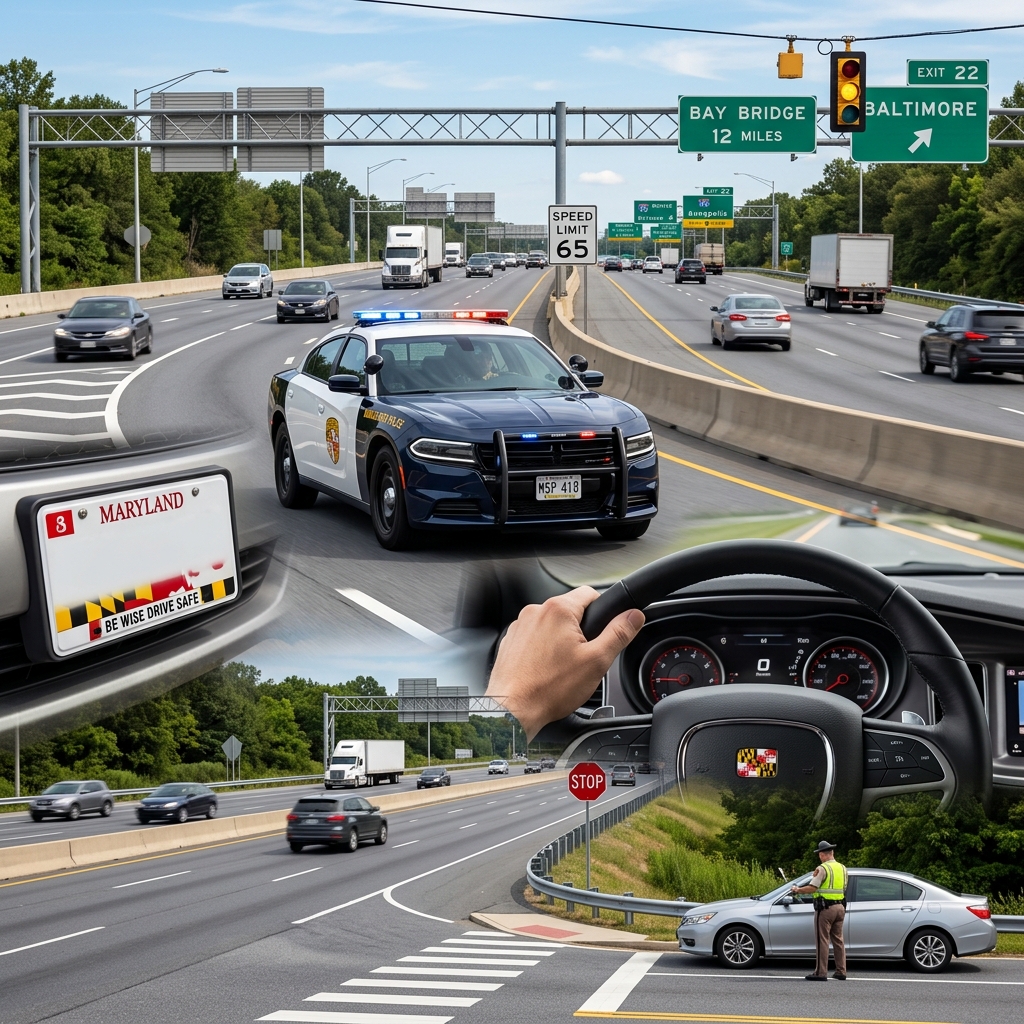
Maryland has a detailed set of traffic rules designed to reduce crashes, protect pedestrians and cyclists, and promote responsible driving behavior. These laws cover everything from speed limits and reckless driving to seatbelt use, cellphone restrictions, learner’s permits, and how points on your driving record affect your license.[10]
This guide explains the most important Maryland traffic laws in clear language, so that new and experienced drivers can understand their obligations, avoid violations, and stay safe on the road.
1. The Legal Framework for Maryland Traffic Rules
Most driving rules in Maryland are codified in the state’s Transportation Article, especially Title 21: Vehicle Laws — Rules of the Road. This title lays out how drivers must behave around signs and signals, pedestrians, bicycles, school buses, and other vehicles.
Key components of the legal framework include:
- Traffic control devices such as lights, signs, and markings, which drivers are legally required to obey.
- General rules for speed, lane use, passing, and yielding that apply on all public roads.[10]
- Special rules for vulnerable road users including pedestrians and bicyclists.[10]
- Administrative rules that allow the Maryland Motor Vehicle Administration (MVA) to assign points for violations and suspend or revoke licenses when necessary.
The Maryland Department of Transportation and the MVA also publish driver manuals and safety guidance that interpret and explain these statutes for everyday drivers.[10]
2. Obeying Traffic Signals, Signs, and Road Markings
Traffic signals and signs are legally enforceable instructions, not suggestions. Failing to comply can lead to tickets, points on your record, and increased crash risk.
2.1 Traffic Lights and Right-of-Way
Maryland law specifically governs how drivers must respond to red, yellow, and green lights:
- Steady red: You must stop at the designated stop line, crosswalk, or before entering the intersection and remain stopped until a green signal or allowed turn is permitted.
- Right turn on red: Generally allowed after a complete stop, but only if you yield to pedestrians and other vehicles with the right-of-way.
- Steady yellow: Warns that the light is about to turn red; drivers should not enter the intersection unless they cannot safely stop in time.
- Steady green: You may proceed, but must yield to pedestrians and traffic already in the intersection.
2.2 Stop Signs, School Buses, and Crosswalks
Other control devices carry equally important legal obligations:[10]
- At a stop sign, you must come to a complete stop at the stop line or before the crosswalk or intersection, then yield to cross traffic until it is safe to proceed.
- When a school bus displays flashing red lights or an extended stop arm, most traffic must stop and may not pass until the signals are deactivated.[10]
- Maryland law requires motorists to stop for pedestrians in crosswalks and at intersections, not merely yield or slow down.[10]
- Bicycles and some personal mobility devices often have similar rights to pedestrians in crosswalks; failing to yield can result in fines, points, and even criminal penalties if a crash occurs.
3. Speed Limits, Reckless Driving, and Aggressive Behavior
Speed management is a central focus of Maryland’s enforcement efforts. Going too fast makes it harder to stop unexpectedly and increases the severity of collisions.[10] The state has recently introduced harsher penalties for dangerous speeding and reckless driving.
3.1 Basic Speed Rules
Drivers must obey posted speed limits and also adjust speed based on road, traffic, and weather conditions.[10] Even if you are below the posted limit, you can be cited if your speed is unsafe for current conditions.
Key expectations include:
- Observe posted limits on highways, local streets, and in school and work zones.
- Reduce speed in poor visibility, wet or icy conditions, or heavy traffic.
- Slow down when approaching stopped emergency, service, or law enforcement vehicles with flashing lights, or move over when possible.
3.2 Reckless, Negligent, and Aggressive Driving
Maryland differentiates between ordinary speeding and more serious behaviors like reckless or aggressive driving. Recent legislation expanded the definitions and penalties:
| Offense Type | Typical Behavior | Possible Penalties |
|---|---|---|
| Reckless driving | Includes driving 30 mph or more over the posted speed limit or otherwise operating with willful disregard for safety. | Up to about $1,000 fine, potential jail time, and six points on the driver’s record if convicted. |
| Negligent driving | Less severe than reckless driving, but still careless or inattentive operation of a vehicle. | Higher fines than ordinary speeding (up to roughly $750) and two points on the driver’s record. |
| Aggressive driving | Two or more specified traffic violations in a single driving episode (such as speeding, tailgating, unsafe lane changes). | Fine up to roughly $1,000 and points on the driver’s record. |
In addition, Maryland’s speed camera system uses a tiered fine structure. Fines start at about $40 for modest speeding (around 12–15 mph over the limit) and can rise to more than $400 for speeds 40 mph or more above the limit.
4. Seatbelts, Impaired Driving, and Collision Duties
Safety equipment and post-crash responsibilities are key parts of Maryland traffic law. They help reduce injuries and ensure that collisions are handled properly.
4.1 Seatbelt and Child Safety Requirements
Maryland law requires most vehicle occupants to use seatbelts or appropriate child restraints:[10]
- All drivers and front-seat passengers must wear a seatbelt.
- Back-seat passengers under age 16 are also legally required to be belted.[10]
- Young children must ride in suitable child safety seats or booster seats, according to age, weight, and height guidelines (further detailed in state child passenger safety rules).[10]
Failing to wear a seatbelt can result in fines and may increase injury risk in a crash.[10]
4.2 Impaired Driving and Alcohol Policies
While Maryland’s specific blood alcohol concentration (BAC) limits and impairment provisions are found elsewhere in the Transportation Article, the state emphasizes that the legal drinking age is 21 and that alcohol use must never be combined with driving.[10]
For commercial learner’s permit holders, new laws disqualify them from driving commercial vehicles for one year if caught operating any vehicle at or above a 0.08 BAC.
4.3 Duties After a Collision
Drivers involved in a collision in Maryland are generally required to:[10]
- Stop at or near the scene rather than leaving.
- Exchange information, including driver’s license details, vehicle registration, and insurance information.
- Render aid to injured persons when possible and safe to do so.
- If vehicles are drivable and it is safe, move them out of travel lanes to reduce further risk.[10]
Police typically will not investigate minor crashes where no one is injured and all vehicles can be driven away, but you are still expected to follow reporting requirements and contact insurers.[10]
5. Cellphones, Texting, and Wireless Devices
Distracted driving is a major contributor to crashes. Maryland has strict rules on the use of handheld and wireless devices while driving.[10]
5.1 Adult Drivers
For most adult drivers:
- It is illegal to use a text messaging device to write, send, or read text or electronic messages while operating a motor vehicle in the travel portion of the roadway.[10]
- An adult driver may not use his or her hands to operate a handheld telephone while the vehicle is in motion, except for very limited actions such as starting or ending a call, turning the phone on or off, or contacting 9-1-1.[10]
5.2 Drivers Under 18
For minors, the restrictions are even stricter:
- Drivers under age 18 generally may not use any wireless communication device—including hands-free systems—while driving, unless calling 9-1-1 in an emergency.[10]
- These rules apply in addition to graduated licensing restrictions on nighttime driving and passenger limits.
6. Licenses, Learner’s Permits, and Teen Restrictions
Maryland uses a graduated licensing system to introduce young drivers to the road in stages. Each stage has its own age requirements and restrictions.
6.1 Age Requirements for Licensure
According to the Maryland People’s Law Library and MVA rules:
- Learner’s permit can generally be issued at age 15 years and 9 months.
- Provisional license can typically be issued at age 16 years and 6 months, assuming the driver meets all conditions.
- Full driver’s license is usually available at age 18, after successful completion of the provisional period.
Schools and the MVA may also deny permits or licenses to students with excessive unexcused absences or those with recent moving violations.
6.2 Teen Driving Restrictions
Drivers under 18 face specific limitations designed to improve safety:[10]
- Most teen drivers cannot operate a vehicle between 12 midnight and 5 a.m. unless supervised by a licensed driver at least 21 years old or traveling for work, school, volunteer, or athletic activities.
- Teen drivers may not use any wireless communication device while driving, except to contact emergency services.[10]
- Points accumulated for moving violations can delay progression from learner’s permit to provisional license, and from provisional to full license.
7. Insurance, Points, and Penalties
Beyond fines and possible jail time, Maryland uses insurance requirements and a point system to encourage lawful driving.
7.1 Mandatory Vehicle Insurance
Maryland law requires all registered vehicles to be insured. Driving without insurance can result in substantial administrative penalties, including annual fines of up to approximately $2,500 per uninsured vehicle.
7.2 Point System and License Consequences
The Maryland MVA tracks many traffic violations using a point system.
- Minor offenses (such as some failure-to-move-over violations) may result in one point and a modest fine.
- More serious violations that cause crashes, injury, or death can carry three or more points and much higher fines.
- Accumulating too many points within a certain period can lead to license suspension or revocation by the MVA.
The Maryland District Court publishes schedules showing fixed fines for common traffic violations, although judges retain some discretion in specific cases.
8. Protecting Pedestrians and Cyclists
Maryland law recognizes pedestrians and bicyclists as vulnerable users, and imposes special duties on drivers to protect them.[10]
8.1 Pedestrian Right-of-Way
Drivers must stop for pedestrians in marked crosswalks and at intersections and exercise caution even where no markings exist.[10] This includes:
- Yielding when turning across a crosswalk.
- Not blocking crosswalks with stopped vehicles.
- Scanning for pedestrians when entering or exiting driveways and parking lots.[10]
8.2 Bicycles and Passing Distance
Bicycles traveling in the roadway have a general right to use the road and, in crosswalks, often share similar protection to pedestrians.
- Motorists must allow at least three feet when passing bicyclists.[10]
- Drivers should show courtesy and avoid aggressive maneuvers around bicycles and other non-motorized users.[10]
- Failure to yield to a bicycle when required, especially if it results in a crash, can carry fines, points, and potentially more serious penalties.
9. Practical Tips to Stay Compliant and Safe
Staying on the right side of Maryland traffic law is easier if you adopt consistent safe driving habits. Consider the following practical strategies:[10]
- Stay alert; put the phone away. Use hands-free systems only where legally allowed, and never text while driving.
- Plan for extra time. Leaving early reduces temptation to speed or drive aggressively.
- Scan for pedestrians and cyclists at every intersection and driveway.
- Use your seatbelt on every trip. Require passengers to buckle up before moving.
- Know your license status and points by checking MVA records periodically.
- Read the Maryland Driver’s Manual and official online resources for updates to laws and penalties.
10. Maryland Traffic Laws FAQ
10.1 Do I have to stop for pedestrians at every crosswalk?
Yes. Maryland law requires motorists to stop for pedestrians in crosswalks and at intersections, not just slow down or yield partially.[10] Failing to do so can result in a citation and increases the risk of serious injury.
10.2 What happens if I drive 30 mph or more over the speed limit?
Driving 30 mph or more above the posted limit now qualifies as reckless driving under Maryland law. A conviction may carry a fine up to about $1,000, possible jail time, and six points on your driving record, in addition to any consequences tied to a crash.
10.3 Can I use a handheld phone while driving if I’m over 18?
Adult drivers may not use their hands to operate a handheld phone while the vehicle is in motion, except to start or end a call, turn the device on or off, or contact 9-1-1.[10] Texting or scrolling on a phone while driving is prohibited.
10.4 Are teen drivers allowed to drive late at night?
Generally no. Teen drivers under 18 cannot drive between midnight and 5 a.m. unless accompanied by a licensed driver at least 21 years old, or traveling to or from work, school, organized volunteer activities, or athletic events.
10.5 What are the consequences of driving without insurance in Maryland?
Driving or owning a vehicle without required insurance can result in significant administrative fines—up to approximately $2,500 per uninsured vehicle per year—and further penalties from the MVA. You may also face civil liability if you cause a crash.
References
- Maryland Traffic Laws – FindLaw — FindLaw. 2025-01-01. https://www.findlaw.com/state/maryland-law/maryland-traffic-laws.html
- New Maryland laws on driving, cannabis, criminal justice and more — CBS News Baltimore. 2025-09-30. https://www.cbsnews.com/baltimore/news/new-laws-oct-1-2025-maryland/
- Maryland Driver’s Manual — Maryland Motor Vehicle Administration. 2024-01-01. https://mva.maryland.gov/media/148
- Maryland Transportation Code §21-202 — Traffic Lights — Maryland General Assembly / Justia. 2025-01-01. https://law.justia.com/codes/maryland/transportation/title-21/subtitle-2/section-21-202/
- Drive Safely in Maryland — Maryland Department of Transportation State Highway Administration. 2023-06-01. https://roads.maryland.gov/mdotsha/pages/Index.aspx?PageId=92
- Drivers Licenses & Teens — Maryland People’s Law Library. 2023-05-01. https://www.peoples-law.org/drivers-licenses-teens
- Traffic Fine Schedule — Maryland District Court. 2024-01-01. https://www.mdcourts.gov/sites/default/files/court-forms/dccr090public.pdf
Similar Articles








Read full bio of medha deb


