
Understanding Liability for Dangerous Consumer Products
A practical legal guide to defective products, consumer rights, and steps to take after an injury caused by everyday items.
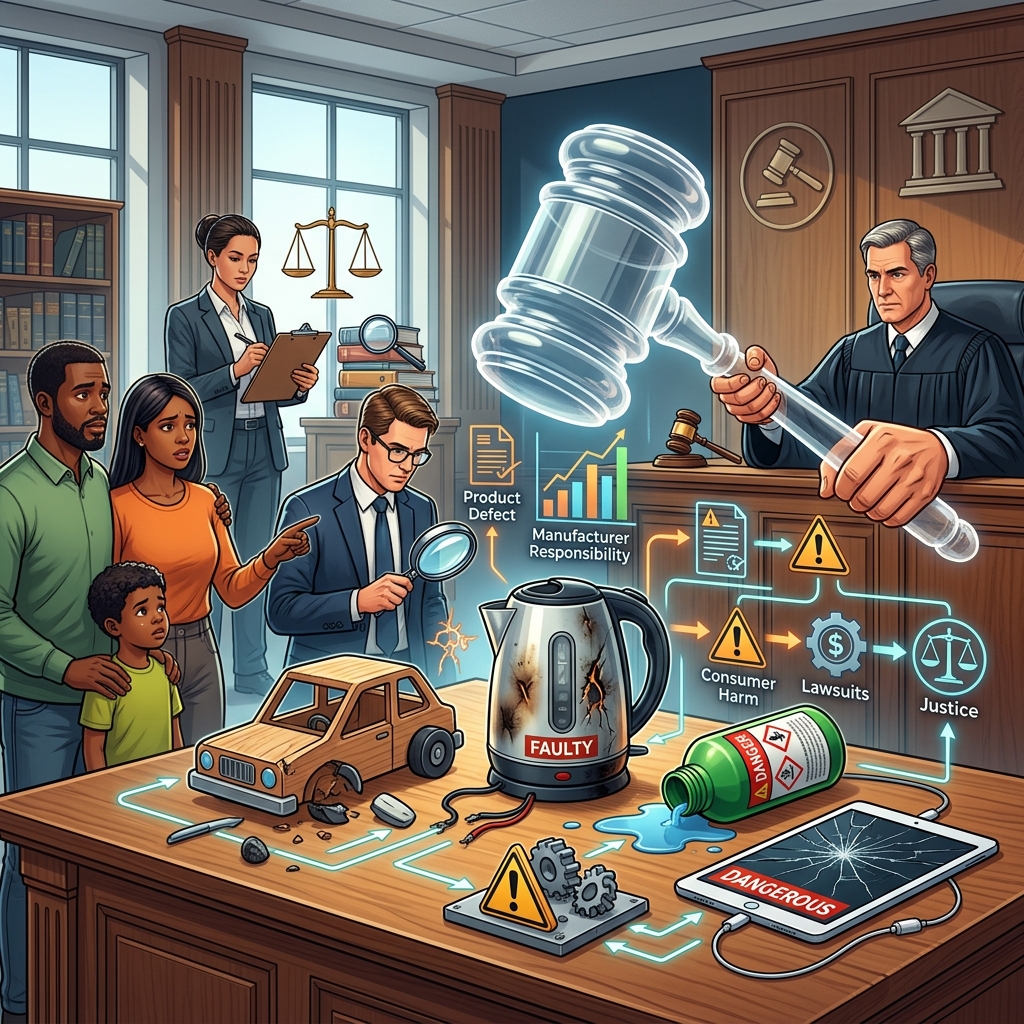
Modern consumers rely on thousands of products every day—from kitchen appliances and power tools to prescription drugs and children’s toys. When one of these items turns out to be dangerous or defective, the consequences can be severe. Product liability law exists to hold businesses accountable for unsafe products and to provide injured people with a pathway to compensation.
This guide explains how dangerous consumer product cases work, what counts as a defect, how liability is established, and what you should do if you or a loved one is harmed by a hazardous product. It is intended for general information and does not replace personal legal advice.
What Makes a Consumer Product “Dangerous” in Law?
Not every injury involving a product automatically leads to legal responsibility. A product is generally considered dangerous or defective in a legal sense when it is not reasonably safe for its intended or foreseeable use and causes injury.
Core elements of a products liability claim
Under U.S. products liability principles, the injured person (the plaintiff) typically must show:
- The defendant sold or distributed a product that the plaintiff used.
- The defendant was a commercial seller (for example, manufacturer, distributor, or retailer).
- The product was defective at the time it was sold.
- The plaintiff suffered an injury.
- The defect was an actual and proximate cause of that injury.
These requirements reflect that products liability is aimed at commercial actors in the chain of distribution, not at casual sellers or individuals who happen to resell used items.
Major Types of Product Defects
Product liability law generally recognizes three main categories of defects. Identifying which type applies is critical for evaluating a claim.
| Type of Defect | What It Means | Common Examples |
|---|---|---|
| Design defect | The product’s blueprint is unsafe, so every unit produced using that design is potentially dangerous, even if manufactured correctly. |
|
| Manufacturing defect | An error occurs during production, causing some units to differ from the intended safe design. |
|
| Failure to warn / marketing defect | The product lacks adequate instructions or warnings about non-obvious risks associated with normal or foreseeable use. |
|
Depending on the facts, a single product can suffer from more than one type of defect—for example, a poorly designed product that is also manufactured inconsistently.
Strict Liability vs. Negligence in Product Cases
Product liability lawsuits may be brought under different legal theories. In many jurisdictions, dangerous consumer product claims rely on the concept of strict liability rather than traditional negligence.
Strict liability: focus on the defect
Under strict liability, a manufacturer or seller can be held liable if a defective product causes injury, even when they exercised significant care in design and production.
- The injured person does not have to prove that the company was careless or intended harm.
- Instead, the key question is whether there was a defect and whether that defect caused the injury.
This approach reflects a policy decision: businesses that profit from selling products are generally better positioned than consumers to bear the costs of defects and to invest in prevention.
Negligence: focus on unreasonable conduct
Some product cases are still pursued under a negligence theory, where the plaintiff must show that the defendant failed to exercise reasonable care.
Examples of potentially negligent conduct include:
- Inadequate safety testing before release to the market.
- Poor quality control leading to inconsistent manufacturing.
- Ignoring known safety complaints without investigating or implementing fixes.
- Failing to provide clear, understandable instructions for safe use.
While strict liability simplifies the injured person’s burden in many states, negligence remains important for claims involving ongoing failures to warn, post-sale conduct, or other unsafe business practices.
The Duty to Warn and Ongoing Safety Responsibilities
Even when a product’s design and manufacturing are sound, it can still be dangerous if users are not properly informed about risks. Many courts recognize a duty to warn, requiring companies to provide adequate warnings about non-obvious hazards linked to reasonably foreseeable uses and misuses of their products.
Key features of an effective warning
To satisfy the duty to warn, businesses typically should ensure that warnings:
- Are visible, clear, and easy to understand.
- Describe the nature and severity of the risk.
- Identify safe operating procedures or protective measures.
- Address both intended uses and predictable misuses.
Warnings may appear directly on the product, on packaging, or in manuals and safety guides. For some high-risk products, multiple layers of warnings are common.
Warnings across the product life cycle
The duty to warn is not limited to the moment a product is first sold. Companies are expected to monitor safety information and respond when new risks become known.
Best practices typically include:
- Before market release: evaluating foreseeable uses and drafting appropriate warnings and instructions.
- After launch: reviewing customer feedback, incident reports, and regulatory communications for emerging safety concerns.
- Updating warnings: revising labels, manuals, and digital instructions if new hazards are identified.
In some situations, failure to update warnings or inform existing customers of serious hazards can form the basis of a product liability claim.
Regulation, Recalls, and the Role of Government
Product liability lawsuits operate alongside government oversight. Federal and state agencies set safety standards and may act when a product presents an unreasonable risk to the public.
Product safety laws and recalls
Product safety laws establish requirements for certain categories of consumer products before they are sold, with the goal of preventing injuries. When an item turns out to be dangerous, several actions may occur:
- Voluntary manufacturer recalls: companies may withdraw a product from the market, repair it, or offer replacements when defects are discovered.
- Government-ordered recalls: regulators can require removal of unsafe products if companies do not act on their own or if risks are particularly serious.
- Public alerts and notices: agencies often publish information describing the hazard and advising consumers on next steps.
Importantly, the existence of a recall does not automatically determine legal liability, but recall information can be highly relevant evidence in subsequent lawsuits.
No single federal product liability statute
In the United States, there is no overarching federal product liability law. Instead, product liability is largely a matter of state law, shaped by statutes and court decisions. This means that:
- Legal standards and time limits to file claims vary from state to state.
- Some states emphasize strict liability more heavily, while others rely more on negligence or warranty theories.
- Outcomes in similar cases can differ depending on the jurisdiction.
Because of this variation, consulting a local attorney with experience in product cases is essential for understanding your rights and options.
Common Types of Dangerous Consumer Products
Any product can be dangerous if it contains defects or is used without appropriate warnings. Some categories more frequently appear in product liability litigation because of their complexity, widespread use, or potential to cause serious harm.
- Household appliances: stoves, heaters, fans, and other devices that may cause fires, shocks, or burns when defective.
- Automotive components: tires, brakes, airbags, and fuel systems where defects can lead to crashes or worsen injuries.
- Children’s products and toys: items that pose choking, strangulation, chemical exposure, or fall risks.
- Medical devices and pharmaceuticals: products that can have serious health consequences when design, manufacturing, or labeling is flawed.
- Tools and industrial equipment: power tools and machinery with inadequate guarding or warnings.
These examples illustrate why safety standards, testing, and quality control are central concerns for manufacturers and regulators.
Steps to Take After Injury from a Dangerous Product
What you do in the hours and days after a product-related injury can significantly influence any future claim. Taking careful, organized steps helps protect your health and preserves important evidence.
Prioritize medical care
- Seek medical attention promptly, even if injuries seem minor. Some conditions, such as internal injuries or chemical exposures, may not be obvious at first.
- Follow all treatment recommendations and attend follow-up appointments. Medical records can later document the nature and extent of your injuries.
Safeguard the product and related materials
- Keep the product in the condition it was in at the time of the incident—do not discard, repair, or return it.
- Preserve packaging, receipts, manuals, and warranty documents, which help show how and when you obtained the product and what information was provided.
- Photograph the product, the scene, and any visible injuries or property damage.
Document your experience
- Write down how the incident occurred while details are still fresh.
- Maintain a log of symptoms, medical visits, work absences, and out-of-pocket expenses.
Seek legal guidance
- Consult a lawyer experienced in product liability to review your situation, applicable state law, and potential claims.
- Avoid giving detailed statements to manufacturers or insurers without independent legal advice, as these statements may affect your rights.
A legal professional can help identify which defect theories may apply, assess damages, and manage communication with companies and insurers.
Potential Compensation in Product Liability Cases
If a dangerous product is found to be legally defective and to have caused injury, the injured person may be entitled to compensation, often referred to as damages. The exact types and amounts depend on the facts and governing state law.
- Medical expenses: past and future costs for treatment, rehabilitation, medication, and assistive devices.
- Lost income: wages, salary, or business income lost due to missed work, along with potential future earnings if the injury affects long-term capacity.
- Pain and suffering: physical pain, emotional distress, and reduced quality of life.
- Property damage: costs to repair or replace damaged belongings.
- In some cases, punitive damages: designed to punish particularly egregious conduct and deter similar behavior, available under specific circumstances in certain states.
Calculating damages can be complex and typically involves medical experts, economic analysis, and careful documentation.
Frequently Asked Questions About Dangerous Consumer Products
1. Do I have a case if I was not using the product exactly as instructed?
Possibly. Product liability often considers reasonably foreseeable misuse as well as intended use. If the way you used the product was predictable and the manufacturer failed to design against that risk or provide warnings, you may still have a viable claim. However, extreme or unforeseeable misuse can reduce or eliminate liability, depending on state law.
2. Is a product automatically defective if I am injured while using it?
No. Some products carry inherent risks even when properly designed and manufactured. A product is legally defective when it is not reasonably safe for expected uses or lacks appropriate warnings about non-obvious dangers. An investigation by experts is often necessary to determine whether the product fell below legal safety standards.
3. Can I sue the retailer, or only the manufacturer?
Product liability can extend to any commercial party in the chain of distribution, including manufacturers, component suppliers, distributors, and retailers. Whether you can sue a particular entity depends on who sold or supplied the product and how state law allocates responsibility.
4. Do recalls prevent me from filing a lawsuit?
No. Recalls are separate from private legal claims. A recall may help prevent additional injuries, but if you were harmed by the product, you can often still pursue compensation. Information from the recall—such as the nature of the defect and the date it was announced—may support your claim.
5. How long do I have to file a product liability claim?
Time limits, known as statutes of limitation, vary significantly by state. Some jurisdictions also have statutes of repose that bar claims after a certain number of years from sale or manufacture, regardless of when the injury occurs. Because these rules are strict, it is advisable to speak with a lawyer as soon as possible after an injury.
References
- Products liability | Wex — Legal Information Institute, Cornell Law School. 2024-01-10. https://www.law.cornell.edu/wex/products_liability
- Product Safety Laws Protecting Consumers — Justia. 2023-08-15. https://www.justia.com/consumer/consumer-protection-law/dangerous-or-defective-products-recalls/
- What is product liability law, and how does it protect consumers? — Finch McCranie LLP. 2024-02-20. https://www.finchmccranie.com/blog/what-is-product-liability-law-and-how-does-it-protect-consumers/
- Dangerous Consumer Products: What Illinois Injury Victims Need to Know — Power Rogers LLP. 2026-06-10. https://www.powerrogers.com/blog/2026/06/dangerous-consumer-products-illinois/
- Duty to Warn: Understanding Product Liability — Amerisure Insurance. 2023-07-12. https://amerisure.com/blog/duty-to-warn/
Similar Articles








Read full bio of Sneha Tete


