
Understanding Exceptions to At-Will Employment
Explore how at-will employment works, when employers can’t freely fire workers, and what legal protections limit wrongful termination.
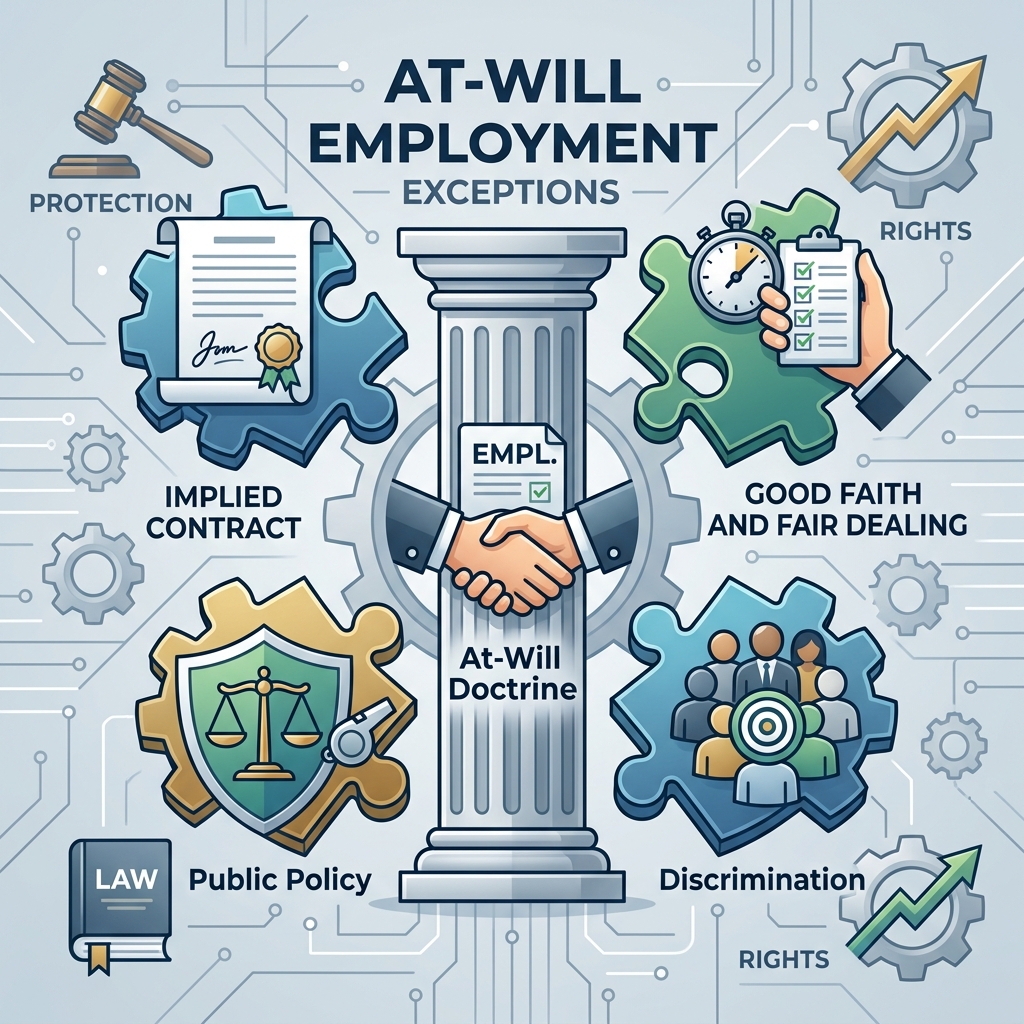
In most parts of the United States, employment is presumed to be at-will, meaning employers can terminate workers for almost any reason, at any time, and employees may leave on similar terms. However, this broad rule is limited by powerful legal exceptions designed to prevent unjust or unlawful terminations. Understanding these exceptions is crucial for both employees and employers navigating discipline, termination, and workplace disputes.
This article explains what at-will employment is, outlines the main exceptions that restrict an employer’s ability to fire someone, and offers practical guidance for spotting potential wrongful termination issues. It is inspired by legal commentary on real-world controversies but focuses on general principles rather than any one individual case.
Core Concept: What At-Will Employment Really Means
At-will employment is the default rule in every U.S. state except Montana, where additional protections apply. Under this doctrine, an employer may end the employment relationship for a good reason, a bad reason, or no stated reason at all, as long as the motive is not illegal. Likewise, an employee may resign at any time, with or without notice.
- Employer flexibility: Businesses can adjust their workforce quickly in response to economic conditions, restructuring, or performance concerns.
- Employee freedom: Workers are not locked into a job and can move on without needing to justify their departure.
Despite this flexibility, at-will employment does not give employers a blank check to fire workers for reasons that violate statutes, public policy, or implied promises. Over time, courts and legislatures have carved out important exceptions to protect fairness, legality, and basic rights.
Overview of Major Exceptions to At-Will Employment
Across the United States, three major common-law exceptions have emerged, alongside a range of statutory protections. While details vary by state, the most widely recognized limitations on at-will firing are:
- Public policy exception – Employers cannot dismiss employees for reasons that contradict clear legal or public policy mandates.
- Implied contract exception – Oral or written assurances and workplace policies may create an expectation of continued employment that restricts arbitrary termination.
- Covenant of good faith and fair dealing – In some states, employers may not terminate workers in bad faith, such as to avoid paying earned benefits.
On top of these judicially created doctrines, federal and state laws prohibit firing for discriminatory or retaliatory reasons, and specific statutes protect whistleblowers, union organizers, and employees exercising legal rights.
| Type of Protection | What It Covers | Typical Examples |
|---|---|---|
| Public Policy Exception | Protects employees from being fired for following the law or exercising legal rights. | Refusing to commit a crime, serving on jury duty, filing workers’ compensation claims. |
| Implied Contract | Arises from employer statements, policies, or practices suggesting job security. | Handbook promises of termination only for “cause,” long-term assurances of job stability. |
| Good Faith & Fair Dealing | Bars terminations carried out deceitfully or maliciously in certain states. | Firing someone solely to avoid paying earned commissions or benefits. |
| Anti-Discrimination Laws | Prohibit firing based on protected characteristics. | Race, sex, religion, age, disability, etc., under federal civil rights statutes. |
| Retaliation & Whistleblower Protections | Ban adverse actions against employees for asserting legal rights or reporting misconduct. | Reporting safety violations, filing discrimination complaints, supporting investigations. |
Public Policy Exception: Protecting Obedience to the Law
The public policy exception is the most widely recognized limit on at-will employment. Under this doctrine, a termination is wrongful if it conflicts with a clear, well-established public policy expressed in statutes, constitutional provisions, or regulatory rules.
Common scenarios include firing an employee for:
- Refusing to commit an illegal act – Employees cannot be lawfully fired for declining to engage in fraud, falsify records, or violate criminal laws on the employer’s behalf.
- Exercising a statutory right – Terminating a worker for filing a workers’ compensation claim or taking protected family and medical leave may violate public policy.
- Performing civic duties – Many states prohibit retaliation against employees who serve on juries or comply with subpoenas.
- Whistleblowing – Reporting safety hazards, discrimination, or financial misconduct to authorities is often protected activity.
For example, federal guidance notes that employers generally may not fire workers for serving on a jury where state law protects this civic obligation. Similarly, states like Texas explicitly recognize a public policy exception when an employee is terminated for refusing to carry out a criminal act.
Implied Contract: When Policies and Promises Create Job Security
Even without a signed employment contract, an implied contract may arise from employer communications, handbooks, and long-standing practices. Courts in many states have held that these factors can create enforceable expectations that employees will not be fired without cause.
Indicators of a potential implied contract include:
- Written policies stating that termination will occur only for specific reasons or following certain procedures.
- Employee handbooks describing progressive discipline or promising job security, without clear disclaimers.
- Oral assurances by managers that an employee will have ongoing employment if performance remains satisfactory.
- A consistent pattern of the employer only firing workers for serious, documented misconduct.
If a court finds that an implied contract exists, the employer must follow the promised procedures or demonstrate valid cause for termination. Firing in disregard of those expectations may constitute wrongful termination even in an at-will state.
Good Faith and Fair Dealing: Limits on Bad-Faith Terminations
Some states recognize a covenant of good faith and fair dealing in employment relationships, often applied where employers use termination as a tool for opportunistic or malicious behavior. Under this exception, an employer may not fire an employee in a way that violates basic notions of fairness or undermines the benefits the employee has earned.
Courts have found potential bad faith where an employer:
- Terminates an employee immediately before vesting of retirement benefits or stock options, solely to avoid paying them.
- Encourages a worker to make long-term investments or relocations, then abruptly fires them without justification.
- Manufactures poor performance allegations as a pretext to get rid of someone for unlawful reasons.
This exception is not universal: some states rely more heavily on statutory protections and traditional contract law, while others allow claims based on broader good-faith principles. Employees and employers should consult local law to understand how far this doctrine extends in their jurisdiction.
Statutory Protections: Discrimination and Retaliation
In addition to common-law doctrines, federal and state statutes impose clear boundaries on when an employer may lawfully terminate a worker.
Anti-Discrimination Laws
Federal civil rights laws, including Title VII of the Civil Rights Act, the Age Discrimination in Employment Act (ADEA), and the Americans with Disabilities Act (ADA), prohibit firing employees based on protected characteristics. These typically include:
- Race or color
- Religion
- Sex or gender (including pregnancy and sexual harassment)
- National origin
- Age (40+)
- Disability
Many states extend protections further to cover traits such as sexual orientation, gender identity, marital status, and other categories. In these circumstances, at-will employment does not allow termination based on discriminatory motives.
Retaliation and Whistleblower Protections
Federal and state laws also prohibit retaliation against employees who engage in protected activities, such as:
- Filing discrimination complaints with agencies like the Equal Employment Opportunity Commission (EEOC).
- Reporting workplace safety violations to the Occupational Safety and Health Administration (OSHA).
- Participating in internal or external investigations of misconduct.
- Taking qualifying family or medical leave under the Family and Medical Leave Act (FMLA).
Employers who terminate workers for these reasons may face legal claims, even if the employment relationship is otherwise at-will.
Contract and Union Exceptions: When At-Will Does Not Apply
Not all employees are subject to the at-will rule. U.S. government guidance confirms that workers covered by collective bargaining agreements or individual contracts specifying terms of employment are not at-will; instead, their rights and termination procedures are controlled by the contract.
- Individual employment contracts: Executives, professionals, and some specialized workers may have written agreements specifying duration of employment, grounds for termination, and severance obligations.
- Unionized employees: Collective bargaining agreements typically require “just cause” for discipline and termination, along with grievance procedures.
- Public sector workers: Many government employees are protected by civil service rules and due process requirements.
In these settings, the employer must comply with contractual or statutory procedures, and wrongful termination claims often center on whether the required steps or standards were met.
Practical Red Flags: When a Termination May Be Unlawful
While every case is fact-specific, certain warning signs commonly appear in disputes over termination. The following red flags suggest that an at-will firing may not be legally permissible:
- The employee was fired shortly after reporting safety hazards, discrimination, or financial irregularities.
- Management encouraged illegal conduct and terminated the worker for refusing to participate.
- Company policies or handbooks promise job security or progressive discipline, but those procedures were ignored.
- Comments or records reveal discriminatory motives related to protected characteristics.
- The timing of the termination coincides with upcoming benefits, suggesting a possible bad-faith motive.
These circumstances do not guarantee a successful claim, but they warrant close examination of public policy, implied contract, good faith, and statutory protections.
Guidance for Employees: Steps to Take After a Suspect Firing
Employees who believe they have been terminated unlawfully should act quickly and methodically. Helpful steps include:
- Document events: Write down dates, conversations, and key incidents leading up to the termination. Preserve emails, messages, performance reviews, and written warnings.
- Review employer policies: Examine handbooks, contracts, and HR documents to identify promises or procedures that may limit at-will termination.
- Identify possible protections: Consider whether any public policy, discrimination, retaliation, or whistleblower protections might apply.
- Seek legal advice: Consult a qualified employment lawyer or legal aid organization to evaluate potential claims and deadlines.
- Observe time limits: Many claims, especially discrimination complaints, have strict filing deadlines with agencies like the EEOC.
Even if a termination does not ultimately qualify as wrongful under the law, this process can clarify rights and options, such as negotiating severance or securing references.
Guidance for Employers: Reducing Risk of Wrongful Termination Claims
Employers can respect at-will flexibility while minimizing legal risk by adopting thoughtful policies and practices. Recommended strategies include:
- Use clear at-will disclaimers: In handbooks and offer letters, clarify that employment is at-will unless a specific contract states otherwise.
- Train managers: Provide training on anti-discrimination, retaliation, and public policy protections, emphasizing the importance of lawful decision-making.
- Document performance issues: Maintain consistent records of evaluations, coaching, and discipline to support legitimate business reasons for termination.
- Apply policies consistently: Avoid selective enforcement of rules, which can create perceptions of bias or pretext.
- Consult counsel before sensitive terminations: Particularly where protected activities or characteristics are involved, legal review can identify risks and appropriate safeguards.
By integrating legal awareness into everyday HR practices, employers can preserve the benefits of at-will employment while respecting the exceptions that protect workers from unjust outcomes.
FAQs About At-Will Employment and Its Exceptions
Is every private-sector employee in the U.S. an at-will employee?
No. While almost every state presumes employment is at-will, workers covered by union contracts, individual employment agreements, or certain public-sector rules may have stronger protections and are not subject to pure at-will termination.
Can my employer fire me for no reason at all?
Legally, an employer does not have to give a reason for termination in an at-will setting. However, the firing still cannot be based on illegal grounds, such as discrimination, retaliation, or violations of public policy.
What if my handbook says I can only be fired for cause?
Depending on the wording and the presence (or absence) of disclaimers, handbook language promising termination only for cause may contribute to an implied contract claim. Courts look at the overall context, including how policies are communicated and applied.
Does refusal to follow an unethical order always protect me?
Protection is strongest when the order would require breaking the law, such as committing fraud or falsifying required records. Refusing purely unethical but not illegal conduct may be less clearly protected, though some statutes and policies extend coverage in specific contexts.
How do I know if my termination was discriminatory?
Evidence may include biased remarks, patterns of different treatment, inconsistent explanations, or timing close to protected activities. Legal professionals and enforcement agencies can help assess whether discrimination laws may have been violated.
References
- The basics of the at-will employment doctrine — Thomson Reuters. 2024-06-10. https://legal.thomsonreuters.com/en/insights/articles/at-will-employment-doctrine
- Exceptions to Employment at Will That Every Employee Should Know — Pasternak & Fidis. 2023-09-14. https://pasternaklaw.com/exceptions-to-employment-at-will/
- What is At-Will Employment? — Stark Law Group. 2025-02-03. https://www.starklawllc.com/blog/2025/02/what-is-at-will-employment/
- The employment-at-will doctrine: three major exceptions — U.S. Bureau of Labor Statistics. 2001-01-01. https://www.bls.gov/opub/mlr/2001/01/art1full.pdf
- Pay and Policies – General (Texas Guidebook for Employers) — Texas Workforce Commission. 2023-08-01. https://efte.twc.texas.gov/pay_and_policies_general.html
- Termination guidance for employers — USA.gov. 2024-04-05. https://www.usa.gov/termination-for-employers
- Michigan At-Will Employment Exceptions Explained — Batey Law Firm. 2024-03-21. https://www.bateylaw.com/blog/at-will-but-not-lawless-michigan-exceptions-every-employee-should-know
Similar Articles








Read full bio of medha deb




