
Transgender Bathroom Access: Laws, Rights, and Ongoing Debates
A clear, evidence‑based guide to how U.S. laws regulate transgender people’s access to restrooms and other gendered facilities.
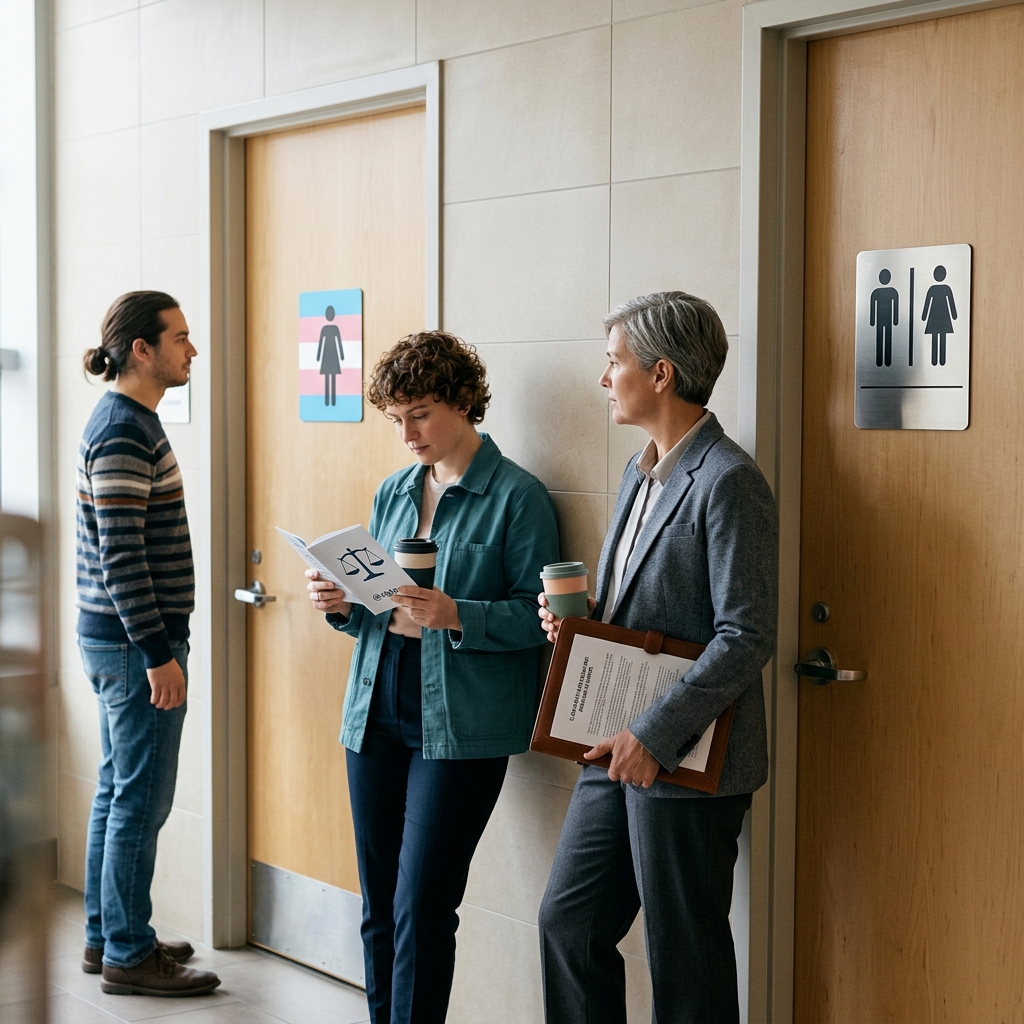
Across the United States, transgender people’s access to bathrooms, locker rooms, and other sex‑segregated spaces has become a focal point of legal and political conflict. Some laws and policies permit people to use facilities that align with their gender identity, while others restrict access based on sex assigned at birth, sometimes adding criminal penalties.
This article explains the legal landscape, the role of federal and state law, the evidence about safety and privacy, and the practical implications for students, workers, and businesses.
1. What Are Transgender Bathroom Laws?
There is no single nationwide rule for bathroom access based on gender identity in the United States. Instead, a patchwork of laws, court decisions, and agency rules determines which restrooms transgender people may legally use in particular settings.
1.1 Core legal questions
Most disputes over bathroom access revolve around three basic questions:
- How is sex defined? Is access based on sex assigned at birth, the sex listed on legal documents, or a person’s gender identity?
- Which spaces are covered? Laws may address multi‑user restrooms, single‑user restrooms, locker rooms, changing areas, showers, or sleeping quarters such as dorms and shelters.
- Who must comply? Some rules bind public schools and government buildings, while others reach colleges, prisons, shelters, or even certain private businesses open to the public.
Policies fall roughly into two groups:
- Inclusive policies allow people to use facilities that correspond to their gender identity.
- Restrictive policies require use based on sex assigned at birth or legal sex, even for people who live and present in a different gender.
1.2 Why bathrooms became a legal battleground
Although anti‑discrimination debates concerning sexual orientation and gender identity have existed for decades, bathroom access came to national attention around 2015–2016, when several states and cities proposed or adopted laws that explicitly targeted restroom use by transgender people. These measures were often framed as “bathroom bills.”
Since then, state legislatures, school boards, and courts have repeatedly revisited the issue. The result is an uneven landscape where rights can drastically differ from one jurisdiction to another.
2. Where Do These Laws Apply?
Bathroom‑access rules are not uniform. They often focus on specific types of institutions and facilities.
2.1 Commonly regulated locations
| Setting | How bathroom laws commonly apply |
|---|---|
| K–12 public schools | Most state‑level bathroom bans or requirements focus on public elementary and secondary schools. |
| Public colleges and universities | Some laws extend to state‑run higher education institutions. |
| Government buildings | Courthouses, city halls, state legislative buildings, and similar facilities may be covered. |
| Correctional facilities | Prisons and jails sometimes have specific provisions for housing and bathroom use by transgender people. |
| Shelters and group housing | Domestic‑violence shelters, homeless shelters, and state‑run group homes may be included. |
| Private businesses | In most states, bans target government settings, but a smaller number extend restrictions to some privately owned facilities open to the public. |
2.2 State‑by‑state variation
State law plays a central role:
- Some states have bans that prohibit transgender people from using bathrooms consistent with their gender identity in certain public settings.
- Some states explicitly protect access by including gender identity in anti‑discrimination laws covering public accommodations such as restrooms.
- Many states have no statewide rule, leaving access to a mix of local ordinances, school‑district policies, and broad civil‑rights statutes.
Advocacy and research organizations track which states impose bans or provide protections, and they note that these policies frequently change through new legislation and court decisions.
3. Federal Law: Title IX, Equal Protection, and Agency Policy
Even when states pass their own bathroom laws, federal law can affect how schools and government agencies treat transgender people. Two major legal anchors are Title IX and the Equal Protection Clause.
3.1 Title IX and gender identity
Title IX is a federal law that prohibits sex discrimination in education programs and activities receiving federal funds. Courts and federal agencies have wrestled with whether discrimination against transgender students constitutes sex discrimination under Title IX.
Federal courts are not unified. Some appellate courts have held that preventing transgender students from using restrooms aligning with their gender identity violates Title IX, while others have disagreed or relied on different reasoning. As a result, students’ rights can differ dramatically depending on which federal circuit they live in.
3.2 Equal Protection and constitutional arguments
Transgender students and employees have also brought claims under the Equal Protection Clause of the Fourteenth Amendment. These cases typically argue that policies singling out transgender people for different restroom treatment are a form of sex‑based or status‑based discrimination that fails constitutional scrutiny.
Some courts have agreed that singling out transgender students for disparate bathroom access violates equal protection, especially when schools cannot show the policy is substantially related to an important governmental interest. Others have been more deferential to school or state justifications, again contributing to a fragmented legal environment.
3.3 Shifting federal agency positions
Presidential administrations and federal agencies periodically update guidance related to gender identity and bathroom access. Guidance from agencies such as the Department of Education or the Equal Employment Opportunity Commission (EEOC) may influence how schools and employers interpret legal obligations, but these positions can change with new administrations and are often challenged in court.
Recent federal actions have moved toward more restrictive interpretations of transgender rights in some contexts, prompting lawsuits by civil‑rights groups and affected individuals. Until these disputes are resolved, the scope of federal protections remains unsettled in key areas.
4. Evidence on Safety, Privacy, and Harm
Public debate over transgender bathroom access is frequently framed in terms of safety and privacy, especially for women and girls. Research, however, paints a different picture.
4.1 What studies show about safety
Empirical research finds no evidence that allowing transgender people to use bathrooms that match their gender identity increases safety risks for others. A 2025 study by the Williams Institute at UCLA School of Law examined violent victimization data in states with and without trans‑inclusive bathroom policies and found no increase in violence by strangers where inclusive policies existed.
Earlier research reached similar conclusions, consistently finding that inclusive bathroom policies do not correlate with higher rates of assaults or privacy violations against non‑transgender people.
4.2 Documented harms to transgender people
While studies do not support claims of heightened risk to others, they consistently show significant risks for transgender people themselves when accessing restrooms and other gendered facilities.
Research and survey data indicate that transgender people frequently experience:
- Being denied access to bathrooms
- Verbal harassment or threats
- Physical assault in or near restrooms
- Health impacts from avoiding bathroom use, such as dehydration or urinary problems
Analysis of data from the 2022 U.S. Transgender Survey suggests that negative incidents are more likely when transgender people are forced to use restrooms that correspond to their sex assigned at birth rather than their gender identity. In other words, restrictive laws may increase, rather than decrease, the risk of conflict and harm.
4.3 Broader social effects
Civil‑rights organizations argue that bathroom bans do not improve safety or privacy but instead limit transgender people’s ability to participate in public life safely and equally. They also note that such laws can encourage increased policing of appearance: anyone who does not conform to narrow expectations of masculinity or femininity may be questioned or harassed, regardless of their actual gender identity.
5. Local and Institutional Policies
Beyond state and federal law, cities, counties, school districts, and employers often adopt their own restroom policies. These rules can offer protections even in states that lack explicit statewide safeguards.
5.1 Local protections and resolutions
Some local governments have passed measures affirming that people should be allowed to use restrooms in government buildings based on their gender identity, regardless of sex assigned at birth. These policies generally emphasize dignity, equal access, and compliance with broader civil‑rights principles.
Typical features of such local policies include:
- Allowing restroom access based on gender identity in government‑owned facilities
- Training staff on respectful and lawful treatment of transgender visitors
- Clarifying that harassment of anyone using restrooms is not tolerated
5.2 Single‑user and all‑gender restrooms
Many jurisdictions encourage or require the availability of at least one single‑user or all‑gender restroom in public buildings and schools. These facilities can provide additional privacy and flexibility, though they are not a substitute for equal access to multi‑user restrooms.
In practice, single‑user restrooms may help:
- Accommodate people who want more privacy, including transgender people and those with disabilities or caregivers
- Reduce conflict in environments where multi‑user policies are still contested
- Signal institutional commitment to inclusion and safety
6. Practical Implications for Different Groups
Bathroom laws affect a wide range of people and institutions. Understanding their practical consequences can help individuals navigate their rights and obligations.
6.1 Students and families
For transgender students, bathroom access policies influence daily life at school:
- In inclusive jurisdictions, students may use facilities that match their gender identity and may have access to privacy options if desired.
- In restrictive states or districts, students might be directed to facilities matching their sex assigned at birth or to a separate single‑user restroom, which some courts and advocates view as stigmatizing.
- Legal recourse may be available under Title IX or constitutional theories, depending on the jurisdiction and recent case law.
6.2 Employees and employers
Bathroom policies in workplaces are shaped by a combination of federal anti‑discrimination law, state civil‑rights statutes, and internal company rules. Courts and federal agencies have increasingly interpreted federal sex‑discrimination law to cover discrimination against transgender employees, which can include restricting restroom access based on gender identity, though the details of that coverage remain contested in some settings.
Many employers adopt policies that:
- Permit employees to use restrooms consistent with their gender identity
- Provide single‑user facilities as an option, but not a requirement, for transgender workers
- Offer training on respectful communication and privacy expectations for all employees
6.3 Public accommodations and businesses
Businesses and other public accommodations (such as restaurants, stores, and theaters) must comply with applicable state and local non‑discrimination laws. In states that protect gender identity, denying restroom access or harassing a customer because they are transgender can violate civil‑rights statutes.
Even in states without explicit protections, some local ordinances or company policies may provide safeguards. Businesses often choose to adopt inclusive restroom practices to reduce legal risk, improve customer experience, and support diversity goals.
7. Key Takeaways and Best‑Practice Approaches
Although the legal environment is evolving, several themes emerge from both current law and empirical research:
- No national rule: Bathroom access rights are determined by a mix of federal law, state statutes, and local policies, leading to wide variation across the country.
- Courts are divided: Federal courts disagree on how Title IX and equal protection apply to transgender bathroom access, so outcomes depend heavily on jurisdiction.
- Evidence does not support safety concerns: Studies find no increase in violent victimization or privacy violations when transgender people use bathrooms aligned with their gender identity.
- Transgender people face documented harms: Restrictive policies correlate with higher rates of harassment, denial of access, and physical assault against transgender people in restrooms.
- Inclusive policies and all‑gender options: Allowing access based on gender identity, combined with single‑user or all‑gender restrooms, is increasingly viewed as a best‑practice approach for balancing inclusion and privacy.
Because laws and court decisions are changing rapidly, anyone affected by a specific policy—students, parents, employees, administrators, or business owners—may benefit from speaking with a qualified attorney familiar with LGBTQ rights and local regulations.
8. Frequently Asked Questions (FAQs)
Are transgender bathroom rights the same in every state?
No. There is no uniform national standard, and states differ widely. Some have laws that restrict transgender people from using restrooms corresponding to their gender identity in certain settings, others provide explicit protections in public accommodations, and many have no explicit statewide rule, leaving decisions to local governments and institutions.
Do inclusive bathroom policies make restrooms less safe?
Research has found no evidence that allowing transgender people to use bathrooms aligned with their gender identity increases violent victimization or privacy violations against non‑transgender people. Studies comparing jurisdictions with and without inclusive policies show no statistically meaningful increase in crimes such as assaults in restrooms when access is inclusive.
How do bathroom bans affect transgender people?
Restrictive laws are associated with higher rates of harassment, denial of access, and assaults against transgender individuals in restrooms and similar facilities. Transgender people may also avoid drinking water, skip classes or activities, or limit time in public spaces to avoid using restrooms, which can negatively affect health and participation in work or education.
What role does Title IX play in bathroom access for students?
Title IX prohibits sex discrimination in federally funded education programs. Some courts have interpreted this to require schools to allow transgender students to use bathrooms consistent with their gender identity, while other courts have reached different conclusions. Because of this split, legal protections under Title IX vary by region until higher courts bring more uniform guidance.
Can private businesses set their own restroom policies?
Private businesses must follow applicable federal, state, and local civil‑rights laws. In places where gender identity is protected, refusing restroom access or harassing someone because they are transgender can violate public accommodations laws. In areas without explicit protections, businesses may still adopt inclusive policies voluntarily, and many do so to support customers and employees and reduce potential liability.
What are all‑gender or gender‑neutral restrooms?
All‑gender or gender‑neutral restrooms are facilities that anyone can use, regardless of gender. They are often single‑user restrooms but can also be multi‑stall designs with enhanced privacy features. Many jurisdictions encourage or require at least one such restroom in public buildings as a way to improve privacy and inclusion for a wide range of users, including transgender people, families, and people with disabilities.
References
- Transgender Bathroom Laws by State — FindLaw. 2026-07-01. https://www.findlaw.com/lgbtq-law/transgender-people-and-bathroom-access-laws.html
- Transgender bathroom access laws in the United States — Ballotpedia. 2018-06-01. https://ballotpedia.org/Transgender_bathroom_access_laws_in_the_United_States
- Bathroom bill — Descriptive overview (encyclopedic entry). Last updated 2024. https://en.wikipedia.org/wiki/Bathroom_bill
- Bans on Transgender People Using Public Bathrooms and Facilities According to Their Gender Identity — Movement Advancement Project. 2026-05-01. https://mapresearch.org/equality-map/bans-on-transgender-people-using-public-bathrooms-and-facilities-according-to-their-gender-identity/
- Safety and Privacy in Public Restrooms and Other Gendered Facilities — Williams Institute, UCLA School of Law. 2025-01-15. https://williamsinstitute.law.ucla.edu/publications/safety-in-restrooms-and-facilites/
- Debunking Misconceptions About Idaho’s Bathroom Ban Laws — American Civil Liberties Union of Idaho. 2025-04-10. https://www.acluidaho.org/news/debunking-misconceptions-about-idahos-bathroom-ban-laws/
- Access to Public Restrooms Based on Gender Identity — Johnson County, Iowa. 2016-06-16. https://www.johnsoncountyiowa.gov/access-public-restrooms
Similar Articles








Read full bio of medha deb


