
Teen Cell Phone Searches and Student Privacy
How a school cell phone privacy case highlights student Fourth Amendment rights and what it means for families.
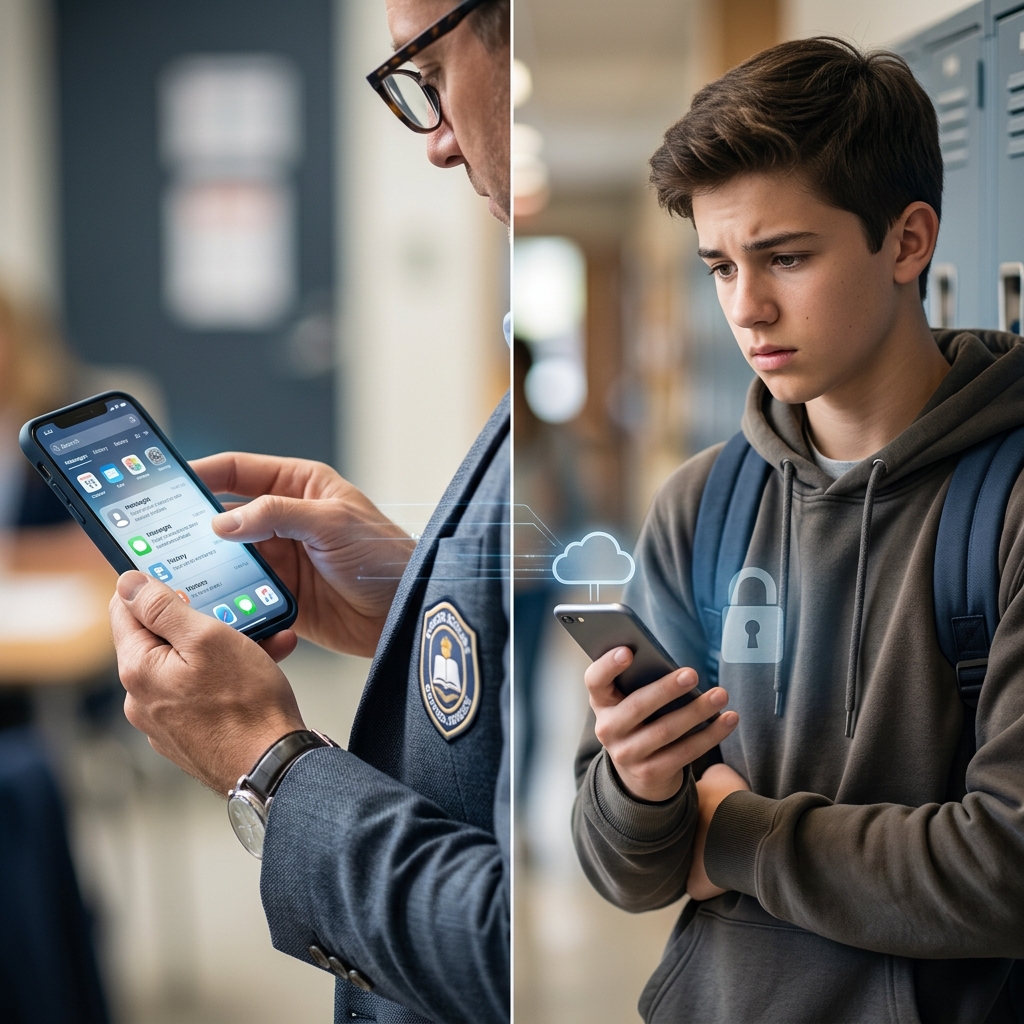
As smartphones have become central to teenagers’ daily lives, a key legal question has emerged: how far can schools go in searching students’ phones when investigating possible misconduct? A recent settlement involving a teen whose device was searched during a school investigation underscores the tension between school safety and constitutional privacy protections.
This article uses that kind of case as a jumping-off point to explain the legal rules that govern student cell phone searches, the limits of school authority, and practical steps families and educators can take to reduce conflict and protect both safety and rights.
Why Student Cell Phone Privacy Matters
For most teens, a phone is far more than just a communication tool; it holds messages, photos, search histories, health apps, and social media accounts that together form a detailed portrait of their lives. The law increasingly recognizes that these devices contain an extraordinary amount of personal data, making them uniquely sensitive objects when it comes to searches by government officials.
Public school administrators are government actors, so when they seize or search a student’s phone, their actions are subject to the Fourth Amendment, which protects against unreasonable searches and seizures. That means the same constitutional principles that apply when police search a home or car also apply, with some modifications, in the school setting.
- Phones can reveal intimate details about family relationships, medical issues, and sexuality.
- They often contain years of communication records, not just the last few texts.
- Teenagers may not fully appreciate the legal consequences of handing over a device or password.
When a teen’s phone is searched without clear justification, the impact can ripple beyond the student alone, potentially exposing parents, siblings, and friends to unwanted scrutiny.
The Legal Framework: Fourth Amendment in Public Schools
The Fourth Amendment generally requires government officials to have probable cause and, in most situations, a warrant before searching private digital information. In schools, however, the Supreme Court has long recognized that administrators must maintain order and safety and therefore operate under a somewhat lower standard.
In the landmark case involving student searches of physical belongings, the Court said that school officials need only reasonable suspicion—a less demanding standard than probable cause—to search students, so long as the search is reasonably related to its purpose and not excessively intrusive in light of age and nature of the alleged violation. Applied to phones, this means:
- Administrators must have a specific, articulable reason to believe the phone contains evidence of a violation of law or school rules.
- The scope of the search must be narrowly tailored to that suspected violation.
- General curiosity about what students are doing on their phones is not enough.
Courts and legal commentators have emphasized that the unique nature of smartphones—vast storage, personal data, and cloud connections—makes them more like a filing cabinet full of private documents than a simple notebook.[10] As a result, even in a school setting, courts are careful about allowing broad, unfocused searches.
What Happens When a School Searches a Teen’s Phone?
The settlement described in the original inspiration article involves a teen whose phone was accessed by school administrators during an investigation into alleged threats or bullying. Similar cases across the country demonstrate common patterns in how these situations arise:
- A student is accused of making online threats or harassing another student.
- Administrators request or demand access to the student’s phone to review messages, posts, or photos.
- In some instances, they read conversations that go far beyond the alleged incident, including unrelated private messages.
- The student and family later argue that the search violated constitutional rights and file a lawsuit, often alleging a Fourth Amendment violation.
One case that has drawn attention involved high school administrators who searched a student’s phone during an investigation into threats, leading the student’s parents to claim a breach of Fourth Amendment rights. In another influential case, a federal appeals court in the Sixth Circuit held that simply catching a student texting in class did not entitle a teacher to read the content of the messages; the school needed reasonable suspicion that the messages themselves contained evidence of wrongdoing.
Common Triggers for Phone Searches
- Reports of violent threats or rumors spread via text or social media.
- Cyberbullying allegations involving direct messages or group chats.
- Suspected sharing of explicit images among students.
- Use of phones to coordinate fights, walkouts, or other disruptive activities.
While these concerns are serious, courts insist that each search be grounded in specific facts pointing to that particular device and the information on it, rather than general concern about students’ technology use.
Reasonable Suspicion vs. Probable Cause: A Quick Comparison
Understanding the difference between the standards used inside and outside school helps clarify when a cell phone search may be lawful.
| Context | Legal Standard | What It Requires | Implication for Phone Searches |
|---|---|---|---|
| Outside school (police) | Probable cause + usually a warrant | Strong, objective reasons to believe a search will uncover evidence of a crime.[10] | Police typically need a warrant before accessing phone contents, except in limited emergencies.[10] |
| Inside public school (administrators) | Reasonable suspicion | Specific facts suggesting the phone has evidence of a violation of law or school rules. | Administrators can search without a warrant but must limit scope and cannot act on pure curiosity. |
Legal advocates stress that, even under the lower school standard, the search must be justified by individualized suspicion that the device contains relevant evidence. Simply possessing a phone against a school rule, or using it in class, does not automatically justify reading its messages or browsing its photos.
Lessons from Recent Student Cell Phone Cases
Courts and legal organizations have drawn several key lessons from recent disputes over student phone searches.
1. Confiscation Is Different from Searching
Many schools have rules prohibiting phone use in class or on campus, and courts generally allow administrators to take a device away temporarily as a disciplinary measure. Confiscation is seen as a reasonable way to enforce rules and reduce distractions.
But legal advocates emphasize a critical distinction: removing a phone from a student’s possession does not automatically authorize a deep dive into its contents.
- Confiscation addresses behavior (using a phone when it is not allowed).
- Searching addresses information (what is stored on or accessed through the device).
- A school may need different and stronger justification to move from confiscation to searching.
2. Background Concerns Are Not Enough
In one reviewed case, a student had a history of emotional struggles and disciplinary issues, which administrators cited as justification for searching his phone. A federal appeals court rejected this reasoning, explaining that general knowledge of a student’s past behavior does not automatically create reasonable suspicion that any given phone message contains evidence of wrongdoing.
The court insisted that schools must base searches on more concrete indicators, such as first-hand observations or credible reports about specific conduct tied to the device.
3. Scope Must Match the Suspected Offense
Legal guidance stresses that when a phone search is justified, it should be carefully tailored to the suspected violation.[10] For example, if the concern is a threatening text sent on a particular day, administrators should not review months of unrelated messages or photos.
To reduce the risk of violating student rights, experts recommend that school officials:
- Identify the specific type of content they are looking for (e.g., a particular chat thread).
- Limit the search to relevant apps or timeframes.
- Avoid opening unrelated messages, photos, or accounts when possible.[10]
Best Practices for Schools: Balancing Safety and Privacy
Education law scholars and professional organizations have proposed best practices to help schools navigate these complex issues without exposing themselves to legal liability.[10]
Policy Design
- Clearly define when and how phones may be used on campus, including any bans during the school day.
- Explain the difference between confiscation and searching in written policies shared with families.
- Specify that searches require individualized reasonable suspicion tied to the device.
- Establish procedures for documenting the basis and scope of any search.
Training for Administrators and Staff
- Provide regular training on student privacy rights and Fourth Amendment standards.[10]
- Use case examples to illustrate when phone searches are and are not justified.
- Emphasize that digital curiosity is not a lawful basis to open messages or photos.
Involving Parents and Guardians
- Notify families promptly when a device has been confiscated or searched, unless there is a pressing safety reason not to.
- Invite parents into conversations about alleged threats or bullying where a phone may contain evidence.
- Consider requesting voluntary cooperation before demanding passwords, and explain the legal framework clearly.
Guidance for Students and Families
The teen settlement that inspired this article highlights that many students and parents are unaware of the legal protections that apply once a phone is in school officials’ hands. Knowing the basics can help families respond calmly and effectively.
Practical Tips for Students
- Understand your school’s phone policy: when you can possess, store, or use your device on campus.
- Avoid using phones in violation of clear rules; this reduces the risk of confiscation and potential pressure to search.
- If an administrator asks to search your phone, you may respectfully ask what specific rule or threat is being investigated.
- Remember that handing over passwords gives broad access to your private information; you can request that the search be limited to particular apps or conversations.
Practical Tips for Parents and Guardians
- Review the school’s written technology and discipline policies at the start of the year.
- Talk with your child about what to do if someone at school asks for their phone or passwords.
- If you learn that your child’s phone has been searched, ask for a written explanation of the basis and scope of the search.
- Consult a lawyer or civil liberties organization if you believe your child’s rights were violated.
Frequently Asked Questions (FAQs)
Can a school search my teen’s phone just because it was used in class?
Generally, no. Courts have found that using a phone in class may justify confiscating the device, but does not automatically allow administrators to read messages or access stored content. To search, schools usually need reasonable suspicion that the phone itself contains evidence of wrongdoing beyond simple misuse.
Is a warrant required for school officials to search a student’s phone?
In most situations involving school administrators (not police officers), a warrant is not required. Instead, they must satisfy the school-specific standard of reasonable suspicion, and their search must be reasonably related in scope to the suspected violation.[10] However, if law enforcement is involved and wants to conduct a broader search, traditional warrant rules may apply.[10]
What if my child voluntarily hands over their phone or password?
Voluntary consent can sometimes make a search lawful, but there are complicated questions about how voluntary a student’s decision really is when under authority pressure at school. Legal advocates often advise that students and families ask for clear explanations about the reason and limits of any search before consenting.
Are students’ privacy rights weaker because they are minors?
Students do have constitutional rights, including under the Fourth Amendment, even though schools can impose reasonable rules and discipline. Courts balance students’ privacy interests against schools’ need to maintain order, which is why the reasonable suspicion standard—and not full probable cause—applies in school. But having fewer rights than adults in some contexts does not mean students have no rights at all.
What steps can schools take to avoid legal problems with phone searches?
Experts recommend that schools adopt clear policies, train staff on constitutional standards, base searches on concrete information rather than generalized concerns, and narrowly limit the scope of any search to the specific issue at hand.[10] Documenting each search and communicating with families also reduces confusion and legal risk.
References
- Jackson et al. v. McCurry et al. — Electronic Privacy Information Center. 2017-02-10. https://epic.org/documents/jackson-et-al-v-mccurry-et-al-2/
- Federal appeals court dials up an important win for students’ cellphone privacy — Student Press Law Center. 2013-05-23. https://splc.org/2013/05/federal-appeals-court-dials-up-an-important-win-for-students-cellphone-privacy/
- Hello! Students Have a Right to Keep Cell Information Private — American Civil Liberties Union. 2015-08-27. https://www.aclu.org/news/smart-justice/hello-students-have-right-keep-cell-information-private
- Searches of Students’ Cell Phones: Case Analysis and Best Practices — ERIC (Journal of Law & Education). 2017-10-01. https://files.eric.ed.gov/fulltext/EJ1159120.pdf
- The Law & Student Cell Phones — Connecticut Association of Schools. 2024-02-26. https://www.casciac.org/pdfs/CAS–TheLawandStudentCellPhones–2.26.2024.pdf
- Cell Phone and Electronic Device Policy — NYC Public Schools. 2024-06-01. https://www.schools.nyc.gov/about-us/policies/cell-phone-and-electronic-device-policy
- Guidance on School Safety, Cell Phones and Student Privacy — Journal of School Safety / NASRO. 2014-12-01. https://www.nasro.org/clientuploads/legal%20articles/Riley-v-CA-Guidance-on-School-Safety-Cell-Phones-Student-Privacy-JOSS-Winter-2014.pdf
Similar Articles








Read full bio of medha deb


