Understanding South Dakota Overtime Rules Under the FLSA
A practical, plain‑English guide to South Dakota overtime rights, exemptions, and employer obligations under federal law.
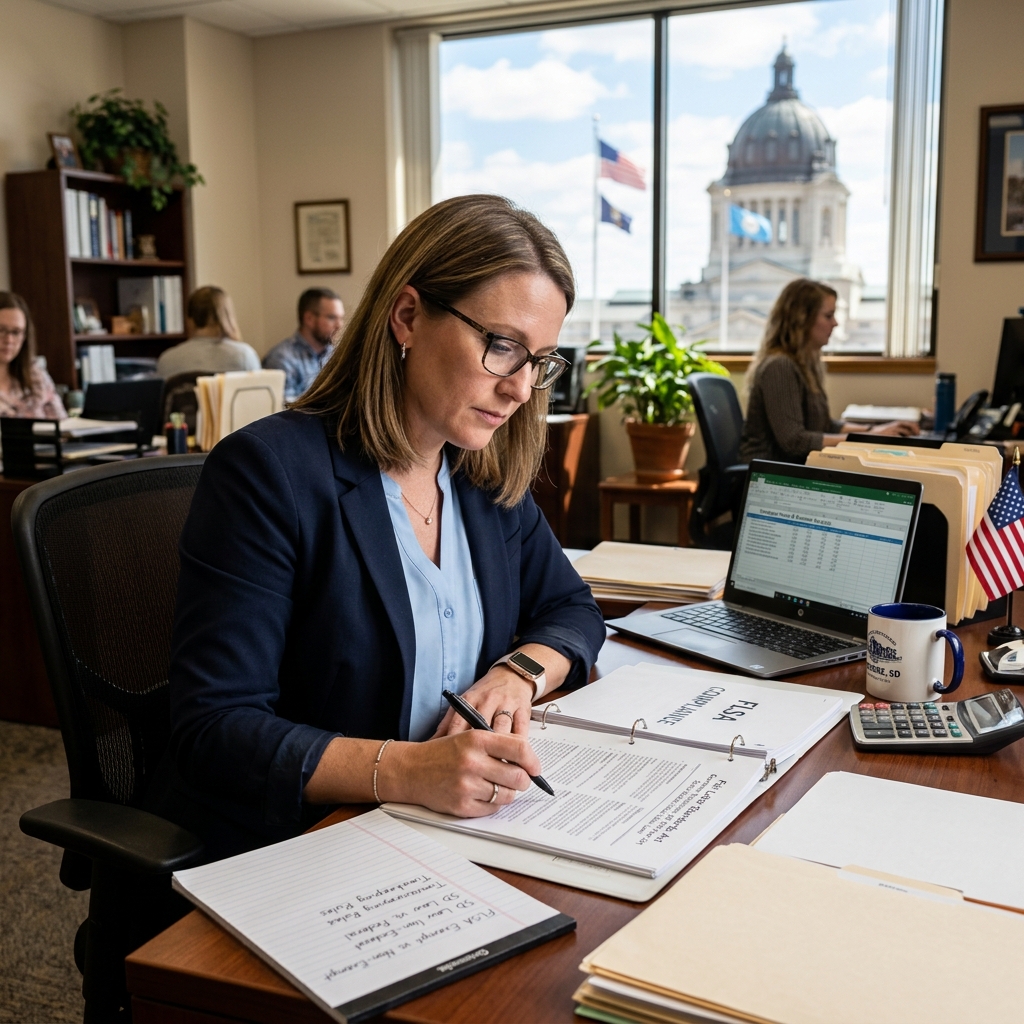
South Dakota does not have its own overtime statute, so workers and employers in the state must follow the federal Fair Labor Standards Act (FLSA) for overtime requirements. Under the FLSA, most covered employees who work more than 40 hours in a single workweek must be paid at least 1.5 times their regular rate of pay for each hour beyond 40. This article explains how those rules apply in South Dakota, who is protected, who is exempt, and what happens when overtime is not paid correctly.
Core Overtime Rule: Time-and-a-Half After 40 Hours
Because South Dakota relies on federal law, the basic overtime standard is simple: once a covered employee works more than 40 hours in a workweek, the employer must pay overtime for the extra hours.
- Standard workweek: 40 hours. Any time beyond this threshold is overtime.
- Overtime rate: at least 1.5 times the employee’s regular hourly rate.
- No daily overtime: South Dakota does not require a higher rate just because an employee works long days; what matters is total hours in the week.
For example, if a non-exempt employee earns $20 per hour and works 45 hours in a week, they must be paid $20 for each of the first 40 hours and $30 (time-and-a-half) for the five overtime hours.
South Dakota and the FLSA: No Separate State Overtime Statute
South Dakota law does not add its own overtime rules or create a separate state overtime system. Instead, the state explicitly points to federal standards:
- State agencies acknowledge that South Dakota has no labor laws concerning overtime and that federal law governs.
- Employers covered by the FLSA must pay overtime at 1.5 times the regular rate for hours over 40 in a workweek.
- There is no different or higher state overtime rate; federal rules apply uniformly.
In practice, this means employees in South Dakota should focus on whether their work and employer are covered by the FLSA and whether they are correctly classified as exempt or non-exempt.



Key Facts Your Lawyer Needs for Child Custody Modification >

Who Is Covered by Federal Overtime Rules?
The FLSA applies to most public and private employers, particularly those engaged in interstate commerce or whose annual business volume meets federal thresholds. In South Dakota, this typically includes:
- Retail businesses, restaurants, and hotels serving interstate travelers
- Manufacturing and transportation companies
- Hospitals, schools, and many nonprofit organizations
- Government entities that fall under the FLSA
Employees covered by the FLSA may be either non-exempt (entitled to overtime) or exempt (not entitled to overtime), depending on job duties and pay structure.
Non-Exempt Employees: Workers Entitled to Overtime
A non-exempt
- Hourly workers in retail, food service, tourism, and agriculture
- Clerical and administrative support staff who do not meet the executive or administrative exemption tests
- Manual laborers, warehouse staff, and production workers
- Most entry-level office and customer service employees
Non-exempt employees must receive at least time-and-a-half for overtime, and overtime wages must be paid no later than the next regular payday after the overtime work is performed.
Exempt Employees: Common Overtime Exemptions
Some workers in South Dakota are legally classified as exempt from overtime under the FLSA. Exempt status depends mainly on a combination of salary level, salary basis, and job duties. The most common exemptions are:
- Executive employees – typically manage a department or the entire business, supervise at least two full-time employees, and have significant authority in hiring or firing decisions.
- Administrative employees – perform office or non-manual work related to business operations and exercise independent judgment on important matters.
- Professional employees – work in fields requiring advanced knowledge, such as law, medicine, teaching, or engineering.
- Computer employees – certain software engineers, systems analysts, and similar specialists who meet specific duty and salary criteria.
- Outside salespeople – primarily work away from the employer’s place of business and are engaged in sales.
Federal regulations also set minimum salary thresholds for many of these exemptions. For example, the U.S. Department of Labor has increased the standard salary level and highly compensated employee thresholds in recent rulemakings, affecting who can qualify as exempt. Employees who do not meet both the duties test and the salary requirements generally must be treated as non-exempt.
Other Exempt Categories Mentioned in South Dakota Guidance
South Dakota labor information also notes other worker types that may be exempt from overtime under federal law, including:
- Certain babysitters employed on a casual basis
- Employees of amusement or recreational establishments that operate seasonally
- Workers for organized camps or religious or nonprofit educational centers, in limited circumstances
Because exemption rules can be complex, employees and employers should consult official federal guidance or legal counsel when a job seems borderline.
How to Calculate the Overtime Rate
Regardless of whether the employee is paid hourly or by salary, the key step is determining the regular rate of pay and then applying the 1.5 multiplier for overtime hours.
Hourly Workers
For hourly workers, overtime pay calculation is straightforward:
- Step 1: Identify the regular hourly rate (for example, $15 per hour).
- Step 2: Multiply by 1.5 to obtain the overtime rate (here, $22.50 per hour).
- Step 3: Multiply the overtime rate by the number of hours worked beyond 40 in the week.
Federal law may require including certain types of nondiscretionary bonuses and commissions when calculating the regular rate, which can increase the overtime amount due.
Salaried Employees Who Are Non-Exempt
Some employees receive a salary but are still non-exempt and entitled to overtime. In that case, the employer must convert the salary to an hourly equivalent:
- Divide the weekly salary by the number of hours the salary is intended to cover (for example, $800 per week divided by 40 hours = $20 per hour).
- Apply the 1.5 multiplier to determine the overtime rate (here, $30 per hour).
- Pay this overtime rate for all hours over 40 in the workweek.
If the salary is meant to cover fewer than 40 hours, the regular rate must be paid for each hour up to 40, and then time-and-a-half for hours beyond 40. Employers who miscalculate overtime for salaried non-exempt employees can face legal claims for back wages.
Meal and Rest Breaks in South Dakota
South Dakota does not have its own statute requiring employers to provide meal periods or rest breaks. As a result, federal FLSA rules govern how breaks are treated when employers choose to offer them:
- Short breaks (typically under 20 minutes): If provided, these must be counted as hours worked and therefore must be paid.
- Meal periods (usually 30 minutes or more): These can be unpaid if the employee is completely relieved from duty and free to use the time as they wish.
- No legal requirement: Employers may decide whether to offer breaks, but must follow pay rules if they do.
Because there is no state-specific requirement, workers who do not receive breaks generally cannot claim a legal right to them, though workplace policies or union contracts may provide additional protections.
Minimum Wage and Its Relationship to Overtime
Overtime pay must be based on at least the applicable minimum wage. South Dakota sets a state minimum wage that is adjusted annually, and overtime is calculated on the regular rate, which cannot be lower than this minimum.
| Year | Minimum Wage (South Dakota) | Minimum Overtime Rate (1.5x) |
|---|---|---|
| Recent Example | $11.85 per hour | $17.78 per hour |
If an employee’s regular rate is higher than the minimum wage, overtime must be calculated using that higher regular rate rather than the minimum.
Special Issues: Comp Time and Public Employers
South Dakota explicitly notes that it has no state laws regarding compensatory (comp) time and overtime. Under federal law, comp time—giving employees time off in the future instead of paying overtime—is heavily restricted:
- Most private sector employers cannot use comp time in place of overtime pay for non-exempt employees under the FLSA.
- Certain public sector employers may offer comp time under specific federal conditions, including caps on hours accrued and requirements that comp time be paid out if employment ends.
Employers who promise extra time off instead of overtime pay, without meeting federal requirements, may be violating the FLSA.
Unpaid Overtime and How to Enforce Your Rights
When overtime is not paid correctly in South Dakota, workers rely on federal enforcement mechanisms. There is no separate state statute that changes the filing deadlines for overtime claims, so federal limitation periods apply.
- Standard limitation period: Employees typically have two years to file claims for unpaid overtime.
- Willful violations: If the employer knowingly disregarded the law, the period can extend to three years.
Employees can pursue unpaid overtime by filing a complaint with the U.S. Department of Labor’s Wage and Hour Division or by bringing a lawsuit in court. Employers may be required to pay back wages and, in some cases, additional damages.
Overtime and Youth Employment
While overtime rules are generally the same for minors, federal child labor standards restrict how many hours certain younger workers may work and the types of jobs they can perform. In South Dakota:
- Fourteen- and fifteen-year-olds face strict limits on daily and weekly hours and the times of day they may work.
- There are no special overtime rules for sixteen- and seventeen-year-olds, but they are barred from certain hazardous occupations defined by federal law.
Employers must comply both with overtime requirements and with youth employment regulations when scheduling younger workers.
Employer Best Practices for Compliance
To reduce the risk of overtime disputes, South Dakota employers should implement clear systems and policies that follow federal law.
- Accurate timekeeping: Use reliable methods to track all hours worked, including before and after scheduled shifts.
- Classification reviews: Regularly reassess which employees are exempt and non-exempt, especially when job duties or salaries change.
- Prompt payment: Ensure overtime wages are paid by the next regular payday.
- Training: Educate supervisors on not discouraging overtime reporting and on the proper handling of off-the-clock work.
Documented policies and regular audits help demonstrate good-faith compliance if questions arise from employees or regulators.
Frequently Asked Questions About South Dakota Overtime
Do I get overtime if I work more than eight hours in a day?
Not automatically. South Dakota follows federal law, which looks at total hours in a workweek, not per day. You are entitled to overtime only when you work more than 40 hours in a week.
My job is salaried. Does that mean I am exempt from overtime?
Not necessarily. Being paid a salary does not by itself make you exempt. Your job must meet specific duties and salary thresholds under the FLSA to qualify for an exemption. Otherwise, you may still be entitled to overtime for hours over 40.
Does South Dakota require lunch or rest breaks?
No. South Dakota has no law mandating breaks. If your employer offers short breaks (generally under 20 minutes), those must be paid. Meal periods of 30 minutes or more can be unpaid if you are fully relieved from work during that time.
Can my employer give me comp time instead of paying overtime?
Private employers generally cannot replace required overtime pay with comp time under the FLSA. Certain public employers may use comp time, but only under specific federal rules. South Dakota has no separate comp time statute.
What should I do if I think I am owed unpaid overtime in South Dakota?
You can talk to your employer and review your timesheets and pay stubs for errors. If the issue is not resolved, you may file a complaint with the U.S. Department of Labor or consult an employment attorney to discuss possible claims under the FLSA within the two- or three-year federal limitation period.
References
- South Dakota Overtime Laws — FindLaw. 2023-10-12. https://www.findlaw.com/state/south-dakota-law/south-dakota-overtime-laws.html
- South Dakota Overtime Laws — WorkforceHub. 2024-04-01. https://www.workforcehub.com/hr-laws-and-regulations/south-dakota/south-dakota-overtime-laws/
- Comp Time and Overtime — South Dakota Department of Labor and Regulation. 2024-07-01. https://dlr.sd.gov/employment_laws/comp_time_overtime.aspx
- South Dakota Employment & Labor Law Overview — Deputy. 2025-01-10. https://www.deputy.com/compliance-hub/states/south-dakota
- South Dakota Labor Law Guide — MyBackWages. 2023-09-15. https://mybackwages.com/labor-law-guide-south-dakota/
- South Dakota Overtime Laws | 2026 — Jibble. 2025-12-20. https://www.jibble.io/labor-laws/us-state-labor-laws/south-dakota/overtime-laws
- South Dakota Labor Laws Poster Information — J. J. Keller & Associates. 2025-01-01. https://www.jjkellerlaborlawposters.com/labor-law-posters/State-Posters/south-dakota
Similar Articles







Read full bio of Sneha Tete