
Racial Harassment in Schools: Rights, Remedies, and Prevention
Understand what racial harassment in education looks like, your legal protections, and how students, families, and schools can respond.
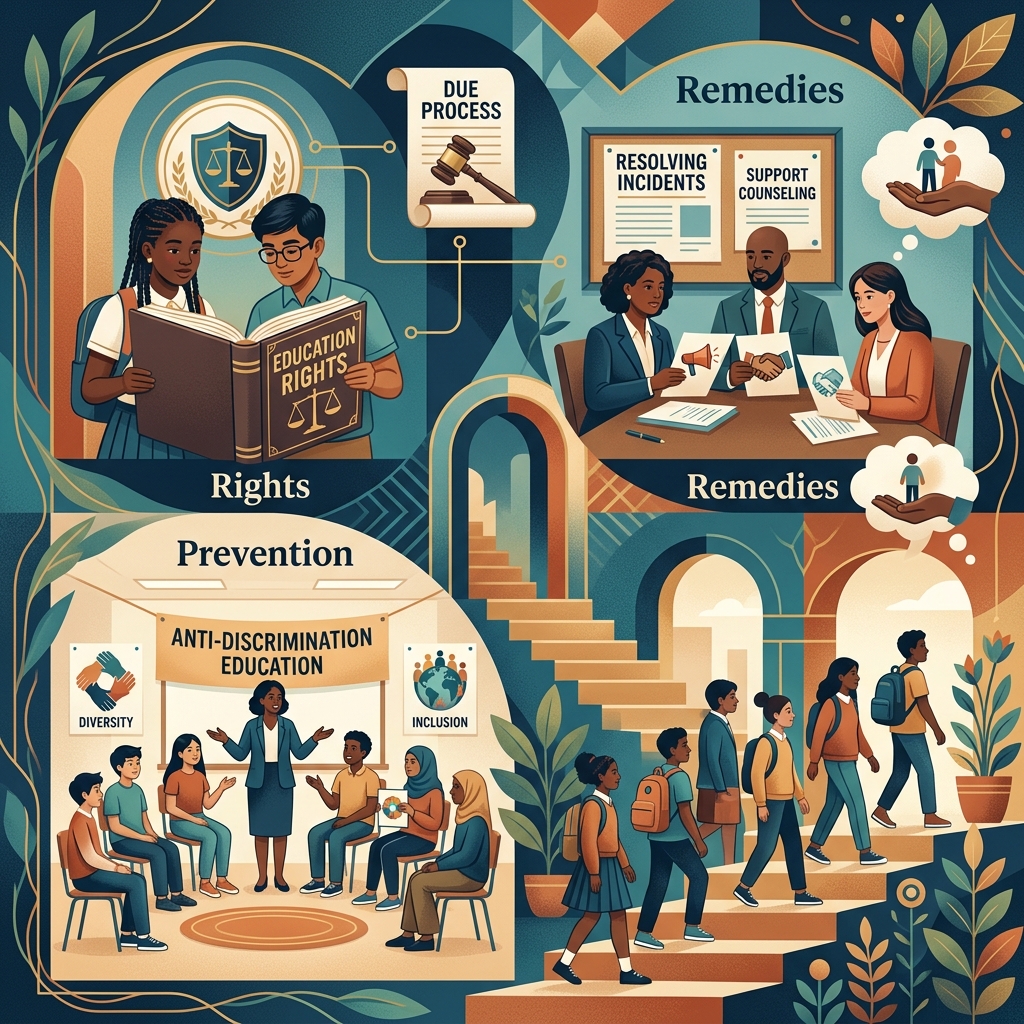
Racial harassment in education is not only harmful to students’ dignity and wellbeing, it is also unlawful when it denies equal access to learning. Federal civil rights laws require schools, colleges, and universities that receive federal funds to prevent, address, and remedy race-based harassment in their programs and activities.[10] This guide explains what racial harassment looks like, how the law protects students, and what families and educators can do in response.
Why Racial Harassment in Education Matters
Racism in school is more than isolated insults. It can shape classroom climate, academic performance, and mental health for years. A 2023 U.S. Centers for Disease Control and Prevention (CDC) survey found that about one in three high school students reported experiencing racism at school, defined as unfair treatment because of race or ethnicity. Students who reported racism were significantly more likely to report poor mental health, suicidal thoughts, and substance use.
These effects are magnified when harassment is frequent or severe, tolerated by adults, or tied to unequal discipline, tracking, or access to school programs. Racial harassment can:
- Lower grades and academic engagement
- Increase school absences and dropout risk
- Contribute to anxiety, depression, and trauma symptoms
- Undermine trust in teachers, administrators, and the education system as a whole
Because of these impacts, federal civil rights law treats racial harassment as a form of discrimination when it interferes with a student’s ability to participate in or benefit from an education program.[10]
What Counts as Racial Harassment in School?
There is no single, one-sentence definition that applies in every context, but generally racial harassment in education means unwelcome conduct based on a student’s race, color, or national origin that is serious enough to create a hostile environment or limit educational opportunities.[10]
Common Forms of Racial Harassment
Racial harassment can be physical, verbal, written, or online. Examples include:
- Racial slurs, name-calling, or mocking accents
- Racist jokes, memes, or social media posts targeting a racial or ethnic group
- Displaying symbols associated with racial hatred or violence
- Threats, intimidation, or stalking based on race
- Excluding students from activities or groups because of race
- Repeated comments that stereotype or demean a racial group
Harassment can be:
- Student-to-student (peer) harassment
- Staff-to-student harassment (by teachers, coaches, counselors, security officers, or other employees)
- Third-party harassment (for example, visiting team members or contractors on campus)
School officials have duties to address racially hostile environments regardless of whether the harasser is another student or a staff member.[10]
Hostile Environment vs. Isolated Incidents
Not every offensive comment will necessarily violate federal law. However, when conduct is severe, pervasive, or persistent enough that a reasonable person in the student’s position would find it hostile or abusive, and it interferes with access to education, it can become discriminatory harassment.[10]
| Factor | What Courts and Agencies Consider |
|---|---|
| Severity | How serious the conduct is (e.g., threats of violence versus isolated rude remarks).[10] |
| Pervasiveness | Whether the conduct happens repeatedly or is widespread across the school.[10] |
| Duration | How long the harassment has continued and whether it escalates over time. |
| Impact on education | Effects on grades, attendance, mental health, participation in class or activities. |
| School response | Whether school officials knew about the problem and how they responded. |
An isolated incident can still be severe enough to create a hostile environment if it involves physical violence, serious threats, or extremely offensive verbal or written attacks. Conversely, ongoing subtler behaviors can add up to an unlawful hostile environment when they are persistent and unaddressed.
Legal Protections Against Racial Harassment in Education
Students in the United States are protected by a network of federal and state laws. The most important federal statute in this context is Title VI of the Civil Rights Act of 1964.
Title VI: Core Federal Protection
Title VI prohibits discrimination based on race, color, or national origin in any program or activity that receives federal financial assistance. This includes almost all public school districts, public colleges and universities, and many private institutions receiving federal funds.
Under guidance from the U.S. Department of Education’s Office for Civil Rights (OCR), schools violate Title VI when they:
- Create or tolerate a racially hostile environment through staff or peer harassment
- Fail to act adequately after learning of racial harassment
- Retaliate against students or families for complaining about race discrimination[10]
Courts interpreting Title VI have held that schools can be liable for deliberate indifference to peer racial harassment when they have actual knowledge of severe, pervasive, and objectively offensive harassment that denies a student access to educational opportunities. To meet this standard, a school’s response must be clearly unreasonable in light of the known circumstances, not merely imperfect or negligent.
Other Legal Sources of Protection
In addition to Title VI, protections against racial harassment may arise from:
- Equal Protection Clause of the Fourteenth Amendment (primarily in lawsuits against public schools)
- State civil rights statutes that prohibit race discrimination in education
- School district policies on bullying, harassment, and nondiscrimination
Many states explicitly require schools to prevent bullying and harassment based on race and to adopt procedures for reporting and investigation.
When Schools Are Responsible for Harassment
Schools are not automatically liable for every racist remark made on campus. However, they become responsible under federal civil rights law when certain conditions are met.
Key Elements of School Responsibility
- Actual or constructive knowledge: A teacher, administrator, or other appropriate official knew or reasonably should have known about the harassment.
- Connection to school programs: The conduct occurred in a context that is part of the school’s programs or activities (classrooms, buses, athletic events, online platforms used for school, etc.).[10]
- Hostile environment or denial of access: The harassment is severe or pervasive enough to limit a student’s ability to participate in or benefit from the education program.
- Inadequate response: The school fails to take prompt and effective steps to stop the harassment, prevent recurrence, and remedy its effects.[10]
For example, if a school repeatedly receives reports that a student is being subjected to racial slurs and threats, but takes no meaningful steps to investigate, discipline perpetrators, or support the targeted student, it may be found deliberately indifferent under Title VI.
How Schools Should Respond to Racial Harassment
Federal guidance does not prescribe a single required response, but schools are expected to take actions that are prompt, thorough, and effective.[10] An appropriate response typically includes both individual and systemic measures.
Immediate Response Steps
- Ensure the immediate safety of the targeted student
- Separate students involved if necessary
- Document what happened, including when, where, and who was involved
- Notify appropriate administrators or Title VI/Title IX coordinators
Investigation and Outcomes
A reasonable investigation usually involves:
- Interviewing the targeted student and alleged harassers
- Collecting witness statements and reviewing relevant social media, messages, or videos
- Assessing whether the conduct created or contributed to a hostile environment
If harassment is found, schools should:
- Impose consequences on those who engaged in harassment, consistent with school policies
- Offer academic and counseling supports to affected students
- Monitor the situation for retaliation or ongoing harassment
Long-Term Prevention Measures
Prevention goes beyond reacting to individual incidents. Evidence-based strategies include:
- Anti-bias and cultural competence training for staff, addressing implicit bias and equitable discipline practices
- Restorative practices that focus on repairing harm and building community rather than relying only on punitive discipline
- Culturally responsive curricula that reflect diverse histories and experiences, fostering a sense of belonging for students of color
- Clear, well-publicized policies on harassment, including multiple ways to report concerns anonymously or confidentially
What Students and Families Can Do
Students and parents or guardians play a critical role in documenting and reporting racial harassment. Clear records and timely reports help school officials fulfill their legal obligations and, if necessary, support a complaint to enforcement agencies.
Documenting Harassment
When possible, keep detailed records, including:
- Dates, times, and locations of incidents
- Names of people involved and potential witnesses
- Copies or screenshots of messages, posts, or emails
- Notes about how the harassment affected the student (missed school, drop in grades, anxiety, medical visits, etc.)
Reporting Within the School or District
Most school districts provide more than one way to report racial harassment. Common options include:
- Informing a teacher, school counselor, or building administrator
- Filing a written complaint with the principal or district office
- Contacting the district’s civil rights, equity, or Title IX/Title VI coordinator
Ask for a copy of the school’s anti-harassment and grievance policies. These usually explain timelines for investigations, appeal options, and protections against retaliation.
Filing a Complaint with the U.S. Department of Education
If the school does not respond effectively, or if the harassment is especially severe, anyone may file an administrative complaint with the U.S. Department of Education’s Office for Civil Rights.
- Who can file: Any person or organization, not just the direct victim.
- Time limits: Typically within 180 days of the alleged discrimination, unless OCR grants a waiver.
- How to file: Via OCR’s online complaint form or by contacting the regional OCR office that serves your state.
OCR can investigate, negotiate resolution agreements with schools, and require corrective measures to bring institutions into compliance with Title VI.[10]
Supporting Students’ Mental Health and Wellbeing
The emotional toll of racial harassment can be as serious as its academic impact. Research links experiences of racism at school with higher levels of sadness, hopelessness, suicidal thoughts, and substance use among adolescents.
Helpful supports include:
- Access to school counselors, psychologists, or social workers trained in trauma and racial stress
- Peer support groups or affinity spaces where students can share experiences safely
- Opportunities for students to express feelings through art, writing, or discussion facilitated by trusted adults
- Connections to community mental health services when additional care is needed
Educators can help by acknowledging students’ experiences, creating spaces to talk about race and fairness, and responding to concerns in a direct and age-appropriate way.
Building Anti-Racist School Environments
Ending racial harassment requires more than addressing individual incidents; it calls for transforming school culture and systems that allow discrimination to persist.
Key Components of an Anti-Racist School
- Equitable discipline: Eliminating disproportionate suspensions and expulsions of students of color and using restorative and trauma-informed approaches instead.
- Inclusive curriculum and materials: Incorporating diverse authors, histories, and perspectives across subjects.
- Diverse and supported staff: Recruiting and retaining educators of color and equipping all staff to recognize and challenge racism.
- Family and community engagement: Partnering with families and community organizations to understand concerns and co-create solutions.
- Transparent policies and data: Publicly sharing data on discipline, achievement, and climate by race and using it to guide improvements.
These systemic efforts, combined with strong enforcement of anti-harassment policies, help reduce both everyday racism and extreme incidents, making schools safer and more equitable for all students.
Frequently Asked Questions About Racial Harassment in Education
Does racial harassment have to be physical to be illegal?
No. Verbal, written, and online conduct can also constitute racial harassment when it is severe or pervasive enough to create a hostile environment or limit a student’s access to education.[10]
What if the harassment happens off campus or online?
Schools may still have responsibilities if off-campus or online harassment creates a hostile environment at school or interferes with a student’s ability to participate in school programs. This includes racist social media attacks that follow a student into the classroom or extracurricular activities.[10]
Can you file a complaint even if you are not the victim?
Yes. Under Title VI, any person or organization can file a complaint with OCR on behalf of a student or group of students they believe has been subjected to discrimination based on race, color, or national origin.
What if the school did “something,” but the harassment continues?
Schools are expected to take steps reasonably calculated to end the harassment, prevent its recurrence, and remedy its effects.[10] If minor measures fail and the harassment continues, the school may need to use stronger interventions. A pattern of ineffective responses may support a claim that the school is deliberately indifferent.
Can a student be punished for reporting racial harassment?
No. Retaliation against students or others for reporting discrimination or participating in a complaint process is itself prohibited under federal civil rights law.[10] Any threats, discipline, or exclusion imposed because someone complained about racism should be reported immediately.
Do private schools have to follow Title VI?
Private schools, colleges, and universities that receive federal financial assistance—such as grants or federally backed student aid—are covered by Title VI. Fully private institutions with no federal funding may still be subject to state civil rights laws and contractual or policy obligations.
References
- Education and Title VI — U.S. Department of Education, Office for Civil Rights. 2021-06-01. https://www.ed.gov/laws-and-policy/civil-rights-laws/title-vi/education-and-title-vi
- Harassment Based on Race, Color, or National Origin — U.S. Department of Education, Office for Civil Rights. 2010-10-26. https://www.ed.gov/laws-and-policy/civil-rights-laws/race-color-and-national-origin-discrimination/race-color-and-national-origin-discrimination-key-issues/harassment-based-race-color-or
- Title VI and Peer-to-Peer Racial Harassment at School — Congressional Research Service. 2022-05-10. https://www.congress.gov/crs_external_products/LSB/PDF/LSB11087/LSB11087
- Experiences of Racism in School and Associations with Mental Health and Substance Use — Centers for Disease Control and Prevention (CDC). 2024-01-26. https://www.cdc.gov/mmwr/volumes/73/su/su7304a4.htm
- Impact of Racial Discrimination in Education and Other Adverse Childhood Experiences — Child and Adolescent Psychiatry and Mental Health (via PubMed Central). 2024-03-15. https://www.ncbi.nlm.nih.gov/pmc/articles/PMC12107663/
- The Right to Be Free from Racism at School — Education Law Center. 2020-09-01. https://www.elc-pa.org/resource/the-right-to-be-free-from-racism-at-school/
- Racial Inequality in Education — The Annie E. Casey Foundation. 2021-05-12. https://www.aecf.org/blog/racial-inequality-in-education
Similar Articles








Read full bio of medha deb


