
North Carolina Prenuptial Agreements Explained
A practical guide to understanding, drafting, and enforcing prenuptial agreements under North Carolina law before you say "I do."
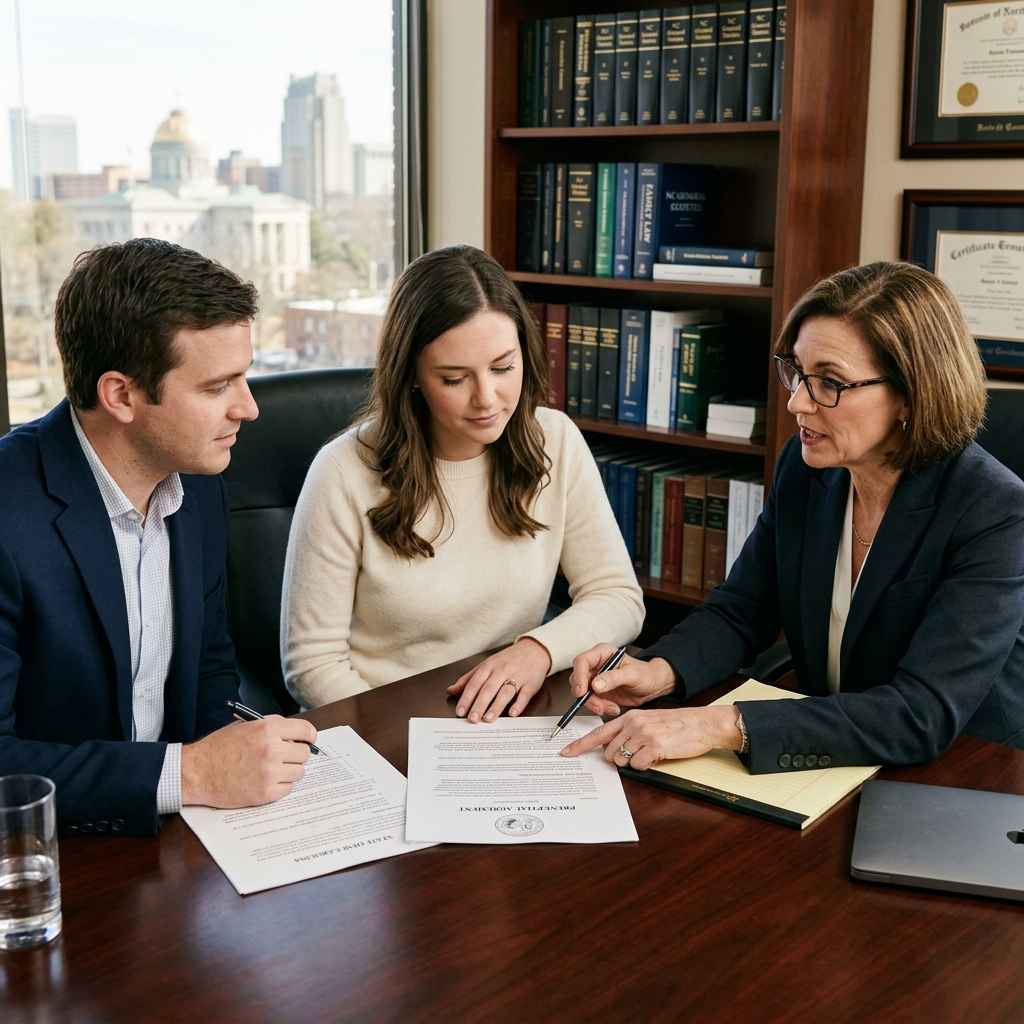
For couples planning to marry in North Carolina, a prenuptial agreement can be a useful tool to clarify financial expectations and protect individual property rights. When properly drafted and executed, a prenup operates as a binding contract that will govern many financial aspects of your relationship if the marriage ends in separation, divorce, or death.
This guide explains how North Carolina law treats prenuptial agreements, the legal requirements you must satisfy, the topics you can and cannot cover, and practical steps to reduce the risk that your agreement will later be challenged.
Understanding Prenuptial Agreements in North Carolina
North Carolina uses the term premarital agreement interchangeably with prenuptial agreement. State law is based on the Uniform Premarital Agreement Act (UPAA), codified in Chapter 52B of the North Carolina General Statutes, which sets out the basic rules for these contracts.
Basic Legal Definition
Under North Carolina law, a premarital agreement is defined as an agreement between prospective spouses made in contemplation of marriage and intended to become effective upon marriage.
- It must be negotiated and signed before the wedding.
- It does not have legal effect unless the parties actually marry.
- Once the marriage occurs, the agreement governs many economic consequences of the marital relationship.
Purpose of a North Carolina Prenup
A North Carolina prenup mainly deals with property and financial rights between spouses. Common objectives include:
- Preserving family assets or business interests for one spouse or their children.
- Defining what will be considered separate property versus property acquired during the marriage.
- Setting expectations for spousal support (alimony) after a divorce.
- Coordinating estate planning and inheritance rights if one spouse dies.
While prenups are often associated with wealthier individuals, they can be valuable for any couple that wants clear, predictable rules about money and property.
Core Legal Requirements for Validity
For a prenuptial agreement to be recognized by a North Carolina court, it must satisfy several statutory and judge‑made requirements. Failure to comply with these rules can result in the agreement being invalid or partially unenforceable.
Formal Requirements: Writing and Signature
North Carolina law expressly requires that a premarital agreement be in writing and signed by both parties. Oral agreements or informal understandings about property will not qualify as enforceable prenups.
- The agreement must be a written document (or set of documents).
- Each future spouse must sign the agreement.
- No additional consideration is required; the marriage itself is sufficient to support the contract.
The agreement becomes legally effective only when the marriage occurs; signing the document alone is not enough.
Timing: Before the Wedding
Because a premarital agreement is defined as an agreement between prospective spouses, it must be entered before the marriage and is effective upon marriage. If the parties sign a document but never marry, the agreement has no legal force.
Voluntariness and Absence of Coercion
North Carolina courts require that each party enter the agreement voluntarily, without duress, undue influence, or coercion. While the UPAA itself does not spell out every scenario, courts have used general contract principles to evaluate whether a prenup was fairly obtained.
- Each party should have enough time to review the document before signing.
- High‑pressure tactics, last‑minute changes, or ultimatums may provide grounds to challenge the agreement.
- Evidence of duress, mistake, fraud, or undue influence can justify setting the agreement aside.
Financial Disclosure and Transparency
Although Chapter 52B does not prescribe detailed disclosure rules, North Carolina precedent and professional guidance emphasize the importance of full and fair financial disclosure.
- Each party should disclose assets, debts, income sources, and significant financial obligations.
- Parties may waive detailed disclosure in writing, but a waiver is safer when paired with at least basic information.
- Lack of adequate disclosure, or fraudulent misstatements in disclosure schedules, is a common basis for challenging enforceability.
In practice, this often means attaching schedules of assets and debts to the agreement and confirming that both parties have reviewed them.
Unconscionability and Public Policy Limits
A North Carolina prenup must not be unconscionable when executed and must not violate public policy.
- Unconscionability focuses on whether the agreement is so one‑sided that it shocks the conscience at the time of signing.
- Courts assess fairness based on circumstances when the contract was made, not on conditions at the time of divorce or separation.
- Provisions that attempt to waive obligations such as child support in ways that harm a child’s right to support are contrary to public policy and not binding.
What a North Carolina Prenup Can Cover
North Carolina law gives couples considerable flexibility in crafting premarital agreements. Chapter 52B lists several areas that may be addressed by contract, so long as the provisions do not conflict with public policy or criminal statutes.
Property Rights and Division
One of the main functions of a prenup is to define how property will be treated during and after the marriage.
- Designation of specific property as separate property that will not be subject to equitable distribution upon divorce.
- Rules for buying, selling, transferring, or encumbering property during the marriage.
- Allocation of assets in the event of separation, divorce, or death.
The agreement can cover real estate, investment accounts, business interests, and personal property, and may specify which jurisdiction’s law will govern interpretation of the contract.
Spousal Support (Alimony)
Parties may address spousal support, including modification or even elimination of alimony, in a North Carolina premarital agreement.
- Setting a formula or amount for alimony if the marriage ends.
- Agreeing that neither party will seek spousal support.
- Defining conditions that trigger or terminate support obligations.
However, extreme waivers that would leave one spouse destitute may be scrutinized for unconscionability or public policy concerns at the time of enforcement.
Estate Planning and Death Benefits
Prenuptial agreements can be coordinated with wills and trusts to manage inheritance rights and financial protection upon death.
- Agreements about what each spouse will leave to the other in a will or trust.
- Rights to life insurance policy death benefits and beneficiary designations.
- Waivers or modifications of statutory spousal inheritance rights.
Choice of Law and Miscellaneous Provisions
Couples may also include a choice of law clause specifying which state’s law will govern the interpretation of the agreement, subject to general conflict‑of‑laws principles.
In addition, parties can contract about other personal rights and obligations that do not violate public policy or criminal statutes. However, lawyers often recommend keeping the focus on financial arrangements rather than lifestyle or personal conduct provisions.
Limits: Child Support and Custody
North Carolina places clear limits on what prenups can accomplish regarding children. The law and judicial practice do not allow parents to bind courts on matters of child support or child custody through a premarital agreement.
- The power of a child to receive support cannot be adversely affected by a premarital agreement.
- Any custody or parenting‑time provisions in a prenup are not controlling on a court if parents later litigate custody.
- Courts must decide custody and child support based on the child’s best interests at the time of separation or divorce.
Creating a Strong, Enforceable Prenup
Even though North Carolina makes it relatively straightforward to create a prenuptial agreement, misunderstandings and disputes sometimes arise years later. Following best practices when drafting and signing a prenup can significantly improve the likelihood that it will be enforced as intended.
Practical Drafting Tips
- Start early: Discuss the idea of a prenup well before the wedding, and allow ample time for negotiation and review.
- Use clear language: Avoid vague terms, ambiguous definitions, or inconsistent provisions.
- Document disclosure: Attach detailed lists of assets and debts, and have each party acknowledge receipt and review of those schedules.
- Address future changes: Consider how major events (children, new business ventures, inheritances) might affect the agreement and whether amendments may be needed later.
Role of Independent Legal Counsel
North Carolina law does not strictly require each party to have a lawyer in order for a prenup to be valid. However, courts often view independent legal advice as a sign that the agreement was entered voluntarily and with full understanding of rights.
- Each party should be encouraged to consult separate counsel.
- Lawyers can explain statutory rights that are being waived or altered.
- Legal advice can help avoid unconscionable terms and drafting errors.
Execution and Formalities
To minimize potential challenges, couples should carefully manage the signing process:
- Sign the agreement well before the wedding date.
- Consider having the signatures notarized, even though notarization is not strictly required, to create a stronger evidentiary record.
- Ensure there are no last‑minute major changes without time for review.
- Keep copies of all drafts, disclosure schedules, and correspondence leading up to the final agreement.
Amending or Revoking a Prenup
After marriage, North Carolina allows spouses to amend or revoke a premarital agreement, but only through another written agreement signed by both parties.
- Changes must be in writing.
- Both spouses must sign the amendment or revocation.
- No additional consideration is required for the modification to be enforceable.
Spouses should consider revisiting the agreement if their financial circumstances change dramatically or if earlier assumptions no longer reflect reality.
Common Grounds for Challenging a Prenup
Even a carefully constructed agreement may be challenged in court. Understanding the most frequent arguments used to attack a prenup can help couples and their attorneys plan ahead.
| Ground for Challenge | Typical Allegation | Preventive Measures |
|---|---|---|
| Duress / Undue Influence | One party claims they were pressured or threatened into signing. | Sign well before the wedding; avoid ultimatums; document voluntary consent. |
| Lack of Financial Disclosure | A party asserts they did not know the other’s true financial situation. | Provide detailed lists of assets and debts; use written acknowledgements and waivers where appropriate. |
| Fraud or Misrepresentation | Allegation that disclosure statements were inaccurate or intentionally misleading. | Verify all information; update schedules if circumstances change before signing; avoid concealment. |
| Unconscionability | Claim that terms are so one‑sided as to shock the conscience. | Seek legal advice; avoid extreme waivers that leave one spouse without reasonable resources; evaluate fairness at the time of signing. |
| Violation of Public Policy | Provisions interfere with child support, criminal laws, or other mandatory legal rights. | Exclude child custody/support provisions; do not try to contract around basic legal obligations. |
Frequently Asked Questions About North Carolina Prenups
Do we need a prenup if we do not have significant assets?
Even couples with modest means may benefit from a prenup if they want clarity about how future earnings, retirement accounts, or inherited property will be treated. The agreement can also reduce uncertainty and conflict if the relationship later ends.
Is a lawyer required for each spouse?
The statutes do not mandate that each party hire counsel for the prenup to be valid. However, having independent attorneys for both spouses is widely considered best practice and can help demonstrate that the agreement was voluntary and informed.
Can we decide child custody and support in a prenup?
No. North Carolina courts are not bound by child support or custody provisions in a premarital agreement and will make decisions based on the child’s best interests at the time of separation or divorce.
What happens if we sign a prenup but never get married?
If no marriage results, the premarital agreement is generally void and unenforceable because it only becomes effective upon marriage.
Can we change our prenup after the wedding?
Yes. Spouses can amend or revoke a premarital agreement after marriage through a new written document signed by both parties. The modification is enforceable without additional consideration.
Does a North Carolina prenup need to be notarized?
Notarization is not explicitly required by statute for a premarital agreement to be valid. However, notarizing signatures is often recommended for evidentiary purposes and to strengthen the appearance of formal execution.
Key Takeaways for Couples Considering a Prenup
- North Carolina’s Uniform Premarital Agreement Act provides a clear legal framework for prenuptial agreements.
- Agreements must be in writing, signed by both parties, and become effective only upon marriage.
- Full financial disclosure, voluntariness, and fair terms at the time of signing are critical to enforceability.
- Prenups can address property division, spousal support, estate planning, and choice of law, but cannot limit a child’s right to support or bind courts on custody.
- Independent legal counsel and careful drafting are strongly recommended to reduce the risk of future challenges.
Couples who take the time to understand the legal landscape and follow best practices in drafting can use North Carolina prenuptial agreements to create a more predictable and mutually respectful financial partnership.
References
- Chapter 52B – Uniform Premarital Agreement Act — North Carolina General Assembly. 2026-01-01. https://www.ncleg.gov/Laws/GeneralStatuteSections/Chapter52B
- NC General Statutes – Chapter 52B (PDF) — North Carolina General Assembly. 2026-01-01. https://www.ncleg.net/EnactedLegislation/Statutes/PDF/ByChapter/Chapter_52b.pdf
- North Carolina Premarital Agreements — Ward and Smith, P.A. 2023-04-15. https://www.wardandsmith.com/practice-areas/north-carolina-premarital-agreements
- How to Create a Watertight Prenuptial Agreement in North Carolina — North Carolina Bar Blog. 2022-09-20. https://www.ncbarblog.com/fl-how-to-create-a-watertight-prenuptial-agreement-in-north-carolina/
- What You Need to Know About Premarital Agreements — Woodruff Family Law Group. 2021-08-10. https://www.wbblawyers.com/blog/things-you-need-to-know-about-premarital-agreements
- North Carolina Prenuptial Agreement Attorneys — Marshall & Taylor PLLC. 2023-06-01. https://www.marshalltaylorlawfirm.com/prenuptial-agreements/
- Prenuptial Do’s and Don’ts in North Carolina — Caulder & Valentine, PLLC. 2022-02-18. https://www.cauldervalentine.com/prenuptial-do-s-and-don-ts-in-north-carolina/
Similar Articles








Read full bio of Sneha Tete


