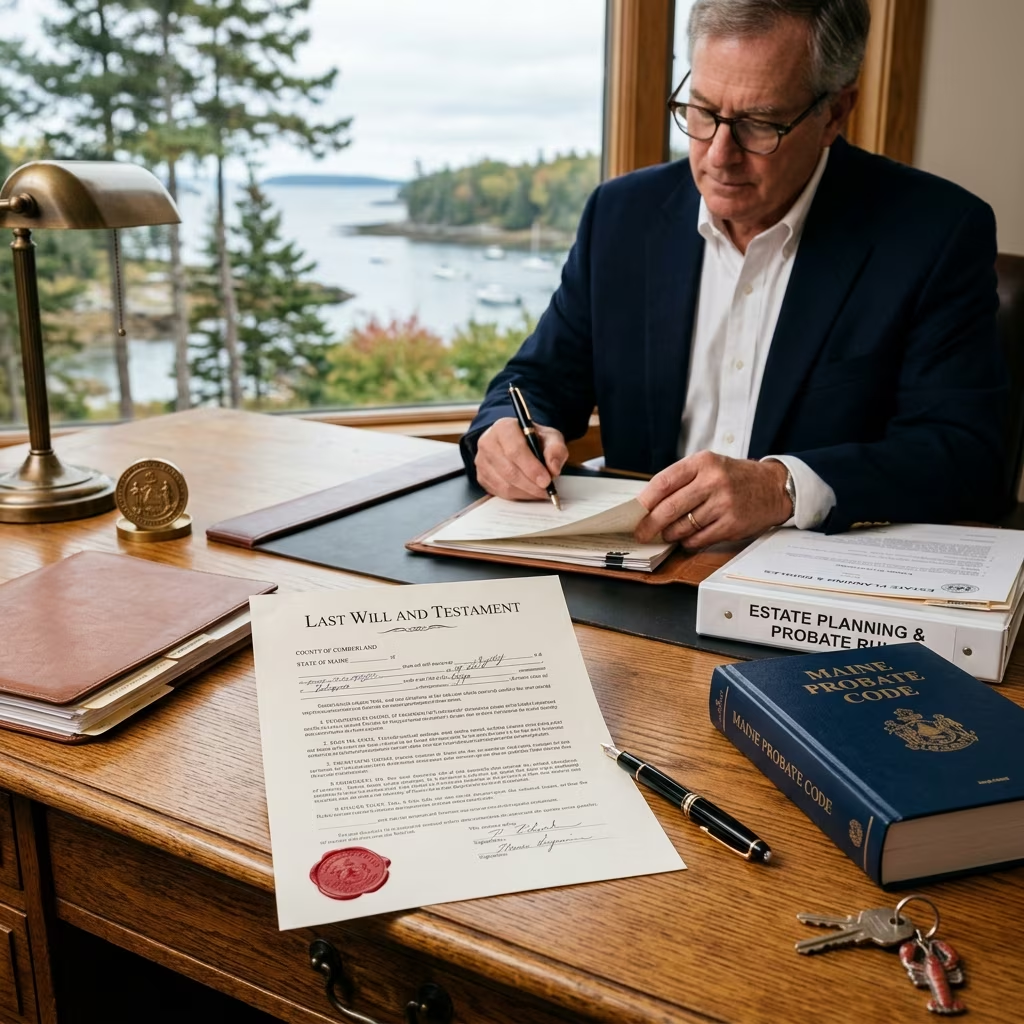
Creating a valid will in Maine is one of the most important steps you can take to control what happens to your property after you die. Maine follows detailed rules for who may make a will, how that will must be signed and witnessed, and how it is handled in probate court. This guide explains those rules in clear, practical terms so you can better understand the process before meeting with a lawyer or using a statutory form provided by the state legislature.
Why a Maine Will Matters
A will, also called a last will and testament, is a legal document that states who should receive your assets and who will be responsible for carrying out your instructions after you die. While Maine law does not force anyone to have a will, the absence of one means that your property is distributed under intestacy rules—default provisions that may not reflect your wishes.
Key reasons people in Maine choose to make a will include:
- Control over beneficiaries — You decide who inherits, rather than relying on the state’s default family tree.
- Appointment of a personal representative — You select the individual or institution that will administer your estate.
- Clarity and reduced conflict — Clear instructions can help reduce disputes among surviving family members.
- Coordination with other estate planning tools — Wills can complement trusts, beneficiary designations, and joint ownership arrangements.
Who Can Make a Will in Maine?
Maine law sets basic eligibility criteria for making a will. Any person who meets these conditions may execute a valid will provided they follow the required formalities.
| Requirement | Standard in Maine |
|---|---|
| Minimum age | At least 18 years old. |
| Mental capacity | Of sound mind, meaning generally competent and not declared legally incompetent in prior court proceedings. |
| Voluntary action | The will must be made freely, without undue influence, duress, or fraud. |
In practice, being of sound mind means that at the time of signing your will you understand the nature of your property, the people who would normally be expected to inherit from you, and the effect of the document you are signing. If there is concern about capacity, it is common to work closely with a legal professional and sometimes a physician to document that you were capable when the will was executed.
Formal Requirements for a Valid Maine Will
Even if you meet the basic eligibility criteria, your will must comply with Maine’s specific execution requirements. These rules exist to reduce the risk of fraud and to ensure that a court can later confirm the document as your true last will.[10]
Written Form
Maine requires that ordinary wills be in writing on paper. Electronic files, audio or video recordings, or purely digital wills are not sufficient under current state law.[10]
Signature of the Testator
The person making the will (the testator) must sign the document, usually at the end. If the testator is physically unable to sign, they may direct another person to sign on their behalf, but that person cannot be one of the witnesses.
- The signature should appear at or near the conclusion of the will, confirming that all preceding provisions are adopted.
- Dating the signature is strongly recommended, as it helps demonstrate the will’s chronology relative to any other estate planning documents.
Witness Requirements
Ordinary written wills in Maine must be signed by two competent witnesses.[10] Witnesses play a critical role in confirming that the testator signed the will willingly and with sufficient capacity.
Core witness rules include:
- At least two witnesses must sign the will.[10]
- Witnesses should sign in the presence of the testator, and ideally in each other’s presence, at the time of execution.[10]
- Witnesses must generally be legal adults and competent to serve in that role.
- Maine permits interested witnesses—those who are beneficiaries—but attorneys often recommend using disinterested witnesses to avoid questions about undue influence.
While the law does not require witnesses to read the will, they should understand that the document being signed is a will and that they are witnessing the testator’s signature.
Holographic and Statutory Wills in Maine
Maine recognizes more than one path to a legally valid will. In addition to conventional typed documents, there are rules for holographic wills and for a standardized statutory will form created by the legislature.
Holographic (Handwritten) Wills
A holographic will is written entirely by hand by the testator. Maine law allows such wills even if they do not have witnesses, provided certain conditions are met.
To be effective, a holographic will should meet these criteria:
- The signature must be in the testator’s handwriting.
- All material portions of the will—such as the identification of beneficiaries and the description of property—must be handwritten by the testator.
- No witnesses are necessary, although adding a date can help prove which document is the most recent if multiple handwritten wills exist.
Because holographic wills are more vulnerable to disputes about authenticity and clarity, many Maine legal services organizations still suggest consulting an attorney or at least considering standardized forms before relying solely on a handwritten document.
Maine Statutory Will Form
Maine has adopted a statutory will that uses a form set out by statute. This is an option for people seeking a low‑cost way to create a will that complies with state law.
Key features of statutory wills include:
- The form is made available by each probate court and offered online in printable form.
- Blank spaces in the form can be completed by typewriter or by the testator’s handwriting.
- A properly completed statutory will is deemed valid if executed according to the instructions and signature requirements provided.
Although the statutory form can be helpful for simple estates, it is not tailored to every situation. Attorneys may add customized provisions to address complex family structures, tax planning, business interests, or special needs beneficiaries.
Self-Proving Wills and the Role of Notarization
Maine does not require notarization for a will to be valid. A will that is properly written, signed, and witnessed can be accepted in probate even without a notary’s seal.
What Is a Self-Proving Will?
While notarization is not mandatory, Maine allows wills to become self‑proving. A self‑proving will includes an affidavit signed by the testator and witnesses before a notary, attesting to the facts of execution.
Advantages of a self‑proving will include:
- Faster probate — Courts can accept the will’s authenticity without calling witnesses to testify.
- Reduced administrative burden — Families may avoid locating witnesses years after the will was signed.
- Added evidentiary value — The notarized affidavit helps demonstrate that the will complied with formalities at the time of execution.
Many lawyers routinely include self‑proving language and affidavits when drafting wills for clients in Maine, as the additional step provides significant practical benefits with relatively little cost.
What Happens If You Die Without a Will in Maine?
When a person dies without a valid will, they are said to die intestate. Maine’s intestacy statutes then determine who inherits the estate. Property usually passes to close relatives such as a surviving spouse, children, and parents, and then outward to more distant relatives if no close family remains.
Important points about intestacy include:
- Partners who are not legally married or in certain legally recognized relationships may not inherit under intestacy rules, even if they shared a household for many years.
- The distribution pattern may be very different from the plan you would have chosen, especially in blended families or where you wish to benefit non‑relatives.
- Some assets, such as accounts with named beneficiaries or jointly owned property, may pass outside of intestacy rules directly to the other owner or beneficiary.
For these reasons, many Maine residents choose to create at least a basic will so their intentions are clear and they are not relying entirely on the default statutory scheme.
The Personal Representative and Probate Process
Every will should name a personal representative (sometimes called an executor) to manage the estate. This person gathers assets, pays debts and taxes, and distributes property according to the terms of the will.
Appointment of the Personal Representative
In Maine, the probate court oversees the appointment of the personal representative. If the will names someone and that person is willing and eligible, they are usually given priority for appointment.
Responsibilities can include:
- Locating the original will and filing it with the appropriate probate court.
- Identifying and valuing estate assets.
- Paying valid debts, expenses, and any taxes due.
- Distributing remaining property to beneficiaries as directed in the will.
Probate Basics
Probate is the court‑supervised process of validating a will and administering the estate. In Maine, wills have no legal effect until a probate court declares a document to be the decedent’s last will and testament.
Some practical features of Maine probate include:
- Probated wills become public records. Once accepted by the court, they may be viewed by anyone, often online.
- Filing fees are based on the value of assets passing through probate. While there is a cost, fees in Maine are generally not extreme compared to the value of larger estates.
- Informal probate procedures may be available for relatively straightforward estates, reducing complexity and delay.
Because probate focuses only on assets that pass through the estate, property held in trust, joint accounts, and certain beneficiary‑designated assets may be handled outside of probate. Understanding this distinction is important when planning how your will interacts with other estate planning tools.
Common Misunderstandings About Maine Wills
People in Maine often hold assumptions about wills and probate that do not match how the law actually works. Clarifying these misunderstandings can help you plan more effectively.
- “Having a will avoids probate.” In Maine, a will is designed to be used in probate, not to sidestep it. The court must still accept the will and oversee administration.
- “My will controls all of my assets.” A will generally governs property owned in your name alone at death; jointly owned property with a right of survivorship and accounts with beneficiary designations often pass outside of the will.
- “Wills are private.” Once probated, wills become public documents accessible through the court’s records.
- “A simple form always fits my situation.” While statutory forms and handwritten wills can be valid, they may not address more complex family or financial circumstances.
Frequently Asked Questions About Maine Wills
Do I need a lawyer to make a will in Maine?
No statute requires you to hire a lawyer, and you can write your own will or use the statutory form. However, many organizations and attorneys recommend seeking legal advice, particularly if your estate or family situation is complex, because a professionally drafted will is more likely to anticipate issues and comply fully with Maine law.
Does my will need to be filed with a court while I am alive?
No. Maine wills typically do not need to be filed with any court or government office during the testator’s lifetime. Filing occurs after death when the estate enters probate.
Can I change my Maine will later?
Yes. You may execute a new will, which usually revokes earlier wills, or you may sign a codicil, an amendment to your existing will. The most recent valid will generally controls, especially where its provisions conflict with prior documents.
Are handwritten notes on my will legally effective?
Handwritten changes made after a will is executed can create uncertainty. Maine recognizes holographic wills in certain circumstances, but informal notes or partial changes may be challenged if they do not meet formal requirements. It is usually safer to sign a new will or a properly executed codicil rather than relying on unstructured handwritten revisions.
Can a non‑resident of Maine make a will that will be honored in Maine?
Generally, if a will was valid under the laws of the state where it was signed, other states — including Maine — will accept it as valid. However, local counsel may still recommend reviewing the will to ensure it operates as intended under Maine’s probate and property rules.
Practical Tips for Creating a Maine Will
To make sure your will is both valid and useful, consider the following practical steps:
- Clearly list major assets and confirm which will pass through probate versus by beneficiary designation or joint ownership.
- Choose a trustworthy, capable personal representative and name alternates in case your first choice cannot serve.
- Use disinterested adult witnesses, even though Maine allows interested witnesses, to minimize later disputes.
- Discuss self‑proving options with your lawyer or notary so your will can be admitted to probate more efficiently.
- Store the original will in a secure but accessible location and let trusted people know where it is kept.
References
- Basic Requirements for a Last Will and Testament in Maine — LawInfo. 2024-01-01. https://www.lawinfo.com/resources/wills/maine/
- Making a Will in Maine — Nolo. 2025-03-01. https://www.nolo.com/legal-encyclopedia/maine-make-will-32175.html
- Title 18-C, §2-517: Statutory wills — Maine Legislature. 2019-07-01. https://legislature.maine.gov/statutes/18-c/title18-Csec2-517.html
- Title 18-C, Article 3: Probate of Wills and Administration — Maine Legislature. 2019-07-01. https://legislature.maine.gov/statutes/18-c/title18-Cch3sec0.html
- Do I Need a Will? Advantages of a Last Will and Testament — Maine Elder Law Firm. 2023-05-01. https://www.maineelderlaw.com/articles/do-i-need-a-will-advantages-of-an-last-will-and-testament/
- Wills and Probate — Legal Services for Maine Elders. 2025-04-01. https://mainelse.org/handbook/planning-future/wills-and-probate
- Settling an Estate: Does The Will Appear Valid? — Maine Education Association Benefits. 2022-09-01. https://www.anthemeap.com/meabt/find-legal-support/resources/estate-law/legal-assist/settling-an-estate-does-the-will-appear-valid