
Laser Pointers, Police, and Federal Prison
How a seemingly harmless beam can result in serious state and federal criminal charges, including prison time.
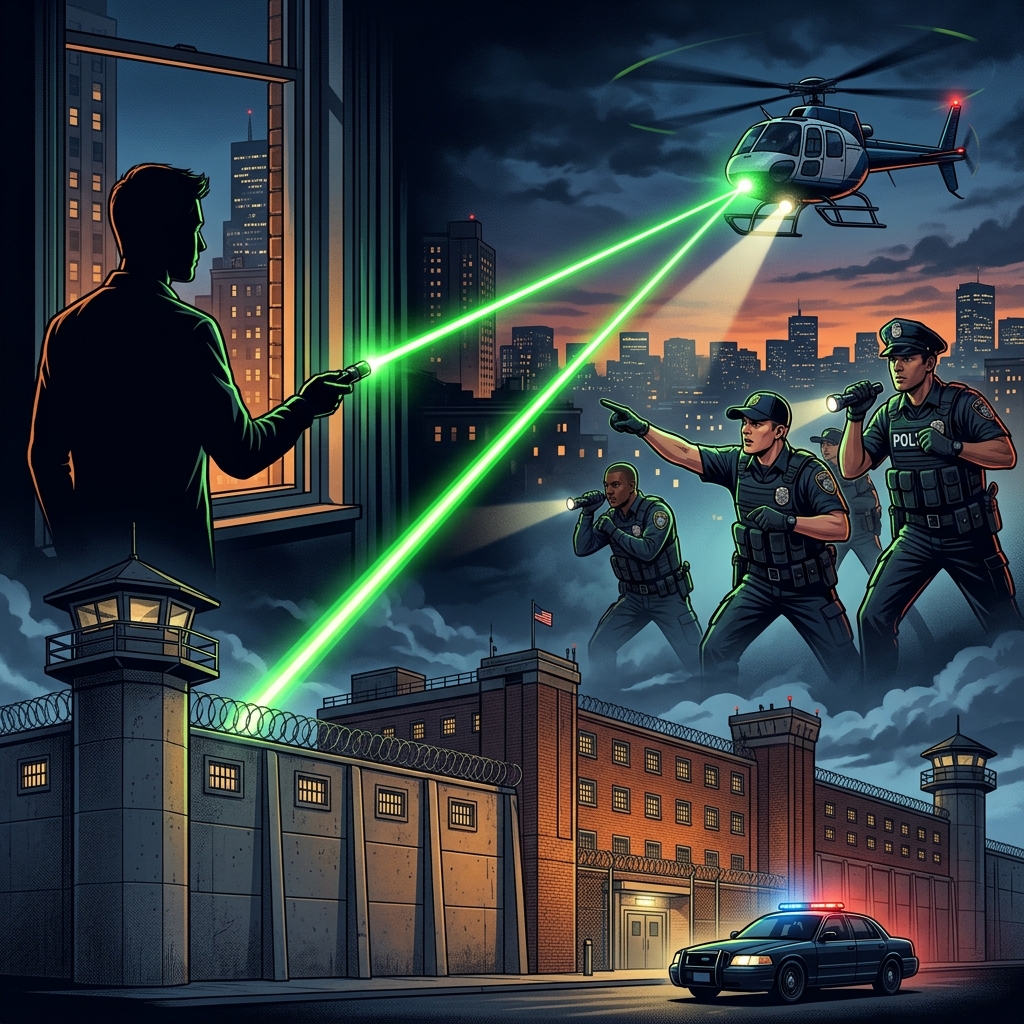
Laser pointers are cheap, widely available, and often treated as toys. Yet in the United States, pointing a laser at police officers or aircraft can quickly escalate from a seemingly harmless stunt to a serious criminal case that may involve federal prison, substantial fines, and a permanent record.
This article explains how U.S. law treats laser misuse, why law enforcement and aviation authorities take it so seriously, and what consequences you could face if you aim a laser at public safety personnel or aircraft.
From Gadget to Crime Scene: Why Laser Misuse Is Dangerous
To understand the legal consequences, it helps to start with why regulators and the courts view laser misuse as more than mere mischief.
Modern handheld laser pointers can emit intense, focused light. When directed at a human being or vehicle, that light can cause:
- Temporary blindness or “flash blindness” that disrupts vision.
- Glare that makes it hard to see instruments, surroundings, or suspects.
- Possible eye injury, especially with higher-powered lasers.
- Distraction and confusion during critical moments in police or flight operations.
For pilots, even a momentary distraction or vision loss while taking off, landing, or maneuvering can jeopardize the safety of passengers and people on the ground. For police officers, a laser pointed at their eyes during a tense encounter can interfere with their ability to assess threats and respond safely.
Key Federal Law: Aiming a Laser at Aircraft
The most prominent federal statute addressing laser misuse is 18 U.S.C. § 39A, which specifically targets people who aim lasers at aircraft.
| Legal Element | What the Law Requires |
|---|---|
| Prohibited Conduct | Knowingly aiming the beam of a laser pointer at an aircraft or the flight path of an aircraft in U.S. special aircraft jurisdiction. |
| Maximum Penalty | Up to 5 years in federal prison, a fine under Title 18, or both. |
| Scope of “Laser Pointer” | Any device that emits a beam used as a pointer or highlighter to indicate a specific position or object. |
In other words, you do not need a high-powered industrial laser to commit a federal crime. A consumer-grade pointer used to highlight slides or point at stars can be enough if it is knowingly aimed at an aircraft in flight.
Important Exceptions Under Federal Law
18 U.S.C. § 39A includes narrow exceptions that reflect legitimate uses of lasers in aviation and defense contexts.
- Research and development conducted by aircraft manufacturers or authorized entities.
- Operations, testing, or training by the Department of Defense or Department of Homeland Security acting in an official capacity.
- Use of a laser emergency signaling device to send a distress signal.
These exceptions do not cover recreational pointing, protests, or attempts to “get the attention” of pilots or law enforcement aircraft. Outside of these narrow categories, shining a laser at aircraft or their flight paths can trigger federal prosecution.
FAA Civil Penalties: Fines on Top of Criminal Charges
Criminal prosecution is only one dimension of the risk. The U.S. Federal Aviation Administration (FAA) also has authority to impose civil penalties for laser strikes against aircraft.
According to FAA guidance, individuals responsible for laser incidents can face civil fines of up to $32,646 per violation, and in 2021, the FAA issued a total of $120,000 in such fines related to laser strikes. These penalties are separate from any criminal charges brought under federal or state law.
In practice, that means someone who points a laser at a helicopter or airplane could face:
- A federal criminal case under 18 U.S.C. § 39A.
- Civil penalties imposed by the FAA for violating aviation safety rules.
- State-level charges if local laws prohibit laser misuse against aircraft or law enforcement officers.
State Laws: Protecting Police Officers from Laser Threats
Beyond federal aviation rules, several states have enacted laws specifically addressing lasers aimed at law enforcement officers. These statutes treat the conduct as a threat to officer safety and public order.
For example, one state law makes it unlawful to shine a laser beam on a law enforcement officer and classifies the offense as a Class A misdemeanor, exposing the offender to potential jail time and fines. Other provisions treat aiming a laser at a person in a threatening manner with intent to cause fear of bodily harm as a misdemeanor punishable by up to 30 days in county jail.
State penalties vary, but the trend is clear: deliberately directing lasers at officers is being codified as criminal behavior, not protest or entertainment.
Lasers and Police Aviation Units
Law enforcement agencies routinely warn that aiming lasers at police helicopters is both dangerous and illegal. Public safety announcements have emphasized that pointing a laser at a helicopter or other aircraft is a felony, punishable by up to five years in prison and fines as high as $250,000 under federal law.
Police aviation units may coordinate with federal authorities when they experience laser strikes, and local arrests can lead to federal charges if the conduct meets the elements of 18 U.S.C. § 39A.
How a Laser Incident Becomes a Federal Case
Not every laser misuse case ends in federal court, but certain facts make a prosecution more likely. While details vary by jurisdiction, typical factors include:
- Targeting aircraft, especially commercial passenger planes, medical helicopters, or police helicopters.
- Repeated incidents or multiple strikes reported in the same area.
- Documented disruption to flight operations, such as pilots reporting flash blindness or aborted landings.
- Evidence of intent, such as deliberate tracking of an aircraft with the laser beam.
Pilots are encouraged to report laser strikes immediately, and air traffic control logs often record the approximate location, time, and direction of the beam. Law enforcement can use this information, along with surveillance, witness reports, and sometimes the laser itself, to identify suspects.
Penalties: Prison, Fines, and Long-Term Consequences
The legal consequences of aiming a laser at police or aircraft can be severe.
Criminal Penalties Under Federal Law
- Up to 5 years in federal prison for violating 18 U.S.C. § 39A.
- Fines that can reach $250,000 for a felony laser offense in federal court.
These penalties reflect Congress’s judgment that laser strikes pose a significant threat to aviation safety and warrant felony-level consequences.
Criminal Penalties Under State Law
States may impose additional penalties for laser misuse, including:
- Misdemeanor jail terms (for example, up to one year in county jail for certain laser offenses involving aircraft).
- Felony sentences for more serious or repeated violations, sometimes including state prison terms of 16 months, two years, or three years, depending on the statute.
- Fines ranging from hundreds to thousands of dollars.
In jurisdictions where aiming a laser at an officer is specifically criminalized, individuals can face arrest even without an aviation component, based solely on the act of targeting law enforcement personnel.
Civil Penalties and Administrative Actions
On top of criminal liability, civil and administrative actions can include:
- FAA fines up to $32,646 per violation for laser incidents affecting aircraft.
- Potential civil lawsuits if injury or property damage occurs.
- Conditions of probation, such as restrictions on owning laser devices or participating in certain activities.
Long-Term Impacts on Your Life
A laser-related conviction can affect more than just your immediate freedom and finances. Consequences may include:
- Permanent criminal record, particularly for felony convictions.
- Difficulty obtaining employment, especially in security-sensitive industries.
- Potential immigration consequences for non-citizens.
- Restrictions on professional licenses or government contracting opportunities.
What might start as a momentary decision to point a laser at a helicopter, airplane, or officers can result in lifelong legal and personal repercussions.
Common Myths About Laser Pointers and the Law
People often underestimate the legal risks because of misconceptions about what lasers are and how they are regulated.
Myth 1: “It’s Just a Toy; It Can’t Be Illegal”
Many consumer laser pointers are marketed for presentations or hobbies, but that does not mean any use is acceptable. The law focuses on how the device is used—aiming it at aircraft or law enforcement can transform a lawful purchase into unlawful conduct.
Myth 2: “If No One Gets Hurt, There’s No Crime”
Federal and state laser statutes generally do not require proof of physical injury. The crime can be complete once the laser is knowingly directed at prohibited targets such as aircraft or officers. The risk to safety and potential disruption is enough to justify prosecution.
Myth 3: “They’ll Never Catch Me”
While some offenders are not immediately identified, law enforcement has tools that make detection more likely than many assume:
- Pilot reports and air traffic control logs that narrow down the location and time of the incident.
- Coordination between local police, federal agents, and aviation authorities.
- Public tips when lasers are repeatedly observed in a particular area.
Authorities have successfully prosecuted individuals for laser strikes, imposing significant fines and federal charges.
Responsible Use of Laser Pointers
Laser pointers can be used safely and lawfully for legitimate purposes such as presentations, astronomy, or education. To avoid legal trouble and protect public safety, consider these guidelines:
- Never aim lasers at people, vehicles, or buildings.
- Keep lasers away from aircraft, including distant lights that might be airplanes or helicopters.
- Check local laws regarding permitted laser power and use, especially for outdoor activities.
- Supervise minors and explain the dangers of aiming lasers at others.
When in doubt, err on the side of caution. The legal consequences of misuse are substantial, and a single incident can be enough to trigger criminal investigation.
Frequently Asked Questions (FAQs)
Is it always a federal crime to point a laser at aircraft?
Knowingly aiming a laser pointer at an aircraft or its flight path in U.S. special aircraft jurisdiction can be prosecuted as a federal offense under 18 U.S.C. § 39A, with penalties of up to 5 years in prison. Whether a particular incident leads to federal charges depends on prosecutorial discretion and case facts.
Can I be arrested for pointing a laser at police officers on the ground?
Yes. Several states have laws that make it a crime to shine a laser on law enforcement officers, often treating the conduct as a misdemeanor or, in some circumstances, a more serious offense. Even without aircraft involvement, targeting officers with lasers can result in arrest.
What if I only pointed the laser once and no one was injured?
Injury is not required for prosecution under many laser statutes. The act of knowingly aiming the laser at protected targets—such as aircraft or officers—can be enough for charges, especially if the incident is reported and documented.
Are there legal ways to use lasers outdoors?
Yes. Lasers can be used for lawful activities like astronomy or construction alignment, but users must ensure beams are kept away from aircraft, roadways, and people. Authorized research, defense operations, and emergency signaling are specifically recognized exceptions under federal law.
Can a laser pointer incident affect my future employment?
A conviction, particularly for a felony offense related to laser misuse, can appear on background checks and may impact hiring decisions in fields that require security clearances, professional licenses, or trust in safety judgment. This risk exists even if the incident began as what seemed like a prank.
References
- U.S. laws for lasers and pointers — LaserPointerSafety.com. 2023-01-01. https://www.laserpointersafety.com/rules-general/uslaws/uslaws.html
- 18 U.S. Code § 39A – Aiming a laser pointer at an aircraft — Legal Information Institute, Cornell Law School. 2018-01-01. https://www.law.cornell.edu/uscode/text/18/39A
- Laser Safety — Federal Aviation Administration. 2022-03-10. https://www.faa.gov/about/initiatives/lasers
- Pointing a laser at an aircraft is a serious federal crime — Idaho News 6 via Facebook. 2017-03-01. https://www.facebook.com/Idahonews6/posts/1282280320745774
- A person convicted of pointing a laser at an aircraft can be fined up to $250,000 — Valerie Bell via Facebook. 2017-03-01. https://www.facebook.com/ReporterValerieBell/posts/390486766235574
Similar Articles








Read full bio of medha deb




