
Ignition Interlock Devices and DUI Penalties
How ignition interlock devices work, when courts require them, and what drivers should expect.
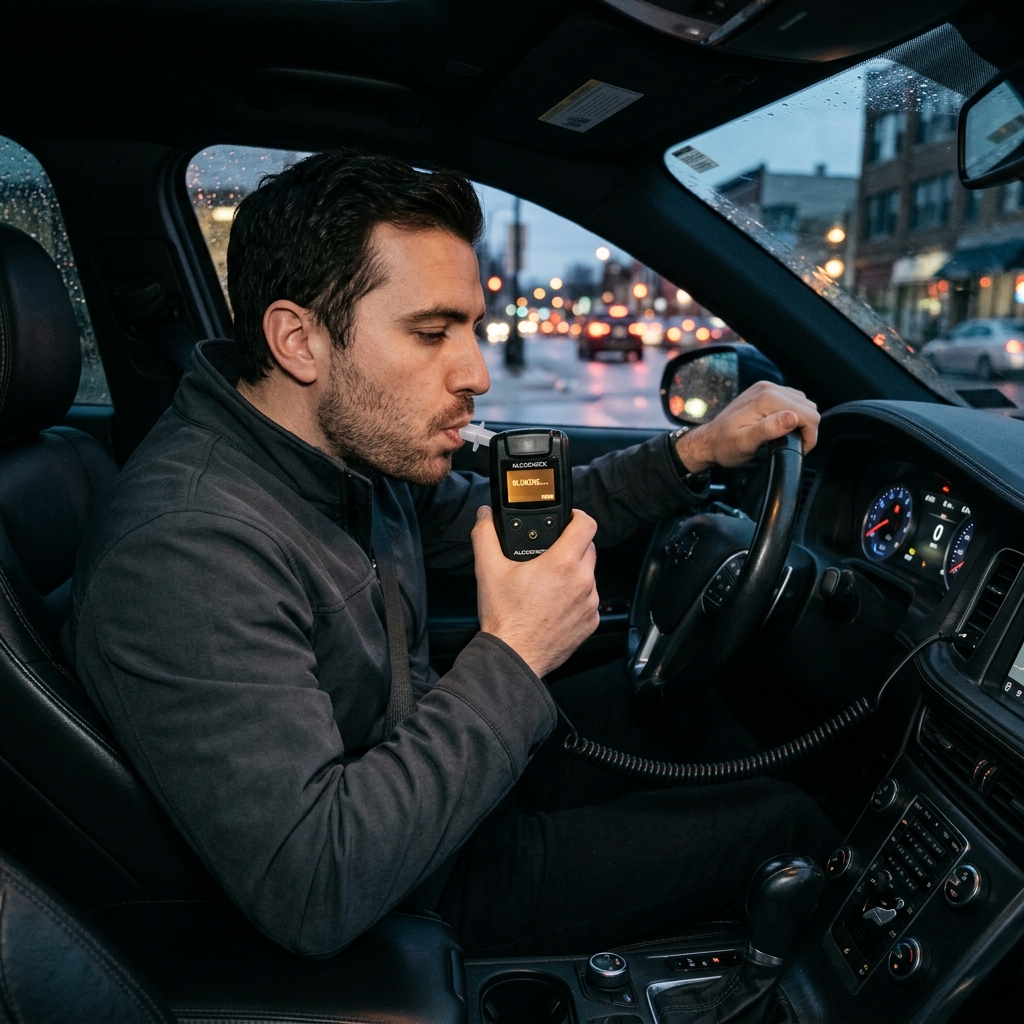
An ignition interlock device is a breath-testing system installed in a vehicle to stop the engine from starting if alcohol is detected. In DUI cases, courts and motor vehicle agencies often use these devices as both a punishment and a public-safety measure, especially when a driver is seeking limited or restored driving privileges.
What an ignition interlock device does
An ignition interlock device, often shortened to IID, works like a car breathalyzer. Before the vehicle can start, the driver must blow into a mouthpiece so the device can measure breath alcohol concentration. If the reading is above the programmed limit, the car will not start.
Many systems also require rolling retests after the vehicle is already running. That means the driver must submit additional breath samples at random intervals during the trip. These repeat checks are designed to prevent someone else from starting the car for an impaired driver and to reduce the chance that alcohol use continues during the drive.
- The device is connected to the vehicle’s ignition system.
- The driver must provide a breath sample before starting the engine.
- The system may request random retests while driving.
- Service providers typically handle installation, calibration, and data review.
Why courts require them after DUI cases
IIDs are commonly used after alcohol-related driving offenses because they allow some drivers to keep driving while limiting the risk of repeat impaired driving. In many states, the device is tied to a restricted license, probation condition, or court order. For some drivers, installing the device is the fastest path back to legal driving after a suspension period.
The device also creates a record of compliance. Service centers can collect data showing whether the driver has failed tests, skipped required retests, or tried to tamper with the equipment. That monitoring function makes the IID more than a starting gate; it becomes part of the enforcement system.
When an IID may be ordered
States vary widely, but official state guidance shows several common situations where an IID is required or may be required. Some states use them for first offenses in limited circumstances, while others make them mandatory for repeat offenders or for cases involving injury or higher blood alcohol concentrations.
| Typical situation | How IID requirements may apply |
|---|---|
| First DUI offense | May be optional, court-ordered, or available as a condition for a restricted license depending on the state. |
| Repeat DUI offense | Often mandatory for a set period, with longer installation terms for later offenses. |
| DUI involving injury | Frequently treated more strictly, with longer IID periods and fewer alternatives. |
| High BAC arrest | Some states require an IID even for a first conviction when the alcohol level is especially high. |
| Restricted or limited license | Driving privileges are often conditioned on installing and maintaining an IID. |
State examples show this pattern clearly. California’s DMV states that repeat and injury-involved DUI offenders are required to install an IID for a period that can range from one to four years, while some first-time offenders may choose a shorter IID restriction or a more limited driving restriction instead. Texas guidance also shows that judges can order ignition interlocks for repeat offenders and for some first-time offenders, especially when the BAC is 0.15 or higher.
How long the device may stay in the car
The installation period depends on the offense history, the state, and sometimes the court. Some drivers may need the device for only a few months, while others may face a year or more. Longer periods are common for repeat offenses or for situations involving injuries or serious aggravating facts.
California’s statewide IID program illustrates how durations can expand with repeated offenses, ranging from one to four years for repeat and injury-involved cases. Virginia law also reflects a minimum period approach in restricted-license cases, requiring a functioning certified ignition interlock system for not less than 12 consecutive months without alcohol-related violations in certain circumstances.
What drivers usually need to do to comply
Installing the device is only one part of the process. Drivers often must complete several steps before they can lawfully return to the road under an IID restriction.
- Wait out any required suspension or revocation period.
- Have the IID installed by an approved provider.
- Submit proof of installation to the licensing agency or court.
- Carry or file proof of insurance if the state requires it.
- Enroll in or complete any required alcohol education or treatment program.
- Return for regular servicing, calibration, and data downloads.
California’s DMV notes that some drivers must also provide proof of alcohol dependency or education class completion, along with SR-22 insurance verification, before privileges can be restored. South Carolina’s probation authority also requires participants to have devices inspected and data downloaded at least every 60 days, showing that regular maintenance is a core part of the program.
What happens if the device records a failed test
A failed breath test can have serious consequences. Depending on the state’s rules, the result may trigger a lockout, an extended monitoring period, or a report to the court or licensing agency. Repeated failed starts can be treated as evidence that the driver is not complying with program requirements.
Drivers should also understand that a failure does not always mean the person is intoxicated at the exact moment the car will not start. Mouth alcohol from drinks, mouthwash, or medications can affect results in some cases, but the legal and administrative response is still often immediate. For that reason, people subject to IID restrictions need to follow all provider instructions carefully and avoid consuming alcohol before or during driving.
Can someone drive without the device installed?
In many jurisdictions, the answer is no if the driver is under an IID restriction. A restricted license usually allows driving only in a vehicle equipped with a functioning device. Driving another vehicle, or removing the device before the requirement ends, can create new penalties and may extend the restriction period.
Pennsylvania’s ignition interlock law is an example of how strict these limits can be. The state explains that an ignition interlock limited license is the path to driving during certain suspension periods, and the interlock program is the only way to obtain an unrestricted license again in those cases.
Costs and ongoing obligations
The financial cost of an IID matters because the driver usually pays for installation, leasing, removal, and periodic maintenance. Those expenses can add up over a six-month or one-year period, especially if the device must be recalibrated or serviced frequently.
Virginia law, for example, includes a fee to cover court and administrative costs related to the system. Even where the fee structure differs, the general pattern is the same: the driver often bears the cost of participating in the program. That makes an IID a compliance requirement with real economic consequences, not just a technical driving restriction.
Common mistakes that can lead to more trouble
Many IID problems come from avoidable mistakes rather than deliberate violations. Drivers may forget service appointments, use a vehicle not equipped with the device, miss a required retest, or fail to follow calibration instructions. Tampering is especially serious and can lead to immediate sanctions.
- Missing scheduled maintenance appointments.
- Trying to start a vehicle without the installed unit.
- Blowing incorrectly or not responding to retest prompts.
- Allowing another person to operate the car if the device is required on that vehicle.
- Removing or disabling the equipment before authorization.
Because many programs download usage data, a small error can become an official violation. For that reason, drivers should treat the device like a court-monitored requirement and keep detailed records of service visits and communications with the provider.
How state laws differ
Although the basic technology is the same, the legal rules are not. Some states treat an IID as a universal condition for any alcohol-related conviction. Others reserve it for repeat offenders or for drivers who want to shorten a suspension by accepting a monitored restriction.
California, Texas, Virginia, Alabama, Pennsylvania, and South Carolina all show different approaches in the official and state-authored materials reviewed here. The common thread is that an IID is used to balance two goals: allowing limited mobility and reducing the risk that someone with a drinking-related offense will drive after consuming alcohol.
What to expect if you need one
If an IID is ordered, the process usually starts with a court order, DMV notice, or probation condition. From there, the driver contacts an approved provider, installs the device, and submits documentation to the relevant agency. After installation, the driver must follow the program rules until the term ends and the provider or agency confirms compliance.
The safest approach is to assume the IID will be closely monitored from day one. Any failure to maintain the device, show up for servicing, or follow the driving restrictions can delay full license restoration.
FAQs
Is an ignition interlock device the same as a breathalyzer?
It is similar, but not identical. A breathalyzer is a general alcohol-testing tool, while an ignition interlock is installed in a vehicle and prevents the engine from starting if alcohol is detected.
Can an IID be required for a first DUI?
Yes. Some states and courts allow or require it for first offenses, especially when the BAC is high or other aggravating facts are present.
How often does the device need service?
That depends on the state and provider. Some programs require periodic inspections and downloads every few weeks or every two months.
Can I drive any car while using an IID?
Usually no. If the restriction applies to a specific vehicle or requires the device on every vehicle driven, the driver must follow those terms exactly.
What happens when the requirement ends?
The device is removed by the approved provider after the agency confirms that the driver has met the program terms, paid all fees, and completed any required compliance steps.
References
- Statewide Ignition Interlock Device Pilot Program — California Department of Motor Vehicles. 2026-07-09. https://www.dmv.ca.gov/portal/driver-education-and-safety/dmv-safety-guidelines-actions/driving-under-the-influence/statewide-ignition-interlock-device-pilot-program/
- Ignition Interlock Laws — Alabama Law Enforcement Agency. 2026-07-09. https://www.alea.gov/dps/driver-license/license-and-id-cards/ignition-interlock-laws
- Ignition Interlock Device (IID) & DUI Laws — Intoxalock. 2026-07-09. https://www.intoxalock.com/state-requirements/california
- Ignition Interlock Device (IID) Law — Orange County DUI Attorney. 2026-07-09. https://dui.williamweinberg.com/california-dui/dui-penalties/ignition-interlock-device-iid-law/
- Texas Ignition Interlock Laws — Texas A&M Transportation Institute. 2026-07-09. https://cades.tti.tamu.edu/files/2019/07/blow2go_texaslaws_TC.pdf
- § 18.2-270.1. Ignition interlock systems; penalty — Virginia Law. 2026-07-09. https://law.lis.virginia.gov/vacode/title18.2/chapter7/section18.2-270.1/
- Ignition Interlock — Pennsylvania DUI Association. 2026-07-09. https://padui.org/ignition-interlock/
- Ignition Interlock — South Carolina Department of Probation, Parole and Pardon Services. 2026-07-09. https://ppp.sc.gov/ignition-interlock
Similar Articles








Read full bio of medha deb




