
Can An HOA Control Holiday Decorations? Fair, Practical Rules
How community rules, safety limits, and religious rights shape seasonal decorating in HOA neighborhoods.
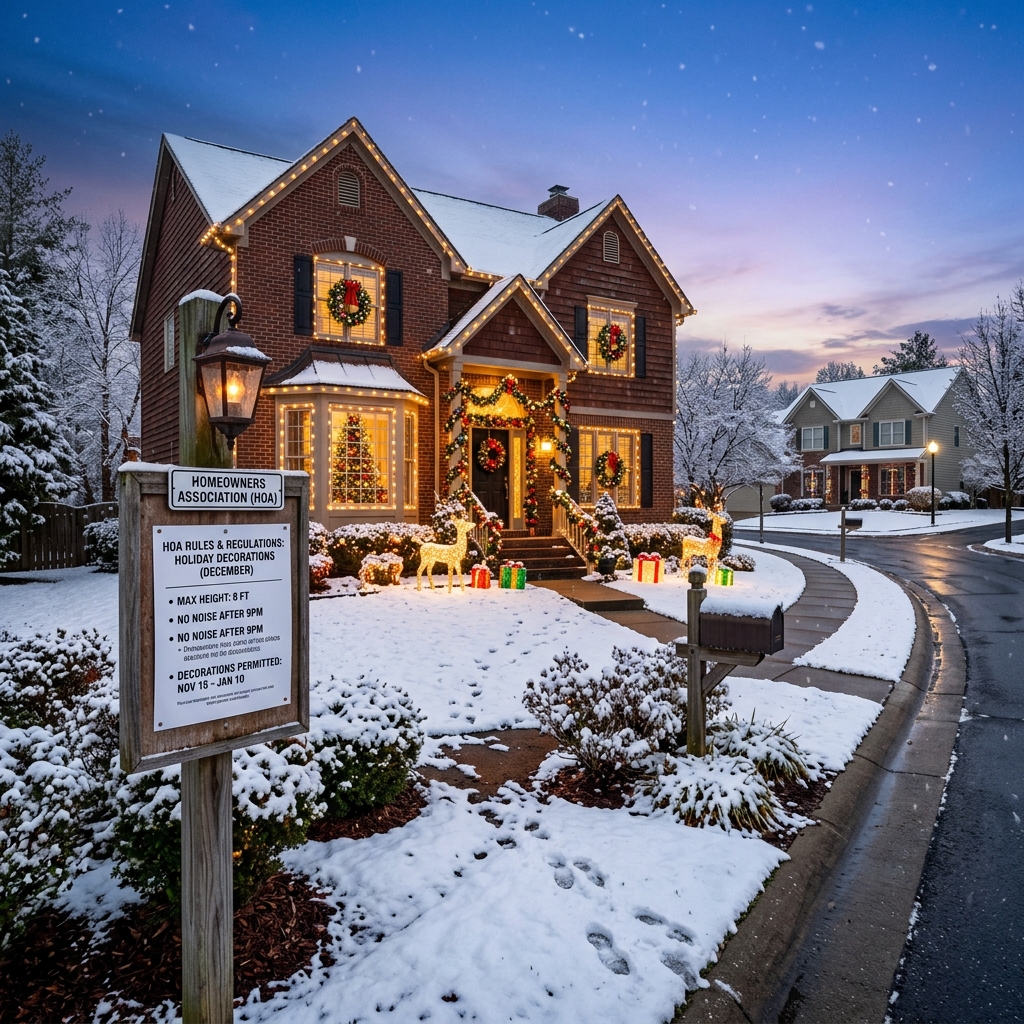
Can an HOA Control Holiday Decorations?
Many homeowners enjoy turning their houses into bright seasonal displays, but living in a common-interest community can change what is allowed. Homeowners associations often have authority to regulate exterior decorations when those rules are tied to the community’s governing documents, safety concerns, or nuisance prevention. The key question is not whether decorations are festive, but whether the association has a legitimate reason to limit them and whether its rules are applied consistently.
In practice, HOA authority usually comes from the declaration, covenants, conditions, and restrictions, along with board-adopted rules. If those documents permit regulation of exterior appearance, common areas, noise, or conduct that affects neighboring properties, the association may be able to restrict some holiday displays. The strongest rules are usually those that focus on objective issues such as timing, location, lighting, electrical hazards, sound, or interference with maintenance access.
For homeowners, the first step is simple: read the governing documents before putting up a display. For boards, the first step is equally important: make sure any seasonal policy is clear, neutral, and easy to enforce.
Why Associations Regulate Seasonal Displays
HOAs do not usually regulate holiday decorating just to control personal taste. The better reasons are practical. A display may create safety risks, block sidewalks, damage common property, interfere with landscaping, or disturb neighbors with excessive noise or bright lighting. Associations also try to preserve a consistent neighborhood appearance, especially in planned communities where exterior rules are part of the value residents agreed to when they bought their homes.
That does not mean every restriction is valid. A rule is more defensible when it addresses a measurable issue rather than a subjective opinion. For example, a board can often justify a limit on inflatable displays in narrow yards, but it is harder to defend a rule that simply bans decorations because they are “unattractive.” Associations are on much firmer ground when they use specific standards that residents can understand in advance.
Common Limits That Are Usually Easier to Defend
Well-written holiday decoration policies often focus on a few recurring issues. These limits are common because they target real community concerns rather than personal preference.
- Timing: Rules may set a start date for putting up decorations and a deadline for removing them after the holiday period ends.
- Location: Decorations may be restricted to private areas and kept out of common elements, landscaping beds, and maintenance zones.
- Safety: Policies may prohibit open flames, unsafe wiring, blocked walkways, or decorations that interfere with emergency access.
- Noise: Associations may limit animated displays, loud speakers, or sound-producing ornaments that become a nuisance.
- Light usage: Boards may require illuminated displays to be turned off during certain nighttime hours.
- Size and placement: Rules may cap the height, footprint, or number of decorations so the display does not dominate the lot or create congestion.
These kinds of standards are popular because they are easier to apply evenly. They also reduce disputes by telling residents exactly what the association expects.
What Boards Should Avoid in a Policy
The most vulnerable HOA rules are the ones that rely on personal judgment. Terms like “tasteful,” “appropriate,” or “not offensive” can create uncertainty and unequal enforcement. One board member may think a particular display is charming, while another may find it excessive. That kind of inconsistency invites conflict.
Boards should also avoid writing rules that effectively favor one holiday over another without a clear reason. A seasonal policy that speaks only about Christmas decorations, for example, may create the appearance of favoritism. A more neutral approach is to regulate “holiday decorations” generally and apply the same standards across different seasonal observances.
Another common mistake is overreaching into private rights without a specific basis in the governing documents. An HOA can often manage exterior visibility, but it should be careful before dictating every detail of how a homeowner decorates inside a window or uses personal religious items on private doors. The more the rule resembles a broad ban rather than a narrow regulation, the more likely it is to cause legal friction.
Religious Displays Can Raise Additional Issues
Holiday decoration disputes are not only about aesthetics. Some displays are tied to sincerely held religious beliefs, and that changes the analysis. In some jurisdictions, laws protect certain religious items displayed on doors or doorframes, and associations may have to accommodate those items unless a valid maintenance or safety reason requires temporary removal. Even where a community can regulate exterior decorations generally, it should be careful not to treat religious expression less favorably than comparable secular displays.
That means a board should think carefully before approving a policy that allows wreaths, lights, and figurines while singling out religious symbols for special restrictions. If a rule permits comparable nonreligious items, it may be difficult to justify a more restrictive rule for religious items alone. Boards should consult the community’s legal documents and applicable state law before adopting any policy that affects religious decorations.
Homeowners, too, should understand that not every religious display is automatically exempt from all HOA rules. If an item creates a hazard, interferes with maintenance, or violates a neutral policy applied to all residents, the association may still have some ability to regulate it. The safest approach on both sides is to focus on neutrality, documentation, and early communication.
How to Draft a Fair Holiday Decoration Policy
Associations that want fewer disputes usually do better with a written seasonal policy than with ad hoc decisions. A clear policy gives residents a roadmap and helps the board respond consistently. It should be practical, concise, and based on objective criteria.
| Policy Topic | Reasonable Approach | Why It Helps |
|---|---|---|
| Display window | Allow decorations for a defined period before and after the holiday | Prevents year-round clutter and confusion |
| Placement | Limit decorations to private areas and keep them out of common space | Protects landscaping and access routes |
| Lighting | Set hours for illuminated displays | Reduces light intrusion and energy concerns |
| Sound | Limit music or sound effects | Reduces nuisance complaints |
| Safety | Ban flames, dangerous wiring, and blocked exits | Reduces injury and liability risk |
| Content neutrality | Use neutral holiday language | Avoids unequal treatment of different celebrations |
Boards should also explain how violations will be handled. Residents are more likely to comply when the enforcement process is predictable. Written notice, a chance to correct the issue, and a fair hearing process can all reduce tension and increase confidence in the board’s decisions.
Best Practices for Homeowners Who Want to Decorate
Homeowners can avoid most holiday disputes by planning ahead. A quick review of the CC&Rs and any seasonal rules can prevent expensive mistakes. If the community has a rule on timing or placement, follow it closely. If no rule exists, it is still wise to use common sense and avoid decorations that spill onto neighboring property or create hazards.
Communication also matters. If you are planning a larger display, especially one with lights, sound, or heavy foot traffic, tell nearby neighbors and the board in advance. A short conversation can solve problems before they become complaints. Homeowners should also keep records of approvals, emails, and any instructions from the association in case questions arise later.
Practical habits can make a big difference:
- Use timers for lights so displays turn off automatically.
- Keep cords secure and away from walking paths.
- Check that decorations do not block mail access, hydrants, stairs, or emergency routes.
- Remove displays promptly after the allowed period ends.
- Ask before attaching anything to common structures or shared property.
The goal is to celebrate without creating unnecessary conflict. In many communities, a little planning prevents complaints and keeps the holiday season friendly for everyone.
When an HOA’s Rule May Go Too Far
Even though associations have broad discretion, their authority is not unlimited. A rule may be vulnerable if it is vague, discriminatory, or unsupported by the governing documents. A policy that bans all holiday decorations but allows similar nonholiday items might be challenged as inconsistent. A rule that selectively targets one faith tradition while allowing others may also be problematic. And a restriction that leaves homeowners guessing about what is allowed can be hard to enforce fairly.
There is also a practical limit to what boards should try to control. The more detailed a rule becomes, the more administrative burden it creates. An HOA that tries to micromanage every color, shape, or ornament style may end up with more disputes than it resolves. The strongest policies are usually the simplest ones: clear rules, neutral standards, and consistent enforcement.
FAQs
Can an HOA ban holiday decorations entirely?
Sometimes, but not always. Whether a complete ban is enforceable depends on the governing documents and state law. Even if a ban is allowed, it still needs to be applied consistently and in a way that does not violate protections for religious expression or other legal rights.
Can an HOA limit how long decorations stay up?
Yes. Time limits are among the most common and defensible rules because they are objective and easy to enforce. Many associations choose a reasonable window before and after the holiday season.
Can the board stop noisy or flashing displays?
Often, yes. Rules that reduce nuisance behavior, limit nighttime disturbances, or prevent dangerous electrical setups are usually easier to support than rules based on personal taste.
What if my decorations are religious?
Religious displays may receive special legal protection in some situations. An HOA should be cautious about restricting them and should compare any rule applied to religious items with the treatment of similar secular decorations.
What should I do if I receive a violation notice?
Review the association’s rule, check whether the notice cites the correct provision, and respond within the deadline. If the rule seems unclear or unfair, ask for clarification or use the HOA’s hearing process if one is available.
Practical Takeaway for Boards and Residents
Holiday decorating works best in an HOA when both sides understand the ground rules. Boards should rely on objective standards, written policies, and neutral language. Homeowners should review the rules early, keep displays safe, and respect the shared nature of community living. When associations regulate timing, safety, placement, and nuisance concerns instead of personal taste, seasonal decorating becomes much easier to manage.
In the end, the strongest HOA policies are not the strictest ones. They are the ones that are clear, fair, and workable for everyone in the community.
References
- Homeowner associations can control holiday lighting for religious purposes under neutral rules — Davis-Stirling.com. 2020-01-01. https://www.davis-stirling.com/HOME/R/Religious-Symbols-Sukkahs-Holiday-Decorations
- Legal Tips for HOA Boards: Holiday Decorations — N.P. Weiss Law. 2024-12-01. https://www.npweisslaw.com/blog/hoa-holiday-decorations
- Understanding your holiday decoration policy — FirstService Residential. 2024-12-01. https://www.fsresidential.com/corporate/news-and-articles/articles/hoa-holiday-decoration-policies/
- Navigating HOA Holiday Decorations: A Legal Guide to Festive Displays — L.S. Carlson Law. 2024-12-01. https://www.lscarlsonlaw.com/articles/hoa-holiday-decorations-legal-guide
- Legal for an HOA to restrict holiday decorations? — FindLaw. 2024-12-01. https://www.findlaw.com/legalblogs/law-and-life/legal-for-an-hoa-to-restrict-holiday-decorations/
Similar Articles








Read full bio of medha deb


