
From Idea to Statute: How a Bill Becomes a Law
Follow a bill’s journey from a simple idea through Congress, the president, and final codification into enforceable law.
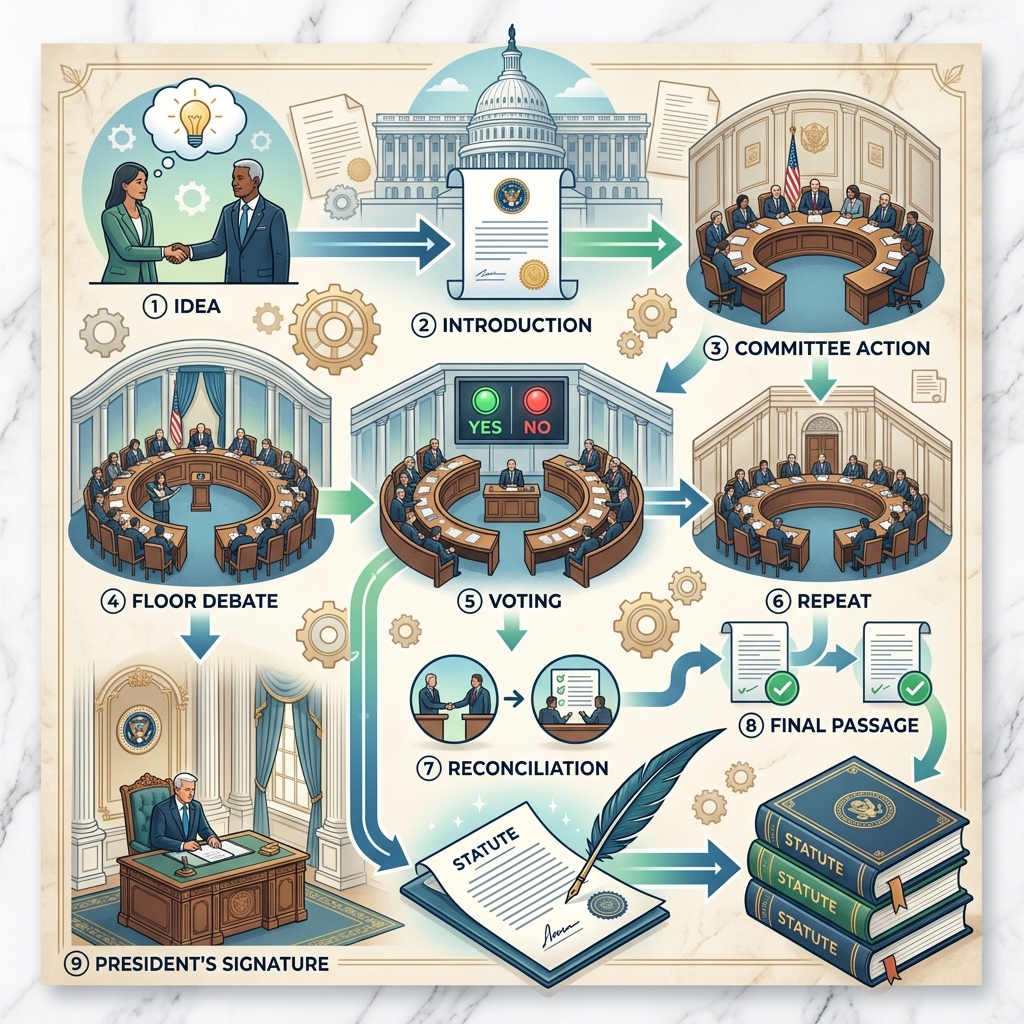
The path from a simple policy idea to a binding law in the United States is deliberate, multi‑layered, and often complex. A proposal must travel through Congress, survive committee scrutiny, win floor votes, and pass presidential review before it is finally published and codified as part of the nation’s legal framework.
This guide walks through each major stage of the federal legislative process, explains key terms, and highlights how the public can follow or influence the journey of a bill.
1. Turning an Idea into a Draft Bill
Every law begins with a problem to solve or a goal to achieve. It may originate from:
- Members of Congress
- Constituents and advocacy groups
- State and local governments
- Executive agencies and policy experts
A member of the House or Senate works with staff, subject‑matter experts, and the Office of Legislative Counsel to translate the idea into precise legal text. This early version is often called a bill draft.
Key questions typically considered at this stage include:
- Policy goal: What concrete problem should the bill address?
- Scope: Who will be affected and how broadly?
- Cost: Will the proposal require federal spending or raise revenue?
- Authority: Is federal action constitutionally appropriate for this issue?
2. Formal Introduction in Congress
Once drafted, the member introduces the bill in their chamber.
| Chamber | Bill Prefix | Example |
|---|---|---|
| House of Representatives | H.R. | H.R. 1001 |
| Senate | S. | S. 1002 |
Clerks assign a bill number and record it in the official legislative database. The bill is then read by title and referred to one or more committees with jurisdiction over its subject matter.
At this point, the bill is formally part of the legislative agenda, but it is far from becoming law. Many proposals will never move beyond committee referral.
3. Committee Review and Hearings
Committees are specialized groups of legislators who focus on broad policy areas such as finance, agriculture, or judiciary. They are the primary gatekeepers of legislation.
After referral, the committee can:
- Hold hearings to gather evidence and testimony from experts, agencies, and the public
- Request analyses from nonpartisan research offices, such as the Congressional Research Service or budget estimators
- Refer the bill to a subcommittee for more detailed work
Committees play a critical role for several reasons:
- They filter out proposals lacking support or technical soundness.
- They improve bills through amendments and negotiation.
- They provide transparency via public hearings and published reports.
Committee Actions on a Bill
At the end of their review, committees typically choose one of several paths:
- Report the bill favorably: Recommend passage, often with a written report explaining the bill’s purpose.
- Report with amendments: Alter the text to clarify definitions, adjust funding, or address concerns.
- Report unfavorably: Suggest that the chamber vote against the proposal.
- Table or take no action: Leave the bill in committee, effectively stopping its progress for that session.
If the committee decides to move forward, the bill is placed on the calendar for consideration by the full chamber.
4. Floor Debate and Amendments
When a bill reaches the House or Senate floor, all members of that chamber may participate in debate, propose amendments, and argue for or against the measure.
Key features of floor action include:
- Structured debate: The time and order of speakers may be governed by chamber rules or a special rule adopted for the bill.
- Amendment process: Members can suggest changes, subject to procedural limits and votes.
- Recorded positions: Debates and votes are recorded, allowing constituents to see how their representatives acted.
Differences between the House and Senate procedures, such as filibusters or unanimous consent agreements in the Senate, can significantly affect how long debate lasts and what amendments are considered.
Voting Methods
After debate, the chamber votes on whether to pass the bill. Common voting methods include:
- Voice vote: Members verbally express support or opposition; no individual record.
- Division vote: Members stand to be counted; still not individually recorded.
- Recorded roll call: Each member’s vote is individually registered and published.
If the bill passes in its originating chamber, it is sent to the other chamber, where it generally goes through a similar process of committee review, floor debate, and voting.
5. Reconciling Differences Between House and Senate Versions
For a bill to become law, both chambers must approve identical text. Because each chamber may amend the bill differently, discrepancies often arise.
To resolve those differences, Congress may use:
- Exchange of amendments: One chamber accepts changes proposed by the other.
- Conference committee: A temporary, bipartisan group of House and Senate members negotiates a compromise version.
The conference committee, if used, produces a conference report containing the final agreed language. Both chambers must then vote on that compromise. If either chamber rejects it, negotiations may continue, or the bill may fail.
6. Presidential Action: Sign, Veto, or Take No Action
Once both the House and Senate approve a single version of the bill, it is enrolled and sent to the President. The Constitution assigns the President several options:
- Sign the bill: The bill becomes law upon signature.
- Veto the bill: The President refuses to sign and returns the bill to Congress with objections.
- No action: Depending on timing and whether Congress is in session, lack of signature can either allow the bill to become law or result in a pocket veto.
Standard Veto and Override
When the President vetoes a bill, Congress may still enact it by overriding the veto. This requires a two‑thirds majority in both the House and the Senate. If both chambers reach that threshold, the bill becomes law without the President’s signature.
Because achieving two‑thirds support is difficult, veto overrides are relatively rare compared to the total number of vetoes issued.
No Action and Pocket Veto
In many situations, if the President does not sign or veto a bill within a specified period (generally 10 days, excluding Sundays), the bill automatically becomes law, provided Congress remains in session during that time.
However, if Congress adjourns before the end of the review period and the President has not signed the bill, the measure does not become law. This is known as a pocket veto, and Congress cannot override it because the bill effectively expires when the legislative session ends.
7. From Public Law to Codified Statute
Once a bill successfully clears congressional approval and presidential action (or override), it becomes a public law. Documentation and publication then follow a standardized process.
Key steps in this final phase include:
- The Office of the Federal Register assigns a public law number, such as P.L. 117‑5.
- The Government Publishing Office issues the text, initially in slip form and later in bound compilations.
- Laws are organized by the order in which they were passed and subsequently codified by subject matter in the United States Code.
Codification allows all laws on related topics to be grouped together, making it easier for courts, agencies, and the public to locate and interpret the applicable rules.
8. Following a Bill and Participating in the Process
Civic engagement is integral to the legislative process. Individuals and organizations can track bills, submit views, and contact their representatives at each stage.
Common ways to engage include:
- Tracking legislation: Use official congressional resources to follow bill status, text, amendments, and votes.
- Submitting comments: Provide written testimony or statements to committees when invited.
- Contacting members: Write, call, or meet with representatives and senators to express support or concern.
- Participating in hearings: Attend public hearings when allowed, either in person or via broadcast.
Although no single citizen controls the outcome of a bill, consistent participation helps shape the policy agenda and informs lawmakers’ choices.
9. Summary Table of the Bill’s Journey
| Stage | Main Actor | Key Outcome |
|---|---|---|
| Idea & Drafting | Member of Congress & staff | Proposal written as legal text |
| Introduction & Referral | House or Senate | Bill numbered and sent to committee |
| Committee Review | Committee & subcommittees | Hearings, amendments, recommendation |
| Floor Debate & Vote | Full chamber | Bill passed or rejected |
| Cross‑chamber Consideration | Other chamber | Repeats committee and floor steps |
| Reconciliation | Both chambers / conference committee | Agreement on identical bill text |
| Presidential Action | President | Sign, veto, or allow law without signature |
| Publication & Codification | Federal Register & GPO | Bill becomes public law and part of the U.S. Code |
10. Frequently Asked Questions (FAQs)
How long does it take for a bill to become law?
There is no fixed timeline. Some bills move quickly if they are non‑controversial or urgent, while others take months or years, and many never become law. Each step—committee review, floor debate, reconciliation, and presidential consideration—can introduce delays.
Can a bill start in either the House or the Senate?
Most bills can be introduced in either chamber, but measures related to raising revenue generally begin in the House of Representatives under constitutional requirements. Regardless of origin, both chambers must ultimately approve identical text.
What happens if the President vetoes a bill?
The bill returns to Congress with a statement of objections. Congress can attempt to override the veto by securing a two‑thirds majority vote in both the House and Senate. If the override succeeds, the bill becomes law despite the veto; if not, the bill fails.
Does every bill receive a committee hearing?
No. Committees have discretion over their agendas. Some bills never receive hearings or votes and remain in committee until the legislative session ends, at which point they effectively die.
How can citizens see the current status of a bill?
Citizens can consult official federal legislative resources to view a bill’s status, including referrals, amendments, votes, and presidential action. These platforms typically show each step the bill has taken and provide the full text in its current form.
References
- How laws are made — USA.gov. 2024-03-15. https://www.usa.gov/how-laws-are-made
- Legislative Process: United States: Bill to Law — Gallagher Law Library, University of Washington. 2018-09-01. https://lib.law.uw.edu/legproc
- How a Bill Becomes a Law — ZERO TO THREE. 2021-06-10. https://www.zerotothree.org/resource/how-a-bill-becomes-a-law/
- How a Bill Becomes a Law — National Volunteer Fire Council. 2020-02-20. https://www.nvfc.org/how-a-bill-becomes-a-law/
- The Legislative Process: Overview — Congress.gov. 2017-01-01. https://www.congress.gov/legislative-process
Similar Articles








Read full bio of Sneha Tete


