
Fake Subpoena Email Scam: How to Spot It
Learn how fake subpoena emails work, why they are dangerous, and the safest ways to verify and respond.
Understanding Fake Subpoena Email Scams
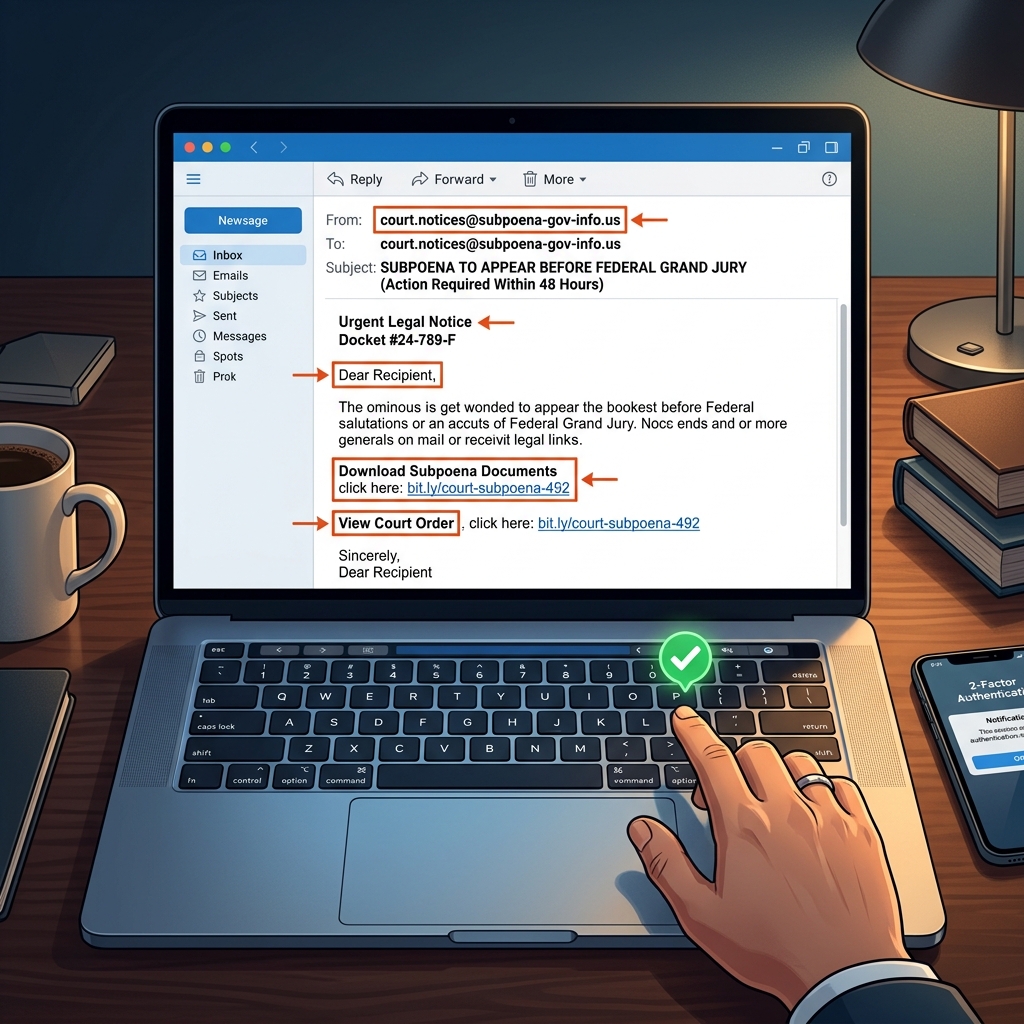
Fake subpoena emails are a form of phishing designed to pressure recipients into opening attachments, clicking links, or surrendering sensitive information. These messages pretend to come from courts, prosecutors, or law-enforcement offices, but their real purpose is usually to steal credentials, install malware, or frighten people into responding quickly. Federal court guidance says these threats are fraudulent and not connected with the federal courts, and warns that courts do not use email or phone calls to demand personal or financial information.
The scam works because a subpoena is a serious legal document. People who receive a message with that word in the subject line often assume it must be legitimate and react before they have time to verify it. That urgency is exactly what scammers want.
How the Scam Usually Works
In many versions of the scam, the email claims that the recipient must appear in court, testify before a grand jury, or respond to an official investigation. The message may include a file attachment, a hyperlink, or both. According to the FBI warning cited by FindLaw, one type of fraudulent subpoena email used a link that installed software capable of capturing keystrokes and sending stolen data over the internet.
Other versions use social engineering instead of malware. The sender may insist that failure to comply will lead to arrest, contempt findings, penalties, or a surprise visit from law enforcement. The fake message may also include case numbers, badge numbers, or official-looking logos to create the appearance of authenticity.
Common Warning Signs
- The message arrives unexpectedly and demands immediate action.
- The email threatens arrest, jail, or severe penalties if you do not comply.
- The sender asks you to click a link or open an attachment to read the subpoena.
- The message requests personal information, payment, or account verification.
- The email address does not match an official court or agency domain.
- The document contains grammar problems, formatting issues, or blurry seals.
- The message tells you not to contact the court or verify the claim independently.
The Federal Trade Commission explains that government agencies do not demand immediate payment over the phone and do not insist on payment by gift cards, payment apps, or cryptocurrency. That same logic applies to email scams that push you toward fast, hard-to-trace action. Legitimate legal process does not depend on panic.
What a Real Subpoena Usually Includes
A genuine subpoena is a formal legal instrument, not a casual message with a threatening tone. While requirements can vary by jurisdiction and case type, a real subpoena generally identifies the issuing court or authority, provides a clear date and place for appearance, and states whether the recipient must testify, bring documents, or do both. It should also include a signature or authority for issuance and some form of official court marking or seal.
| Feature | Legitimate subpoena | Suspicious email scam |
|---|---|---|
| Issuing authority | Named court, prosecutor, or authorized office | Vague or mismatched sender identity |
| Delivery method | Formal service procedures | Unexpected email with attachment or link |
| Instructions | Specific and verifiable | Urgent demands with threats |
| Payment request | Unusual in a subpoena context | Often requested as a “fee” or “fine” |
| Verification | Can be checked directly with the issuing office | Sender discourages independent confirmation |
The key point is that appearance alone is not proof. Scammers can copy formatting and use realistic-looking language, so verification matters more than the design of the document.
Why These Messages Are So Effective
Fraudsters exploit fear, confusion, and respect for legal authority. Many recipients do not know how subpoenas work, so they may assume a legal-sounding email must be obeyed immediately. The New York Times reporting referenced by FindLaw noted that executives received fake subpoena emails that appeared credible enough to trigger serious concern, especially because they appeared to come from a federal court.
These attacks are also effective because they target busy people. A manager, professional, or small-business owner may open a message while handling other tasks and respond without carefully checking the source. In that window, a single click can expose passwords, corporate records, or other sensitive data.
Safe Steps to Take If You Receive One
- Do not click any links or open any attachment in the message.
- Do not reply with personal, financial, or login information.
- Check the sender address carefully for signs of impersonation.
- Contact the alleged court or agency using a number or website you already know is legitimate.
- Ask whether the subpoena was actually issued and whether the case number matches an existing matter.
- Save screenshots, headers, and related records before deleting the message.
The United States Courts advises recipients of suspicious communications to avoid disclosing information, to distrust threats of fines or jail, and to verify the matter directly through the court. That approach is the safest response when the message is unfamiliar or unusually urgent.
How to Verify Without Trusting the Email
Verification should happen outside the message itself. If the email claims to come from a court, use an official court website or publicly listed clerk’s office number rather than any contact information embedded in the suspicious message. Ask whether the subpoena was issued by that office and whether the case number, names, and dates are valid.
If the message claims to come from a law-enforcement or government office, call the main office number listed on an official source and ask for confirmation. Do not assume a phone number in the email is real. Scammers regularly copy names, logos, and office titles while routing replies to themselves.
If you are unsure whether the matter is civil, criminal, or administrative, ask the office that allegedly issued the document to explain the process. Real institutions can explain how service occurs, how deadlines work, and what the document means. Scammers usually cannot survive careful follow-up.
What to Do If You Clicked the Link
If you clicked a suspicious link, the risk depends on what happened next. If a page opened but you entered nothing, you may still want to close the page, clear the browser history, and scan your device for malware. If you downloaded a file, disconnect from sensitive accounts until your device has been checked. The FBI warning referenced by FindLaw described a malicious link that installed software capable of recording keystrokes, which means the danger may extend beyond a single inbox.
If you entered a password, change it immediately from a safe device and enable multi-factor authentication if available. If you entered financial information, contact your bank or card issuer right away. If you shared business credentials, notify your employer or IT team so they can reset access and check for unusual logins.
When a Message May Be a Different Kind of Scam
Some fake subpoena emails are part of a broader impersonation campaign rather than a standalone phishing attempt. The same criminal may pretend to be a court clerk, a sheriff’s deputy, a prosecutor, or a juror coordinator. Federal courts have warned about fraudulent calls and emails that threaten fines and jail time while requesting sensitive information or payments. Consumer protection alerts also show that scammers may combine court themes with jury-duty warnings or fake badge numbers to make the story sound more credible.
These overlaps matter because the response should remain the same: pause, verify, and refuse any demand for instant payment or confidential data.
How Organizations Can Reduce the Risk
Businesses, law firms, and public institutions can reduce damage by training staff to recognize legal-themed phishing. Employees should know that subpoenas and similar documents require verification before any action is taken. Security teams should encourage reporting, not embarrassment, so a suspicious message can be assessed quickly.
Technical controls also help. Email filtering, attachment sandboxing, multi-factor authentication, and restricted macro execution can reduce the chance that one fraudulent message leads to a wider breach. For high-risk teams, a policy requiring independent confirmation of any legal request can prevent an urgent email from becoming an expensive incident.
Practical Myths That Deserve Correction
- A subpoena in an email is not automatically valid just because it looks official.
- Courts do not rely on fear-based messages to collect money or personal details.
- Urgency is a warning sign, not proof of legitimacy.
- Threats of immediate arrest are commonly used in scams.
- Independent verification is normal and appropriate.
Consumers are often told by scammers not to contact the court, police, or a lawyer. That instruction is itself a red flag. A genuine legal process can stand up to verification.
Frequently Asked Questions
Is every subpoena email a scam?
No. Some legal notices may be delivered electronically in certain situations, but a real notice should still be verifiable through official channels. If the message pressures you to act immediately or asks for payment or sensitive information, treat it as suspicious.
Should I reply to ask if it is real?
No. Replying confirms that your email address is active and may invite more scam messages. Verify through the official office instead.
What if the email includes my name and case details?
That does not prove legitimacy. Personal information can be gathered from public records, previous data breaches, or other sources. Scammers often use real details to appear credible.
Should I pay to avoid problems?
No. A demand for immediate payment by gift card, payment app, wire transfer, or cryptocurrency is a classic fraud signal.
Who should I report it to?
If you suspect fraud, report it to the relevant court or agency, and consider filing a complaint with the Federal Trade Commission or the FBI’s Internet Crime Complaint Center if personal or financial information was exposed.
Final Checklist Before You Act
- Stop and read the message carefully.
- Look for threats, pressure, or payment demands.
- Verify the source using an official contact method.
- Do not open suspicious files or click unknown links.
- Preserve evidence if the message appears fraudulent.
- Reset passwords and contact your financial institution if information was shared.
References
- Did you get a call or email saying you missed jury duty and need to pay? It’s a scam — Federal Trade Commission. 2024-09. https://consumer.ftc.gov/consumer-alerts/2024/09/did-you-get-call-or-email-saying-you-missed-jury-duty-need-pay-its-scam
- Fake Subpoena Email Phishing Scam – FindLaw — FindLaw. 2026-07. https://www.findlaw.com/legalblogs/consumer-protection/fake-subpoena-e/
- Federal Court Scams — United States Courts. 2026-07. https://www.uscourts.gov/data-news/news/federal-court-scams
- Scam of the Month: Sheriff Impersonation — Washington University in St. Louis Information Security. 2026-07. https://informationsecurity.wustl.edu/scam-of-the-month-sheriff-impersonation/
- What to Do If You Receive a Fake Court Subpoena Circulating Online — Respicio. 2026-07. https://www.respicio.ph/commentaries/what-to-do-if-you-become-a-victim-of-an-escrow-scam-on-an-online-marketplace-or-platform
Similar Articles








Read full bio of Sneha Tete


