
Fake Service Animals: Laws, Risks, and Real-World Impact
Why misrepresenting a pet as a service animal can lead to fines, jail time, and lasting harm for people with disabilities.
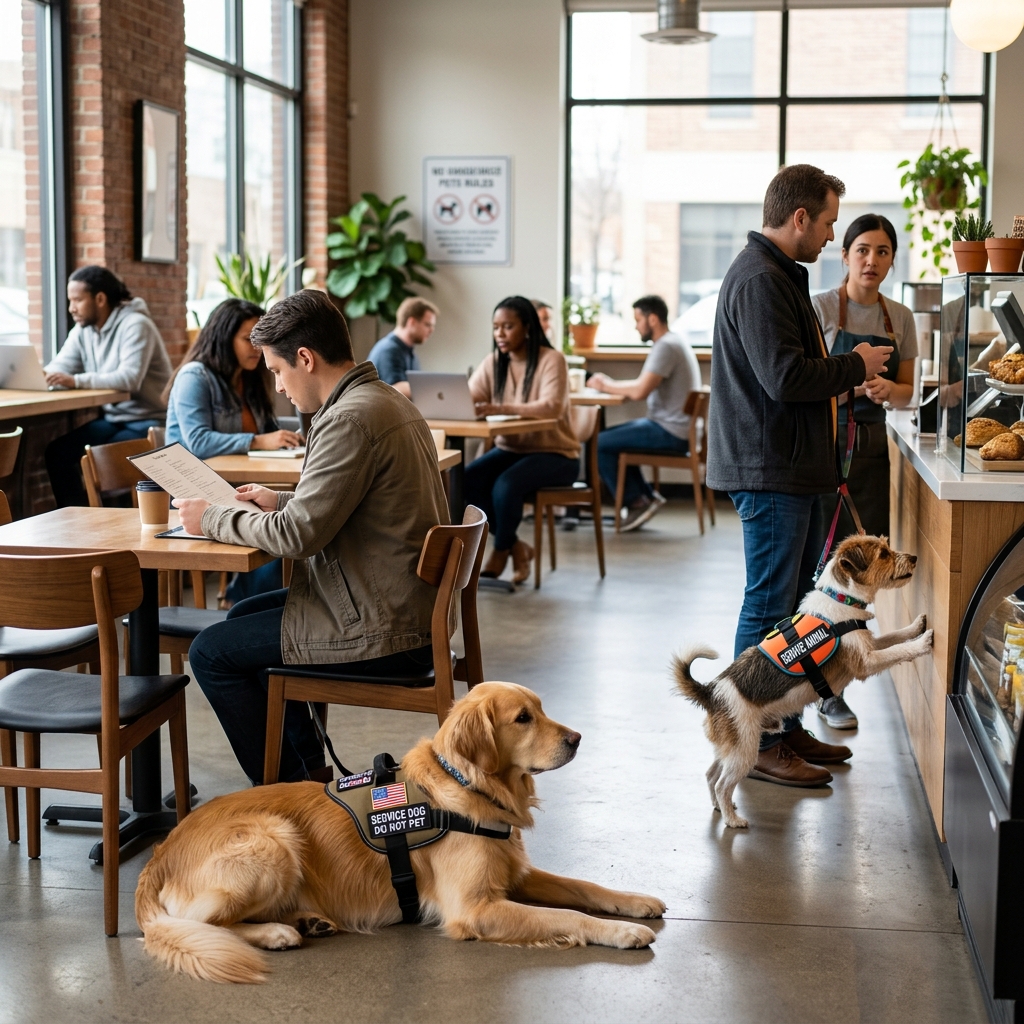
Misrepresenting a pet as a service animal might seem harmless to some, but in many U.S. states it is now a punishable offense that can result in fines, criminal charges, and even jail time. Beyond legal consequences, fake service animals undermine the rights and safety of people with disabilities who depend on properly trained dogs to navigate daily life.
Understanding What a True Service Animal Is
To make sense of why fake service animals are such a serious issue, it is essential to understand how the law defines a genuine service animal.
Under the Americans with Disabilities Act (ADA), a service animal is generally a dog that has been individually trained to perform specific tasks or work for a person with a disability. In limited circumstances, trained miniature horses may also qualify, but other species do not.
- Task-focused training: The animal must be trained to perform one or more tasks directly related to its handler’s disability, such as guiding, alerting, pulling a wheelchair, or interrupting dangerous behaviors.
- Disability-related function: The tasks must mitigate a physical or psychiatric disability, not simply provide comfort or companionship.
- Behavioral standards: Service animals are expected to be under control, housebroken, and capable of working safely in public spaces.
Animals that provide only emotional support, comfort, or companionship without specific task training are not considered service animals under the ADA, even if they are very important to their owners.
Service Animals vs. Emotional Support Animals
Confusion between service animals and emotional support animals (ESAs) is one of the main drivers of misrepresentation. Although both can be meaningful to their handlers, the law treats them differently.
| Feature | Service Animal | Emotional Support Animal |
|---|---|---|
| Legal definition | Dog (or sometimes miniature horse) trained to perform tasks for a person with a disability. | Animal that provides comfort or emotional support but is not task-trained under ADA. |
| ADA public access rights | Generally allowed in most public accommodations (stores, restaurants, government buildings) when accompanying a person with a disability. | Does not have automatic public access rights under ADA. |
| Training requirement | Individually trained to perform specific tasks related to the disability. | No standardized training requirement under ADA; often untrained beyond basic manners. |
| Typical examples | Guide dog, mobility assistance dog, seizure alert dog, psychiatric service dog. | Comfort animal that helps reduce anxiety or depression through its presence. |
When owners try to pass ESAs or pets off as service animals to gain entry to public places, they may be breaking state laws designed to prevent misrepresentation.
Why Fake Service Animals Are a Growing Problem
As public awareness of service animals has increased, so has the incentive for some people to misuse the label. Several overlapping trends contribute to the rise of fake service animals:
- Online sales of vests and ID cards: There is a thriving market for service-dog style vests, patches, and ID badges that can be purchased with no training or qualification, making it easy to give an ordinary pet a “service dog” appearance.
- Access and convenience benefits: People may want their pets to accompany them into stores, restaurants, or housing where animals are usually restricted, and misrepresenting them as service animals appears to provide a shortcut.
- Misunderstanding of legal categories: Many people incorrectly assume that emotional support animals and service animals are legally interchangeable, which is not the case under ADA rules.
- Lack of certification requirements: The ADA does not require service animals to wear specific gear or carry official documentation, so businesses cannot rely on visual or paperwork cues to distinguish legitimate service animals from impersonators.
The cumulative effect is a growing number of untrained pets in public spaces behaving poorly while wearing service vests, leading some businesses and members of the public to question the legitimacy of all service animals.
State Laws Targeting Fake Service Animals
While federal law (the ADA) establishes the definition of service animals and their access rights, it does not directly criminalize misrepresenting a pet as a service animal. In response to perceived abuse, many states have enacted additional statutes that specifically address fraudulent service animals.
As of 2026, misrepresenting a pet as a service dog is explicitly a civil or criminal offense in at least 31 U.S. states, with penalties ranging from modest fines to misdemeanor charges and potential jail time for repeat offenders.
Common Elements of Misrepresentation Laws
Although the wording varies from state to state, these laws share several core features:
- Knowing or intentional misrepresentation: Most statutes require that the person knowingly or fraudulently
- Covered conduct: Prohibited actions typically include:
- Claiming an untrained pet is a service animal to gain access to a public accommodation.
- Putting a service vest, harness, or ID card on an animal that is not a trained service animal.
- Using forged or counterfeit service animal documentation.
- Falsely claiming to have a disability that requires a service animal.
- Penalties: Sanctions may involve fines, community service, and, in some states, misdemeanor records that can appear on background checks.
Illustrative Examples from Specific States
Several states have clearly defined consequences for fake service animals:
- Arizona: Arizona law makes it illegal to fraudulently misrepresent any animal as a service animal in a public place. Each violation can lead to a civil penalty of up to $250.
- California: In California, knowingly and fraudulently representing yourself as the owner of a service animal can result in a misdemeanor charge punishable by a fine of up to $1,000 and/or up to six months in jail.
- Other states: Many additional states impose fines (often from $100–$500) and community service obligations, while some treat misrepresentation as a misdemeanor with potential criminal records for repeat offenses.
These laws have emerged over the past decade as state legislatures respond to growing concerns about fraudulent service animals and their impact on disability access.
Impact on People Who Rely on Real Service Dogs
The most serious consequences of fake service animals are not the fines imposed on misrepresenting owners, but the harm caused to people with disabilities who depend on genuine service dogs.
Safety Risks
Untrained pets in public spaces may behave unpredictably, which can create direct safety hazards:
- Aggression toward other dogs: A poorly controlled pet posing as a service animal may bark at, lunge toward, or attack legitimate service dogs, putting both animals and handlers at risk.
- Disruption of critical tasks: When a trained service dog is distracted or threatened by another animal, it may be unable to perform tasks such as guiding, alerting to medical events, or providing mobility assistance.
- Public health concerns: Untrained animals may not be reliably housebroken or vaccinated, raising hygiene and health concerns in crowded environments.
Erosion of Trust and Increased Scrutiny
Repeated encounters with fake service animals can cause businesses and staff to become skeptical of anyone who enters with a dog. That skepticism often falls disproportionately on people with invisible disabilities, whose need for a service animal may not be immediately obvious.
- Legitimate handlers may face more questions and suspicion when bringing their service dogs into stores and restaurants.
- They may feel pressure to disclose private medical information to justify their animal’s presence, despite legal protections that limit such inquiries.
- In extreme cases, they may be unlawfully denied access because staff assume the dog is fake based on past negative experiences.
This erosion of trust makes daily life more stressful for people with disabilities and undermines the purpose of service animal protections.
What Businesses Are Allowed to Ask
Business owners and staff often worry about either violating the ADA or being exploited by fake service animals. Federal guidance provides clear boundaries to help balance access and enforcement.
Under the ADA, when it is not obvious that a dog is a service animal, staff may ask only two questions:
- “Is the dog a service animal required because of a disability?”
- “What work or task has the dog been trained to perform?”
Staff cannot:
- Ask about the nature or details of the person’s disability.
- Require medical documentation or proof of disability.
- Demand special identification cards, certification papers, or training documentation for the dog.
- Insist that the dog perform its tasks as a demonstration.
However, businesses are not required to tolerate disruptive or unsafe behavior. A person with a disability may be asked to remove their service animal if:
- The dog is out of control and the handler does not take effective action to control it.
- The dog is not housebroken.
In such cases, the individual must be allowed to remain and access goods or services without the animal, to the extent possible.
Responsibilities of Handlers and the Public
Reducing the prevalence of fake service animals requires responsible behavior from pet owners, service dog handlers, and the broader public.
For Pet Owners and ESA Handlers
- Do not misrepresent your animal: Representing a pet or ESA as a service animal can violate state law, result in fines or criminal charges, and harm people with disabilities.
- Seek appropriate support options: If you rely on an ESA for emotional support, explore housing and workplace policies that legitimately recognize ESAs instead of misusing the service animal label.
- Invest in training and manners: Even if your animal is not a service dog, good obedience and social behavior help keep public spaces safe and respectful.
For Businesses and Staff
- Know your rights and duties: Understand the two permissible questions and the behavioral standards that allow you to ask an animal to leave.
- Focus on behavior, not appearance: Vests, patches, or ID cards are not reliable indicators of legitimacy; evaluate the animal’s behavior and the handler’s answers instead.
- Maintain respect and privacy: Treat all customers with dignity, avoid intrusive questions about disabilities, and enforce rules consistently.
For the General Public
- Avoid confronting suspected fakes directly: Disability organizations generally advise against confronting handlers of suspected fake service dogs. Instead, you may politely inform a manager and allow them to apply the law and store policies.
- Promote accurate information: Share reliable guidance about what service animals are and why misrepresentation is harmful to real handlers.
Frequently Asked Questions (FAQ)
1. Is it illegal to put a service vest on my pet dog?
In many states, knowingly outfitting a pet with service animal gear and claiming it is a service animal to gain access to public places can violate misrepresentation laws and lead to fines or other penalties. Even if your state lacks a specific statute, doing so may still be considered fraudulent behavior.
2. Can I be asked to show paperwork for my service dog?
Under the ADA, businesses cannot require certification papers, IDs, or proof of training for a service dog. Staff are limited to asking whether the dog is required because of a disability and what tasks it performs. Any demand for special documentation beyond those questions goes beyond ADA guidance.
3. Are psychiatric service dogs treated the same as other service animals?
Yes. Psychiatric service dogs that are trained to perform specific tasks related to a psychiatric disability—such as interrupting self-harm behaviors or guiding a person away from danger—are recognized as service animals under the ADA. What matters is task training, not the category of disability.
4. Can emotional support animals go everywhere that service dogs can?
No. Emotional support animals are not covered by the ADA’s public access provisions in the same way as service dogs. While housing and certain other contexts may provide protections for ESAs, they do not automatically have the right to enter all public accommodations.
5. What should I do if a dog in a store is disruptive or aggressive?
If a dog is clearly out of control, barking excessively, jumping on people, or acting aggressively, staff are permitted to ask the handler to remove the animal regardless of whether it is a service dog or a pet. It is generally advisable for customers to notify a manager rather than confronting the handler themselves.
Balancing Protection and Access
Laws against fake service animals are designed to protect the integrity of service dog programs and preserve safe, reliable access for people with disabilities. At the same time, it is important that these laws not become a pretext for targeting or over-scrutinizing legitimate handlers.
Policymakers, disability advocates, and legal scholars continue to debate how best to balance deterrence of misrepresentation with respect for privacy and disability rights. Clear education for the public and businesses, careful enforcement of existing laws, and ongoing dialogue with disabled communities are all crucial to achieving that balance.
References
- Fake Service Dog Laws: 31 States With Criminal Penalties (2026) — U.S. Service Animal Registrar. 2026-01-10. https://usserviceanimalregistrar.org/fake-service-dog-laws-penalties/
- “Fake” Service Animal law does not give license to violate the ADA’s service animal protections — Disability Rights Arizona. 2018-08-28. https://disabilityrightsaz.org/news/fake-service-animal-law-does-not-give-license-to-violate-the-adas-service-animal-protections/
- California’s Penalties for Using Fraudulent Service Animals — New Life K9s. 2020-02-05. https://www.newlifek9s.org/post/california-s-penalties-for-using-fraudulent-service-animals
- These 19 states are cracking down on fake service dogs — PBS NewsHour. 2017-08-02. https://www.pbs.org/newshour/health/19-states-cracking-fake-service-dogs
- Criminalizing Fake Service Dogs: Helping or Hurting Service Dog Users? — Tiffany Lee, Lewis & Clark Law Review. 2019-06-01. https://law.lclark.edu/live/files/32143-23-2-tiffany-leepdf
- Fake Service Dogs: The Growing Problem and Its Impact — Educated Canines Assisting with Disabilities (ECAD). 2017-10-15. https://www.ecad1.org/index.php/resources/blog/212-fake-service-dogs-the-growing-problem-and-its-impact
- Service Dog Fraud Guidelines — Canine Companions. 2021-03-12. https://canine.org/service-dog-fraud-guidelines/
Similar Articles








Read full bio of Sneha Tete


