
Criminal Jury Trials: A Clear Guide for Defendants
Understand the criminal jury trial process from start to finish, from your right to a jury through verdict, appeals, and common questions.
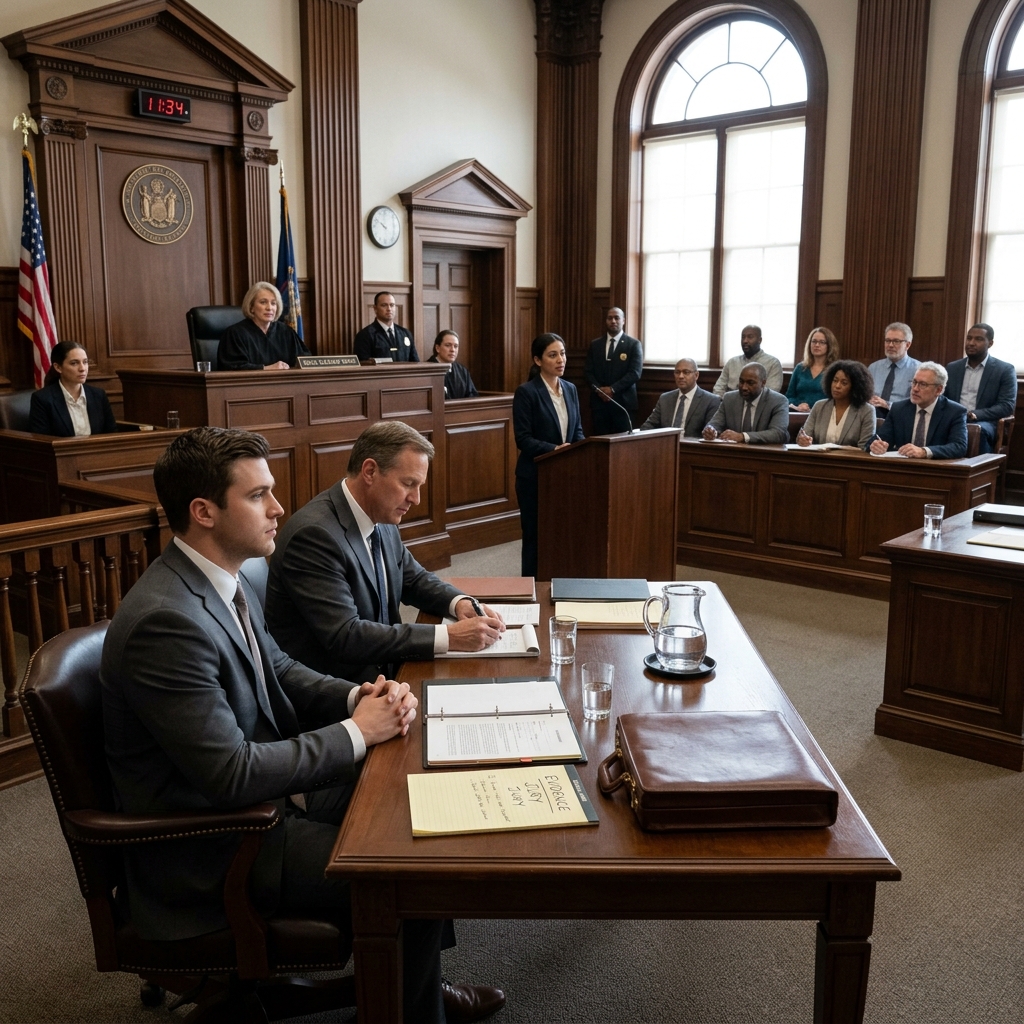
A criminal jury trial is the process where a group of citizens listens to evidence and decides whether the government has proven a criminal charge beyond a reasonable doubt. In most systems the jury finds the facts, while the judge applies the law, manages the courtroom, and imposes any sentence after a conviction.
This guide explains how criminal jury trials work, what your rights are, and what you can expect at each stage, from the decision to have a jury through the verdict and possible appeal.
1. What Is a Criminal Jury Trial?
In a criminal jury trial, the government (the prosecution) presents evidence to a panel of citizens called the jury, who decide if you are guilty or not guilty of the crime charged. The judge presides over the trial, rules on legal questions, and instructs the jury about the law.
A criminal jury trial is different from a bench trial, where the judge decides both the law and the facts without a jury. Jury trials are a key safeguard in many legal systems because they insert ordinary citizens into the criminal justice process.
Key Roles in the Courtroom
- Judge – controls the courtroom, decides legal issues, and explains the law to the jury.
- Jury – hears the evidence, evaluates the facts, and returns a verdict of guilty or not guilty.
- Prosecutor – represents the government, presents evidence, and must prove the case beyond a reasonable doubt.
- Defense attorney – represents the defendant, challenges the prosecution’s evidence, and presents defenses.
- Defendant – the person accused of a crime, presumed innocent unless and until proven guilty.
- Clerk and bailiff – handle records, swearing in jurors and witnesses, and general courtroom security.
2. Your Right to a Jury Trial
In many jurisdictions, people charged with serious criminal offenses have a constitutional or statutory right to a jury trial. For the most severe crimes, such as serious felonies, a jury trial may even be mandatory unless specific conditions are met.
When Jury Trials Are Available
The exact rules vary by jurisdiction, but commonly:
- Felony charges typically carry a right to a jury trial, often with 12 jurors.
- Misdemeanor charges may have a right to a smaller jury, such as 6 jurors, depending on the potential punishment.
- Minor or petty offenses may allow a jury trial only if the defendant takes extra steps, like filing a written request and paying a nominal fee.
Waiving the Right to a Jury
In some cases, a defendant can waive (give up) the right to a jury and choose a bench trial instead, where the judge decides the facts. For certain very serious charges, however, the law may not allow this, or it may require the consent of the prosecution or the court.
Whether to choose a jury trial or bench trial is a strategic decision that should be discussed with your attorney, considering the complexity of the evidence, the legal issues involved, and how a jury is likely to react to the case.
3. Step-by-Step Walkthrough of a Criminal Jury Trial
While details can differ by state or country, criminal jury trials in many places follow a similar sequence. The table below outlines the most common stages.
| Stage | What Happens | Who Leads |
|---|---|---|
| 1. Jury selection | Prospective jurors are questioned and either chosen or excused. | Judge and both lawyers |
| 2. Opening statements | Each side outlines what it expects the evidence will show. | Prosecutor, then defense |
| 3. Prosecution case | Government calls witnesses and presents evidence first. | Prosecutor |
| 4. Defense case | Defense may present its own witnesses and evidence, or may rest. | Defense attorney |
| 5. Rebuttal evidence | Limited additional evidence to address points raised by the other side. | Either side, with judge’s permission |
| 6. Closing arguments | Each side reviews the evidence and argues for its interpretation. | Both lawyers |
| 7. Jury instructions | Judge explains the law and the standards the jury must apply. | Judge |
| 8. Jury deliberations | Jurors discuss the case privately and attempt to reach a verdict. | Jury |
| 9. Verdict | Jury announces its decision in open court. | Jury and judge |
4. Jury Selection: Finding an Impartial Panel
A fair jury is essential to a fair trial. The process of choosing jurors is called jury selection or voir dire.
How Jurors Are Questioned
Prospective jurors are brought into the courtroom and sworn to truthfully answer questions about their ability to serve. The judge and attorneys ask about background, experiences, and attitudes to see whether each person can be impartial.
Attorneys may ask the court to remove a juror for cause if there is a clear reason the juror cannot be fair, such as a personal relationship with a party or strong bias. In addition, each side has a limited number of peremptory challenges, which allow them to excuse jurors without giving a reason, within certain legal limits.
Typical Jury Size and Unanimity
- Serious criminal cases often use 12 jurors, and the verdict must be unanimous.
- Less serious cases may use smaller juries, such as 6 jurors, depending on local law.
The judge will explain the exact rules for your case at the start of trial.
5. Presenting the Evidence
After the jury is sworn in, the trial turns to the evidence. The prosecution goes first because it carries the burden of proof—the legal duty to prove guilt beyond a reasonable doubt.
Opening Statements
Each side may give an opening statement to outline the case and explain what the evidence will show. This is not argument; it is an overview to help jurors follow the evidence.
Typically:
- The prosecutor speaks first, previewing the evidence that will be presented to prove each element of the crime.
- The defense may speak next, either immediately or after the prosecution rests, depending on local practice.
Witnesses and Exhibits
The prosecution presents its case by calling witnesses, such as police officers, experts, and other people with relevant knowledge. Physical or documentary evidence—like photos, documents, recordings, or objects—may also be introduced.
For each witness:
- The side calling the witness asks questions on direct examination.
- The other side may then question the witness through cross-examination, testing credibility and challenging the testimony.
- The judge decides which evidence and questions are allowed, based on the rules of evidence.
After the prosecution rests, the defense may choose to present evidence or may argue that the prosecution has not met its burden and rest without calling witnesses. The defendant has the right to remain silent and cannot be forced to testify.
Closing Arguments
After both sides have finished presenting evidence, each side gives closing arguments. Here, attorneys:
- Review the evidence in detail.
- Explain how the law applies to the facts.
- Ask the jury to reach a particular verdict.
The prosecution usually speaks first and last, with the defense in between, but specific procedures can vary.
6. Jury Instructions, Deliberations, and Verdict
Jury Instructions
Before deliberations, the judge reads jury instructions that define the crimes charged, explain legal terms, and set out the burden of proof and any defenses raised. The instructions may be provided in writing for the jury to take into the jury room.
Key legal principles often covered include:
- The presumption of innocence.
- The meaning of proof beyond a reasonable doubt.
- The elements of each offense that the prosecution must prove.
- Any applicable defenses or lesser included offenses.
Jury Deliberations
After instructions, the jury retires to a private room to deliberate. Jurors choose a presiding juror to lead discussions and manage votes. They review the evidence, consider the instructions, and attempt to reach a unanimous verdict in criminal cases.
During deliberations:
- Jurors may ask the judge written questions through the bailiff if they need clarification.
- They may request to see certain exhibits again or have testimony read back, if the judge allows.
- They must not do independent research or discuss the case with anyone outside the jury.
The Verdict
Once jurors have agreed, the presiding juror signs the verdict form and notifies the court through the bailiff. Everyone returns to the courtroom, and the judge or clerk reads the verdict aloud, often with the defendant standing.
Outcomes may include:
- Not guilty – the defendant is acquitted and generally cannot be tried again for the same offense (double jeopardy).
- Guilty – the defendant is convicted, and sentencing will follow, either immediately or at a later hearing.
- Hung jury – if the jury cannot reach the required unanimous decision after a reasonable time, the judge may declare a mistrial. The case may then be retried with a new jury.
7. After the Verdict: Sentencing and Appeals
Sentencing
If the jury returns a guilty verdict, the judge determines the sentence within the limits set by law. For minor cases, sentencing may occur immediately. For more serious charges, a separate sentencing hearing is often scheduled so the judge can consider additional information.
Factors that may influence sentencing include:
- The severity of the offense.
- The defendant’s prior record, if any.
- Victim impact statements.
- Sentencing guidelines or statutory minimums and maximums.
Appeals
Defendants who believe legal errors affected the fairness of their trial may have the right to appeal to a higher court. An appeal challenges decisions made by the trial judge, not the jury’s view of the facts.
Common grounds for appeal include:
- Improper admission or exclusion of evidence.
- Incorrect jury instructions.
- Insufficient evidence to support the verdict.
If the appellate court finds serious errors, it may order a new trial or, in rare cases, reverse the conviction.
8. Practical Tips for Defendants Facing a Jury Trial
If you are heading toward a criminal jury trial, understanding how the process works can reduce uncertainty and help you assist in your own defense. Here are practical points to keep in mind.
Work Closely With Your Lawyer
- Discuss the pros and cons of a jury trial vs. a bench trial in your jurisdiction.
- Help identify potential witnesses and evidence that support your version of events.
- Be honest about your background and prior history so your attorney can prepare.
Respect Courtroom Rules
- Arrive on time and dress neatly; jurors and judges notice professionalism.
- Follow instructions from the judge and court staff.
- Do not attempt to talk to jurors or anyone about the case outside of your attorney.
Understand the Burden of Proof
The prosecution must prove guilt beyond a reasonable doubt, which is a very high standard. You are not required to prove your innocence, call witnesses, or testify, although your attorney may advise you to present evidence if it will help your case.
9. Frequently Asked Questions About Criminal Jury Trials
Do all criminal cases go to a jury trial?
No. Many cases resolve through plea agreements before trial. Others may be tried before a judge alone if the defendant knowingly waives the right to a jury and the law allows it.
Can a jury’s verdict be anything other than guilty or not guilty?
In criminal cases, the verdict is usually guilty or not guilty. However, juries may sometimes consider lesser included offenses, which are less serious crimes that contain some of the same elements as the charged offense, if the judge instructs them on those options.
What happens if one juror refuses to agree with the others?
In systems that require a unanimous verdict, a single holdout can prevent a decision. If the jury cannot reach unanimity after sufficient deliberation, the judge may declare a hung jury and a mistrial, and the prosecution must decide whether to retry the case.
Can jurors do their own research about the case?
No. Jurors must base their decision only on evidence presented in court and the law as explained by the judge. Independent research, including online searches or visiting locations, is prohibited and can cause a mistrial.
Is the number of jurors always twelve?
Not always. While 12-person juries are traditional for serious criminal cases in many jurisdictions, smaller juries may be used for less serious offenses, such as six-person juries in some misdemeanor cases.
References
- Jury Trial in Colorado Criminal Cases — Colorado Lawyer Team. 2023-01-01. https://cldg.legal/process/jury-trial/
- About the Trial Process – Jury Service — Judicial Council of California. 2023-06-01. https://courts.ca.gov/courts/jury-service/about-trial-process
- The Eight Stages of Trial — U.S. District Court, Southern District of New York. 2022-05-01. https://wp.nysd.uscourts.gov/jurors/the-eight-stages-of-trial
- A 10 Step Guide to a Criminal Jury Trial — Kalamaya | Goscha. 2022-08-01. https://kalamaya.law/a-10-step-guide-to-a-criminal-jury-trial/
- Jury Trial — Legal Information Institute, Cornell Law School. 2021-09-01. https://www.law.cornell.edu/wex/jury_trial
- Jury Trial — Encyclopedic Entry, referenced primary sources. 2020-01-01. https://en.wikipedia.org/wiki/Jury_trial
Similar Articles








Read full bio of medha deb




