
Burden of Proof in Criminal Cases Explained
Learn who must prove what in a criminal case and why the “beyond a reasonable doubt” standard protects the presumption of innocence.
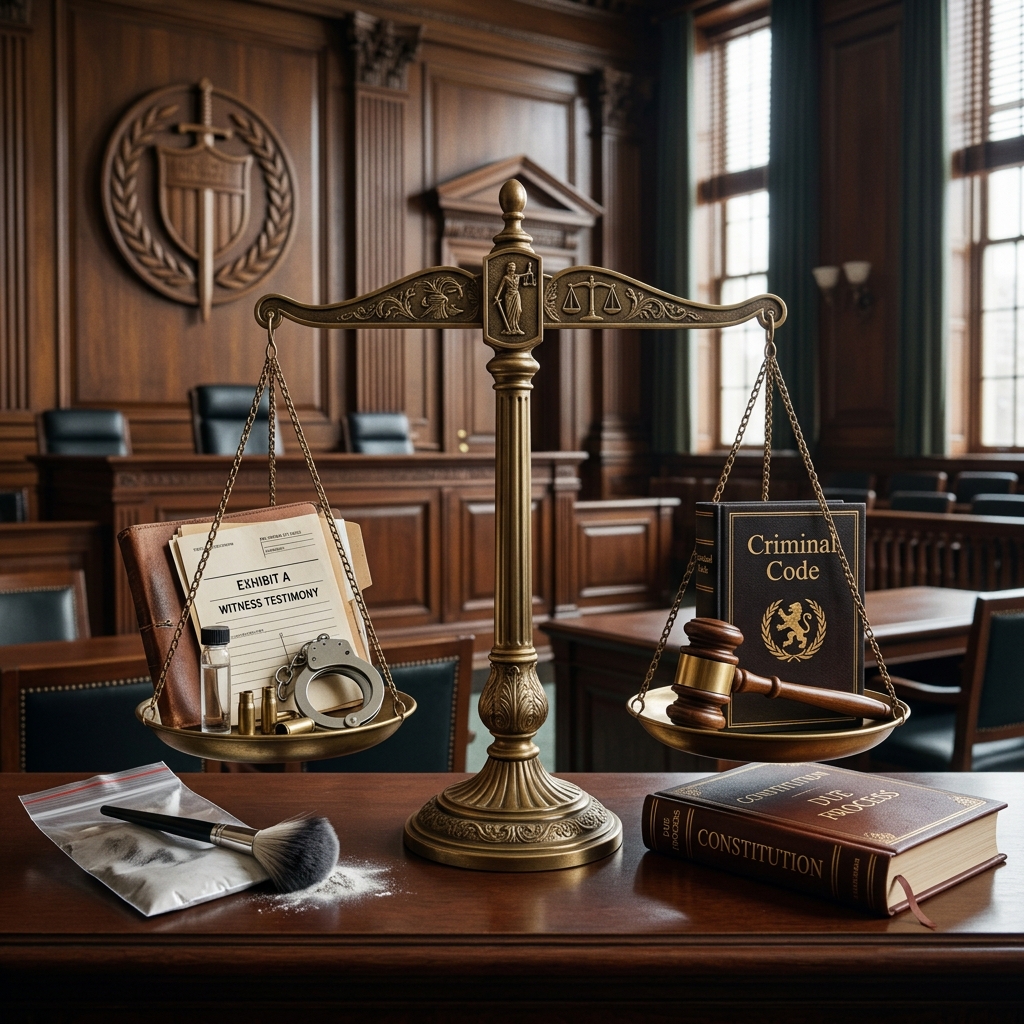
The burden of proof in a criminal case determines who has to prove a fact and how convincing that proof must be before the government can obtain a conviction. At its core, it is what stands between an accused person and wrongful punishment: the prosecution must establish guilt beyond a reasonable doubt, while the accused is presumed innocent from start to finish.
This article offers a practical, plain-language guide to how the burden of proof works in criminal cases, what the main standards of proof are, and why these concepts matter for anyone facing criminal charges or serving on a jury.
What “Burden of Proof” Means in Criminal Law
In legal terms, the burden of proof is the obligation placed on a party in a court case to bring evidence and persuade the judge or jury of a particular claim. In criminal law, that obligation falls primarily on the government, not on the accused.
Two distinct but related ideas are wrapped into the phrase “burden of proof”:
- Burdens of production and persuasion
- Levels or standards of proof
Understanding both helps explain why criminal trials are structured the way they are and why not-guilty verdicts can occur even when a defendant “seems” suspicious.
Burden of Production vs. Burden of Persuasion
Courts and legal scholars typically divide the burden of proof into two components: the burden of production and the burden of persuasion.
| Concept | What it Requires | Typical Role in Criminal Cases |
|---|---|---|
| Burden of production | Duty to offer enough evidence that a reasonable judge or jury could find a fact true. | Prosecution must present basic evidence of each element of the crime; if it fails, the judge can dismiss before the jury deliberates. |
| Burden of persuasion | Duty to convince the judge or jury to a specific legal standard (such as beyond a reasonable doubt). | Prosecution must persuade the jury the defendant is guilty under the relevant standard; if it cannot, the verdict must be not guilty. |
If either burden is not met by the prosecution at the appropriate stage, the defendant cannot be lawfully convicted.
Presumption of Innocence and Who Bears the Burden
A cornerstone of modern criminal justice is the principle that a person is presumed innocent unless and until the government proves guilt in court. This presumption directly shapes the allocation of the burden of proof.
Government’s Responsibility
In a criminal case brought in the United States, the prosecution (the government) carries the burden of proving the defendant’s guilt. This obligation covers every essential element of the offense charged and typically requires proof beyond a reasonable doubt.
In practical terms, this means:
- The state must present evidence for each element of the crime (for example, act, mental state, circumstances).
- The state must also disprove most defenses raised by the defense, with some exceptions for so‑called affirmative defenses, depending on the jurisdiction.
- If the state falls short, the defendant must be acquitted, even if the judge or jurors suspect involvement.
Defendant’s Position
Because of the presumption of innocence, the accused typically has no duty to prove innocence and may remain silent throughout the trial. The defendant may present evidence, cross‑examine witnesses, and argue that the government has not met its burden, but is not required to prove anything in most circumstances.
There are limited exceptions involving affirmative defenses, such as certain insanity defenses or statutory exceptions, where legislatures have placed a production or persuasion burden on the defendant. However, even in those situations, the prosecution still has to prove the core elements of the crime.
Standards of Proof: How Sure Must the Jury Be?
The second major part of the burden of proof concerns the degree of certainty required. Law does not treat all decisions alike; making someone pay money is different from sending someone to prison. As a result, different types of cases use different standards.
Common Legal Standards
Across the legal system, courts recognize several recurring standards of proof.
- Beyond a reasonable doubt – the highest standard, used for criminal guilt.
- Clear and convincing evidence – an intermediate standard used in some civil and quasi‑criminal matters.
- Preponderance of the evidence – the usual civil standard, meaning more likely than not.
| Standard | Rough Description | Typical Use |
|---|---|---|
| Beyond a reasonable doubt | Evidence leaves no reasonable uncertainty; other explanations are not reasonable based on the proof. | Criminal trials to prove guilt. |
| Clear and convincing evidence | Evidence shows a fact is highly and substantially more probable than not, creating a firm belief in its truth. | Some civil matters, such as fraud, and certain rights‑related proceedings. |
| Preponderance of the evidence | Evidence tips the balance slightly; more likely than not (51% likelihood). | Most civil lawsuits, such as contract and personal injury cases. |
Because criminal convictions may lead to loss of liberty or even life, criminal courts use the highest standard: proof beyond a reasonable doubt.
What “Beyond a Reasonable Doubt” Really Means
Although judges and juries routinely apply the phrase, “beyond a reasonable doubt” does not mean mathematical certainty or proof beyond all possible doubt. Instead, it sets a very high threshold to protect against wrongful convictions.
Key Features of the Standard
Courts and legal authorities describe the standard in ways that emphasize both its demanding nature and its practical limits:
- It is the highest evidentiary standard used in regular court proceedings.
- It requires that the evidence be so convincing that the only reasonable conclusion is that the defendant committed the crime.
- Jurors should reach a state of being firmly convinced of the defendant’s guilt based on the evidence presented.
- If a juror has a reasonable doubt—an honest, rational uncertainty based on the evidence or lack of evidence—they must vote not guilty.
Because doubt is reasonable only if grounded in the evidence, speculative or imaginary possibilities are not enough to prevent a conviction. The standard balances the reality that absolute certainty is rarely achievable with the need to protect individuals from unjust punishment.
Why the Standard Is So High
One often-cited rationale for this demanding standard is the widely held view that it is worse to convict an innocent person than to let a guilty person go free. Protecting against erroneous conviction is thus a central objective of criminal procedure. The burden of proof and the height of the standard work together to keep most close or uncertain cases from resulting in a criminal record or incarceration.
How Burdens Operate During a Criminal Trial
The burden of proof is not just a technical phrase for textbooks. It shapes every stage of a criminal trial, from the initial presentation of evidence through closing arguments and jury deliberations.
During the Prosecution’s Case
When the government presents its witnesses and exhibits, it is trying to satisfy both the burden of production and the burden of persuasion.
- The prosecution must introduce enough evidence on each element that the case can legitimately go to the jury.
- If the evidence is insufficient, the defense can move for a judgment of acquittal, asking the judge to rule that no reasonable jury could find guilt beyond a reasonable doubt.
- Throughout, the prosecution aims to show a clear narrative that connects the defendant to the charged offense under the governing law.
Defense Strategy and the Burden
Defense counsel uses the existence of the burden of proof as a central theme. Because the government must carry the load, the defense is free to focus on raising doubt, attacking the credibility of witnesses, pointing out gaps in the evidence, and offering alternative explanations.
Common defense strategies tied to the burden include:
- Highlighting inconsistencies in witness statements or physical evidence.
- Arguing reasonable alternative explanations for the facts (for example, someone else could have committed the crime).
- Emphasizing missing evidence that the government might have obtained but did not.
- Reminding jurors that the defendant does not have to prove innocence and that any reasonable doubt requires acquittal.
Jury Instructions and Deliberation
Before the jury begins deliberations, the judge provides formal instructions that define the charged offenses, explain the presumption of innocence, and describe the standard of proof. Jurors are typically told that:
- The defendant is presumed innocent.
- The prosecution bears the burden of proving every element beyond a reasonable doubt.
- The burden never shifts to the defendant to prove innocence.
Jurors then review the evidence in light of these instructions. If the prosecution’s evidence persuades them beyond a reasonable doubt, they may return a guilty verdict; if any reasonable doubt remains, they must return a not guilty verdict.
Criminal vs. Civil Burdens of Proof
People are often surprised to learn that a person acquitted in criminal court can still be sued in civil court over the same events. This is largely because the burden and standard of proof differ between criminal and civil cases.
| Feature | Criminal Case | Civil Case |
|---|---|---|
| Who brings the case? | Government (prosecutor) | Private party (plaintiff) |
| Primary goal | Punish wrongdoing and protect the public | Compensate for harm or enforce rights |
| Standard of proof | Beyond a reasonable doubt | Preponderance of the evidence in most cases |
| Potential consequences | Incarceration, fines, probation, collateral consequences | Money damages, injunctions, declaratory relief |
Because the civil standard is lower, someone might be found not guilty in a criminal trial but still held liable for damages in a civil lawsuit based on the same conduct. The cases are not inconsistent; they simply apply different standards to answer different questions.
Why the Burden of Proof Matters to Defendants
For a person accused of a crime, the allocation and level of the burden of proof are more than abstract principles—they can determine the outcome of the case and shape defense decisions from the very beginning.
Protection Against Wrongful Conviction
The requirement that the government prove guilt beyond a reasonable doubt significantly reduces the risk of innocent people being convicted. Although no system is perfect, the high standard forces prosecutors to build strong cases and courts to scrutinize the sufficiency of evidence.
Impact on Plea Decisions
Most criminal cases resolve before trial, often through plea agreements. Understanding the burden of proof can help defendants, with the advice of counsel, assess how strong the government’s case is likely to look at trial and whether the prosecution can realistically meet its heavy burden.
Guidance for Exercising Rights
Knowledge of the burden of proof reinforces a defendant’s right to remain silent and to demand that the state prove its case. It also underscores the importance of legal representation capable of challenging the prosecution’s evidence and reminding the court and jurors of the presumption of innocence.
Frequently Asked Questions About Burden of Proof in Criminal Cases
Does a defendant ever have to prove anything in a criminal case?
In many situations, the defendant has no obligation to prove any fact and may rely entirely on the prosecution’s failure to meet its burden. However, certain affirmative defenses (such as specific statutory defenses or some insanity claims) may place a limited burden on the defendant, either to produce evidence supporting the defense or, in some systems, to prove the defense to a particular standard. Even then, the prosecution still must prove the basic elements of the crime beyond a reasonable doubt.
Can the burden of proof shift to the defendant?
The core burden of proving guilt never shifts away from the prosecution in a criminal case. What may shift are some limited evidentiary obligations regarding particular defenses or exceptions, especially when a statute explicitly assigns that responsibility to the defendant. But the government always retains the ultimate duty to prove criminal liability.
What is the difference between a reasonable doubt and any doubt?
A reasonable doubt is an honest, rational uncertainty about guilt based on the evidence or lack of evidence. It is not a speculative or imaginary doubt; the law does not require jurors to be 100% certain in a mathematical sense, only that they be firmly convinced and free from reasonable uncertainty before convicting.
Why is the standard lower in civil cases?
Civil cases usually involve monetary liability or private rights, not loss of liberty or a criminal record. Because the consequences are generally less severe, the law allows a lower standard of proof—typically a preponderance of the evidence, meaning more likely than not—so that injured parties can obtain relief without having to meet the demanding criminal standard.
What happens if the prosecution’s evidence is strong but not overwhelming?
Even if the prosecution’s case appears strong, the jury must acquit if any juror retains a reasonable doubt about guilt after considering all the evidence and the judge’s instructions. Strength of suspicion is not enough; the law demands proof that satisfies the beyond‑a‑reasonable‑doubt standard.
References
- Burden of proof — Legal Information Institute, Cornell Law School. 2021-04-19. https://www.law.cornell.edu/wex/burden_of_proof
- Evidentiary Standards and Burdens of Proof in Legal Proceedings — Justia. 2020-06-01. https://www.justia.com/trials-litigation/lawsuits-and-the-court-process/evidentiary-standards-and-burdens-of-proof/
- Burden of Proof Explained: What You Must Prove in Court — Ben Crump Law. 2022-08-15. https://bencrump.com/burden-of-proof-legal-standard/
- Burden of Proof in Criminal Trials — LawInfo. 2019-03-10. https://www.lawinfo.com/videos/criminal-defense/burden-of-proof-in-a-criminal-trials.html
- Burden of proof (law) — Duke Law / various sources via Wikipedia references. 2018-01-01. https://scholarship.law.duke.edu/cgi/viewcontent.cgi?article=4249&context=dlj
Similar Articles








Read full bio of medha deb




