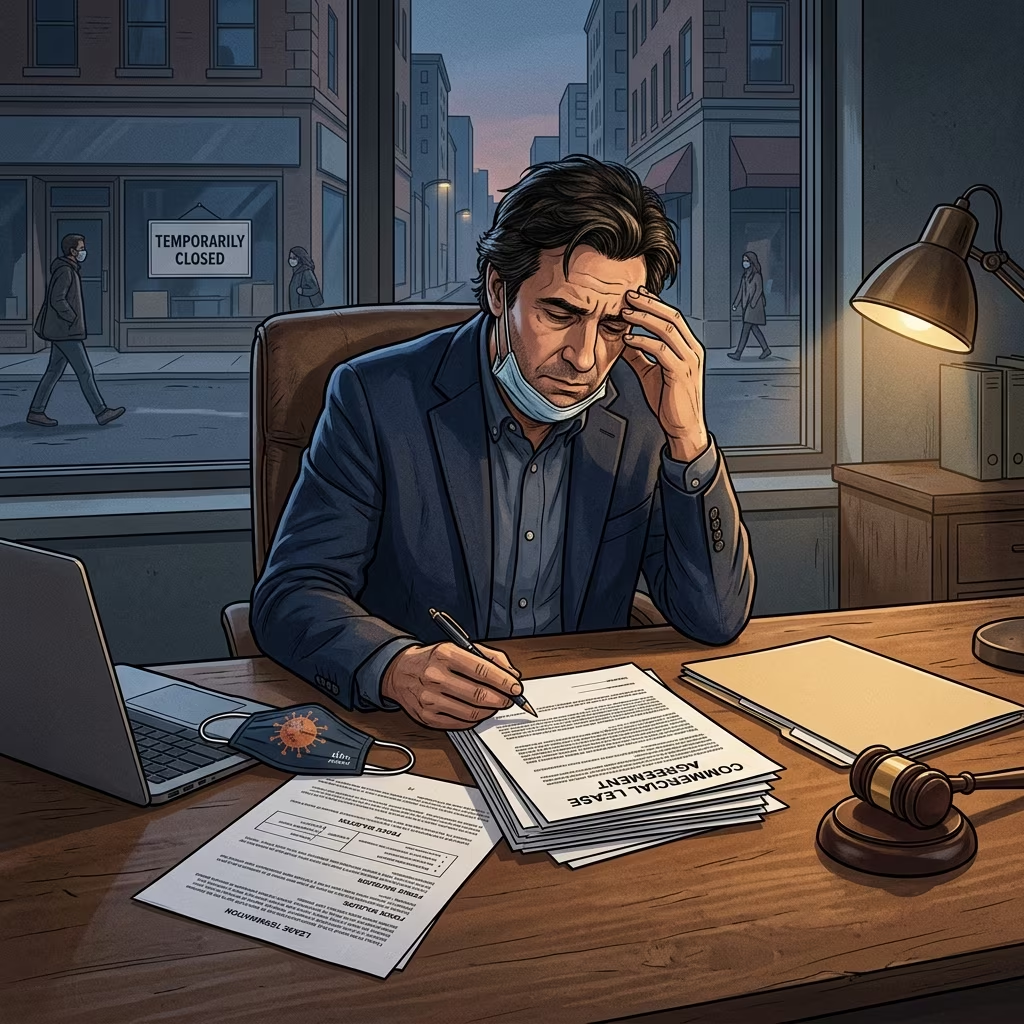
What changed for commercial tenants during COVID-19?
The pandemic reshaped how many businesses used office and retail space. Companies that once needed a full-time physical location suddenly relied on remote operations, reduced staffing, and shorter in-person hours. For some tenants, that shift made an existing lease feel unnecessary or financially unsustainable.
Even when a business no longer needs the same square footage, a commercial lease does not automatically disappear. In most cases, the lease remains binding unless the contract allows an exit, the landlord agrees to a change, or a legal defense applies under the facts and local law.
That is why the first step is not to assume the lease can be abandoned. The better approach is to review the agreement carefully, identify available remedies, and then decide whether to negotiate, sublease, assign, or seek early termination.
Start with the lease itself
Commercial leases are heavily customized, and the details matter. Two businesses with similar rent amounts may have very different rights if one lease contains an early termination clause, a force majeure provision, or a subletting right while the other does not.
Before taking action, look for the following provisions:
- Termination rights that allow one or both sides to end the lease early under specific conditions.
- Force majeure language that addresses extraordinary events such as government shutdowns or disasters.
- Use restrictions that limit how the space may be occupied or operated.
- Assignment and sublease clauses that explain whether the tenant may transfer the lease or rent part of the premises to someone else.
- Default and cure provisions that describe what happens if rent is missed or another obligation is breached.
- Renewal and holdover terms that affect what happens if the tenant stays after the lease ends.
If the lease is unclear, the contract language may still be interpreted under ordinary state contract law. But ambiguity creates risk, so tenants are usually better off documenting any agreement with the landlord in writing rather than relying on assumptions or informal conversations.
How remote work affects lease decisions
Remote work changed the economic value of many commercial spaces. A lease that once supported a full office team may no longer make sense if employees are hybrid or fully remote. Some businesses realized they were paying for desks, conference rooms, and storage areas they rarely used.
That does not mean a lease becomes unenforceable simply because the space is underused. Courts generally do not treat a tenant’s change in business model as automatic permission to walk away. Instead, remote work is usually a business reason to renegotiate or restructure the lease, not a legal excuse by itself.
Common responses included downsizing, removing unused services, shortening occupancy periods, or converting to a smaller footprint. In many cases, those solutions worked better than a disputed lease exit because they reduced cost without creating a default record.
When relocation makes early termination more attractive
Relocation often creates the strongest practical reason to end a lease. A company may move to another city, open a lower-cost office, or relocate closer to customers and employees. If the new site is in place, the old lease can become an expensive duplicate obligation.
Relocation, however, does not erase the existing contract. Unless the lease has a relocation clause or the landlord agrees to release the tenant, the business may still owe rent for the remainder of the term. That means a tenant should treat relocation as a negotiation issue, a transfer issue, or a mitigation issue—not as a self-executing termination right.
In practice, tenants often have three paths: ask for a negotiated buyout, find a replacement tenant through assignment or sublease, or continue paying while trying to reduce losses elsewhere. The best option depends on the lease language, the local market, and how much time remains on the term.
Negotiating with the landlord
Many commercial landlords were willing to discuss lease changes during the pandemic, especially when a tenant was facing real hardship and the alternative was vacancy or litigation. Negotiation is often faster and less costly than a formal dispute.
Possible requests include:
- A temporary rent reduction.
- A payment plan for arrears.
- An early termination in exchange for a fee.
- A shorter lease term with revised rent.
- Permission to sublease part of the space.
- A move to a smaller suite within the same property.
Landlords usually respond more favorably when the tenant presents a clear business case and specific numbers. A vague request to “get out of the lease” is less persuasive than a proposal that shows occupancy data, projected savings, and a realistic transition date.
Any agreement should be put in writing and signed by both sides. Written amendments prevent later disputes over whether the landlord agreed to waive rent, forgive a balance, or release guarantors.
Can a tenant sublease or assign the lease?
For many businesses, subleasing or assignment is the most practical way to reduce lease pressure without walking away. A sublease allows another occupant to use the space while the original tenant remains responsible to the landlord. An assignment transfers the tenant’s lease interest to another party, subject to the lease terms and landlord consent where required.
These options are not identical, and the lease may treat them differently. Some contracts require the landlord’s approval before either arrangement. Others allow transfer only if the landlord acts reasonably or if the new occupant meets specified financial standards.
The tenant should also confirm whether the original business remains liable if the replacement occupant defaults. In many sublease arrangements, the original tenant stays on the hook for rent and other obligations even after giving someone else possession.
Possible legal defenses if payment became impossible
Some tenants looked to legal defenses after COVID-19 restrictions reduced or shut down operations. These arguments can be useful, but they are usually limited and fact-specific.
Two commonly discussed defenses are impossibility and frustration of purpose. Impossibility applies when an unforeseen event makes performance objectively impossible. Frustration of purpose applies when the basic reason for the contract has been destroyed, even if performance is still physically possible.
Those doctrines are typically applied narrowly. A business that can still use some of the premises, or that continues operating in a reduced way, may have difficulty proving that the lease became unenforceable. A complete shutdown ordered by government authority may strengthen the argument, but local law and the exact lease language remain critical.
Force majeure clauses may also matter if they expressly cover pandemics, government orders, or closures. Even then, these clauses often excuse performance only for the event specifically listed, and they may not eliminate rent obligations unless the wording is unusually broad.
What to do when rent cannot be paid
If the business cannot pay rent, ignoring the problem is usually the worst option. Lease default can trigger late charges, interest, attorney’s fees, and a claim for future rent depending on state law and the lease terms.
A more strategic response includes:
- Reviewing the lease for default and notice requirements.
- Checking whether a cure period applies before the landlord can act.
- Calculating the exact amount owed, including additional rent or operating expenses.
- Contacting the landlord early to propose a written resolution.
- Documenting any government shutdown orders, occupancy limits, or revenue losses that affected performance.
Open communication can sometimes prevent escalation. A landlord may prefer a temporary concession or structured exit over the cost and uncertainty of a vacancy, especially if the market is weak or the tenant space is specialized.
Comparing common exit strategies
| Option | How it works | Main tradeoff |
|---|---|---|
| Negotiated termination | Landlord agrees to end the lease early, often for a fee or settlement | Upfront cost, but clean exit |
| Sublease | Another business uses the space while the original tenant stays liable | Tenant may still owe rent if subtenant fails |
| Assignment | Lease rights are transferred to another tenant, sometimes with consent | Landlord approval may be required |
| Lease modification | Terms are rewritten to reduce space, rent, or duration | Requires agreement, but can preserve continuity |
| Legal defense | Tenant argues performance was excused by law or contract language | Uncertain outcome and possible litigation |
How to protect the business before signing anything new
Businesses leaving one location often rush into another lease too quickly. That can create a second problem if the new premises are larger or more expensive than needed. A careful review before signing can prevent repeating the same cycle.
Practical safeguards include limiting the term, preserving flexibility to expand or shrink, clarifying repair duties, and confirming whether remote or hybrid operations justify a smaller footprint. If a company expects future uncertainty, flexibility is often more valuable than a longer lease with slightly lower monthly rent.
It is also wise to track whether the lease ties rent to operating hours, amenities, parking, utilities, or other services that may not be necessary under a remote-first model. Eliminating unneeded extras can make a lease more manageable without requiring a full exit.
Frequently asked questions
Can I just stop paying if my office is mostly empty?
No. Under a commercial lease, low use of the space usually does not cancel rent obligations. The lease remains enforceable unless the contract, the landlord, or the law provides relief.
Does remote work count as a legal reason to break the lease?
Usually not by itself. Remote work is commonly a business decision that may support negotiation, but it is not automatically a legal defense to rent.
Is relocation enough to end the lease early?
Not unless the lease allows it or the landlord agrees. Relocation is often a practical reason to seek termination, sublease, or assignment, but the original agreement still controls.
What if the lease has a force majeure clause?
Read it closely. Some clauses mention pandemics or government shutdowns, but many do not excuse rent unless the language clearly says so.
Should any agreement with the landlord be written down?
Yes. A written amendment or settlement reduces the risk of disputes over rent relief, exit terms, or future liability.
Final practical approach
The best strategy depends on the business’s goals, the lease language, and the local legal environment. Some tenants need a complete exit. Others only need a smaller space, temporary relief, or a path to transfer the lease. The key is to act early, gather the lease documents, and choose the option that minimizes both cost and legal exposure.
For many businesses, the safest route is a negotiated solution backed by written terms. That approach may not eliminate every obligation, but it often produces a more predictable result than a unilateral decision to leave the premises.
References
- COVID-19 & Commercial Leases – Considerations for Landlords and Tenants — Tetlow Legal. 2020-04-16. https://tetlowlegal.com.au/covid-19-commercial-leases/
- Navigating Your Commercial Lease during COVID-19 and Beyond — Rachel Luna Law. 2020-04-08. https://rachellunalaw.com/blog/commercial-lease
- Commercial Leases and COVID-19 — The Legal Aid Society. 2020-04-09. https://legalaidnyc.org/wp-content/uploads/2020/04/Commercial-Leases-and-Covid-19-4.9.2020.pdf
- Temporary Moratorium on Commercial Evictions Regulations — City and County of San Francisco. 2021-12-09. https://media.api.sf.gov/documents/Guidance20Temporary20Moratorium20on20Commercial20Evictions20v12.09.21.pdf