Workplace Bag Checks and Employee Privacy Rights
Understand when your employer may inspect bags or personal items at work, how privacy laws apply, and what practical rights you have.
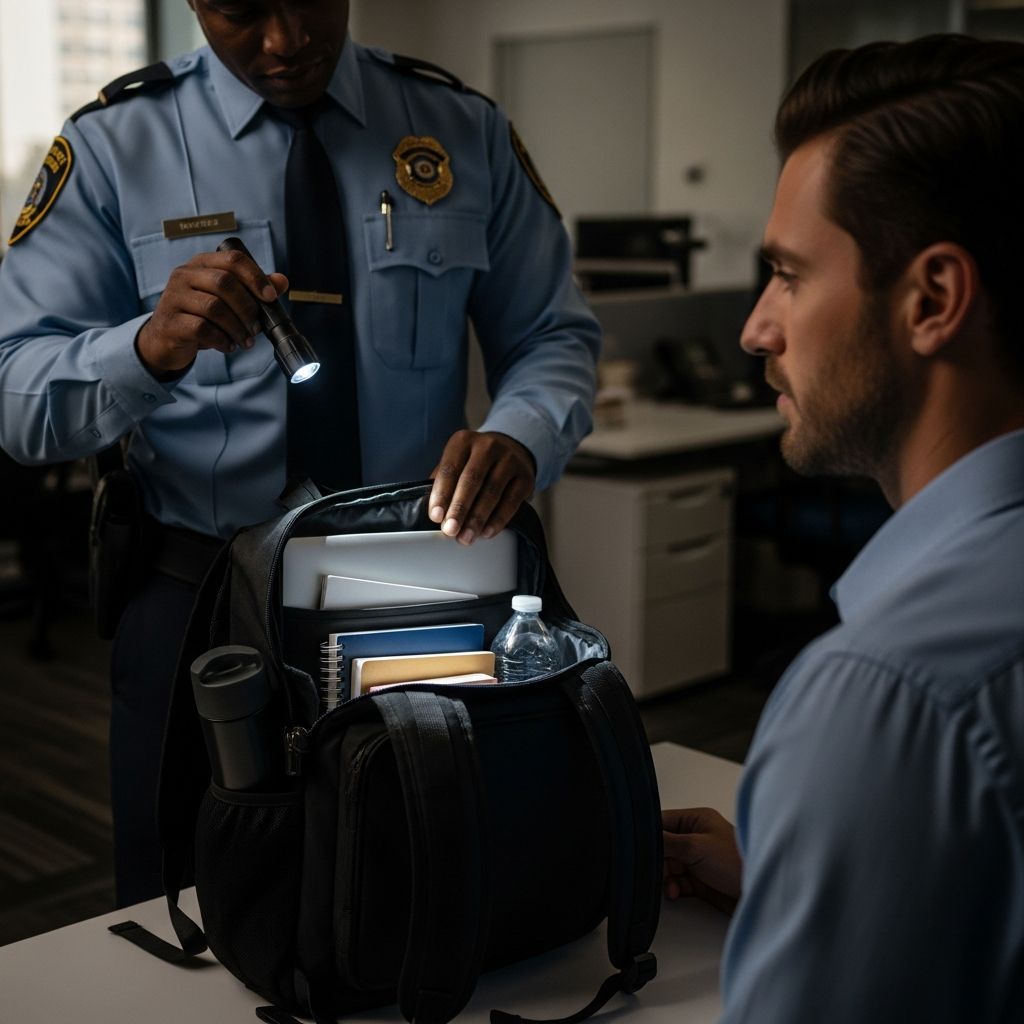
Many workers are surprised to learn that their employer might be allowed to look inside a purse, backpack, or lunch bag when they enter or leave the workplace. This raises uncomfortable questions about privacy, dignity, and what the law really allows. Understanding how workplace searches work can help you recognize your rights, evaluate employer policies, and respond calmly if you are ever asked to open your bag.
Why Employers Conduct Bag Inspections
Employers rarely search employees’ bags out of curiosity alone. Instead, bag checks are typically tied to business and safety concerns, such as:
- Theft prevention – to reduce loss of inventory, equipment, or confidential documents.
- Workplace safety – to detect weapons, explosives, or other dangerous objects.
- Drug and alcohol control – in safety-sensitive industries or where substance abuse creates significant risk.
- Compliance obligations – in regulated fields like healthcare, laboratories, or defense, where employers must safeguard certain materials or data.
At the same time, employees do not completely surrender their privacy rights when they step into the workplace. Courts often balance the employer’s legitimate need to search against the employee’s reasonable expectation of privacy.
Public vs. Private Employers: Different Legal Frameworks
The first major distinction is whether your employer is part of the government or a private company. The rules are not identical.
| Type of Employer | Main Legal Framework | Key Protection for Employees |
|---|---|---|
| Public (federal, state, local government) | U.S. Constitution’s Fourth Amendment limits unreasonable searches and seizures by government actors. | Searches generally must be reasonable; courts weigh the employee’s privacy expectation against the government’s work-related need. |
| Private (most businesses and nonprofits) | State constitutions, privacy statutes, common-law privacy torts, and contract policies. | Employers have broader leeway but still risk liability for highly intrusive, unjustified, or discriminatory searches. |
Public Employees and Constitutional Limits
Because public employers are part of the government, their searches are subject to constitutional scrutiny. Courts typically ask:
- Did the employee have a reasonable expectation of privacy in the item searched (for example, a purse or closed briefcase)?
- Was the search justified at its start (for instance, based on a concrete suspicion of misconduct or a clear workplace policy)?
- Was the scope of the search reasonably related to the purpose and not excessively intrusive?
Public employees often have heightened privacy expectations in personal containers they bring from home, even on government property. Courts may be more skeptical of random, suspicionless searches that are not tied to specific safety or security programs.
Private Employees and Contract-Based Expectations
Private employers are not directly bound by the Fourth Amendment, but they can still face claims under state privacy laws or common-law invasion of privacy. Key factors include:
- Whether the employer gave clear prior notice that belongings may be searched.
- Whether the search was conducted for a legitimate business reason rather than curiosity or retaliation.
- How intrusive the search was and whether less invasive options were available.
When employers adopt written policies and communicate them in advance, courts are more likely to conclude that employees had a limited expectation of privacy in the workplace and its contents.
Reasonable Expectation of Privacy: What It Means at Work
Most legal disputes over workplace searches turn on the concept of a reasonable expectation of privacy. This is a legal standard that asks two basic questions:
- Did the employee personally expect the area or item to be private?
- Would society generally recognize that expectation as reasonable in that setting?
At work, privacy expectations are often lower than at home, but they are not zero. Courts look closely at context.
Privacy Expectations in Different Locations
- Personal bags and purses: Employees usually have a relatively strong privacy interest in closed personal containers, such as purses, backpacks, and briefcases, particularly if there is no policy stating they are subject to search.
- Lockers and desks: If the employer provides a lock or keeps a master key and has a policy reserving the right to inspect, the employee’s privacy interest is reduced. If employees must purchase their own lock and are told only they control access, courts may find a higher expectation of privacy.
- Common areas and open workspaces: Cubicles, shared offices, and common storage areas usually carry lower privacy expectations because of frequent access by others.
- Body and clothing: Physically touching or searching an employee’s body, or requiring removal of clothing, is considered extremely intrusive and is rarely justified outside extraordinary safety or security contexts.
The Balancing Test Courts Often Use
When judges assess whether a workplace search was lawful, they typically weigh competing interests. Resources aimed at employees and employers describe a similar three-part analysis:
- Employee’s expectation of privacy – How private was the item or space? What did policies say? How common were inspections?
- Employer’s justification – Was there reasonable suspicion of theft, safety hazards, or serious misconduct, or was this part of a clearly defined security program?
- Intrusiveness and scope – Did the search go further than necessary, extend to highly personal areas, or cause unreasonable humiliation?
The stronger the employer’s reason and the more limited the search, the more likely it is to be considered reasonable. Conversely, broad fishing expeditions into personal bags with little justification are more vulnerable to legal challenge.
Role of Workplace Policies and Consent
Written policies are often the most important factor shaping workplace privacy expectations.
Typical Features of Bag Search Policies
Many employers adopt security or loss-prevention policies that:
- State that bags, briefcases, and packages brought onto company property may be inspected when entering or leaving the premises.
- Explain that employees have a limited expectation of privacy in items brought into the workplace.
- Describe when searches may occur (for example, random checks at exits, or targeted checks when there is suspected theft).
- Outline the method of searching, such as a visual inspection while the employee opens the bag themselves.
- Prohibit retaliation against workers who raise concerns or complain in good faith.
By signing an employee handbook acknowledgment or accepting continued employment, workers may be considered to have consented to these procedures, which significantly reduces the likelihood that a court will view a search as unexpected or unreasonable.
Limits to “Consent” in the Workplace
Even where policies exist, consent is not unlimited:
- Employees generally cannot be physically forced to submit to a search. Physical restraint or threats of confinement may give rise to claims such as false imprisonment.
- Coerced or discriminatory searches (for example, targeting only certain racial or ethnic groups) may support civil-rights or discrimination claims under state or federal law.
- A search that goes far beyond what policies describe may still be challenged as an invasion of privacy.
Examples of More and Less Risky Searches
The following table illustrates how similar actions may be evaluated differently depending on circumstances:
| Scenario | Privacy Expectation | Risk of Being Deemed Unreasonable |
|---|---|---|
| Visual bag check at exit under a clearly communicated security policy, applied to all employees. | Moderate; employees were warned bags may be inspected. | Relatively low if conducted respectfully and non-discriminatorily. |
| Supervisor secretly opens a purse in a private office with no prior policy, looking for gossip or personal information. | High; closed purse with no policy suggesting it may be searched. | High; could support an invasion-of-privacy claim in many states. |
| Security guard detains an employee, blocks the exit, and demands a bag search without explanation. | Varies, but detention and threats raise serious concerns. | Significant; could create liability for unlawful detention or coercive search, particularly if no clear policy exists. |
When Searches Become Potentially Illegal
Even when employers have legitimate reasons to inspect bags, there are clear lines they should not cross. Potentially unlawful or actionable searches may involve:
- Excessive intrusion, such as strip searches or invasive touching, except in unusual and highly regulated contexts.
- Searches without justification, especially where there is no policy and no reasonable basis to suspect wrongdoing.
- Discriminatory targeting of individuals based on race, gender, age, disability, or other protected characteristics.
- Joint actions with law enforcement that skirt constitutional protections, such as private security working closely with police to perform searches that would otherwise require legal process.
In some jurisdictions, employees may file civil lawsuits seeking compensation for emotional distress, reputational harm, and other damages arising from highly intrusive or abusive searches.
Pay for Time Spent in Security Screenings
Aside from privacy, bag-check procedures can also raise wage-and-hour questions. In certain states, courts have held that time employees spend waiting for or undergoing mandatory security screenings may be considered hours worked and must be compensated under state wage laws. Whether this applies to a particular workplace depends heavily on local law and how integral the screening is to the job.
Practical Tips for Employees
If your employer conducts or proposes to conduct bag searches, consider these practical steps:
- Review your handbook: Look for policies mentioning security, loss prevention, or inspections of personal property.
- Limit what you bring: Avoid bringing highly sensitive personal items, unnecessary valuables, or private documents to work when possible.
- Ask clarifying questions: If asked to open your bag, you can calmly ask who authorized the search and whether there is a written policy.
- Document your experience: If a search feels abusive or targeted, write down what happened, when, and who was involved.
- Seek legal advice: For serious or repeated invasions of privacy, consider consulting an employment attorney or a legal-aid organization familiar with your state’s law.
Practical Tips for Employers
Employers who choose to implement bag inspections can reduce legal risk and employee resentment by following best practices noted in legal and HR guidance:
- Adopt clear, written policies that explain why and how inspections occur.
- Provide advance notice to employees and visitors so they can decide whether to enter or remain on the premises.
- Apply procedures consistently across similarly situated employees to avoid claims of discrimination.
- Use the least intrusive method that meets safety or security needs, such as visual inspections rather than physical handling of items.
- Train supervisors and security personnel on respectful communication, anti-discrimination rules, and when to involve legal counsel.
Frequently Asked Questions (FAQs)
Can my employer search my bag without telling me in advance?
In many workplaces, especially in the private sector, an employer might legally search your bag even without a written policy if there is a strong, work-related justification and the search is not overly intrusive. However, lack of notice increases the risk that a court could later view the search as an unreasonable invasion of privacy, particularly for very personal containers.
Do I have to consent to a bag search to be allowed to leave?
Employers are strongly discouraged from physically blocking exits or detaining employees who decline a search, because such conduct can lead to claims like false imprisonment. In practice, refusing a search may have employment consequences, but physical coercion or confinement can create serious legal exposure for the employer.
Are public employees better protected than private employees?
Public employees benefit from constitutional protection against unreasonable searches by government employers, so courts analyze public workplace searches under the Fourth Amendment’s reasonableness standard. Private employees usually rely on state privacy laws and employer policies, which may offer less robust but still meaningful protection.
What should I do if I think a search violated my privacy rights?
Consider documenting the incident, reviewing any relevant workplace policies, and speaking with a trusted HR representative if you feel safe doing so. For more serious concerns—such as highly intrusive searches, discrimination, or involvement of security staff—you may wish to consult an employment lawyer or a workers’ rights organization to evaluate potential claims under your state’s laws.
Can my employer look through my phone during a bag search?
Searching personal electronic devices raises additional privacy concerns because of the large volume of sensitive data they contain. Many legal experts advise employers to avoid accessing personal phones or tablets unless there is a clear, pressing, and well-documented legal reason to do so, and even then only with careful adherence to applicable privacy and data-protection laws. Employees often have a stronger expectation of privacy in digital contents than in the physical items in a bag.
References
- Can our employer search our bags as we leave work? — Anthem Legal Assistance (Anthem Blue Cross). 2018-05-01. https://www.anthemeap.com/anthem-california/find-legal-support/resources/consumer-rights/legal-assist/can-our-employer-search-our-bags-as-we-leave-work
- When can a company search personal belongings of employees? — Vida HR. 2023-06-15. https://www.vidahr.com/post/hr-insights-when-can-a-company-search-personal-belongings-of-employees
- Employer Liability for Illegal Search and Seizure & Private Security — Horn Wright, LLP. 2022-11-10. https://www.hornwright.com/civil-rights-law/illegal-search-seizure/employer-liability-for-illegal-search-and-seizur/
- Can Employers Search Your Bag? — Paycor Resource Center. 2021-09-30. https://www.paycor.com/resource-center/articles/ask-hr-are-we-allowed-to-search-the-bags-of-employees-and-visitors/
- Workplace Searches — Workplace Fairness. 2020-03-01. https://www.workplacefairness.org/workplace-searches/
- Employer Searches and Seizures: What Are Your Rights? — Nolo. 2020-07-15. https://www.nolo.com/legal-encyclopedia/free-books/employee-rights-book/chapter5-5.html
- California Supreme Court: Employers Must Pay For Time Spent During Bag Searches — Lewis Brisbois Bisgaard & Smith LLP. 2020-02-24. https://lewisbrisbois.com/blog/category/labor-employment/california-supreme-court-employers-must-pay-for-time-spent-during-bag-searches
Similar Articles








Read full bio of medha deb