
Wisconsin Traffic Laws: Essential Rules Every Driver Needs Now
A practical guide to Wisconsin road rules, common violations, and driver responsibilities.
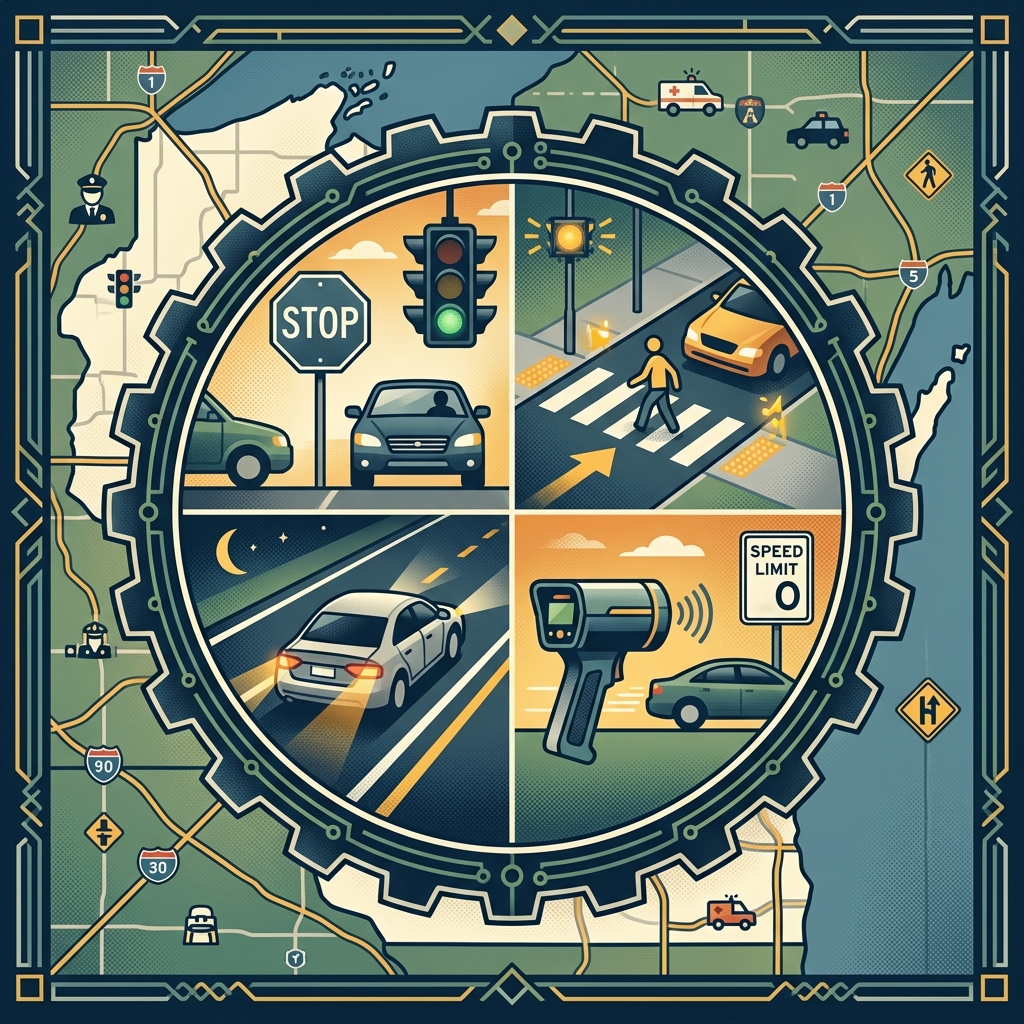
Driving in Wisconsin means more than following posted signs. State law sets out a broad set of duties that govern speed, lane changes, passing, parking, school zones, bus stops, and roadside safety. For drivers, the most important takeaway is that Wisconsin traffic law is built around the idea of reasonable caution: you must adapt to road conditions, watch for vulnerable road users, and avoid conduct that creates unnecessary risk.
This guide explains the major road rules that Wisconsin motorists are most likely to encounter. It is designed to help drivers understand everyday obligations in plain language, while also highlighting the kinds of mistakes that can lead to tickets, fines, points, or more serious consequences.
How Wisconsin’s road rules work
Wisconsin’s traffic laws are not limited to speed limits and stop signs. The state’s rules of the road also cover how drivers must behave near pedestrians, bicycles, emergency vehicles, school buses, intersections, and disabled vehicles on the shoulder. In practice, that means a driver may be obeying the speed limit and still violate the law by failing to yield, following too closely, or blocking traffic.
Several rules are intentionally broad. For example, drivers are expected to use ordinary care and to slow down when conditions make normal travel unsafe. That approach gives law enforcement and courts room to evaluate conduct based on the real situation, not just the number on a sign.
Speed is always tied to conditions
Wisconsin drivers must obey posted speed limits, but the basic rule is broader than the sign. A safe speed depends on the weather, visibility, traffic, road surface, and the driver’s ability to stop in time. A speed that is legal on a dry, open highway may be too fast for rain, snow, ice, fog, or heavy congestion.
That is why a driver can be cited for unsafe speed even when traveling below the posted limit. The law expects motorists to slow down whenever conditions reduce the margin for error. This is especially important during winter driving, when stopping distance can increase quickly on slick pavement.
Passing, lane use, and following distance
Passing another vehicle is allowed only when the roadway makes it safe to do so. Wisconsin law relies heavily on lane markings and traffic control devices to show when passing is permitted and when it is prohibited. Drivers should not cross solid lines or ignore posted no-passing zones.
Safe passing also requires a clear return path. A driver should not move back into the lane until there is enough room to avoid cutting off the overtaken vehicle. Tailgating and impatient lane changes are common causes of collisions, especially on two-lane roads and busy highways.
Following distance matters just as much as passing distance. Drivers need enough space to react if traffic slows, a pedestrian steps out, or another motorist brakes unexpectedly. On wet or slippery roads, that gap should be larger.
Intersections and right-of-way
Intersections are among the most dangerous places on the road, which is why Wisconsin law places special emphasis on right-of-way rules. Drivers should not enter an intersection unless there is room to clear it. Blocking cross traffic can create gridlock and can also expose the driver to a citation.
At stop signs and four-way stops, the order of arrival usually determines who proceeds first. If two vehicles arrive at the same time, the vehicle on the right generally has the advantage. When turning, drivers must also yield to pedestrians and any traffic that is already inside the intersection.
Turning on red is allowed only when it is lawful and safe. Even then, the driver must come to a complete stop and check for pedestrians, bicycles, and vehicles with the right-of-way before moving forward.
Pedestrians and bicyclists deserve extra caution
Wisconsin drivers must pay close attention to people on foot and on bicycles. Pedestrians may be present at marked crosswalks, unmarked crossings at intersections, parking lots, school areas, and neighborhood streets. A green light does not erase the duty to yield when a pedestrian is already in the crossing.
Bicyclists are also entitled to use many roadways and bike lanes. Motorists should leave enough room when passing and should avoid sudden turns or lane changes that force a cyclist to brake or swerve. A careful driver watches for bikes before opening a door, turning right, or merging into a shared lane.
School buses and children create special duties
Few traffic rules are enforced more strictly than those involving school buses. When a school bus is stopped with flashing red lights and an extended stop arm, drivers generally must stop and remain stopped. This rule is meant to protect children crossing the road, and it applies broadly rather than only on certain types of roads.
Drivers should also slow down in school zones and near playgrounds, parks, and other areas where children may enter the roadway unexpectedly. In these settings, stopping distance and attention matter more than convenience. A motorist who is distracted or rushing through a school area can create serious danger very quickly.
Wisconsin’s move-over rule protects roadside workers
When emergency responders, tow operators, maintenance crews, or disabled vehicles are stopped at the roadside, Wisconsin requires drivers to move over when possible. If changing lanes is not practical, the driver must slow down and pass with caution. The goal is to create a protective buffer around people and vehicles that are outside the normal flow of traffic.
This is one of the most important safety rules in the state because roadside workers are exposed to fast-moving traffic. Drivers who fail to adjust can face fines and greater penalties if their conduct causes harm. The safest response is simple: look ahead, reduce speed early, and give stopped vehicles as much space as the road allows.
Headlights, visibility, and low-light conditions
Wisconsin expects drivers to use headlights when visibility drops. Rain, snow, fog, smoke, and darkness all reduce a driver’s ability to see and be seen. Lights are not just for the driver’s benefit; they help other road users judge distance, speed, and lane position.
A good rule of thumb is that if weather or road spray makes it harder to see clearly, the driver should switch on the headlights sooner rather than later. In poor visibility, extra caution is also needed for turns, merging, and passing.
Cell phone use and distracted driving
Distracted driving laws are especially strict for young drivers. Wisconsin restricts handheld cellphone use by drivers under 18, with limited emergency exceptions. For all drivers, distraction remains a major safety issue even when a specific phone action is not the direct target of a citation.
Texting, scrolling, typing a destination, or looking down for too long can all cause a driver to miss traffic changes. Because road conditions change in seconds, distraction often matters just as much as speed. A driver who is mentally or visually disengaged may violate broader negligence or careless driving standards even without a phone-specific offense.
Parking rules are stricter than many drivers expect
Parking violations are common because many drivers underestimate how specific the rules can be. Wisconsin generally prohibits parking too close to fire hydrants, too near intersections, across from or too close to driveways, and in locations that block visibility or traffic flow. Parking is also restricted on bridges, overpasses, and other places where a stopped vehicle would create a hazard.
Drivers should also park in the direction of traffic and avoid blocking sidewalks, crosswalks, or fire lanes. A poorly parked vehicle can interfere with emergency access, force pedestrians into the street, and create avoidable conflicts with other motorists.
Common traffic offenses and what they can lead to
Many traffic offenses in Wisconsin are not criminal in the dramatic sense, but they can still carry real consequences. Speeding, failing to yield, disobeying signals, improper passing, and parking violations may result in citations, fines, and points on a driver’s record. Repeated violations can lead to higher insurance costs and, in serious cases, a suspended license.
The most serious conduct includes reckless or repeated disregard for traffic law, fleeing from an officer, and dangerous behavior that injures others. Even one event can have lasting effects if it triggers a suspension, a court appearance, or a civil claim after a crash.
Quick reference for everyday driving
| Situation | Driver expectation |
|---|---|
| Approaching a stopped emergency or service vehicle | Move over when possible or slow down and pass cautiously |
| Driving in rain, snow, or fog | Reduce speed and use headlights when visibility drops |
| Arriving at a stop sign or four-way stop | Yield based on arrival order and the right-of-way rules |
| Passing a school bus with lights flashing | Stop and wait until the bus is no longer actively loading or unloading |
| Driving near pedestrians or cyclists | Yield, leave space, and watch for unexpected movement |
Practical habits that reduce violations
Staying legal in Wisconsin often comes down to habits rather than memory. Drivers who scan ahead, slow down early, and check mirrors frequently are less likely to make split-second mistakes. It also helps to assume that conditions may be worse than they first appear, especially during winter, at night, or near construction zones.
- Keep speeds flexible instead of treating the posted limit as an automatic target.
- Look for pedestrians, bicycles, and children before turning or backing up.
- Give extra room to stopped vehicles on the shoulder.
- Use headlights whenever visibility starts to fade.
- Avoid multitasking so your attention stays on traffic changes.
Frequently asked questions
Can I be ticketed for driving under the speed limit?
Yes. If the conditions make your speed unsafe, a citation can be issued even when you are below the posted limit.
Do I always have to stop for a school bus?
In many cases, yes. When the bus has flashing red lights and the stop arm is out, drivers must stop unless a specific roadway exception applies.
What should I do if I cannot move over for a roadside vehicle?
Slow down substantially and proceed with caution. The point of the rule is to create as much space as the roadway allows.
Are pedestrians always entitled to cross first?
No, but drivers must yield whenever the pedestrian has the right-of-way, especially at crosswalks and intersections.
Can a parking violation affect my record?
Many parking tickets mainly involve fines, but repeated or serious violations can still create practical problems, especially if they lead to towing or other enforcement action.
References
- Wisconsin Legislature: Chapter 346 — Wisconsin Legislature. 2026-07-09. https://docs.legis.wisconsin.gov/statutes/statutes/346
- Wisconsin Statutes Chapter 346 Rules of the Road — Wisconsin Department of Transportation. 2026-07-09. https://wisconsindot.gov/Documents/safety/education/drv-behavior/346.pdf
- Wisconsin Motorists’ Handbook — Wisconsin Department of Transportation. 2026-07-09. https://wisconsindot.gov/documents/dmv/shared/bds126-motorists-handbook.pdf
- Traffic Laws Unique to Wisconsin — Buss Law, LLC. 2026-07-09. https://www.buss-law.com/buss-law-blog/traffic-laws-unique-to-wisconsin/
- Driving in Wisconsin: Driving Tips and Road Rules — SIXT. 2026-07-09. https://www.sixt.com/magazine/tips/driving-in-wisconsin/
Similar Articles








Read full bio of medha deb


