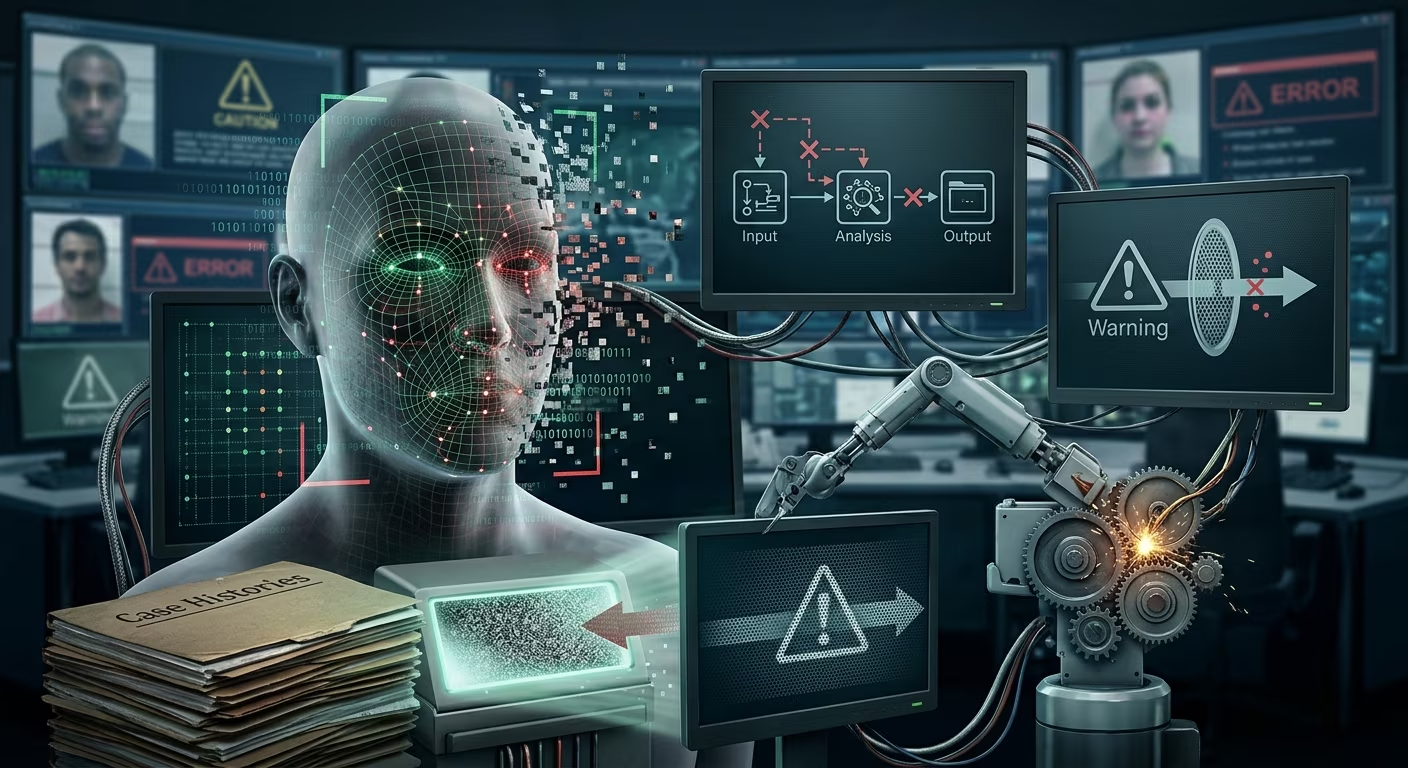
The Allure of Biometric Surveillance in Modern Policing
In recent years, the integration of artificial intelligence into public safety apparatuses has radically transformed how law enforcement agencies operate. Among the most controversial of these tools is facial recognition technology (FRT). Capable of scanning vast databases of driver’s licenses, mugshots, and social media images in mere seconds, biometric software promises unprecedented efficiency in identifying suspects captured on low-resolution security cameras or mobile phone footage.
However, the rapid deployment of this technology has outpaced both the legal frameworks required to govern it and the scientific understanding necessary to use it safely. Recognizing the potential for algorithmic error, software vendors and police departments have largely settled on a seemingly straightforward compromise: the procedural disclaimer. When an algorithm generates a match, the output is typically accompanied by a warning label explicitly stating that the result is strictly an “investigative lead.” It mandates that the match should never serve as the sole basis for establishing probable cause or executing an arrest.
On paper, this caveat appears to be a robust safeguard. It shifts the burden of verification back onto the human operator, theoretically insulating citizens from the catastrophic consequences of machine error. Yet, in practice, this disclaimer is deeply inadequate. A mounting body of evidence suggests that superficial warning labels fail to neutralize the profound psychological, systemic, and technological vulnerabilities inherent in biometric policing, ultimately leaving marginalized communities at severe risk of wrongful arrest.
The Psychology of Algorithmic Deference: Understanding Automation Bias
To understand why procedural warnings fail, one must examine the intersection of human psychology and technological design. When individuals are tasked with making high-stakes decisions under immense pressure—such as a detective attempting to close a violent crime case—the brain instinctively seeks cognitive shortcuts. This phenomenon is heavily exacerbated by “automation bias,” a well-documented psychological propensity for humans to favor suggestions from automated decision-making systems while simultaneously ignoring contradictory information made without automation.
Despite being trained professionals, law enforcement officers are not immune to this cognitive trap. When a sophisticated computer system, backed by millions of dollars in proprietary development, outputs a suspect’s face alongside a “98% match” confidence score, the human brain struggles to maintain objective skepticism. The subjective, probabilistic nature of the algorithm is suddenly perceived as mathematical certainty. The procedural disclaimer urging caution is swiftly overridden by the authoritative presentation of the machine’s conclusion.
Consequently, the required independent investigation often devolves into an exercise in confirmation bias. Instead of objectively scrutinizing the “lead” and seeking out potentially exculpatory evidence, an investigator might inadvertently retrofit the case around the algorithm’s chosen suspect. Eyewitnesses may be shown biased photo lineups, and ambiguous circumstantial evidence may be interpreted as definitive proof, all because the foundational assumption of guilt was established by a machine. A small line of text at the bottom of a printout is profoundly insufficient to combat the overwhelming cognitive gravity of an algorithmic directive.
Systemic Flaws and the Demographics of Inaccuracy
The reliance on facial recognition would be problematic even if the technology were flawless. Unfortunately, it is not. The illusion of algorithmic objectivity obscures severe technological deficiencies, particularly concerning demographic bias. Machine learning models are only as robust as the datasets upon which they are trained. If the training data disproportionately represents certain demographics while underrepresenting others, the resulting algorithm will inevitably exhibit skewed accuracy rates.
Extensive evaluations have confirmed these disparities. A landmark evaluation of demographic effects in biometric algorithms revealed that the technology struggles significantly when processing the faces of people of color, women, and the elderly. False positive rates—instances where the software incorrectly identifies an innocent person as the suspect—are exponentially higher for these marginalized demographic groups compared to their white male counterparts. When analyzing the faces of individuals with darker skin tones, the software’s ability to distinguish subtle facial geometry degrades dramatically.
When you combine these demographic inaccuracies with the aforementioned automation bias, the true danger of the “investigative lead” disclaimer comes into sharp focus. The technology is statistically most likely to falsely accuse individuals from marginalized communities, and human operators are psychologically primed to believe those false accusations. The procedural warning acts as a legal shield for the technology vendor and the department, but it offers zero tangible protection to the innocent citizen whose face was erroneously flagged by a structurally biased system.
The “Investigative Lead” Loophole and Policy Failures
Beyond cognitive and technological shortcomings, the regulatory environment surrounding facial recognition in law enforcement further undermines the efficacy of disclaimers. The definition of an “investigative lead” is remarkably ambiguous, leaving ample room for procedural exploitation. In an ideal scenario, an investigative lead functions as a mere starting point, requiring investigators to gather independent, compelling evidence—such as fingerprints, DNA, or verified alibi contradictions—before pursuing an arrest warrant.
In reality, the evidentiary threshold applied post-algorithm match is often shockingly low. Officers may use the facial recognition output to pull a suspect’s prior criminal record. If the suspect has a history of similar offenses, that history—combined with the algorithm’s match—may be sufficient to convince a judge to sign an arrest warrant, completely bypassing the need for rigorous, independent physical evidence connecting the individual to the specific crime in question.
Furthermore, internal oversight and training are often severely lacking. Investigations into federal law enforcement practices have revealed that multiple agencies deployed facial recognition services without requiring the staff to undergo specific training on how the technology works, its inherent limitations, or the civil liberty implications of its misuse. If the personnel utilizing these highly complex tools are not thoroughly educated on how to interpret algorithmic outputs and mitigate bias, expecting a generic warning label to dictate proper operational protocol is not just optimistic; it is administratively negligent.
The Cascading Consequences of False Positives
The failure of procedural warnings is not merely an academic or theoretical concern; it has devastating real-world consequences. Being the subject of a wrongful arrest is a profoundly traumatic experience that can derail an individual’s life instantly. When facial recognition software produces a false positive, and automation bias ushers that error through the investigative chain, the resulting damage to civil liberties is catastrophic.
Victims of algorithmic misidentification frequently find themselves incarcerated, facing severe financial ruin due to exorbitant legal fees, and suffering irreversible damage to their personal and professional reputations. The burden of proof effectively flips in these scenarios. Instead of the state proving the suspect’s guilt beyond a reasonable doubt, the defendant is forced to definitively prove their innocence, often against an opponent they cannot cross-examine: a proprietary, black-box algorithm.
Aggravating this injustice is the lack of transparency in the legal process. Because the facial recognition match is technically classified as an “investigative lead” rather than substantive evidence, prosecutors sometimes fail to disclose the use of the technology to defense attorneys during the discovery phase. This deprives defendants of the opportunity to challenge the accuracy of the software or highlight the statistical likelihood of demographic bias, allowing the algorithmic error to remain hidden under the guise of traditional police work.
Building Robust Protocols Beyond Mere Warnings
If we acknowledge that procedural disclaimers are functionally useless in preventing biometric wrongful arrests, the question becomes: what oversight mechanisms should replace them? Lawmakers, civil rights advocates, and technology ethicists argue that systemic, structural guardrails must be legally mandated to prevent the technology from operating as a tool of unchecked surveillance.
- Strict Evidentiary Prerequisites: Legislation must dictate that algorithmic matches cannot, under any circumstances, form the primary basis for probable cause. Strict standards must require independent, objective corroboration—such as location data or physical evidence—before an arrest can be executed.
- Mandatory Double-Blind Lineups: If a facial recognition match is used to construct a photo array for an eyewitness, the process must be double-blind. The officer administering the lineup must not know which photo belongs to the algorithm’s suspect, mitigating the risk of subtle, unintentional coercion.
- Comprehensive Algorithmic Auditing: Departments must be legally required to use only software that has been independently audited for demographic bias and has met rigorous accuracy thresholds across all racial and gender categories.
- Total Transparency in Discovery: Any use of biometric technology in the chain of custody of an investigation must be mandatorily disclosed to the defense, allowing for proper legal scrutiny of the tool’s reliability.
Ultimately, safeguarding civil liberties in the age of artificial intelligence requires more than placing a small warning label on a complex, biased machine. It demands a fundamental restructuring of how law enforcement interacts with technology, prioritizing human accountability, scientific validity, and constitutional rights over perceived operational efficiency.
Frequently Asked Questions (FAQ)
What is automation bias in the context of policing?
Automation bias is a psychological phenomenon where humans inherently trust the output of an automated system or computer over their own judgment or contradictory evidence. In policing, this means officers may unconsciously treat a facial recognition “match” as an absolute certainty, ignoring protocol that requires them to treat it merely as a lead.
Why do facial recognition systems disproportionately affect marginalized communities?
Facial recognition algorithms are trained on massive datasets of images. If these datasets lack diversity, the algorithm becomes proficient at identifying the majority demographic (often white males) but struggles with others. This leads to significantly higher false positive error rates for people of color, women, and the elderly.
What does “investigative lead only” mean?
An “investigative lead” means the information provides a direction for the investigation but is not sufficient on its own to prove guilt or establish probable cause for an arrest. Investigators are supposed to use the lead to find independent, concrete evidence corroborating the suspect’s involvement.
Why is a disclaimer not enough to stop wrongful arrests?
Disclaimers fail because they cannot override human psychology (automation bias) and the systemic pressures to close cases quickly. Furthermore, a warning label does nothing to fix the underlying demographic biases of the technology; it merely attempts to shift the legal liability away from the vendor.
What steps are being taken to regulate this technology?
Advocates are pushing for comprehensive legislation that includes mandatory transparency during the legal discovery process, strict prerequisites requiring independent physical evidence prior to arrest, and outright bans on software that fails independent demographic bias audits.
References
- Facial Recognition Services: Federal Law Enforcement Agencies Should Take Actions to Implement Training, and Policies for Civil Liberties — U.S. Government Accountability Office (GAO). 2023-09-12. https://www.gao.gov/products/gao-23-105607
- Face Recognition Vendor Test (FRVT) Part 3: Demographic Effects — National Institute of Standards and Technology (NIST). 2019-12-19. https://doi.org/10.6028/NIST.IR.8280 This foundational 2019 report remains the canonical official evaluation of demographic differentials in biometric algorithms.
- Automation bias: a systematic review of frequency, effect mediators, and mitigators — Journal of the American Medical Informatics Association. 2012-01-01. https://doi.org/10.1136/amiajnl-2011-000089 This seminal peer-reviewed paper remains the authoritative framework for defining automation bias in high-stakes algorithmic decision-making.