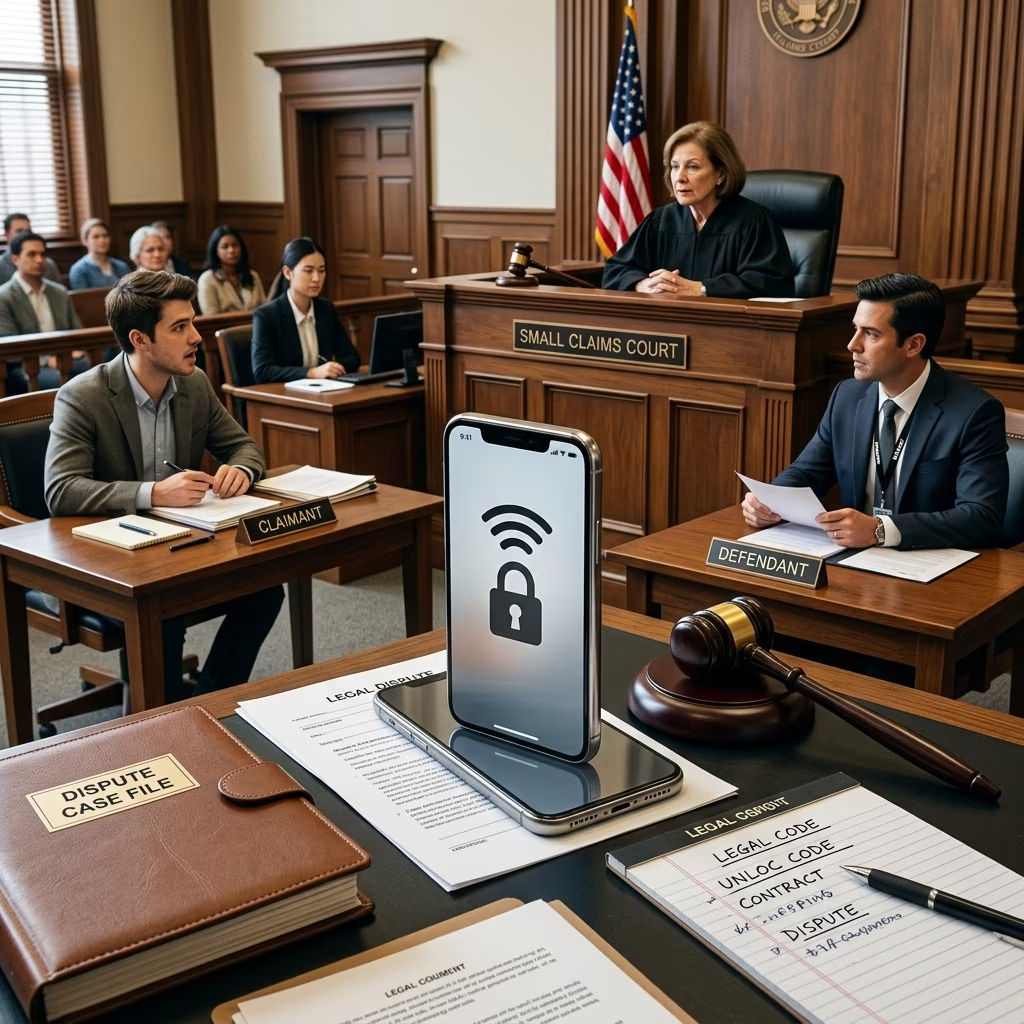
When a phone is locked to one carrier, that lock can become more than a technical setting. For some customers, it can determine whether a paid-off device is usable, whether a move to another network is possible, and whether a dispute ends in a support ticket or a courtroom. Verizon’s unlocking rules have also changed over time, and the Federal Communications Commission has recently adjusted the company’s obligations in response to fraud concerns.[10]
This article explains how phone unlocking disputes develop, why they sometimes end up in small claims court, and what consumers should know before taking that step. It also outlines the policy environment around Verizon device locks and the practical evidence that can matter if a customer decides to sue.
What a phone lock actually does
Phone unlocking is not about removing software for convenience alone. A locked phone is configured to work only on a specific carrier’s network until the carrier removes that restriction. Verizon describes unlocking as disabling the software that prevents a device intended for one carrier from being activated on another.
That distinction matters because many customers assume that paying off a phone or finishing a contract automatically means immediate portability. In practice, the timing depends on the carrier’s policy, whether the device was financed, whether it was purchased at full retail price, and whether the carrier has fraud concerns tied to the transaction.
| Issue | Why it matters |
|---|---|
| Locked device | Limits use to one carrier until the restriction is removed |
| Paid-off phone | May still remain locked if the carrier’s conditions are not fully satisfied |
| Unlocked phone | Can generally be used on another compatible network |
| Fraud review | Can delay unlocking even after payment or activation milestones are met |
Why Verizon’s unlocking policy has been in flux
Verizon’s unlocking obligations have not been static. Reuters reported that the FCC revised a long-standing rule that had required Verizon to unlock mobile devices 60 days after activation, citing significant fraud issues. Ars Technica likewise reported that the FCC granted Verizon a waiver from the 60-day rule and said the carrier would instead follow a voluntary industry approach while the agency works toward a broader standard.
Verizon’s own policy materials also show that unlocking rules have changed. The company’s consumer safety page says that, effective February 18, 2026, devices purchased from Verizon remain locked until 365 days of paid and active service, unless the device is deemed stolen or fraudulently purchased. Verizon’s support page adds that devices purchased directly from Verizon are locked to the network, but may unlock automatically when bought at full retail price or when the financing balance is paid in full.
That combination of regulatory change and internal policy updates creates a difficult environment for consumers. A customer may rely on an older rule, assume a device should unlock at payoff, and then discover the carrier is applying a newer policy or a fraud-related hold.
How a simple support dispute turns into a legal claim
Most unlocking problems begin as ordinary customer service issues. A consumer contacts support, asks for the phone to be unlocked, and is told either that the request is denied or that additional time is required. If repeated calls do not solve the problem, the customer may begin to see the matter less as a service complaint and more as a breach of expectations or a failure to follow the applicable rules.
That is where small claims court enters the picture. Small claims courts are designed for lower-dollar disputes that do not require a full-scale civil lawsuit. They are often used when a consumer believes a business has held money, property, or a service right longer than it should have. In the Verizon unlocking context, the value at stake may not be the phone itself alone; it can include the cost of delays, the inability to switch carriers, and the practical loss of use while the dispute remains unresolved.
In the FindLaw-reported dispute, a customer’s unlocking problem ended with a trip to small claims court, and the judge entered judgment in the customer’s favor for $410.40, plus court costs and a service fee. The case illustrates a key point: sometimes a modest dispute becomes worth litigating when informal channels fail.
Why small claims can be effective in phone-locking cases
Small claims court is often attractive for consumers because it is faster, less expensive, and more accessible than higher courts. The rules are simpler, the damages are usually limited, and people often represent themselves. That makes it a practical forum for a dispute involving one device, a short period of alleged improper locking, or a specific out-of-pocket loss.
It can also change the dynamics of the dispute. A company that does not move a customer-service case forward may respond differently once it is served with a court filing. Even where a consumer does not win a large money judgment, the possibility of court can encourage settlement or a last-minute resolution.
That said, small claims court is not a magic fix. The consumer still needs a recognizable legal theory, evidence, and a realistic account of damages. If a carrier can show that the device was subject to a valid lock period, a fraud review, or another stated condition, the claim may be weaker.[10]
What evidence matters before filing
Consumers considering a claim should gather records before filing. The most useful documents are usually the ones that show what the carrier promised, what the customer paid, and how the carrier responded when unlocking was requested.
- Purchase receipt or financing agreement
- Proof that the phone balance was paid in full
- Copies of chat logs, emails, or support tickets
- Carrier policy pages saved before the dispute changed
- Phone screenshots showing the device remained locked
- Dates of activation, payment, and unlock requests
Timing is especially important. If the carrier says the lock stays in place for a set number of days or until a balance is completely satisfied, a consumer must be able to show that those conditions were met. Verizon’s current materials, for example, distinguish among devices bought at full retail price, devices paid off under financing, devices with fraud concerns, and devices associated with military relocation exceptions.
Possible legal arguments in a consumer case
Small claims pleadings do not need to be elaborate, but they should be concrete. A consumer might argue that the carrier failed to follow its own written policy, delayed unlocks without a valid basis, or did not properly account for a completed payment. The strongest arguments usually rely on documents rather than broad fairness claims.
In a dispute over a locked phone, possible arguments may include:
- The device met the published unlocking conditions.
- The carrier continued to lock the phone after payment was complete.
- The customer suffered measurable losses from the delay.
- The carrier’s explanation changed over time or lacked documentation.
- The customer relied on a prior policy that was still relevant when the phone was bought or financed.
By contrast, a carrier may defend the lock by pointing to fraud protections, stolen-device holds, unpaid balances, or newer policy language. Reuters reported that Verizon told regulators the 60-day unlock rule was causing hundreds of millions of dollars in annual losses through fraud-related activity. That kind of claim can matter in court if the company shows the phone was withheld under an established exception rather than out of simple refusal.
How regulators shape the consumer experience
Device locking is not governed only by private contract terms. Federal oversight matters as well. The FCC’s actions show that the agency can revise, waive, or reconsider carrier obligations when it believes a rule is no longer serving the broader public interest or is creating security problems.[10]
Those regulatory shifts can benefit or complicate consumers depending on timing. A customer who expected a 60-day unlock may now face a longer period under Verizon’s updated policy, while another customer may benefit from a company-wide policy that automatically unlocks a device once the relevant conditions are met.[10]
Public comments and industry lobbying also matter. Broadband Breakfast reported that law enforcement groups backed Verizon’s request for relief, arguing that unlocked phones were helping criminal activity, while other stakeholders pushed for a more uniform rule. That debate helps explain why unlocking questions can feel routine to consumers but highly contested to regulators and carriers.
Practical steps before going to court
Before filing suit, a consumer should usually make one final, organized attempt to resolve the issue. A concise written demand can be more effective than repeated calls because it creates a paper trail and states the exact remedy requested.
Useful pre-suit steps include:
- Ask for the unlock request number or reference ID.
- Request the specific reason for denial in writing.
- Save a copy of the current unlocking policy.
- Escalate through the carrier’s formal complaint process.
- Give a short deadline for resolution before filing.
If the carrier’s response is inconsistent with its own policy or leaves the customer stuck without a clear explanation, the case for small claims becomes stronger. The goal is not only to win, but to show the judge that the consumer made a reasonable effort to solve the issue without litigation.
When a lawsuit is more about leverage than money
Many small claims cases are not really about the dollar amount alone. They are about leverage, accountability, and the desire for a business to honor a promised service. In a phone-unlocking dispute, the consumer may want the practical freedom to switch carriers, use a traveling spouse’s network, or sell the phone at full value. A delay can reduce that value even if the handset itself still works.
The case reported by FindLaw shows that even a relatively modest award can validate a consumer’s complaint and create pressure for better handling in future cases. That is one reason these disputes matter: they sit at the intersection of contract terms, customer expectations, and the real-world value of a device that many people rely on every day.
Frequently asked questions
Can Verizon refuse to unlock a paid-off phone?
Yes, in some circumstances. Verizon’s policy says unlocking can still be delayed if the device is stolen, fraudulently obtained, or otherwise subject to a policy-based hold.
Does paying off a device always unlock it immediately?
No. Verizon’s support pages say some phones unlock automatically when purchased at full retail price or once the financing balance is paid in full, but the policy also includes exceptions and timing rules.
Why would a consumer go to small claims court over a phone?
Because a denied unlock can prevent the consumer from switching carriers, using the device elsewhere, or fully benefiting from a phone they already paid for. Small claims court can be a low-cost way to seek a remedy when support channels fail.
What kind of proof is most important?
The most persuasive proof is usually a combination of the purchase record, proof of payment, the carrier’s written policy, and documentation showing that the unlock request was denied or ignored.
Is the legal issue only about Verizon?
No. Verizon is the focus of this dispute because of its unique regulatory history, but device-locking questions can arise with other carriers too. The specifics depend on each carrier’s policy and the applicable regulatory framework.
References
- FCC revises Verizon phone unlocking rules after significant fraud issues — Reuters. 2026-01-12. https://www.reuters.com/business/media-telecom/fcc-revises-verizon-phone-unlocking-rules-after-significant-fraud-issues-2026-01-12/
- Unlocking This Verizon Phone Required a Trip to Small Claims Court — FindLaw. 2026. https://www.findlaw.com/legalblogs/law-and-life/unlocking-this-verizon-phone-required-a-trip-to-small-claims-court/
- Device Unlocking Policies — Verizon. 2026-02-18. https://www.verizon.com/about/consumer-safety/device-unlocking-policy
- Law enforcement rallies behind Verizon for waiver of phone unlocking rules — Broadband Breakfast. 2025-07-01. https://broadbandbreakfast.com/law-enforcement-rallies-behind-verizon-for-waiver-of-phone-unlocking-rules/
- Verizon to stop automatic unlocking of phones as FCC ends 60-day rule — Ars Technica. 2026-01-12. https://arstechnica.com/tech-policy/2026/01/fcc-lets-verizon-lock-phones-for-longer-making-it-harder-to-switch-carriers/
- Verizon’s phone unlock proposal draws a lot of opposition — Fierce Network. 2025. https://www.fierce-network.com/wireless/verizons-phone-unlock-proposal-draws-bunch-opposition